Religion and I (Continued)

Somewhere along the way, I got interested in the philosophy of Baruch Spinoza, the great rationalist thinker of the 17th century. Spinoza argued that “God” and “Nature” are two names for the same thing. That one thing is the universe as a whole. It’s the only thing that truly exists. Everything else (atoms, thoughts, you, me) is a mode or modification of that one infinite substance, God or Nature (Deus sive Natura).

Reading Spinoza made me try to think about the universe (the whole of nature) in a religious sense, as a sacred thing, a worthy object of worship. Obviously, there have been nature religions since prehistoric times. But the idea didn’t work for me. The universe is totally amazing and the Earth is our treasured home, but I never got close to thinking of nature in religious terms.

Neither of us being drawn to any of the standard religions, my wife and I began attending a local chapter of what’s often called the Ethical Culture Society. That was in the 1980s. The organization’s actual name is the American Ethical Union. It was founded in New York City in 1877 by a former rabbinical student named Felix Adler. Here’s an explanatory paragraph from their site:

Ethical Humanism, also called Ethical Culture, is an evolving body of ideas that inspires Ethical Societies. Humanism is a progressive philosophy of life that, without supernaturalism, affirms our ability and responsibility to lead ethical lives of personal fulfillment that aspire to the greater good of humanity (Humanist Manifesto III). For Ethical Humanists, the ultimate religious questions are not about the existence of gods or an afterlife, but rather, “How can we create meaningfulness in this life?” and “How should we treat each other?”

We didn’t stay in the neighborhood long enough to become serious followers of Ethical Culture, but some years later, in the 1990s, we began attending our local Unitarian Church. We both felt at home there. The minister was a scholarly man and an excellent speaker. He also doubted that Jesus was a real person, let alone the son of any god. Like the American Ethical Union, the Unitarian Universalist Association welcomes those who believe in God and those who don’t, because its principal focus is on ethical behavior. From the UUA site and the organization’s bylaws:

We, the member congregations of the Unitarian Universalist Association, covenant to affirm and promote:

  1. The inherent worth and dignity of every person; 
  2. Justice, equity and compassion in human relations; 
  3. Acceptance of one another and encouragement to spiritual growth in our congregations;
  4. A free and responsible search for truth and meaning;
  5. The right of conscience and the use of the democratic process within our congregations and in society at large;
  6. The goal of world community with peace, liberty and justice for all;
  7. Respect for the interdependent web of all existence of which we are a part.

… Grateful for the religious pluralism which enriches and ennobles our faith, we are inspired to deepen our understanding and expand our vision. As free congregations we enter into this covenant, promising to one another our mutual trust and support.

The high point of my time as a church-attending Unitarian was ten years ago. The church offered a class called “Building Your Own Theology” (the perfect title for Unitarian adult education). The culmination of the class was supposed to be a personal statement from each of us regarding our fundamental beliefs, which we could then present to the congregation as part of a regular service. I think only two of us chose to address the congregation. The minister helped me with some editing, I put my blue suit on and one Sunday morning I gave it a go. It made me happy that it was well-received.

Here’s some of the conclusion (rearranged a little – consider it a theology that’s still being built):

Is there anything sacred, anything I might revere instead of God? The answer is yes: personal ideals like rationality, curiosity and courage; ethical ideals like generosity, honesty and kindness; and political ideals like justice and democracy. Our ideals and actions, insofar as they exemplify our ideals, can be sacred.

My view is that, if a god existed, it would be a middle-man between us and what is truly sacred, the ideals we hold dear.

I fell away from the church as the years passed. I didn’t feel like I was getting much out of it anymore, especially after my favorite minister retired. But I still love some of the jokes:

Q: How many Unitarians does it take to change a light bulb?
A: We choose not to make a statement either in favor of or against the need for a light bulb. However, if in your own journey, you have found that light bulbs work for you, that is wonderful. You are invited to write a poem or compose a modern dance about your personal relationship with your light bulb. Present it next month at our annual Light Bulb Sunday Service, in which we will explore a number of light bulb traditions, including incandescent, fluorescent, 3-way, long-life, and tinted, all of which are equally valid paths to luminescence.

Q: Why can’t UUs sing very well in choirs?
A: Because they’re always reading ahead to see if they agree with the next verse.

The children in a UU church school class were drawing pictures. The teacher asked one, “What are you drawing a picture of?”
“I’m drawing a picture of God,” was the reply.
“But nobody knows what God looks like,” objected the teacher.
“They will,” said the child, “in a minute.”

And, finally, from the comedian Lenny Bruce: “I know my humor is outrageous when it makes the Unitarians so mad they burn a question mark on my front lawn.”

Again, almost certainly next time: I found a label for what I believe, and have begun reading the New Testament in a way I never thought of before.

Religion and I

My parents were Protestants, but rarely attended church. I never went to Sunday School, but always said a prayer before going to bed. When I was young, it was always the well-known (but morbid) prayer from the 18th century:

Now I lay me down to sleep,
I pray the Lord my soul to keep.
If I should die before I wake,
I pray the Lord my soul to take.

Amen.

At some point, I graduated to the Lord’s Prayer. As best I can remember, it was the long Protestant one with “debts” and “debtors”, instead of “trespass” and “trespasses”, and the extra praise at the end:

Our Father who art in Heaven,
Hallowed be thy name;
Thy kingdom come;
Thy will be done
On earth as it is in heaven.
Give us this day our daily bread;
And forgive us our debts
As we forgive our debtors;
And lead us not into temptation,
But deliver us from evil.
For thine is the kingdom
And the power
And the glory,
Forever.

Amen.

By the way, did you know that “amen” is roughly translated as “so be it” and that it came from Hebrew, or maybe Aramaic, through Greek and Latin and then to us? In other words, just like the rest of the Bible.

Then one night when I was 13 or so, in the grip of burgeoning skepticism or adolescent rebelliousness, I decided not to recite my nightly prayer. It felt like a major step. I’d never felt religious, except maybe around Christmas. But I wondered whether going straight to sleep would mean I’d end up in Hell. (Obviously, the jury is still out.) I think I’d concluded that God probably doesn’t exist. For roughly ten years, I’d simply been talking to myself, rather like Peter O’Toole in The Ruling Class:

Lady Claire Gurney: “How do you know you’re God?”

Jack Arnold Alexander Tancred Gurney, 14th Earl of Gurney: “Simple. When I pray to Him, I find I am talking to myself.”

Within a few years, I was studying philosophy and my skepticism increased. Philosophers are trained to question assumptions and offer evidence. Citing tradition or faith as justification for one’s views isn’t enough. Plus, the philosophical arguments for the existence of God are uniformly weak. As a rule, therefore, philosophy is hard on religion. So much for religion, for the next twenty years.

Then, however, I began thinking about religion again – not because I wanted to become religious, but because I wanted to understand its popularity. Where did religion come from? Why do so many people take it so seriously? Why, for example, have religious authorities been so concerned about sex?

I began reading about the history of Christianity in particular. I read William James’s The Varieties of Religious Experience, and about the “historical” Jesus, and the Council of Nicea, and several books by the historian of religion, Elaine Pagels. I read about the idea of Satan, and the Gnostics, and Paul’s conflict with Jesus’s brother James.

The conclusion I reached is that the history of Christianity is much more complex than most people realize. What got into the Bible and what is promulgated in church could have turned out very differently if other people had translated or copied the texts or won the arguments about church doctrine. People will say it’s all been decided and documented according to God’s hidden plan. I think it’s much more likely to have been a messy, contingent, unpredictable process, like all other major human endeavors, and there’s nothing supernatural about it.

Probably next time: I found a label for what I believe, and have begun reading the New Testament in a way I never thought of before.
You Can Spare a Few Dollars to Lobby the Electoral College

Politico reports that full-page advertisements are running in several newspapers encouraging Republicans in the Electoral College to vote against the Orange Menace. The advertisements are being paid for by a Go Fund Me campaign that’s raised more than $250,000 so far. You can make a donation here. The complete text of the advertisement, entitled “Letter To Electors”, is available here. 

From that “Letter to Electors”:

Never in our Republic’s history has there been a President-apparent comparable to [the Orange Menace]. His inauguration would present a grave and continual threat to the Constitution, to domestic tranquility, and to international stability…

We place country before party in imploring you, our fellow Americans, to investigate and deliberate. We stand with you as you exercise your conscience and give profound consideration to the consequences of your vote. We affirm your right and your duty to do so free from intimidation, and urge you to cast your ballot for a person with the temperament, integrity and commitment to Constitutional principles necessary in a President.

In doing so, know that you enjoy the support of millions of Americans.

If you’re thinking about contributing, do it today. The Electoral College votes on Monday, December 19th.

Stating the Obvious – It Should Be Stated Again and Again

Although this may be the last time I state it. The election was five weeks ago. Its otherworldly result is likely to be set in stone by 300 members of the Electoral College next week (despite their duty to do otherwise). In the weeks ahead, therefore, I hope to turn my attention to the election’s aftermath, and possibly even other topics of interest, like Brian Wilson’s very good memoir, what to look for in a snow shovel and how to leave the U.S. without a passport. Or maybe where to acquire body armor and the safest way to throw a Molotov cocktail.

Nevertheless, Amanda Marcotte has a very good summary at Salon of how the Russians got away with hacking the election. The long headline is:  

The big problem isn’t that Russian hackers tried to influence our election — it’s more that we let them – Media lameness, a gullible public, useful idiots on the left and the GOP all helped enable Russian propaganda

She makes an excellent point. It’s not a new point, but it bears repeating over and over again (by someone else, not me). Assuming we escape the clutches of the Orange Menace one day, how do we avoid going through something like this again if we don’t understand how it happened? 

She begins:

(The Russian’s apparent) strategy worked because too many power players in the American political ecosystem were too shortsighted, lazy and selfish to look past their own immediate self-interest and consider the big picture. What the purported Russian email hack ended up doing was illustrating the various weaknesses in our political systems and culture — weaknesses that Trump, likely with Vladimir Putin’s assistance, was able to exploit to claw his way into the White House.

First, “mainstream media outlets are more interested in appearing fair than actually being fair”. Fox News, of course, being a propaganda machine, doesn’t care about being balanced. They simply claim to be. Reputable news sources like CNN and the New York Times, however, want to provide “balanced” coverage. They want to acquire and retain customers all along the political spectrum. But, in 2016, their lame attempts to be balanced led to disaster: 

Trump is so corrupt that he coughs up more genuine scandals before breakfast than most dirty politicians can come up with in a lifetime. Hillary Clinton, in contrast, is a clean politician, which we know because she’s been under some kind of dogged investigation for the better part of three decades, without a speck of real dirt coming up on her.

But to report this basic truth — that one candidate was irredeemably corrupt and the other was not — would have drawn accusations from the right that the media was in the tank for Clinton. So, in order to appear fair, mainstream media outlets embraced a policy of being incredibly unfair to Clinton, blowing every non-scandal out of proportion.

Marcotte then points her finger at the average American voter:Most people don’t really read the news, but just glean general themes from headlines and cable TV”. One of the example she cites from Vanity Fair magazine:

juicy

But in the actual text, writer T.A. Frank admitted that “you’ll find nothing close to a scandal in itself” and “Clinton’s campaign is, mostly, reassuringly plodding and rules-bound.”

An honest headline written by someone whose goal was to inform the public would have looked something like this: 

PODESTA EMAILS SHOW PLODDING, SCANDAL-FREE CAMPAIGN

Sensationalism like Vanity Fair‘s is one reason most voters thought Clinton was more corrupt than T—p:

All these stories about “leaked” emails left the indelible impression with voters that there must have been something in them that was worth leaking, even if they had no idea what it was. 

Marcotte then points out that people on the left are open to conspiracy theories, too. Emails stolen from the Democratic National Committee convinced some Sanders supporters that the primary elections were rigged:

The email hack did not actually reveal any evidence that the Democratic National Committee had treated Sanders unfairly during the primary. It did find that some DNC employees expressed negative thoughts about him after his campaign repeatedly accused party officials of dirty pool, but there was no dirt beyond private grousing.

Nevertheless, the impression grew that somehow Sanders had been cheated. That led some who would ordinarily vote Democratic to stay home or vote for a third party. Consider, for example, that in Michigan, Pennsylvania and Wisconsin, the Green Party candidate got more than 133,000 votes. Clinton lost those three states and, as a result, the Electoral College by 78,000. 

Lastly, of course, most Republican politicians put party over country. In particular, Senator McConnell’s refusal to condemn or even acknowledge the Russian hacking was, in Marcotte’s words:

… a neat distillation of Republicans’ attitude toward any Trump-based corruption: They’re happy to look the other way as Trump and his supporters plunder the country, spread racism and bigotry and undermine our democracy, so long as they get a crack at destroying Social Security and Medicare.

So, putting the election aside and looking to the future, Kurt Eichenwald of Newsweek has a long article that shows how T—p’s business would (or will) lead to major conflicts of interest. They even have a 3-minute video that summarizes the sad story.

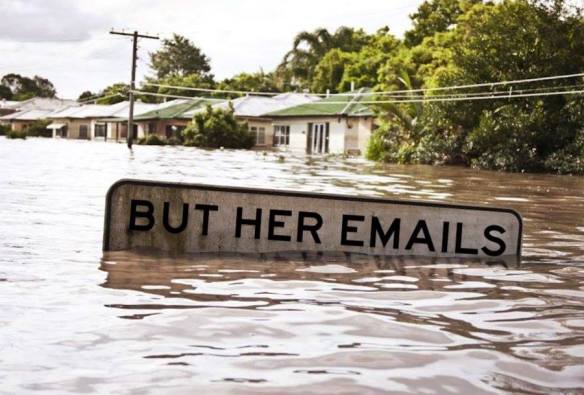
For All the Special Snowflakes Out There

Who couldn’t bring themselves to vote for a “flawed” candidate.

czlrgidxeaepghr

(Thanks to whoever made this. Assuming it isn’t real. Yet.)