A Guide to Reality, Part 11

In chapter 6 of The Atheist’s Guide to Reality: Enjoying Life Without Illusions, Professor Alex Rosenberg offers an explanation of what he calls “nice nihilism”. The point he wants to make is that, although we should all be ethical nihilists and recognize that morality is an illusion, nihilism is nothing to worry about. We humans have evolved to be nice to each other, on balance, so we can continue to behave ethically despite giving up the idea that any of our ethical beliefs are true or correct.

Rosenberg begins with an account of human evolution, beginning a few million years ago when our ancestors left the African jungle and moved to the savanna. 

savanna2

Scientists believe that our ancestors began consuming more protein on the savanna (see striped animals above). This dietary change had certain biological effects, including increased fertility:

[There were] more mouths to feed over longer periods, but mothers prevented from providing for older offspring by the demands of younger ones; males living longer and so having still more offspring, putting further strains on available resources; and those offspring needing literally years of protection and nourishment before they could fend for themselves [118].

Living on the savanna also meant our ancestors had to compete with other predators and scavengers and avoid being eaten themselves. To make a long story short, the key to survival was cooperation, including the division of labor.

Rosenberg admits that reconstructing the very early history of the human race is somewhat speculative, but he invokes game theory to help explain why cooperation won out. Game theory, supported by computer simulations, has revealed that “tit for tat” and “fair and equal” strategies have the most favorable outcomes over time and, as he points out, human evolution was not an overnight phenomenon.

Still, he wonders whether biology and game theory can alone account for the widespread existence of norms like fairness, equity and cooperation:

But how does natural selection get people to adopt such norms? How does it shape such adaptations? … This problem looks like it’s too hard to be solved by genetically-based natural selection. Maybe if there were genes for playing tit for tat, they would be selected for. But at least in the human case, if not in animal models, such genes seem unlikely [134].

It isn’t clear why Rosenberg doubts the existence of a strong genetic basis for cooperation. On the contrary, there is some recent evidence that human infants have a built-in sense of fair play (The Atheists Guide was published in 2011). Instead, Rosenberg argues that core morality (the morality that’s common among world cultures) has come about partly through a process of “cultural natural selection” (134).

Again, I’m not sure what Rosenberg means by “cultural natural selection”, since earlier he suggested that “core morality is almost certainly locked-in by now” (108). Obviously, purely cultural practices are learned, not transmitted genetically. There is no set of genes that transmits the rules of baseball. Maybe he’s merely pointing out that there is no genetic basis for specific moral rules or practices, like keeping promises or tit-for-tat. Instead, he asks:

What kind of a device could nature have hit on in the course of our evolution that could guarantee to others that we will act in accordance with norms of niceness, fairness, equity and much of the rest of the moral core? It would have had to be a device that overrides the temptation to cheat, cut corners, free-ride when the opportunity occurs [136].

His answer is emotion. Emotions are “hardwired by genes we share” and “get harnessed together” with norms that are adaptive in our environments. They “motivate enforcement” of core morality and also morality’s local variations. For example, he argues that different norms will develop in pastoral vs. agricultural communities. Shepherds have to protect against rustlers, since their animals are easy to lead away. Farmers don’t have a similar problem, since a rustler can’t lead away a herd of wheat. As a result, herding communities develop strong emotions regarding theft and the need for revenge, while farming communities don’t (maybe they develop strong emotions regarding their plots of land, but Rosenberg doesn’t say). Some important combinations of norms and emotions enhance fitness in all environments, however; the norms in those combinations become part of core morality.

I don’t think it’s important for our purposes to understand exactly where the obscure boundary is between genetic and cultural transmission of norms and emotions. His thesis is that there is a strong relationship between morality and emotion, and that natural selection has played an important role in the evolution of both. In particular, the emotions of shame and guilt have been especially important in getting people to choose long-term benefits (e.g., remaining part of a community by behaving nicely) over short-term ones (e.g., enjoying candy you stole from your little brother).

Pointing out the strong connection between morality and emotion isn’t new with Rosenberg or isn’t an especially scientistic view. That connection has been emphasized by most philosophers, some of whom have argued that morality is a kind of cultural emotionalism: morality promotes or should promote behavior that makes people happy or feel good in the long run, and discourages or should discourage behavior that doesn’t. It’s also been pointed out that emotions aren’t usually irrational. People often get angry over things that aren’t that important from other people’s perspective, but angry people can almost always say why they’re angry, and there is usually some validity to their reasoning.

The last issue Rosenberg addresses in chapter 6 is why there is so much bad behavior if morality has been programmed into us. The obvious answer is that there is always variation in traits that are subject to evolution. With morality, most people end up in the middle, with saints on one side and sociopaths on the other. The chapter ends with the reminder that, although core morality evolved into its present form and has contributed to the reproductive success of human beings, that doesn’t make it right or true, since ethical beliefs are neither true nor false. 

One question Rosenberg should have considered in greater depth is whether accepting ethical nihilism would make people behave less ethically. His answer is that we shouldn’t worry about the nihilists who may be lurking in our midst because they’ve also been programmed via natural and cultural selection to behave ethically (for the most part).

But some studies have shown that after being exposed to the idea that they lack free will and therefore aren’t responsible for their actions, people tend to become more selfish or dishonest. Being exposed to new philosophical ideas can clearly affect behavior. It’s been reported that one philosopher, Saul Smilansky, refuses to teach his students about free will and determinism because he’s afraid that their sense of responsibility will be affected. So it isn’t clear at all that the widespread adoption of ethical nihilism by itself or as part of scientism would leave society’s moral behavior untouched. This might be a case in which we couldn’t handle the truth.

Next installment: Whether we should let consciousness be our guide.
What Academic Philosophers Work on These Days

Ever wonder what people in the Philosophy Department spend their time working on? Probably not. But if you’d like to take a brief survey that will tell you the answer by asking you questions, it’s available here:

http://leiterreports.typepad.com/blog/2014/03/survey-about-personality-and-belief.html

PS — They don’t ask you for your family income.

Us, Them and Incentives Again, But Briefly

Remember when Clinton was President and the federal government briefly ran a surplus? The Republican response was: “Cut taxes!” Their justification was: “It’s our money, not the government’s!”. Since then, the surplus having been eliminated, the Republican response has been: “Cut taxes! That will lead to growth and reduce the deficit!” Which isn’t completely relevant to “Us, Them and Incentives”, but I’m getting there. It’s another example of how adherence to a political ideology can lead to inconsistency, especially when you try to justify what you already want to do. 

In writing about the Republican approach to incentives this week (less income for the rich will make them less productive, but less income for the poor will make them more productive), I may have been unfair. Maybe the Republican position makes sense based on the relative economic success of the rich and the poor.

After all, rich people are doing well, you might say, so they must be doing things right. Therefore, let’s reward them. That way they won’t get discouraged and stop doing things right. Poor people, however, aren’t doing well, so they must be doing things wrong. Obviously, we shouldn’t reward them for doing things wrong. And, if we don’t reward them, maybe they’ll start doing things right. In a capitalist nutshell, economic incentives should be given to productive people, and economic disincentives should be given to unproductive people.

This approach sounds an awful lot like social engineering, which the Republicans are supposed to be against. Putting that aside, however, the question is whether it’s a good idea to make life harder for people who are struggling and make it easier for people who aren’t. If you view life as a total morality play, in which good people prosper and bad people don’t, maybe it does makes sense. That is, we all know, the reason for heaven and hell (which St. Thomas Aquinas understood so perfectly).

But people are doing well or badly these days, economically-speaking, for lots of different reasons: skills, health, age, location, connections, work ethic, luck, education, competition and so on. In fact, one major hindrance to doing well economically is being poor to begin with (when you’re poor, it’s harder to get around, harder to fit in, harder to stay healthy, and so on). Once we view our fellow Americans as individuals with actual, often difficult lives, not simply as Us and Them, the reasonable response is to help the ones who are struggling, not the ones who are already getting ahead.

(Coming soon, “A Guide to Reality, Part 11”, I hope.)

Us and Them Again

As noted in an update to the post below, the Conservative Political Action Conference (CPAC) is having their annual convention, which means leading Republican politicians are getting the chance to express their deepest thoughts. So Senator Rubio of Florida got the opportunity to explain why Franklin Roosevelt had it all wrong — we should be very, very afraid.

Also today, Congressman Paul Ryan highlighted the difference between the right and the left by telling the story of a Wisconsin kid who’d prefer bringing his own lunch to school instead of mooching off the rest of us by getting a lunch at taxpayer expense.

Juliet Lapidos of the New York Times points out Congressman Ryan’s underlying, contradictory assumption:

[Ryan] argued that Americans want to work — every bit as much as the Republican Party wants them to work. “People don’t just want a life of comfort,” he said. “They want a life of dignity. They want a life of self-determination”….

In Mr. Ryan’s view, Americans would rather depend on themselves, or their families, than on the government. And yet, in Mr. Ryan’s view, if these same Americans gain access to government programs, they’ll jump at the chance to abandon their responsibilities, effectively exchanging a “life of dignity” for a “life of comfort.”

That doesn’t make sense. If all or most Americans, like the kid in Wisconsin, want their own lunch rather than a government lunch, then the prospect of a government lunch won’t change their behavior.

Ryan doesn’t notice the contradiction, since he thinks of his fellow citizens as Us and Them. On one hand, there are the honorable, hard-working Americans who hate the idea of getting help from the government (you know who they are). On the other hand, there are the dishonorable, lazy Americans who want nothing more than to live off government handouts (you know who they are too).

This is the same point I tried to make recently in a comment on another blog. There is a strange dichotomy between how Republicans expect poor people and rich people to respond to financial incentives:

— People who are struggling should receive as little financial assistance as possible, because helping them will only discourage them from becoming productive members of society. After all, they’re not really motivated to increase their incomes beyond the bare minimum. In their case, therefore, less income will translate into more work, and more income will translate into less work.

— People who aren’t struggling should receive as much financial assistance as possible, especially in the form of lower taxes, because helping them will encourage them to become even more productive members of society. In their case, more income will translate into more work, while less income will translate into less work!

It isn’t fun at all being poor or unemployed, but Republicans believe that making life as difficult as possible for the economy’s losers will convince them to do better. That’s because they’re not like us. They don’t care about improving their situations and they don’t respond to economic incentives the way normal people do.

Less money for the poor, so they will work harder; more money for the rich, so they will work harder. It makes perfect sense!

(Note: I’m going to try to lay off writing about right-wingers for a while. Maybe I’ll try fashion reporting. Or poetry! “There once was a girl from Nantucket, …”)

Us and Them

Psychologists and others have been trying to figure out why people have opposing political views. Why are some of us stalwart liberals or progressives, and why are some of us “conservatives” or right-wing nincompoops?

Personally, I leaned right when I was a teenager, moved left in college and have maintained that position through thick and thin. The people who study this question aren’t interested in individual stories, however. They’re trying to explain why these different political perspectives exist at all and why they have such staying power.

The Washington Monthly has a long review by Chris Mooney of two books on the subject. These are the two key differences Mooney cites:

— Liberals tend to score higher on openness (the willingness to explore, try new things and meet new people), while conservatives score higher on conscientiousness (the desire for order and stability — and as I’ve read elsewhere, although the article doesn’t mention these characteristics — loyalty or a sense of duty).

— Conservatives pay more attention to negative stimuli than liberals. For example, when conservatives are shown images of alarming, threatening or disgusting things, they tend to look at the images more closely and have stronger physical reactions.

There is evidence of a partial genetic basis for these differences. Researchers suspect that:

What is ultimately being inherited is a set of core dispositions about how societies should resolve recurring problems: how to distribute resources (should we be individualistic or collectivist?); how to deal with outsiders and out-groups (are they threatening or enticing?); how to structure power relationships (should we be hierarchical or egalitarian?); and so on. These are, of course, problems that all human societies have had to grapple with…. Inheriting a core disposition on how to resolve them would naturally predispose one to a variety of specific issue stances in a given political context.

It’s possible, therefore, that the two-dimensional diagram posted here earlier this week that labels voters as populists, conservatives, libertarians or liberals based on their social and economic preferences may measure the underlying dispositions described above.

If it’s true that conservatives experience the world as more threatening than liberals do, there may be little point in trying to convince them otherwise, as Mooney points out. Their perception of the world is built-in to a great extent. Likewise, of course, if liberals perceive the world as less threatening, there is little point in trying to convince them it’s more dangerous than they think. Despite this apparent difficulty, Mooney ends his review with a call to action:

We run around shutting down governments and occupying city centers—behaviors that can only be driven by a combination of intense belief and equally intense emotion—with almost zero perspective on why we can be so passionate one way, even as our opponents are passionate in the other….Ideological diversity is clearly real, deeply rooted, and probably a core facet of human nature. Given this, we simply have no choice but to come up with a much better way to live with it.

I tend to be more skeptical. If these tendencies are actually so deeply-rooted, there’s probably little we can do to surmount them. In fact, the only option may be to keep pounding away at the facts, hoping to persuade people whose dispositions aren’t so deeply-rooted to move in our direction. And by our direction, I mean toward the perspective that is more open to new possibilities, less fearful of people who don’t belong to our tribe, and more egalitarian. 

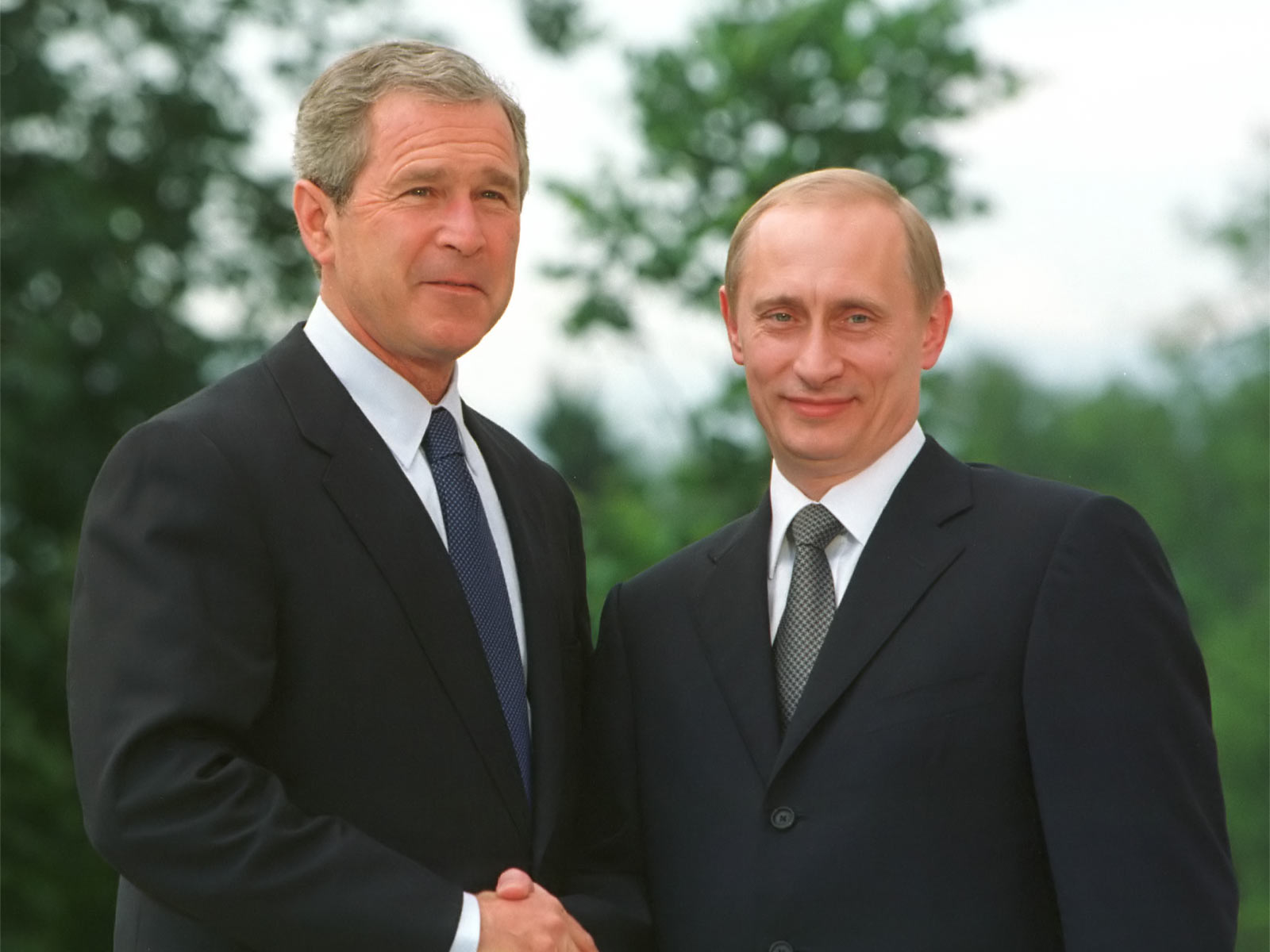
Our other option is to wait for evolution to do more work, for despite the fact that there are benefits to having people in your group who are more fearful and others who are more adventurous, it seems likely to me that human progress has partly consisted in liberal tendencies edging out conservative ones. These two specimens, for example, appear to be remnants of an earlier stage in human development:

putin-bush

Update:

As I was saying:  

Republican Senator Marco Rubio of Florida addressed the Conservative Political Action Conference today:

The presidential contender urged that “young people” in the crowd “extrapolate what the world would look like in ten years if [the current international situation] continues forward.” … “If you inherit a world where the Chinese get to decide who gets to ship products to the South China Sea and all the countries in that region are tributaries,” and “North Korea can blow up California” with nukes, and “Iran can reach the East Coast of the United States, and can wipe Israel off the face of the earth,” and “Russia continues to hold its neighbors hostage” through both its military and its oil.

The only thing we have to fear is everything.