A Different View of “Peace For Our Time”

The recent deal regarding Iran’s nuclear program evoked lots of references to Prime Minister Neville Chamberlain negotiating with Hitler in 1938. Chamberlain infamously came back from Munich, waved a “scrap of paper” and promised “peace for [not “in”] our time”. Germany immediately absorbed part of Czechoslovakia and eleven months later invaded Poland.

How could Chamberlain have been such a fool? If only he had stood up to Hitler! Was he a coward? What happened in Munich was appeasement at its worst.
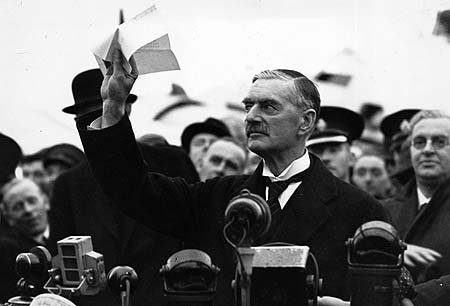
chamberlain-plane-ticket-pic-collect-178249005

As is often the case with famous or infamous historical events, the common view isn’t necessarily correct. Historians who suggest a new interpretation of the past are called “revisionists”. Sometimes they’re right, especially when their revisions are based on new evidence.

I’m not qualified to judge the merits of the standard view of the Munich Agreement, but, according to this article at Salon:

… among historians, that view changed in the late 1950s, when the British government began making Chamberlain-era records available to researchers. “The result of this was the discovery of all sorts of factors that narrowed the options of the British government in general and narrowed the options of Neville Chamberlain in particular,” explains David Dutton, a British historian who wrote a recent biography of the prime minister. “The evidence was so overwhelming,” he says, that many historians came to believe that Chamberlain “couldn’t do anything other than what he did” at Munich. Over time, Dutton says, “the weight of the historiography began to shift to a much more sympathetic appreciation” of Chamberlain.

The author suggests several reasons why, in his opinion, Chamberlain made the right decision: (1) most historians believe the British military wasn’t prepared for war with Germany in 1938; (2) Chamberlain’s military advisors told him that British forces couldn’t stop Germany from invading Czechoslovakia, but could eventually defeat Germany given time to prepare; (3) by 1938, Australia, New Zealand and Canada were no longer required to participate in a British war; (4) the Soviet Union was considered a potential enemy, not an ally; (5) America’s neutrality laws made it unlikely that America would join the fight; (6) although France was a likely major ally, British authorities had a very low opinion of France’s unstable government and the French military; (7) the British public, still traumatized by World War I, was strongly in favor of negotiation; (8) preserving the territorial integrity of Czechoslovakia wasn’t seen as justification for war, partly because Czechoslovakia had only existed for 20 years and many ethnic Germans in Czechoslovakia wanted to be part of a Germany; (9) the British generally believed that Hitler was similar to Mussolini, a fascist leader they knew, who was “more bravado than substance”.

The Munich agreement between the United Kingdom, France, Germany and Italy was greeted in Britain as a success: “cheering crowds filled the streets and the press rejoiced”. The French reaction was similar. When Germany took more of Czechoslovakia six months later, however, Chamberlain realized that war was inevitable, increased the pace of British rearmament and instituted Britain’s first peacetime draft.

Maybe Chamberlain and his supporters should have known better. After all, some of the British, as well as observers in other countries, correctly predicted that Hitler’s ultimate goal was the subjugation of Europe. We know the rest.

Still, it’s impossible to say whether Hitler would have been stopped sooner or more easily if Chamberlain (and the French president Daladier) had never made a deal in Munich. Nick Baumann, the author of the Salon article, concludes:

The story we’re told about Munich is one about the futility and foolishness of searching for peace. In American political debates, the words “appeasement” and “Munich” are used to bludgeon those who argue against war. But every war is not World War II, and every dictator is not Hitler. Should we really fault Chamberlain for postponing a potentially disastrous fight that his military advisers cautioned against, his allies weren’t ready for, and his people didn’t support?

At any rate, removing some economic sanctions in exchange for limits on Iran’s nuclear program isn’t the same as letting Hitler take part of Czechoslovakia in exchange for a promise of peace. 

By the way, the author of The Atheist’s Guide to Reality, the book I’ve been writing about recently, argues that we can learn nothing from history, since circumstances are always changing. In other words, history is bunk. But that’s consistent with his view that science is the only true path to knowledge. A more reasonable view is that there are recurring patterns in history, even if history doesn’t repeat itself. Looking back, it’s reasonable to conclude that negotiation is generally better than war.

A Guide to Reality, Part 3

Continuing to work through The Atheist’s Guide to Reality by Alex Rosenberg:

Professor Rosenberg begins chapter 1 by explaining why he’s not going to spend much time arguing for atheism: others, especially David Hume, have already done that quite well; such arguments, even very good ones, don’t convince true believers; and anyway, it’s more important to understand how science can help us live without illusions than to keep talking about religion.

Instead, Rosenberg is going to discuss a view called “scientism”. As he notes, “scientism” is usually applied in a negative way to people who supposedly worship science, or try to extend it beyond its natural borders, or simply take it too seriously. Rosenberg welcomes the term, defining it this way:

[Scientism] is the conviction that the methods of science are the only reliable ways to secure knowledge of anything; that science’s description of the world is correct in its fundamentals; and that when “complete”, what science tells us will not be surprisingly different from what it tells us today (6-7).

The idea that the current scientific description of the word is fundamentally accurate is known among philosophers as “scientific realism”. The Stanford Encyclopedia of Philosophy defines it as “a positive epistemic attitude towards the content of our best [scientific] theories and models, recommending belief in both observable and unobservable aspects of the world described by the sciences”. In other words, science is a highly reliable way to acquire knowledge of the world. Science allows us to learn about the world as it is, independent of our minds. Science even allows us to find out about things we can’t directly observe, like the Big Bang and sub-atomic particles.

Rosenberg is clearly a scientific realist. Not all philosophers are (they, in fact, disagree to some extent about what science is). But Rosenberg’s scientism goes beyond simple scientific realism when he asserts that “the methods of science are the only reliable ways to secure knowledge of anything”.

Maybe he’s exaggerating on purpose (not something philosophers ordinarily do), but are you and I doing science when we look out the window and agree that it’s snowing? Is a student doing science when she concludes that Socrates was mortal if Socrates was a man and all men are mortal? As Rosenberg knows, of course, science relies on occasionally unreliable activities like seeing and hearing in order to gather evidence. Even though scientists don’t rely on a single person’s observations, they do use the same perceptual abilities the rest of us employ to acquire knowledge. In addition, most of us would agree that people clearly know lots of things that aren’t “scientific” in the usual sense (including math, logic, historical facts, cultural practices and whether the Ford is in the driveway).

Perhaps it’s enough that an adherent of scientism believes that, when applied correctly, the various methods of science are by far the best ways we have to get at the truth about many or most features of the world. Those methods include classification, observation, experimentation, measurement, replication, discussion, publication and other things physicists, chemists, biologists and psychologists regularly do.That seems right to me, but I don’t think it’s enough for Rosenberg.

Before moving on, I should mention that Rosenberg also considers this question: if science is such a reliable method of determining the truth, why do so many people reject scientific conclusions? One reason, of course, is that scientific results are often revised. Another is that scientists often disagree among themselves, especially on topics that make the news, in some cases because they are influenced by un-scientific factors, like working for Exxon. Yet another big reason why many are skeptical about science is that scientific conclusions often make people uncomfortable (as in the case of climate change, for example).

Rosenberg, however, mainly discusses the human need for “stories”, by which he means our tendency to understand the world in terms of personalities and purposes. He argues that our ancestors became good at recognizing and interpreting purposeful behavior because that skill made it much easier to live and prosper among other people. Evolution, however, overshot the mark. People heard thunder and concluded that Someone was angry. Today, according to Rosenberg, people have trouble understanding math and physics because their subject matter doesn’t include human beings or other creatures doing things. In other words, science is especially hard because most people haven’t been built (through evolution) to understand it. Religion, on the other hand, often involves stories, which we generally find more easy to understand than science.

In the next installment: physics and the nature of reality.

Medical News To Be Thankful For

Some filibuster-reform in the Senate and the Pope expressing himself on the subject of global capitalism aren’t the only events in the news to be thankful for. For example, an editorial and an accompanying story in The New Scientist call attention to a promising development in the treatment of cancer:

Cancer is a many-headed hydra: it rapidly out-evolves treatments that target specific features of cancer cells. Even superficially identical tumours contain many different mutations, making therapy for one type useless against others.

Armed with this information, researchers are focusing on approaches that stimulate patients’ own immune systems to attack their tumour. Unlike drugs, immune systems can evolve as the cancer does, staying one step ahead of new mutations. This is how treatments based on a type of white blood cell called T-cells are curing some cancers, rather than just slowing their advance.

This new therapy involves immune cells taken from the patient and then genetically-engineered to attack the patient’s cancer cells. The modified T-cells leave healthy cells alone. Earlier this year, one patient’s “incurable” leukemia disappeared in eight days.

I have no idea whether this treatment will eventually lead to a cure for cancer (and one that is available to lots of patients), but using genetic engineering to help the body’s own immune system attack cancer sounds like an important step in the right direction.

From the New Scientist article:

29442801

Pope Francis on Economic Tyranny and the “Deified Market”

Pope Francis I has issued his first apostolic exhortation to the “bishops, clergy, consecrated persons and the lay faithful”. It’s called Evangelii Gaudium (“The Joy of the Gospel”). 

The most joyful part for many of us will be his comments on the global economy. He wants the world to say “No to an economy of exclusion”, “No to the new idolatry of money”, “No to a financial system which rules rather than serves” and “No to the inequality which spawns violence”.

Will his words affect those of us, Catholic or not, who would rather cut food stamps than regulate banks? Probably not, but it’s still great to hear the Pope talk like a Christian.

Quoted at length from the Vatican’s website:

53. Just as the commandment “Thou shalt not kill” sets a clear limit in order to safeguard the value of human life, today we also have to say “thou shalt not” to an economy of exclusion and inequality. Such an economy kills….Today everything comes under the laws of competition and the survival of the fittest, where the powerful feed upon the powerless. As a consequence, masses of people find themselves excluded and marginalized: without work, without possibilities, without any means of escape.

Human beings are themselves considered consumer goods to be used and then discarded. We have created a “disposable” culture which is now spreading. It is no longer simply about exploitation and oppression, but something new. Exclusion ultimately has to do with what it means to be a part of the society in which we live; those excluded are no longer society’s underside or its fringes or its disenfranchised – they are no longer even a part of it. The excluded are not the “exploited” but the outcast, the “leftovers”.

54. In this context, some people continue to defend trickle-down theories which assume that economic growth, encouraged by a free market, will inevitably succeed in bringing about greater justice and inclusiveness in the world. This opinion, which has never been confirmed by the facts, expresses a crude and naïve trust in the goodness of those wielding economic power and in the sacralized workings of the prevailing economic system. Meanwhile, the excluded are still waiting. To sustain a lifestyle which excludes others, or to sustain enthusiasm for that selfish ideal, a globalization of indifference has developed. Almost without being aware of it, we end up being incapable of feeling compassion at the outcry of the poor, weeping for other people’s pain, and feeling a need to help them, as though all this were someone else’s responsibility and not our own. The culture of prosperity deadens us; we are thrilled if the market offers us something new to purchase; and in the meantime all those lives stunted for lack of opportunity seem a mere spectacle; they fail to move us. 

55. One cause of this situation is found in our relationship with money, since we calmly accept its dominion over ourselves and our societies. The current financial crisis can make us overlook the fact that it originated in a profound human crisis: the denial of the primacy of the human person! We have created new idols. The worship of the ancient golden calf … has returned in a new and ruthless guise in the idolatry of money and the dictatorship of an impersonal economy lacking a truly human purpose. The worldwide crisis affecting finance and the economy lays bare their imbalances and, above all, their lack of real concern for human beings; man is reduced to one of his needs alone: consumption.

56. While the earnings of a minority are growing exponentially, so too is the gap separating the majority from the prosperity enjoyed by those happy few. This imbalance is the result of ideologies which defend the absolute autonomy of the marketplace and financial speculation. Consequently, they reject the right of states, charged with vigilance for the common good, to exercise any form of control. A new tyranny is thus born, invisible and often virtual, which unilaterally and relentlessly imposes its own laws and rules. Debt and the accumulation of interest also make it difficult for countries to realize the potential of their own economies and keep citizens from enjoying their real purchasing power. To all this we can add widespread corruption and self-serving tax evasion, which have taken on worldwide dimensions. The thirst for power and possessions knows no limits. In this system, which tends to devour everything which stands in the way of increased profits, whatever is fragile, like the environment, is defenseless before the interests of a deified market, which become the only rule. 

57. Behind this attitude lurks a rejection of ethics and a rejection of God. Ethics has come to be viewed with a certain scornful derision. It is seen as counterproductive, too human, because it makes money and power relative. It is felt to be a threat, since it condemns the manipulation and debasement of the person. In effect, ethics leads to a God who calls for a committed response which is outside of the categories of the marketplace. When these latter are absolutized, God can only be seen as uncontrollable, unmanageable, even dangerous, since he calls human beings to their full realization and to freedom from all forms of enslavement. Ethics – a non-ideological ethics – would make it possible to bring about balance and a more humane social order. With this in mind, I encourage financial experts and political leaders to ponder the words of one of the sages of antiquity: “Not to share one’s wealth with the poor is to steal from them and to take away their livelihood. It is not our own goods which we hold, but theirs”.

58. A financial reform open to such ethical considerations would require a vigorous change of approach on the part of political leaders. I urge them to face this challenge with determination and an eye to the future, while not ignoring, of course, the specifics of each case. Money must serve, not rule! The Pope loves everyone, rich and poor alike, but he is obliged in the name of Christ to remind all that the rich must help, respect and promote the poor. I exhort you to generous solidarity and a return of economics and finance to an ethical approach which favours human beings.

59. Today in many places we hear a call for greater security. But until exclusion and inequality in society and between peoples is reversed, it will be impossible to eliminate violence. The poor and the poorer peoples are accused of violence, yet without equal opportunities the different forms of aggression and conflict will find a fertile terrain for growth and eventually explode. When a society – whether local, national or global – is willing to leave a part of itself on the fringes, no political programmes or resources spent on law enforcement or surveillance systems can indefinitely guarantee tranquility. This is not the case simply because inequality provokes a violent reaction from those excluded from the system, but because the socioeconomic system is unjust at its root. Just as goodness tends to spread, the toleration of evil, which is injustice, tends to expand its baneful influence and quietly to undermine any political and social system, no matter how solid it may appear. If every action has its consequences, an evil embedded in the structures of a society has a constant potential for disintegration and death. It is evil crystallized in unjust social structures, which cannot be the basis of hope for a better future. We are far from the so-called “end of history”, since the conditions for a sustainable and peaceful development have not yet been adequately articulated and realized.

60. Today’s economic mechanisms promote inordinate consumption, yet it is evident that unbridled consumerism combined with inequality proves doubly damaging to the social fabric. Inequality eventually engenders a violence which recourse to arms cannot and never will be able to resolve. This serves only to offer false hopes to those clamouring for heightened security, even though nowadays we know that weapons and violence, rather than providing solutions, create new and more serious conflicts. Some simply content themselves with blaming the poor and the poorer countries themselves for their troubles; indulging in unwarranted generalizations, they claim that the solution is an “education” that would tranquilize them, making them tame and harmless. All this becomes even more exasperating for the marginalized in the light of the widespread and deeply rooted corruption found in many countries – in their governments, businesses and institutions – whatever the political ideology of their leaders.

Far from the Madding Crowd by Thomas Hardy

Published in 1874, Far from the Madding Crowd is the story of the young, independent and beautiful Bathsheba Everdene (what a name!) and three very different men. Gabriel Oak is a thoughtful, competent young shepherd who meets her and quickly proposes marriage. Mr. Boldwood is an older, gentleman farmer who has no experience with women and falls in love with her too. Francis Troy is a semi-aristocratic soldier who has experience with women and is not to be trusted. It wouldn’t be much of a story if Bathsheba chose the right one right away.

The novel is set in the region of southern England that Hardy called “Wessex”. There are many fine descriptions of the countryside and country life. The downside is that there are a few too many discussions between the local rustics, who speak in dialect and serve as a rural Greek chorus.

The title is from Thomas Gray’s “Elegy Written in a Country Churchyard”:

Far from the madding crowd’s ignoble strife
Their sober wishes never learn’d to stray;
Along the cool sequester’d vale of life
They kept the noiseless tenor of their way.

The characters in Hardy’s first popular novel do live far from the crowds, but don’t always avoid madness. They might get under your skin a little bit (it’s remarkable how fictional people can affect us).

One of my favorite passages comes near the end of the novel:

Theirs was that substantial affection which arises (if any arises at all) when the two who are thrown together begin first by knowing the rougher sides of each other’s character, and not the best till further on, the romance growing up in the interstices of a mass of hard prosaic reality. This good-fellowship — camaraderie — usually occurring through similarity of pursuits, is unfortunately seldom superadded to love between the sexes, because men and women associate, not in their labours, but in their pleasures merely. Where, however, happy circumstance permits its development, the compounded feeling proves itself to be the only love which is strong as death — that love which many waters cannot quench, nor the floods drown, beside which the passion usually called by the name is evanescent as steam.