An Israeli on Failure in Gaza and the Way Out

Assaf Sharon, a philosophy professor at Tel Aviv University, has an article in the New York Review of Books concerning the recent violence in the Gaza Strip and the only realistic way to resolve the Israeli/Palestinian conflict. Below are extended selections from “Failure in Gaza”, which is available in full here:

“In Israel, endless controversy over Gaza has overlooked one question: How did we get here in the first place? Why, after a considerable period of relative calm, did Hamas resume rocket fire into Israel?”

“Before the current operation began, Hamas was at one of the lowest points in its history….In these circumstances, Hamas agreed last April to reconciliation with its political rival Fatah, based on Fatah’s terms. For example, the agreement called for a government of technocrats largely under the control of the Palestinian Authority led by Mahmoud Abbas.”

“But Benjamin Netanyahu viewed the reconciliation as a threat rather than an opportunity….He saw the reconciliation with Hamas as an opportunity to criticize the Palestinian president…. As soon as the reconciliation was announced, Netanyahu launched a public offensive against Palestinian unity and demanded that the international community oppose it….”

“Netanyahu could have chosen a different path. He could have used the reconciliation to reinforce Abbas’s position and further destabilize Hamas. He could, in recognition of the agreement, have encouraged Egypt to open its border with Gaza in order to demonstrate to Gazans that the Palestinian Authority offered a better life than Hamas. Instead, Israel prevented the transfer of salaries to 43,000 Hamas officials in Gaza, sending a clear message that Israel would not treat Gaza any differently under the rule of moderate technocrats from the Palestinian Authority.”

“The abduction of three Israeli youths in the West Bank on June 12 gave Netanyahu another opportunity to undermine the reconciliation…. Despite the statement by … the Hamas political bureau chief, that the Hamas political leadership did not know of the plans to carry out the abduction, Netanyahu was quick to lay the blame on Hamas, declaring that Israel had ‘unequivocal proof’ that the organization was involved in the abduction.”

“As yet, Israeli authorities have produced no such proof and the involvement of the Hamas leadership in the kidnapping remains unclear. While the individuals suspected of having carried out the kidnapping are associated with Hamas, some of the evidence suggests that they may have been acting on their own initiative and not under the direction of Hamas’s central leadership. Regardless of this, Netanyahu’s response, apparently driven by the ill-advised aim of undermining Palestinian reconciliation, was reckless.”

“Determined to achieve by force what he failed to accomplish through diplomacy, Netanyahu not only blamed Hamas, but linked the abduction to Palestinian reconciliation, as if the two events were somehow causally related. ‘Sadly, this incident illustrates what we have been saying for months,’ he stated, ‘that the alliance with Hamas has extremely grave consequences’. Israeli security forces were in possession of evidence strongly indicating the teens were dead, but withheld this information from the public until July 1….”

“On the prime minister’s orders, IDF forces raided Hamas’s civil and welfare offices throughout the West Bank and arrested hundreds of Hamas leaders and operatives. These arrests did not help to locate the abductors or their captives. Among the arrested were fifty-eight Palestinians previously released as part of the deal to return the Israeli soldier Gilad Shalit, who had been a captive of Hamas since 2006.”

“As part of this ill-conceived operation against Hamas, Israel also mounted air strikes on Hamas facilities in Gaza. Apparently, Hamas did not take an active part in firing rockets for more than two weeks, although it did not prevent other factions in Gaza from firing. Only on June 29 or 30 did Hamas restart the rocket bombardment of Israeli territory, which it had not engaged in since November 2012. Israel retaliated against Hamas in Gaza and a vicious cycle began. Netanyahu lost control over an escalation he had instigated. In his badly misjudged eagerness to blame Abbas and punish him for reconciling with Hamas, Netanyahu turned a vicious but local terrorist attack into a runaway crisis….”

….

“Israel’s conduct throughout the crisis has been based directly on Netanyahu’s philosophy of ‘conflict management’, whose underlying premise is that the conflict between Israelis and Palestinians cannot be solved, but can be effectively ‘managed’ for a very long period of time. This feeble, not to mention defeatist, assumption is not only wrong but also dangerous, trapping Israel in an illusion that is shattered time and again. ‘Control’ and ‘stability’ only exist between each inevitable round of violence. In fact, recurring rounds of violence are inherent to this approach.”

“’Conflict management’ means continued Israeli control over the Palestinians in Gaza and in the West Bank, with the inevitable reality of organizations and factions struggling to overthrow that control. Under the illusion that the conflict is being managed, opportunities for change provided by calm periods are squandered….” 

“So long as Hamas is willing to use terror against innocent Israeli civilians and so long as it refuses to recognize the State of Israel, it will not be a ‘partner’ for peace. But it could be partner to interest-based agreements requiring it to modify its behavior, as many academic and security experts claim. In fact, despite Netanyahu’s being the most vocal opponent of dialogue with Gazan terror organizations, it was he who reached two agreements with Hamas: the 2011 Shalit deal and the 2012 agreement that ended Operation Pillar of Defense…” 

“A long-term resolution with respect to Gaza requires changing its political predicament. The only sensible way of doing this is to establish a Palestinian state in the West Bank and Gaza, a state whose existence would be negotiated with the Palestine Liberation Organization under Abbas’s leadership. As part of a comprehensive political agreement, Hamas is very likely to agree to a long-term truce, as its representatives have repeatedly said.”

“In 1997, its founder and spiritual leader Ahmad Yassin suggested a thirty-year hudna (truce) with Israel. In 2006, one of its leaders, Mahmoud al-Zahar, proposed a ‘long-term hudna’. Earlier this year, Sheikh Hassan Yousef, a senior Hamas functionary in the West Bank, reiterated the organization’s willingness for a hudna and said the organization was willing to accept a peace agreement with Israel if a majority of Palestinians supported it. In 2010, in an interview with a Muslim Brotherhood daily circulated in Jordan, Hamas’s political leader Khaled Mashal expressed pragmatic views and willingness to reach an agreement with Israel. In late July, he [said] ‘We want peace without occupation, without settlements, without Judaization, without the siege’.”

“All these proposals were contingent on ending the Israeli occupation and establishing a Palestinian state within the 1967 borders. They received no response from Israel. Although a Palestinian state contradicts Netanyahu’s ideological commitments and conflicts with his own political interests, a state is clearly in Israel’s interest….”

“The historic conflict with the Palestinians will not be settled by a single agreement. Reconciliation between Israelis and Palestinians—overcoming decades of bloodshed and hatred—will require a long process of acceptance and forgiveness spanning years and probably decades. The armed conflict, however, can certainly be ended. Israel has already ended armed conflicts with several neighboring countries: with some, like Egypt and Jordan, it achieved comprehensive peace agreements; with others, it agreed to other kinds of accords.”

“An agreement can be reached with the Palestinians, too: the terms are known and the price is fixed. Whether it is reached or not is a matter of political will on the part of Israeli and Palestinian leaders. Unfortunately, Israel’s current leadership will do anything to avoid this choice, to the detriment of both peoples.”

“The war in Gaza is, fundamentally, not about tunnels and not against rockets. It is a war over the status quo. Netanyahu’s ‘conflict management’ is a euphemism for maintaining a status quo of settlement and occupation, allowing no progress. The Israeli opposition must distance itself from this hopeless conception and other countries need to reject it. Both must be done forcefully and before violence erupts once more, and force becomes the only option—yet again.”

Trying to Understand Hamas, Part 1

It isn’t easy to understand what Hamas is trying to accomplish in this latest conflict. The rockets they launch toward Israel are quickly followed by destruction in Gaza. Don’t the leaders of Hamas care about the hundreds of Palestinian deaths, the thousands of injuries and the obliteration of entire neighborhoods in places like Gaza City?

28HAMAS-superJumbo

One way to attempt to understand Hamas’ actions is to consider how this latest round of violence started. The events below are taken from Wikipedia’s detailed timeline, except for two interesting additions, the first for June 11th and the second for June 30th.

6/11: It’s not part of the Wikipedia timeline, but a weekly report for June 10-16th from the United Nations Office for the Coordination of Humanitarian Affairs states on page 4:

On 11 June, the Israeli Air Force targeted an alleged member of an armed group riding on a motorcycle together with a ten-year old child, in the Beit Lahiya area. The man died instantly and the child, who sustained serious injuries, died three days later; two civilian bystanders were also injured. 

The last targeted killing in the Gaza Strip was reported in early March. Following this incident and through the rest of the week, Palestinian armed groups launched a number of rockets at southern Israel.

6/12: Three Israeli teenagers are kidnapped in the West Bank.

6/14: Israel sends troops and police officers into the West Bank to conduct searches and arrests.

6/15: The Israeli Prime Minister claims to know “for a fact” that Hamas was responsible for the kidnappings. Israel further restricts border crossings for both the West Bank and Gaza.

6/16: At least 150 Palestinians have been arrested. The Chief of Staff of the Israeli Defense Force (IDF) announces that many of the arrests are unrelated to the search for the kidnappers. Instead, they are meant to put pressure on Hamas.

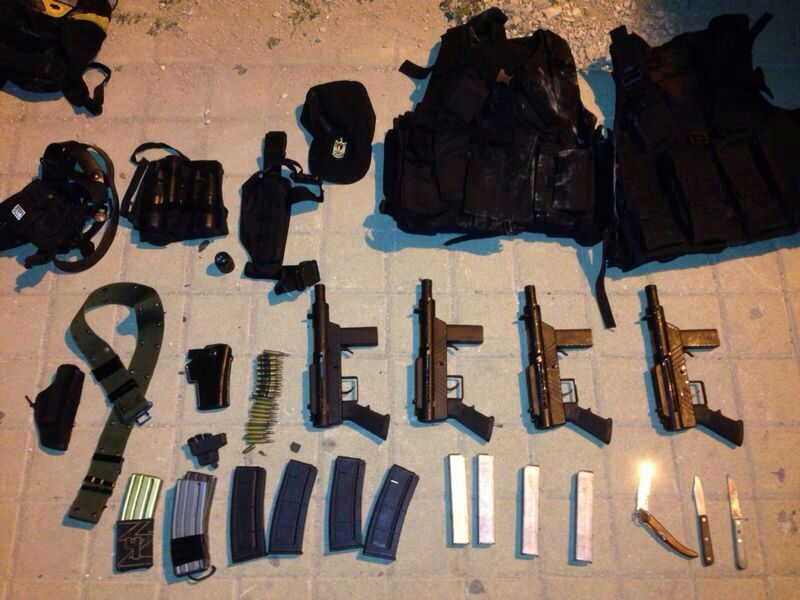
Photograph of weapons said to have been found by the IDF after a search:

Palestinian_Weapons_Exposed_During_Operation_Brother’s_Keeper_(14256563989)

6/18: After six days, Israeli forces have made 240 arrests, searched 800 structures, put 300,000 Palestinians under curfew and restricted the movements of 600,000.

6/20: Palestinians commit sporadic violence in the West Bank. At least two Palestinians are killed by Israeli forces. Some 1000 buildings have been damaged during searches, mostly private dwellings.

6/22: Three more Palestinians are dead. The Palestinian Authority calls on the U.N. to intervene and stop what it calls “collective punishment”.

6/23: An Israeli officer states that the operation has been a success because it has crippled Hamas’ infrastructure, although no progress has been made in locating the three teenagers. Prime Minister Netanyahu again affirms that Hamas was clearly responsible for the kidnapping.

6/24: Photograph of a nursery said to have been taken after an IDF search:

Nursery_after_search_24_June_2014

6/26: “According to Israel figures, state detentions number 381, of whom 282 are affiliated to Hamas. The number of locations searched rose to 1,955, including 64 Hamas institutions. Palestinian figures state that 566 were detained, 6 were shot dead, and over 120 wounded; 2 elderly people died of heart attacks during Israeli operations, and over 1,200 homes were searched.”

6/30: According to the Times of Israel, but not mentioned in the Wikipedia timeline:

At least 16 rockets were fired at Israel Monday morning [on June 30], most of them hitting open areas in the Eshkol region, the army said. The security sources, who spoke on condition of anonymity, assessed that Hamas had probably launched the barrage in revenge for an Israeli airstrike several hours earlier which killed one person and injured three more. A member of Hamas’s militant wing was killed in the attack, Gaza health official Ashraf al-Kidra said….

Hamas hasn’t fired rockets into Israel since Operation Pillar of Defense ended in November 2012, and has yet to take responsibility for this latest barrage.

Also 6/30: The bodies of the teenagers are found. That night, Israeli forces destroy the homes of two Palestinian suspects.

7/1: “Israeli jets and helicopters struck 34 locations in the Hamas-run Gaza Strip in response to over 20 rockets being fired at Israel from Gaza.” Another Palestinian is shot and killed.

7/2: A Palestinian teenager is abducted and killed. “Palestinians fired nine rockets into Israeli territory, three of which heavily damaged residential buildings”, but no casualties were reported.

7/3: “The Israeli Air Force conducted 15 air strikes in Gaza.”

7/8: Israel announces plans to call up 50,000 reserves as part of Operation Protective Edge. In the early morning, Israel strikes at 50 targets in Gaza, injuring 17. PM Netanyahu instructs the IDF to “take their gloves off” against Hamas and take any means necessary to restore peace to Israeli citizens.

“The Geneva-based nonprofit, nongovernmental human rights organization Euro-Mid Observer for Human Rights, [reports that] the Israeli government has been accused of having stolen around $370,000 in cash and $2.5 million in property, in search of the abducted youths. In 387 incidents throughout the West Bank, the Israeli government has confiscated goods ranging from computers, cars, mobile phones and jewelry, taken from a wide variety of localities, including private homes, clinics, companies and universities, says the report. Spokespersons for the Israeli government say that goods were confiscated from sources that were using them to fund or support terrorism.

Note: On July 25th, a BBC journalist reported that Israeli police spokesman Micky Rosenfeld informed him that the killers of the three teenagers were “definitely” from a “lone cell”, affiliated with Hamas but not under Hamas’ direct leadership. Further, if the kidnapping had been ordered by Hamas’ ledership, the Israelis would have know about it in advance. Later, in seeking to explain his remarks, Rosenfeld reiterated that the suspects were affiliated with Hamas. 

So, given the extreme military imbalance, what moved Hamas to launch those rockets at Israel for the first time since 2012?

Considering the timeline above, one explanation that seems fairly reasonable is that the people in the Gaza Strip who control those rockets got very angry and decided to fight back, whatever the consequences might be. 

Tomorrow: a shorter part 2 regarding different perspectives, real and imagined.

A Way Forward for the Palestinians

While wondering what to say about the growing slaughter in the Gaza Strip, I happened to read a review of two movies dealing with Israel’s occupation and increasing colonization of the West Bank. 

The review, published in April, was written by David Shulman, a professor at the Hebrew University of Jerusalem who is active in the Israeli peace movement (a part of the Israeli political scene that doesn’t get much publicity in the United States). Shulman is an American who emigrated to Israel almost 50 years ago. Here are some extended excerpts (I hope The New York Review of Books won’t mind):

The impossible backdrop … is the Israeli occupation of the West Bank; and indeed there is much that is unbelievable about this occupation and the reality it has created and maintained for nearly half a century….It is hard to fathom how the Israelis themselves can stand to live with the ongoing misery and cruelty they have inflicted, and it’s not so easy to understand how the rest of the world has let them get away with it.

Like any young Palestinian, Omar [the main character] is subject to routine harassment and humiliation by Israeli soldiers. Those who have not seen such practices with their own eyes will find the relevant scene, early on in the film, instructive. Omar is stopped by soldiers while walking down the street, then forced to balance himself on a rock while they chat and laugh at him; when he protests, they break his nose. I’ve myself seen much worse incidents in the South Hebron hills, including violent arrest of innocent civilians simply trying to reach their fields or homes.

On the level closest to the surface, the film shows us one of the main pillars of the occupation—the deep penetration of Palestinian society by an army of informers and secret agents who provide the information necessary for near-total control ….. For decades, well-trained Israeli handlers have mastered an evolving and highly effective repertory of psychological devices and various forms of blackmail that serve first to “turn” their captives into informers, and then to manipulate them.

Life under the occupation, with its Kafkaesque requirement of bureaucratic permits for almost anything a person might want or need to do (movement from place to place, medical treatment, visits to parents or other relatives, building an outhouse, and so on) makes any Palestinian potentially vulnerable to blackmail. That, in fact, is the meaning, and also the ultimate purpose, of full control. The Israelis have not invented these methods, but they have proven to be very skilled, and unscrupulous, in using them. Among them, needless to say, is the devilish threat to harm or even destroy a loved one, a girlfriend or wife, as we see in this film….

The problem is that these ordinary Israelis, the “common people” who are just people, have mostly, for decades now, elected governments of the extreme right, like the present settlers’ regime run by Benjamin Netanyahu. Moreover, these same ordinary people continue to demonstrate, day after day, a shocking, willful indifference to the fate of their Palestinian neighbors. Here we touch another, even more fundamental pillar of the occupation, something far more malignant and consequential than anything the Shin Bet can do….

At bottom, all of us [Israelis and Palestinians] feel trapped. Why, then, one might wonder, does Israel, which holds nearly all the cards in its hand, not wish to move toward some possible resolution of the endless conflict…? Why is Israel continuously deepening and expanding the occupation, and above all the settlements, instead of negotiating in good faith? … Does Israel really think it’s possible to hem in and terrorize an entire people by torture, blackmail, and other instruments of coercion far into the unknown future?

There are, I think, answers to these questions that go beyond the usual platitudes about mutual suspicion and the ancient, ever-lengthening list of Jewish traumas. Tribal nationalism, including in Israel, tends to be totalistic and easily drifts toward the totalitarian. It absolutizes the tribe as an almost-divine being and demonizes the outsider, who can—perhaps must—be humiliated, removed, or destroyed. You can hear voices speaking to that effect every day in the Knesset, including those of some who are close to or indeed are members of the present government. But whatever the reasons, it seems clear that Israel will have to be forced to make some sort of peace—or, in a variant of the South African trajectory, eventually to enfranchise all Palestinians and thus move into some model of the single, binational state.

A positive scenario would involve mass nonviolent Palestinian resistance. On the face of it, the apparatus of Israeli control so vividly portrayed in both these films would seem to preclude such an outcome; the Israeli security services probably still think they can control any foreseeable outcome on the ground. Moreover, the extreme fragmentation of the West Bank into discontiguous, fenced-in enclaves has so far worked to keep nonviolent protest highly localized. But anyone who knows the Palestinian grassroots activists … knows that the dream of mass Gandhian-style action is their great hope.

Israel would have no answer to hundreds of thousands of unarmed civilians marching on the roadblocks or the settlements (and, no doubt, paying the price in casualties). Many of the younger Palestinian activists are educating a new generation about this ethos, invoking Martin Luther King, Mahatma Gandhi and Henry David Thoreau. They’ve had plenty of time to read the relevant texts, usually in Israeli jails…

Violence on one side merely provides an excuse for violence on the other side, and there is always some incident perpetrated by the other side that can be offered as justification. It’s reported that 2 Israelis but more than 260 Palestinians have been killed in the recent fighting (and of course there are the non-fatal injuries as well). Since the Israelis are willing and able to generate much more violence than the Palestinians, the Palestinians will never reclaim their freedom or land by force.

On top of that, Israeli Prime Minister Netanyahu made this declaration last week: “There cannot be a situation, under any agreement, in which we relinquish security control of the territory west of the River Jordan”.  As noted in Israel, but hardly at all in America, that means Netanyahu has now publicly stated his opposition to the “two-state solution”. Of course, full integration of the Palestinians into Israeli society is off the table too.

As Professor Shulman says, mass nonviolent resistance is probably their best hope. The Palestinians need their own Gandhi or Martin Luther King, and leaders like that are rare.Â