It’s the difference between a linear and a non-linear system. Andrew Dessler, Professor of Atmospheric Sciences at Texas A&M, explains:
If you’re struggling to understand why the impacts of climate change suddenly seem so awful, it’s time we discuss a key scientific term: non-linearity.
In a linear system, changes occur in a straight line. If climate impacts were linear, each 0.1°C increase in temperature would produce the same increment of damage. In this world, things slowly get worse over decades until, later this century, the accumulations of slow impacts becomes truly terrible.
But impacts of climate change are different — they are non-linear. In a rain event, for example, the first few inches of rain typically produce no damage because existing infrastructure (e.g., storm drains) were designed to handle that much rain.
As rainfall continues to intensify, however, it eventually exceeds the capacity of the storm runoff infrastructure and the neighborhood floods. You go from zero damage if the water stops half an inch below the front door of your house to tens of thousands of dollars of damage if the water rises one additional inch and flows into your house.
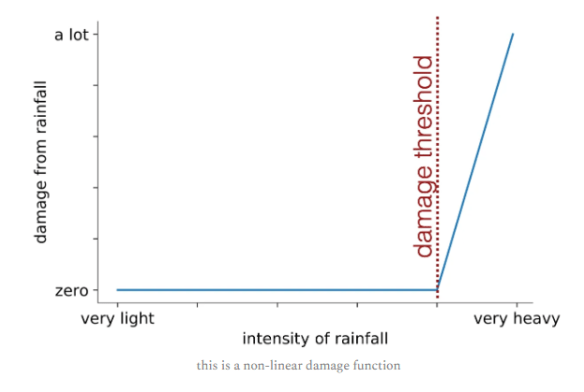
Thus, the correct mental model is not one of impacts slowly getting worse over decades. Rather, the correct way to understand climate change is that things are fine until they’re not, at which point they’re really terrible. And the system can go from “fine” to “terrible” in the blink of an eye.
The key to this is recognizing the thresholds that exist in the systems around us. For example, when engineers of the 20th century designed the infrastructure that we live with today (bridges, dams, storm runoff systems), they designed it for the range of climate conditions that existed at the time, adding in a small margin for unforeseen weather extremities. But not too much of a margin — they wanted to keep costs down.
This range and margin together define the design limits of the built world. If we still had the climate of the 20th century, we’d be fine. But the relentless warming of our planet has taken us to the edge and beyond these 20th-century design limits.
The speed of us passing limits is mind bending. People who are affected are often shocked and we frequently see people bemoaning the fact that some impact never happened before — this is the calling card of non-linear effects.
So when we see all of the climate impacts of the last few years suddenly appearing, it shouldn’t surprise us. The very rapid warming we are experiencing is pushing us past many thresholds in our human and natural systems.
Note that these damages are not uniformly distributed. When the globe warms from 1.1C to 1.2C, most people are unaffected. But, for a minority of people, this will drive the climate system past important thresholds, resulting in enormous damages and suffering for them. It could be a rainfall event that, intensified by warming, crosses a threshold and floods a city. Or it could be a heatwave that, powered by increasing temperatures, becomes intense enough to wipe out entire crops. Whatever the scenario, for those people it is awful.
When the Earth warms the next 0.1C, an entirely new group of thresholds will be passed, bringing great harms to entirely different groups of people. Many of them will not expect it, having been lulled into complacency by the fact that they hadn’t been negatively impacted by warming up to then. Is that you?
Let’s hope not, but the reality is that someone, somewhere, will inevitably face climate disaster in the near future. Therefore, it’s crucial to discard the notion of climate change as a distant, linear threat and acknowledge that all of us are in the non-linear firing line.
 Whereof One Can Speak 🇺🇦
You must be logged in to post a comment.