Where We Live Matches How We Vote

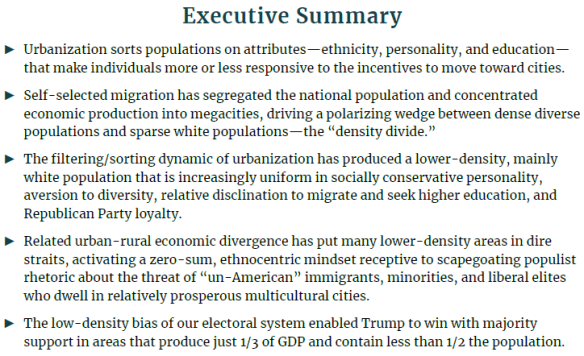
To understand the disheartening state of American politics, we need to consider the growth of cities and suburbs and the related decline of rural areas. That’s the conclusion of a 79-page report issued a few years ago by Will Wilkinson of the Niskanen Center. It’s called “The Density Divide: Urbanization, Polarization and Populist Backlash”. Here the author summarizes his findings: 

I weave recent research in political science, economics, psychology and more into an account of political polarization and the rise of populist nationalism as a surprising and overlooked side-effect of urbanization.

I claim that we’ve failed to fully grasp that urbanization is a relentless, glacial social force that transforms entire societies and, in the process, generates cultural and political polarization by segregating populations along the lines of the traits that make individuals more or less responsive to the incentives that draw people to the city. I explore three such traits — ethnicity, ideology-correlated aspects of personality, and level of educational achievement — and their intricate web of relationships.

The upshot is that, over the course of millions of moves over many decades, high density areas have become economically thriving multicultural havens while whiter, lower density places are facing stagnation and decline as their populations have become increasingly uniform in terms of socially conservative personality, aversion to diversity, and lower levels of education. This self-segregation of the population, I argue, created the polarized economic and cultural conditions that led to populist backlash.

Because the story of urbanization just is the story of a strengthening relationship between density, human capital and economic productivity, it’s also the story of relative small town and rural decline. The same process that has filtered better-educated, more temperamentally liberal whites out of lower density places has left those places with less vibrant economies, but also with more place-bound, ethnocentric populations.

It’s no shock that leavers leave and stayers stay. What’s surprising is that, if you’re white (and if you’re not, you’re almost certainly urban), the personality traits that make you more or less inclined to leave or stay — that make you more or less magnetized to the rising attractive force of the city — also predict how socially conservative or liberal you’ll tend to be, and which political party you’ll tend to support.

So the pull of urbanization has segregated us geographically on those traits, and it has done it so thoroughly that Democratic vote share now rises, and Republican vote share drops, in a remarkably linear fashion as population density rises. The relationship between density and party affiliation is, with few exceptions, similar everywhere — in “red states” and “blue states,” in sprawling metro regions and bucolic small towns — and majorities tend to flip at the density typical of a big city’s outer suburbs. I call this partisan polarization on population density the “density divide.”

When populations segregate geographically on traits relevant to ideology and party affiliation, political polarization is sure to follow. The increasing concentration of the economy in big cities, which is both a cause and effect of urbanization, amplifies this polarization. Rising prosperity reliably produces a liberalizing, tolerant, positive-sum mood. Material insecurity, in contrast, tends to elicit a grim, zero-sum, us-or-them mindset.

Because the sunshine of prosperity has become increasingly focused on urban populations, lower density white populations — which, thanks to the sorting logic of urbanization, are already more conservative and ethnocentric — have been left with objectively darkening prospects and a mounting sense of anxiety that is, at once, economic and ethno-cultural.

This combination of conditions created a political opportunity [our former president] managed to exploit. Because urbanization is reshaping societies everywhere around the world, it has created similar conditions, and similarly illiberal strongman leaders, in other countries as well. If we’re going to be able to do anything about the acrimony of polarization and the peril of ethno-nationalist populism, we’re going to have to get the story straight. This cross-disciplinary account of the social and psychological forces behind the density divide is my preliminary attempt to put us, finally, on the right track.
Untitled

Unquote.

The growth of cities and suburbs tends to make American politics more progressive, but a constitution ratified in 1789 that favors small states doesn’t make it easy.
People in Congress Vote, But They Don’t All Believe in Democracy

Yesterday, I posted part of a pro-democracy, pro-majority rule speech given this week by a Democratic congressman, Sean Casten of Illinois. He argues that Congress doesn’t do what most voters want it to do because our government has a built-in bias toward minority-rule. Given how we elect presidents and members of Congress and how the Supreme Court functions, a minority of voters and a minority in Congress can make it difficult, sometimes impossible, for the government to do things most of us want it to do. He therefore recommends changes to the House of Representatives, Senate, Supreme Court and Electoral College that would make each of those institutions more democratic, i.e. more responsive to the will of the majority.

At the beginning of his speech, however, he said something about his colleagues in the House that just isn’t true:

Now everybody in this body has different policy views, different ideas of what a better position in that relay might look like. But I submit that we do have some universal goals that we all agree on or else we wouldn’t be in this line of work.

We all want a government that delivers the greatest good for the greatest number. We all want a government that upholds our founding promise of freedom and equality.

We all, I think, believe Abraham Lincoln’s admonition to us that a government of, by, and for the people should not perish from this Earth. And we all, also, I think agree that on those really hard questions, … the single best way to resolve those disputes is through a democratic process.

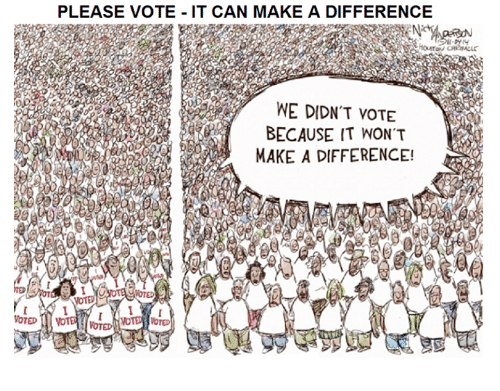
A few bedrock principles of democracy are that the vast majority of adult citizens get to vote, each of their votes counts the same, the person or proposal getting the most votes wins and people should be encouraged to vote (otherwise we won’t know what the majority wants).

It’s hard to know what Rep. Casten was thinking when he suggested that everybody in Congress believes in democracy. Maybe he was being collegial or sarcastic. But it simply isn’t true that his Republican colleagues accept the democratic principles he thinks are universal.

I just finished a book by two sociologists called The Flag and the Cross. It’s a great book if you want to understand American politics, since it deals with the rise of White Christian nationalism, the ideology that’s become dominant in the Republican Party. In a nutshell, White Christian nationalists think America should be a Christian country and White people who profess to support Christianity (mainly White men) should be in charge. You can immediately see there’s a conflict here with democracy and majority rule. Republicans don’t always admit they oppose majority rule, but sometimes they do. This is from The Flag and the Cross (pp. 96-98):

White Christian nationalism designates who is “worthy” of the freedom it cherishes, namely, “people like us.” But for the “others” outside that group, white Christian nationalism grants whites in authority the “freedom” to control such populations, to maintain a certain kind of social order that privileges “good people like us”….

Both legal and illegal voter suppression have long been a tactic of white conservatives to tilt elections in their favor. Yet political scientists and sociologists often forget the ideological support for such efforts since the civil rights movement has come from white Christian nationalism. Just months before the 1980 election, Paul Weyrich, cofounder of the American Legislative Exchange Council and the Moral Majority, spoke at a Dallas conference to an audience that included evangelical leaders … as well as GOP presidential candidate Ronald Reagan.

Weyrich told his audience, “Now many of our Christians have what I call the ‘goo-goo syndrome.’ Good government. They want everybody to vote. I don’t want everybody to vote. Elections are not won by a majority of people. They never have been from the beginning of our country, and they are not now.” He went on, explaining: “As a matter of fact, our leverage in the elections quite candidly goes up as the voting populace goes down.”

Here before his Christian Right audience, Weyrich explained the strategy: our group stays in power if fewer people—especially our opponents—are able to vote. The policy implication is clear: make it harder for “problem” populations to vote, or at least don’t make it easier.

Weyrich’s antidemocratic sentiment has been repeated on the Christian Right for decades since. Also among those in attendance at that 1980 meeting was longtime conservative activist Phyllis Schlafly. Leading up to the 2012 presidential election, Schlafly underscored why limiting early voting was so critical. “The reduction in the number of days allowed for early voting is particularly important because early voting plays a major role in Obama’s ground game. The Democrats carried most states that allow many days of early voting.”

Several years later, former Baptist pastor, governor of Arkansas, and GOP presidential candidate Mike Huckabee echoed Weyrich’s words: “I know that most politicians say we want everyone to vote, I’m gonna be honest with you, I don’t want everyone to vote. If they’re so stupid—that’s right, if they’re gonna vote for me they need to vote, if they’re not gonna vote for me they need to stay home. I mean, it’s that simple . . . But in the big picture, there are people who vote and they have no idea what our Constitution says.” This last part of Huckabee’s quote is instructive in that he ties citizens’ worthiness to vote not only to their support for him, but to their knowledge of the Constitution.

Undergirding these views is an understanding of democratic participation that has deep historical roots, namely, that only certain groups (i.e., people like us) are “worthy” to have a say in government and it is perfectly acceptable to make it more difficult to vote, and particularly for those who might be “undeserving” (i.e., people like them). Indeed, we find the connection between white Christian nationalism and these attitudes is exceptionally strong.

In October 2020, just before the election, we asked Americans a series of questions about voter access…. Christian nationalism is the strongest predictor that white Americans believe we already make it too easy to vote in this country and that they would support hypothetical laws restricting the vote….By contrast, as white Americans’ affirmation of our Christian nationalism indicators increases, their likelihood of believing voter suppression in presidential elections is a real problem plummets.

Why would we see these patterns even after we account for relevant political characteristics? Because White Christian nationalism is fundamentally antidemocratic for “others,” that is, those who are “unworthy” of participation. This is how order is maintained: freedom for us, restraint for them.

If you’d like to see more recent examples, this (gift) Washington Post article from two years ago quotes several Republican politicians who admit their party “needs voting restrictions to win”. It concludes:

In this age, in which one party in particular has embraced an all’s-fair-in-politics approach, they’re bothering less with arguing that this is the right policy for government, and more that it’s the right policy for Republicans being able to control government.

President Biden Speaks to the Nation Again, but Ignores a Big Part of the Story

Last night, President Biden gave a televised speech about the right-wing attack on democracy. But he didn’t express the obvious truth that most Republican politicians are in on it. Maybe he actually believes it’s just those extreme MAGA Republicans we have to worry about, not the average ones who are lukewarm on democracy and the rule of law. Anyway, here’s most of what he said:

Just a few days ago, a little before 2:30 a.m. in the morning, a man smashed the back windows and broke into the home of the Speaker of the House of Representatives, the third-highest-ranking official in America. He carried in his backpack zip ties, duct tape, rope and a hammer.

As he told the police, he had come looking for Nancy Pelosi to take her hostage, to interrogate her, to threaten to break her kneecaps. But she wasn’t there. Her husband … was home alone. The assailant tried to take Paul hostage….

The assailant entered the home asking: “Where’s Nancy? Where’s Nancy?” Those are the very same words used by the mob when they stormed the United States Capitol on January 6th, when they broke windows, kicked in the doors, brutally attacked law enforcement, roamed the corridors hunting for officials and erected gallows….

It was an enraged mob that had been whipped up into a frenzy by a president repeating over and over again the Big Lie, that the election of 2020 had been stolen. It’s a lie that’s fueled the dangerous rise in political violence and voter intimidation over the past two years.

Even before January 6th, we saw election officials and election workers in a number of states subjected to menacing calls, physical threats, even threats to their lives…. 

This intimidation, this violence against Democrats, Republicans and nonpartisan officials just doing their jobs, are the consequence of lies told for power and profit, lies of conspiracy and malice, lies repeated over and over to generate a cycle of anger, hate, vitriol and even violence.

In this moment, we have to confront those lies with the truth. The very future of our nation depends on it. My fellow Americans, we’re facing a defining moment, an inflection point. We must with one overwhelming unified voice speak as a country and say there’s no place, no place for voter intimidation or political violence in America. Whether it’s directed at Democrats or Republicans. No place, period. No place ever.

I speak today near Capitol Hill, near the U.S. Capitol, the citadel of our democracy. I know there’s a lot at stake in these midterm elections, from our economy, to the safety of our streets, to our personal freedoms, to the future of health care and Social Security, Medicare. It’s all important. But we’ll have our differences, we’ll have our difference of opinion. And that’s what it’s supposed to be.

But there’s something else at stake, democracy itself. I’m not the only one who sees it. Recent polls have shown an overwhelming majority of Americans believe our democracy is at risk, that our democracy is under threat. They too see that democracy is on the ballot this year, and they’re deeply concerned about it. [Note: The president failed to point out that Democrats are worried about a real threat to democracy, while Republicans are worried about an imaginary one premised on the Big Lie. Voting by mail? Truckloads of counterfeit ballots?]

So today, I appeal to all Americans, regardless of party, to meet this moment of national and generational importance. We must vote knowing what’s at stake and not just the policy of the moment. Institutions that have held us together as we’ve sought a more perfect union are also at stake. We must vote knowing who we have been, what we’re at risk of becoming.

Look, my fellow Americans, the old expression, “Freedom is not free,” it requires constant vigilance. From the very beginning, nothing has been guaranteed about democracy in America. Every generation has had to defend it, protect it, preserve it, choose it. For that’s what democracy is. It’s a choice, a decision of the people, by the people and for the people. The issue couldn’t be clearer, in my view.

We the people must decide whether we will have fair and free elections, and every vote counts. We the people must decide whether we’re going to sustain a republic, where reality’s accepted, the law is obeyed and your vote is truly sacred.

We the people must decide whether the rule of law will prevail or whether we will allow the dark forces and thirst for power put ahead of the principles that have long guided us.

You know, American democracy is under attack because the defeated former president of the United States refused to accept the results of the 2020 election. If he refuses to accept the will of the people, if he refuses to accept the fact that he lost, he’s abused his power and put the loyalty to himself before loyalty to the Constitution. And he’s made a big lie an article of faith in the MAGA Republican Party, the minority of that party [Unfortunately, recent polls say up to 60% of Republicans accept the lie.]

The great irony about the 2020 election is that it’s the most attacked election in our history. And, yet, there’s no election in our history that we can be more certain of its results. Every legal challenge that could have been brought was brought. Every recount that could have been undertaken was undertaken. Every recount confirmed the results. Wherever fact or evidence had been demanded, the Big Lie has been proven to be just that, a big lie. Every single time.

Yet now extreme MAGA Republicans aim to question not only the legitimacy of past elections, but elections being held now and into the future. The extreme MAGA element of the Republican Party [is] its driving force. It’s trying to succeed where they failed in 2020, to suppress the right of voters and subvert the electoral system itself. That means denying your right to vote and deciding whether your vote even counts.

Instead of waiting until an election is over, they’re starting well before it. They’re starting now. They’ve emboldened violence and intimidation of voters and election officials. It’s estimated that there are more than 300 election deniers on the ballot all across America this year. We can’t ignore the impact this is having on our country. It’s damaging, it’s corrosive and it’s destructive.

And I want to be very clear, this is not about me, it’s about all of us…. It’s about the durability of our democracy. For democracies are more than a form of government. They’re a way of being, a way of seeing the world, a way that defines who we are, what we believe, why we do what we do. Democracy is simply that fundamental.

We must, in this moment, dig deep within ourselves and recognize that we can’t take democracy for granted any longer. With democracy on the ballot, we have to remember these first principles. Democracy means the rule of the people, not the rule of monarchs or the moneyed, but the rule of the people.

Autocracy is the opposite of democracy. It means the rule of one, one person, one interest, one ideology, one party. To state the obvious, the lives of billions of people, from antiquity till now, have been shaped by the battle between these competing forces, between the aspirations of the many and the greed and power of the few, between the people’s right for self-determination, and the self-seeking autocrat, between the dreams of a democracy and the appetites of an autocracy.

What we’re doing now is going to determine whether democracy will long endure and, in my view, it is the biggest of questions, whether the American system that prizes the individual bends toward justice and depends on the rule of law, whether that system will prevail. This is the struggle we’re now in….

There’s been anger before in America. There’s been division before in America. But we’ve never given up on the American experiment. And we can’t do that now.… We have to face this problem. We can’t turn away from it. We can’t pretend it’s just going to solve itself.

There’s an alarming rise in the number of our people in this country condoning political violence, or simply remaining silent, because silence is complicity. To the disturbing rise of voter intimidation, the pernicious tendency to excuse political violence or at least, at least trying to explain it away. We can’t allow this sentiment to grow. We must confront it head on now. It has to stop now….

Look, even as I speak here tonight, 27 million people have already cast their ballot in the midterm elections. Millions more will cast their ballots in the final days leading up to November the 9th — 8th, excuse me…. Once again we’re seeing record turnout all over the country. And that’s good. We want Americans to vote. We want every American’s voice to be heard. Now we have to move the process forward. We know that more and more ballots are cast in early voting or by mail in America. We know that many states don’t start counting those ballots till after the polls close on Nov. 8.

That means in some cases we won’t know the winner of the election for a few days — until a few days after the election. It takes time to count all legitimate ballots in a legal and orderly manner. It’s always been important for citizens in the democracy to be informed and engaged. Now it’s important for a citizen to be patient as well. That’s how this is supposed to work.

This is the first election since the events of January 6th, 2021….I wish I could say the assault on our democracy ended that day, but I cannot.

As I stand here today, there are candidates running for every level of office in America — for governor, Congress, attorney general, secretary of state — who won’t commit, that will not commit to accepting the results of the election that they’re running in. This is a path to chaos in America. It’s unprecedented. It’s unlawful, and it’s un-American.

… So I ask you to think long and hard about the moment we’re in. In a typical year, we’re not faced with questions of whether the vote we cast will preserve democracy or put us at risk. But this year we are. This year I hope you’ll make the future of our democracy an important part of your decision to vote and how you vote….You have the power, it’s your choice, it’s your decision, the fate of the nation, the fate of the soul of America lies where it always does, with the people, in your hands, in your heart, in your ballot….

We Need To Work Together the Way They Have

The Atlantic has an article called “America Is Growing Apart, Possibly For Good”. It includes a few statistics that show how states with Democratic and Republic political leaders are diverging. 

For example, blue states lead in such factors as life expectancy, gross domestic product per person, median household income, spending on elementary and secondary education, access to health insurance, minimum wage rates, union membership and abortion rights

Red states have more children in poverty, more working households in poverty, more gun deaths, and higher maternal and COVID mortality rates.

It’s also easier to vote in blue states.

David Roberts, who publishes the Volts newsletter on politics and clean energy, cited the Atlantic article and took it from there:

The differences between red & blue America are rising to the surface again after a late-20th century period of anomalous convergence. This isn’t about misunderstanding or incivility or “partisanship” — these are real, deep, fundamental differences in values.

Red America is well into a program of attempting, with a numerical minority, to impose its will & its values on the entire country. It is aided by innumerable biases in the US constitutional system & a wildly unrepresentative Supreme Court.

This is all obvious enough (one would hope) by now, but all I want to add — as someone who woke to find his wife quietly sobbing at her computer & is filled with helpless fury — is that Red America has also been helped over the last several decades by the fact that a large number of people in Blue America refuse to take its side — refuse to take sides at all. Instead go about trying to impress each other with how above-it-all they are, how they see the flaws in both sides, how they’re too clever to just fucking fight.

I’m talking about the self-righteous lefties pissing on “libs”, the self-righteous moderates pissing on the activists, the pundits wringing their hands over process questions & tone policing, the gerontocratic Democrats lost in fantasies of bipartisanship.

Survey the whole landscape & you find legions of people naturally situated on one side of this battle simply refusing to fight it, refusing even to clearly describe the battle lines, mostly out of vanity masquerading as nobility.

Pick your episode — start with the stolen 2000 election, start earlier, whatever — and you find Blue America divided, squabbling, irresolute, taken by surprise again & again, bizarrely resistant to simply identifying Red America for what it is & trying to stop it.

Over & over again, it’s “well, maybe they have a point” or “sure I disagree but let’s not fight” or “if you squint, they’re actually just worried about lost factory jobs” or “the problem is us, we need to spend more time in diners,” on & on ad nauseam.

This isn’t unique to America of course — history provides plenty of examples of the Blue parts of society failing to take the Red parts seriously until it’s too late, only to find themselves swept up in rising autocracy & violence. A certain German example comes to mind.

So let’s make it plain: Red America wants a fundamentalist Christian patriarchal society, with white Christian men on top, protected by the law but not bound by it, & everyone else bound but not protected, begging for leftovers.

If you don’t want that — if you want a multiethnic, multiracial democracy in which every citizen is ensured a basic level of material security & dignity — then it’s time to wrench your gaze away from the ways fellow Blue Americans annoy you (yes, yes, I do too) and fix your gaze on the enemy of rising fascism.

“I’m too clever to be on any team” is over. Nobody’s impressed. Join the fucking fight or get out of the way.

Unquote.

As if the gun ruling and the abortion ruling weren’t enough, the renegade Supreme Court majority is poised to issue a ruling that could fundamentally change the way the federal government functions:

The Supreme Court is expected to issue a decision in the coming days that could curtail the [Environmental Protection Agency’s] ability to drive down carbon emissions at power plants.

But it could go much further than that.

Legal experts are waiting to see if the ruling in West Virginia v. EPA begins to chip away at the ability of federal agencies — all of them, not just EPA — to write and enforce regulations.

It would foreshadow a power shift with profound consequences, not just for climate policy but virtually everything the executive branch does, from directing air traffic to protecting investors [to dealing with pandemics].

Sherilyn Ifill, former head of the NAACP Legal Defense Fund, explains what we need to do to get out of this “democratic freefall”:

We need radical structural reform to the functioning of all three branches of government in this country. Extremists have found the keys to gaming & hijacking the system – in Congress, the White House, & [the Supreme Court].

We have witnessed the vulnerability of the rules that govern each branch of government, which have been weaponized to herd us toward minority rule. Do we have the boldness & courage to reset the rules of government so that they serve democracy? Because that’s the project. It begins with power.

If we hope to remain a democracy then we need to be prepared to fundamentally reset key aspects of how we’ve allowed our government to function (or malfunction): Congress, the Presidency, the Supreme Court. Healthy democracies learn & adjust. Can we? I don’t see how we make it any other way.

It’s a huge job, but we can do it.

FWD44E-UsAA-5md

What’s a Fusion Party?

Third political parties don’t do well in the US. What they usually do is take votes away from the major party they’re ideologically closest to. Thus, in the 2020 election, 1.8 million people voted for the Libertarian Party candidate, not the Republican, and 400,000 voted for the Green Party candidate, not the Democrat. In 2016, 4.5 million voted Libertarian and 1.5 million voted Green. Voting for a third party in America is a way to “send a message”, while helping to elect the Democrat or Republican you probably can’t stand. A classic case was Ralph Nader, noted progressive and consumer advocate, getting 97,000 votes in Florida, in an election with a final margin between Bush and Gore of 573 (thanks to the Supreme Court). Bush should have invited Nader to the White House, although Nader wouldn’t have shown up.

But some third parties make sense. They’re called “fusion” parties. A fusion party nominates the major party candidate they like best. All votes cast for the fusion party in the general election go to the Democrat or Republican they’ve nominated. Thus, in New York, where fusion parties are legal, the Working Families Party usually nominates the Democrat and the Conservative Party usually nominates the Republican. It may sound like a dumb idea (why not just vote for the Democratic or Republican nominee?), but it allows the fusion party to run its own campaign and allows fusion party voters to avoid thinking of themselves as Democrats or Republicans.

The most interesting case, however, is when the fusion party nominates a candidate they’d ordinarily oppose. That happens when the other major party candidate is so bad, the fusion party can’t support them. That’s what’s happening in New Jersey’s 7th Congressional District this year. Disaffected Republicans have created the Moderate Party and nominated the Democrat (who happens to be relatively moderate). They don’t want to support the Republican, because he’s an empty suit who’s aligned himself with the Make America Great Again crowd. They see the Moderate Party as a political home for Republicans or others who might ordinarily vote for a Republican, but can’t bring themselves to support an extremist.

As of now, however, fusion parties are illegal in New Jersey and most other states. They were popular in the 19th century and legal in New Jersey until 1920. For whatever reason, Democratic and Republican politicians have usually preferred the two-party system that put them in power. In 1997, the Supreme Court ruled that states have a strong interest in “the stability of the two-party system”, so although a third party could “endorse” a Democrat or a Republican, they could be prohibited from casting ballots for that candidate.

Assuming the state of New Jersey declines to recognize the Moderate Party, its organizers plan to sue. According to the New Jersey Globe:

The Moderate Party is expected to argue that fusion voting protects voter rights, free speech and equal protection for candidates and voters. Organizers say their group will include Republicans, Democrats and unaffiliated voters.

The Globe article cites two cases in which fusion parties made a difference:

Democrat Daniel Malloy was elected governor of Connecticut in 2010 by 6,500 votes after winning 26,000 votes as the candidate of the Connecticut Working Families Party.

In his 1980 U.S. Senate race in New York, Republican Alphonse D’Amato received 275,000 votes on the Conservative Party line and an additional 152,000 as the Right to Life Party candidate.  That enabled him to defeat Democrat Elizabeth Holtzman by 81,000 votes.

Now that the Republican Party has lost its collective mind, fusion parties would be a way to elect more Democrats. We’ll see if New Jersey’s Secretary of State and Supreme Court allow it to happen.