The Disappointing State of Play in the Senate

The Brookings think tank has a page that explains the US Senate’s filibuster. This is a key section:

“Senators have two options when they seek to vote on a measure or motion. Most often, the majority leader (or another senator) seeks “unanimous consent,” asking if any of the 100 senators objects to ending debate and moving to a vote. If no objection is heard, the Senate proceeds to a vote. If the majority leader can’t secure the consent of all 100 senators, the leader (or another senator) typically files a cloture motion, which then requires 60 votes to adopt. If fewer than 60 senators—a supermajority of the chamber—support cloture, that’s when we often say that a measure has been filibustered” [meaning the measure won’t be debated, voted on or adopted].

“While much of the Senate’s business now requires the filing of cloture motions, there are some important exceptions. One involves nominations to executive branch positions and federal judgeships on which, thanks to two procedural changes adopted in 2013 and 2017, only a simple majority is required to end debate. A second includes certain types of legislation for which Congress has previously written into law special procedures that limit the amount time for debate. Because there is a specified amount of time for debate in these cases, there is no need to use cloture to cut off debate. Perhaps the best known and most consequential example of these are special budget rules, known as the budget reconciliation process, that allow a simple majority to adopt certain bills addressing entitlement spending and revenue provisions, thereby prohibiting a filibuster.”

Unquote. The upshot is that senators cannot filibuster the two things Republicans most care about, appointing judges and cutting taxes (odd how that worked out). 

To avoid a Republican filibuster, the Democrats are trying to use the budget reconciliation process to pass Biden’s very important Build Back Better act by a simple majority (meaning 50 Democratic “yes” votes, followed by Vice President Harris voting “yes” to break the 50-50 tie). But one Democratic senator still won’t provide the 50th vote the Democrats need. 

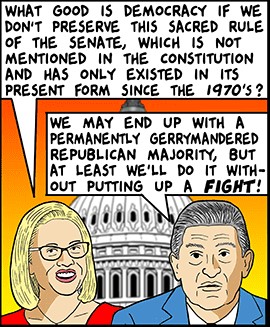
They also want to pass voting rights legislation to protect what’s left of American democracy. They can’t use the budget reconciliation process for voting rights, so they need a different way to get around a Republican filibuster. The only way to do that is for the 50 Democrats (and VP Harris) to change Senate rules to make voting rights legislation an exception to the filibuster (in the same way judges and tax cuts are exceptions). But one or two Democratic senators still won’t provide the 49th and 50th vote the Democrats need. 

From today’s Crooked Media “What a Day” newsletter:

With Sens. Joe Manchin (D-WV) and Kyrsten Sinema (D-AZ) blocking passage of the Build Back Better Act, Senate Democrats have gamely pivoted to the voting-rights legislation also blocked by Manchin and Sinema. Get in, loser, we’re going nowhere in a different direction! 

  • Final negotiations on the reconciliation package appear to have ground to a halt, as Manchin’s objections to temporary programs (including the temporary child-tax-credit extension) and overall price tag thwart Senate Majority Leader Chuck Schumer’s plan to get it passed by Christmas. The final monthly payment authorized under the current expanded child tax credit went out on Wednesday; Congress would need to extend the program by December 28 to keep the payments on track in January. 
  • Anxious to get something done, some Senate Democrats have announced a new push to pass their elections bill, despite still needing unanimous agreement on changing filibuster rules to do so. Schumer said on Thursday that he hopes to get voting legislation passed “in time for the 2022 elections,” tacitly acknowledging that there’s no way a bill makes it to President Biden’s desk before the end of the year. 
  • On the one hand, Sen. Raphael Warnock (D-GA) made a terrific point on the Senate floor this week, after lawmakers approved a filibuster [exception] to raise the debt ceiling: “I believe that it is misplaced to change the Senate rules only for the benefit of the economy when the warning lights on our democracy are flashing at the same time. I happen to believe that our democracy is at least as important as the economy.” Hard to fault that logic!

On the other hand, there’s no indication that Manchin and Sinema have come around to the rule changes necessary to pass the bills they say they support. 

  • Manchin indicated on Tuesday that he’s still not open to reforming the filibuster to pass voting-rights legislation unless there are Republican votes to do so, to the gleeful cackles of Republicans everywhere. A Sinema spokesperson ruined everyone’s holidays by announcing Wednesday that she “continues to support the Senate’s 60-vote threshold,” though Democrats are discussing narrow filibuster reforms and not outright abolition, so it’s worth noting that Sinema’s office also called for “the Senate to publicly debate its rules, including the filibuster, so senators and all Americans can hear and fully consider such ideas, concerns, and consequences.” It’s not, like, a lot of hope, but at this point we’ll settle for vaguely hope-scented. 
  • Schumer may not have an obvious plan to get voting bills passed before the midterms, but he’s right to want to. Democrats may have owned themselves out of their House majority by refusing to gerrymander as aggressively as Republicans in the handful of states where they had the chance, in the absence of redistricting reforms. The decision of just five blue states—California, Colorado, New Jersey, Virginia, and Washington—to switch over to nonpartisan redistricting commissions will cost House Democrats 10-15 seats, according to trusted redistricting nerd Dave Wasserman. It’s entirely possible that Republicans will gain control with a smaller margin than that.

To quote Sen. Mazie Hirono (D-HI) this morning, “a 50-50 Senate sucks and we can’t get things done.” Rather than unconvincingly pretending otherwise until it’s time for another vacation, Senate Democrats might as well be clear about the fact that two of their members are abetting the GOP assault on democracy, and at some point make them go on the record about it.

America Is a Failed Democracy: A Primer (It’s Long But Essential)

. . . the American republic, originally designed to be a majoritarian representative democracy, has become minoritarian. Or more precisely, at every level of the current institutions of our representative democracy, we have rendered those institutions unrepresentative. This fact alone should be enough to lead aspiring democracies around the world to look elsewhere for models for how democracy might be made to work. 

Those are the words of Laurence Lessig, a Harvard law professor, writing for The New York Review of Books. If you want to understand the ways this country has failed at democracy, read what follows. The features of minority rule discussed below include gerrymandered state legislatures and congressional districts, vote suppression, political action committees, the Electoral College, the Supreme Court, the Senate and the filibuster:

What’s most striking about America’s understanding of our own democracy is our ability to see what’s just not there. We are not a model for the world to copy. The United States is instead a failed democratic state.

At every level, the institutions that the US has evolved for implementing our democracy betray the basic commitment of a representative democracy: that it be, at its core, fair and majoritarian. Instead, that commitment is now corrupted in America. And every aspiring democracy around the world should understand the specifics of that corruption—if only to avoid the same in its own land.


The corruption of our majoritarian representative democracy begins at the state legislatures. Because the Supreme Court has declared that partisan gerrymandering is beyond the ken of our Constitution, states have radically manipulated legislative districts. As Miriam Seifter . . . summarized in a recent article for the Columbia Law Review, “across the nation, the vast majority of states in recent memory have had legislatures controlled by either a clear or probable minority party.” Her work was based in part upon an extraordinary analysis published by the USC Schwarzenegger Institute, which found that after the 2018 election, close to 60 million Americans “live under minority rule in their US state legislatures.” The most egregious states in this mix are also among the most important in presidential elections. In Wisconsin, for example, the popular vote for Republicans in 2018 was 44.7 percent; but Republicans controlled 64.6 percent of the seats in the statehouse. Likewise, Republicans in Virginia won just 44.5 percent of the vote but received 51 percent of statehouse seats.

State legislatures, as Seifter characterizes them, are “the least majoritarian branch” of our representative democracy. Yet this fact is all but invisible to most Americans—including, as she evinces, justices on the Supreme Court. We are all outraged when the Electoral College selects a president who hasn’t won a plurality of votes, something it has done five times in its history. Why are we so sanguine about legislatures that are regularly controlled by the party that won fewer votes across the state?

These gerrymandered states then spread their minoritarian poison in two distinctive ways. First, they have taken up the most ambitious program of vote suppression since Jim Crow. Through a wide range of techniques, Republican state legislatures are making it selectively more difficult for presumptively Democratic voters to vote, by reducing the number of polling places in Democratic districts, by ending early voting or voting outside of ordinary working hours, by deploying biased ID requirements that selectively allow forms of identification commonly held by Republicans (gun club registration cards) while disallowing those held by likely Democratic voters (student cards), by understaffing polling places so voters must queue for hours to vote, and by many other creative techniques. In Georgia, the legislature has even made it a crime to give water to people waiting in line to vote. What possible legitimate state interest could that law serve?

These acts are often framed by their opponents in racial terms. That framing is a strategic mistake. I’m happy to stipulate that some who push these techniques of suppression may well be motivated by race—after all, many of the techniques were those of race discrimination before —though most would surely disavow any such thing. But every single person pushing these techniques of suppression is certainly motivated by politics. It is raw partisan power, driven to destroy the electoral prospects of the other party, that explains what is happening here. Before the United States Supreme Court, Justice Amy Coney Barrett asked lawyers from the Republican National Committee why they were opposing provisions enabling more people to vote. Because it “puts us at a competitive disadvantage,” the lawyer was untroubled to reply. How can it be permissible for the party in power nakedly to rig the system against its opponents?

The second way that minoritarian state legislatures spread their poison is by gerrymandering the United States House of Representatives. Partisan gerrymandering was first perfected in its modern “big data” form by Republicans in 2010, and the Democrats then spent the following decade trying to get the Supreme Court to put a stop to it. When the Court announced it would not, there was little left for the Democrats except good government initiatives, aiming at moving the redistricting process away from the most egregiously partisan influences. That did some good—until the 2020 election signaled to Republicans that their party faces virtual annihilation if the majority gets its say. The efforts to gerrymander for 2022 will therefore be the most sophisticated seen yet. Barring a legislative miracle to safeguard voting rights, by the next presidential election Republicans will have secured through gerrymandering the control of the House of Representatives, whether or not they succeed in winning more votes than Democrats. And if the plans of some extremists come to fruition, a critical mass of state legislatures will also have passed laws by then that give them the power to overturn the results of a popular presidential election in their states.

These two techniques of minoritarian rule—gerrymandering and partisan vote suppression—could have been resisted by the courts. Yet what’s striking about the United States Supreme Court is not only that it has done nothing to resist minoritarianism but also that its most significant recent interventions have only ratified perhaps the most egregious aspects of our minoritarian democracy: the influence of money in politics.


While most mature democracies have various techniques for minimizing the corrupting effect of money in politics, the US Supreme Court has embraced the most radical conception of campaign money-as-free speech of any comparable democracy. While the Court has upheld limitations on direct contributions to political campaigns, it has simultaneously held, in its infamous decision in Citizens United v. FEC (2010), that any limitation on independent spending violates the First Amendment. Lower courts have then read Citizens United to mean that any limits on contributions to independent political action committees would violate the First Amendment as well. These rulings together gave rise to the so-called Super PACs that now dominate political spending, and enable strategic coordination of influence that is more effective than spending alone. In 2020, for example, the ten top Super PACs accounted for 54 percent of outside spending.

What’s critical to recognize is that the real power of this money comes not from its effect in persuading voters. Its power comes instead from the dependence it creates within our political system. Candidates know they need the support of Super PACs, either to make the case for them or to defend them from others who would attack. That dependence produces enormous power in the Super PACs concentrated in the hands of a tiny number of very wealthy individuals (who are presumptively but not necessarily Americans). In a nation of hundreds of millions, a few hundred families now dominate political spending.

Here again, there is no shame. In June 2021, the political action committee (PAC) No Labels had a call with Senator Joe Manchin, Democrat of West Virginia, about legislative priorities in the balance of the year. On the call, the founders of the PAC emphasized the power their group had in Washington—not because of their ideas, but because of their money. The ultra-wealthy donors supporting No Labels were able to “hand out $50,000 checks,” its cofounder, Andrew Burskey, bragged. And those checks, he explained, represented the most valuable money in any political campaign. This was “hard” money, money given to candidates directly, which FEC rules allow the candidates to spend themselves. And then to prove just why that money was so valuable, Burskey offered the incredibly revealing picture of just why the economy of influence in Washington gave the ultra-wealthy so much power in Congress. As he explained:

[Most House members] are spending four hours on the telephone, dialing for dollars. And so what [a large contribution from donors] does—aside from sending the very strong message that there are folks who will have your back if you take tough votes that . . . may not be popular within your party—it also in real life frees them to do more work, because it’s spending less time raising those funds.

Burskey is remarking upon the obvious dependence that exists with our current system for campaign finance: the dependence of representatives on fundraising. Because of that dependence, particular kinds of funders—namely, large funders—are especially valuable. Large contributors give members two things at the same time: first, and obviously, money; but second, and even more critically, time. A $50,000 contribution gives members of Congress the chance to breathe, even as it naturally obliges them to [serve] the interests of the person who enabled that chance.


The legislative branch, of course, is not the only minoritarian institution within our republic. Because of the way states allocate Electoral College votes, the executive branch is effectively minoritarian, too. Not just in the most egregious way, when the candidate who wins fewer votes nonetheless becomes the president, but also, and more significantly, in the most regular way: because of the way states allocate their Electoral College votes, it is only a tiny fraction of American voters who actually matter to the ultimate result. All but two states give the winner of the popular vote in their state all of the electors from that state. This means that the only states that are actually contested in any presidential election are the “swing states,” at most a dozen or so of the fifty in the union. Those swing states represent a minority of America—less than 40 percent of the electorate depending on the election. That minority is in turn radically unrepresentative of America itself. The voters in the swing states are older and whiter. Their occupations are more traditional. For example, seven and a half times more people work in solar energy in America than mine coal, yet we never hear anything about solar energy industry workers as an important political bloc in a presidential campaign because those people live in non-swing states like Texas and California. Coal miners live in battleground states, so they become the central focus of the candidates running for president.

It is thus this tiny, unrepresentative minority that effectively selects the occupant of the Oval Office—making the president, as political scientists (such as Douglas Kriner and Andrew Reeves) have shown, especially responsive to this unrepresentative few. Federal spending is higher, all things being equal, in swing states over non-swing states, and regulators are particularly accommodating of swing states’ regulatory concerns. Does America tinker with steel tariffs or ethanol subsidies because either policy makes any sense? No. We live with these policy vagaries because their beneficiaries live in Pennsylvania and Iowa (both swing states).


And so, too, with the courts: if any institution within a representative democracy is supposed to be minoritarian, or at least, counter-majoritarian, courts are. That is true substantively, but it is not supposed to be true politically. Substantively, of course, courts are meant to uphold constitutional rights, regardless of popular majorities. My First Amendment right to speak should not depend upon whether my views are liked by a majority. But the institution of the judiciary is also populated through political action. And to the extent that those actors have power because of a minoritarian corruption of representative democracy, the courts they populate are likewise tainted by minoritarianism.

Consider the Supreme Court: the current bench is divided 6–3, with the majority dominated by extremely conservative justices. That division is in no sense representative of America. Two thirds of the US is certainly not “conservative.” And while the random nature of Supreme Court turnover can sometimes produce such unrepresentativeness, this Court was expressly constructed by Senate leaders who changed the norms of confirmation to effectively steal a Supreme Court seat. In February 2016, then Majority Leader Mitch McConnell declared, after Justice Scalia’s death, that it was “inappropriate” to confirm a nominee of President Barack Obama’s because it was an election year. But when Justice Ginsburg died just six weeks before an election, McConnell declared that it was perfectly appropriate to rush a nominee through the Senate before the 2020 election. In record time (for a modern appointment), Justice Amy Coney Barrett—certainly among the most conservative of the justices now seated on the Supreme Court—was confirmed by a Republican Senate.


Yet, without doubt, the most extreme institution of minoritarian democracy in America today is the United States Senate. Of course, that flaw was in a sense intended: the only way small states were going to agree to the new Constitution in 1787 was if the Constitution gave them extra power. That compromise enraged James Madison, but he could read the political writing on the wall and eventually became a defender of this counter-majoritarian compromise at the heart of our republic.

Even then, though, the minoritarianism built in to the Senate was muted in the first century after the Constitution’s signing. It was muted first because the differences in states’ populations were much smaller than they are today. The largest state in 1790 (Virginia) was thirteen times more populous than the smallest (Delaware). Today, the largest (California) is sixty-eight times more populous than the smallest (Wyoming). But it was muted second, and more fundamentally, because until this century the Senate did not regularly block the will of the majority of senators. The original Senate rules expressly protected the power of the majority, a simple majority, to vote on any bill whenever it wanted. It was only when Senator John C. Calhoun, the proslavery Democrat of South Carolina, began to muck about with those rules fifty years after the Constitution was ratified that the will of the majority was placed in jeopardy.

We miss this fact because the technique of this blocking has a name that has long been part of Senate lore: the filibuster. And given the tactic’s long pedigree, it is easy to imagine that what we are talking about today is the same as existed in the Senate for most of the institution’s history.

The reality is radically different.

The filibuster that existed for most of the Senate’s history was a device that simply slowed the consideration of legislation. It didn’t kill it. The one exception to that characterization was civil rights legislation: the only examples of laws being blocked by filibuster all the way through 1965 were anti-lynching laws, and laws to improve civil rights. For the rest, the filibuster simply delayed the debating and passage of legislation. And for that delaying tactic to operate, the Senators supporting the filibuster had to do real work: if a Senator was to filibuster a bill, he would have to stand on the floor of the Senate and speak, for many hours without a break. Strom Thurmond, Democrat of South Carolina, held the floor for twenty-four hours to hold up the 1957 Civil Rights Bill. That was not mere showmanship as House Minority Leader Kevin McCarthy’s recent eight-hour filibuster was. It was the only way that a filibuster could have any effect.

Today, however, the mechanism of the filibuster is radically different. All a senator must do to assure that a bill is filibustered is make a request to their party leader. That request—which can literally be by e-mail or text—then shifts the bill from being one that will pass if a simple majority supports it to being one that cannot even be debated unless a supermajority of sixty senators supports it.

The effect of the old filibuster was to keep a bill on the floor of the Senate as the filibusterers were debating. That allowed their dissent to be better understood, if not in the Senate, then at least by the public. The effect of the new filibuster is exactly the opposite: its effect is to block any debate until a supermajority allows it. Thus, the For the People Act—a bill that would have reversed much of the state suppression of the vote, ended partisan gerrymandering, and changed fundamentally the way campaigns are funded—has been blocked from debate on the floor of the Senate now twice, even though a majority would vote to allow that debate to occur. This modern filibuster thus doesn’t enable debate or understanding. The modern filibuster is just a gag rule on any legislation a minority does not like.

Even this description, however, masks the real corruption in the system. The norms that limited the filibuster to important issues are gone. Both parties killed those conventions over the past twenty years, the Republicans more aggressively than the Democrats. The filibuster has now become a routine hurdle that any significant legislation must clear. What that means is that we have now introduced a procedural requirement into the passage of legislation that makes the process more institutionally minoritarian than that of any legislature in any comparable representative democracy. Senators from the twenty-one smallest and most conservative states, representing just 21 percent of America, now have the power to block any non-budget legislation.

This filibuster lock alone—setting aside all the gerrymandering in the states, the gerrymandering of Congress, the suppression of the vote in elections, the Electoral College, the corrupting dependence of money—would be enough to categorize America as a “minoritarian democracy.” Like segregationist or sectarian regimes such as South Africa under apartheid, or the Sunni rule of Baathist Iraq, or Syria under the Alawi, the American republic, originally designed to be a majoritarian representative democracy, has become minoritarian. Or more precisely, at every level of the current institutions of our representative democracy, we have rendered those institutions unrepresentative. This fact alone should be enough to lead aspiring democracies around the world to look elsewhere for models for how democracy might be made to work. Our only lesson for these democracies is the consequence of our own failure.


In 1997, after he had surprised the world by winning reelection decisively, Bill Clinton convened a small dinner with the top donors to the Democratic Party at the Mayflower Hotel in Washington, D.C. What should he do in his second term? What did they think he could achieve? It was a moment of great hope and possibility—nine months before the revelations of a White House intern would deflect the administration from achieving anything of significance.

As the story is told, about thirty of America’s super-wealthy sat around a table. The president asked each in turn to give him their views. One by one, they rose to speak. The last to rise was a businessman, the founder of Stride Rite Shoes, and the second-largest contributor to the Democrats in 1996. As he stood up, few had any sense of what he would say. When he sat down, few could believe he’d actually said what he did say.

“Mr. President,” Arnold Hiatt began, “I know you’re an admirer of Franklin Delano Roosevelt. So I want you to put yourself in FDR’s shoes in 1940—the year when Roosevelt realized that he was going to have to convince a reluctant nation to wage a war to save democracy. Because that, Mr. President, is precisely what you need to do now—to convince a reluctant nation to wage a war to save democracy.” That would not, of course, be a war against fascists. It would be a fight against fat cats—people like Hiatt, rich people, and people who believed (unlike Hiatt) that just because they are rich, they’re entitled to dinner with the president at the Mayflower. Hiatt was challenging the president to recognize that “current campaign finance practices are threatening this nation in a different, but no less serious way,” he said. . . . There was silence when Hiatt finished. No doubt, some were uncomfortable. . . .

At the time Hiatt spoke, Citizens United was still more than a dozen years in the future. We had not yet seen the pathological gerrymandering of 2010. Few could have imagined the open efforts by partisans in state legislatures to suppress the votes of their political opponents. Not a single Republican in any state legislature was then considering legislation to allow state legislatures to override the popular vote for president. And though the filibuster had been deployed beyond the domain of civil rights by then, it would be nine years before the architect of the modern filibuster, Mitch McConnell, would be elected to lead his party in the United States Senate. And no one—literally, no one—could have imagined an event like January 6 taking place in the United States of America. From our perspective today, Hiatt spoke at a time of relative health in the American democracy. And yet to him, and to many others then—including an eighty-eight-year-old woman who, nine months later, would begin a 3,000-mile walk across the country with the words “campaign finance reform” emblazoned across her chest—the corruption of money was already reason enough to “wage a war to save democracy.”


Today, we confront a Republican Party that has effectively declared war on majoritarian democracy. At every level, the leadership of that party challenges the fundamental idea of majority rule. Rather than adjust their policies to appeal to a true majority of Americans, Republicans have embraced the minoritarian strategy of entrenching what has become, in effect, a partisan, quasi-ethnic group against any possible democratic challenge. They rig the system so the majority cannot rule.

In the face of this threat, what America needs is what Hiatt said FDR had been: a leader who could “convince a reluctant nation to wage a war to save democracy.” Or maybe better, what America needs is a leader like Winston Churchill, who could convince a distracted nation that there is a fundamental threat to our democracy that we must now wage war to save.

Yet we don’t have a Churchill leading this fight. We have a Chamberlain. Rather than name the threat, and rally America against it, President Biden has been keen to negotiate the differences in conciliatory fashion—as if the modern filibuster were not a fundamental threat to democracy and as if the fight against majoritarianism were not a threat either. Biden has been eager to engage in a bizarre nostalgia, recalling a golden age when white men from different parties somehow got along, rather than recognizing that American democracy has never faced a threat like one—even if this is precisely the political reality that Black Americans have known for all of the country’s history.

There was real hope this year for effective action to address this corruption of democracy. Every single major candidate for president in the Democratic Party in 2020 (with the exception of Kamala Harris) had committed to making the For the People Act a top priority in the first hundred days; some had promised even more. Speaker Nancy Pelosi maintained that momentum and passed the act in the House. And after she succeeded in the House, Majority Leader Chuck Schumer committed to getting the Senate to do the same.

Standing in the way, however, was the filibuster.

For most of this year, President Biden defended the filibuster and stood practically silent on this critical reform. He has focused not on the crumbling critical infrastructure of American democracy, but on the benefits of better bridges and faster Internet. Democratic progressives in Congress were little better on this question. Although Alexandria Ocasio-Cortez, Bernie Sanders, and Elizabeth Warren all supported the For the People Act, in the public eye the issues they’ve championed have overlooked the country’s broken democratic machinery: forgive student debt, raise the minimum wage, give us a Green New Deal…. As a progressive myself, I love all these ideas, but none of them are possible unless we end the corruption that has destroyed this democracy. None of them will happen until we fix democracy first.

It may well be that nothing could have been done this year. It may well be true that nothing Biden could say or do would move Senators Joe Manchin and Krysten Sinema, the two who are apparently blocking reform just now. Yet we have to frame the stakes accurately and clearly: if we do not confront those imperfections in our democracy, openly and transparently, we will lose this democracy. . . . [i.e. what’s left of it].
Good News, Yes, Good News

There might be good news coming from Washington. The obvious good news should be the passage of the Build Back Better Act in some form or other. Last month, Reuters used seven categories to summarize what’s in the bill (the details of which are all subject to change):

  1. Climate
  2. Education
  3. Family Benefits
  4. Healthcare
  5. Housing
  6. Immigration
  7. Taxes
  8. Other

Its passage after months of negotiation between the best and worst Democrats in Congress will be a very good thing (Republicans are opposed to progress and fairness so will all vote against it).

Meanwhile, Senate Democrats are working on changes to the filibuster. That would allow them to pass some kind of voting rights legislation over the usual Republican opposition. From Politico:

The latest attempt is taking place among a group of Senate Democrats who have gone back to the drawing board. Rather than the draconian step of tossing out the filibuster, they’re debating other possible rule changes to the chamber that could pave the way for election reform bills that are viewed by Democrats as paramount to combatting restrictive new voting laws and preserving democracy.

Sen. Tim Kaine (D-Va.), who is a member of the group drafting the reforms, said it would be “premature” to share specifics of the possible rule changes at this stage because “there’s no handshake deal yet.” But he did express a level of cautious optimism, stressing that abolishing the filibuster, which requires 60 Senate votes to advance legislation, is not under consideration this time.

“We’re not going to abolish the filibuster. Joe Manchin (D-W.Va.) has made [it] very plain we’re not abolishing the filibuster,” Kaine said in an interview. “We’re looking at a number of complaints that Democrats and Republicans have had about the way the place operates to see if we can restore it to operating better and do it in a way that would facilitate passage of voting rights.”

Kaine said the group is “analyzing potential rule reforms” by “putting the shoe on the other foot” and asking “If we’re in the minority, how would we feel about this? Can we live under this? Would this make the Senate work better for either party under a president of either party?”

The latest conversations come after four failed attempts by Democrats to pass voting or election reform bills in the Senate due to a [Republican] blockade. The hope within the party is that once President Joe Biden’s social spending plan is passed, they can prioritize voting rights and present a pathway to get it through the Senate. . . . 

The effort is expected to come to a head as early as January, according to multiple senators involved. . . . 

Ideas being floated . . . include changes to the amendment process and how the Senate debates legislation and nominations. . . . Other options raised by Democrats — and Manchin himself — include a standing filibuster which would require senators to continue debating on the floor rather than needing 60 votes to end debate on a bill. . . . 

Biden has urged Congress to pass legislation that expands ballot access, ends partisan gerrymandering and would restore the pre-clearance authority of the 1965 Voting Rights Act gutted by the Supreme Court. . . . Biden has characterized the moment as an inflection point that poses the “most significant test of our democracy since the Civil War”, as civil rights advocates press the administration to match the president’s rhetoric with urgent action . . .

For months, Democrats have repeatedly run into a brick wall as every GOP senator but one has refused to offer votes for even a restoration of key sections of the Voting Rights Act, a reform Democrats see as a modest step. Republicans have voted for such reauthorizations in the past but their opposition has led an increasing number of Democrats to either endorse a carveout to the filibuster, if not an outright elimination. . .

But Democrats will need buy-in from Manchin and Sen. Kyrsten Sinema (D-Ariz.) — who both oppose nixing the legislative filibuster — if they want to change the chambers’ rules. . . .

Tester said Tuesday that he thinks Manchin and Sinema are “absolutely” open to some of the changes being considered. . . .

Unquote.

On another front, the five most reactionary Republicans on the Supreme Court decided it’s fine to let states ignore the Supreme Court and the Constitution. This is how Chief Justice Roberts, the least reactionary Republican, described the majority’s ruling on Texas’s anti-abortion bounty hunter law:

The clear purpose and actual effect of [the Texas law] has been to nullify this Court’s rulings. It is, however, a basic principle that the Constitution is the “fundamental and paramount law of the nation,” and “[i]t is emphatically the province and duty of the judicial department to say what the law is.” Marbury v. Madison (1803). Indeed, “[i]f the legislatures of the several states may, at will, annul the judgments of the courts of the United States, and destroy the rights acquired under those judgments, the constitution itself becomes a solemn mockery.” United States v. Peters (1809). The nature of the federal right infringed does not matter; it is the role of the Supreme Court in our constitutional system that is at stake.

Justice Sonia Sotomayor wrote:

The Court should have put an end to this madness months ago, before [the law] first went into effect. It failed to do so then, and it fails again today. . . . The Court thus betrays not only the citizens of Texas, but also our constitutional system of government.

Given that a Supreme Court majority has gone renegade, reform is clearly necessary. A former federal judge and a law professor published a column in The Washington Post explaining why they now favor a major change:

We now believe that Congress must expand the size of the Supreme Court and do so as soon as possible. We did not come to this conclusion lightly. . . . We started out leaning toward term limits for Supreme Court justices but against court expansion and ended up doubtful about term limits but in favor of expanding the size of the court. . . . 

Sadly, we no longer have [confidence in the Court], given three things: first, the dubious legitimacy of the way some justices were appointed; second, what Justice Sonia Sotomayor rightly called the “stench” of politics hovering over this court’s deliberations about the most contentious issues; and third, the anti-democratic, anti-egalitarian direction of this court’s decisions about matters such as voting rights, gerrymandering and the corrupting effects of dark money.

Those judicial decisions haven’t been just wrong; they put the court — and, more important, our entire system of government — on a one-way trip from a defective but still hopeful democracy toward a system in which the few corruptly govern the many, something between autocracy and oligarchy. Instead of serving as a guardrail against going over that cliff, our Supreme Court has become an all-too-willing accomplice in that disaster . . . [We cannot look] other way when the court seeks to undo decades of precedent relied on by half the population to shape their lives just because, given the new majority, it has the votes.

Unquote.

Republicans go too far when they have power. Their overreach invites a Democratic response. Perhaps they’ve done it this time as well. I sure hope so.

Midnight Is Approaching: We Can Have Either the Filibuster or Democracy

Last month, Republican senators refused to allow a vote on the Freedom To Vote Act. Because of the Senate’s filibuster rule, the fifty Democratic senators needed ten of their Republican colleagues to join them in allowing the bill to come up for a vote. But not one Republican voted with the Democrats (the Democratic majority leader changed his vote to No so the bill can be given another chance). Here’s why Republicans oppose the bill. The Freedom To Vote Act would:

  • Expand voter registration (e.g., automatic and same-day registration) and voting access (e.g., vote-by-mail and early voting) and limit removing voters from voter rolls.
  • Establish Election Day as a federal holiday.
  • Allow ex-felons to vote. 
  • Make it illegal to interfere with another person’s ability to register and vote.
  • Require states to follow new rules for post-election audits and congressional redistricting.
  • Expand the prohibition on campaign spending by foreign nationals and require additional disclosure of campaign-related fundraising and spending.

No wonder every single Republican senator refused to allow the bill to be considered. They’re opposed to the idea of majority rule.

In support of the bill’s passage, however, more than 150 academics, experts in subjects like political science, history and public policy, have released this statement:

We, the undersigned, are scholars of democracy writing in support of the Freedom to Vote Act, the most important piece of legislation to defend and strengthen American democracy since the Voting Rights Act of 1965. This bill would protect our elections from interference, partisan gerrymandering, dark money, and voter suppression. We urge all members of Congress to pass the bill, if necessary by suspending the Senate filibuster rule and using a simple majority vote.

This is no ordinary moment in the course of our democracy. It is a moment of great peril and risk.

Though disputes over the legitimacy of America’s elections have been growing for two decades, they have taken a catastrophic turn since the 2020 election. The “Big Lie” of a stolen election is now widely accepted among Republican voters, and support for it has become a litmus test for Republicans running for public office. Republican state legislatures in Georgia, Florida, Texas, and across the country have enacted partisan laws intended to make it harder for Democrats to win elections. Most alarmingly, these laws have forged legal pathways for partisan politicians to overturn state election results if they are dissatisfied with the outcome.

The partisan politicization of what has long been trustworthy, non-partisan administration of elections represents a clear and present threat to the future of electoral democracy in the United States. The history of other crisis-ridden democracies tells us this threat cannot be wished away. It must be promptly and forthrightly confronted. Failure to pass the Freedom to Vote Act would heighten post-election disputes, weaken government legitimacy, and damage America’s international reputation as a beacon of democracy in the world.

Each branch of government has a role to play in protecting free and fair elections, but Congress’s responsibility looms largest. After the Civil War, when the path of American democracy was highly uncertain, Congress built the foundations of our modern democracy by passing two constitutional amendments and five pieces of legislation to protect the right of African Americans to vote. All were passed on party-line votes. But in 1890, the Senate failed to break a filibuster on a sixth piece of legislation: the Federal Elections Bill (also known as the Lodge Bill), which would have pushed back against voting rights violations in the South.

The upshot of that critical vote was that southern states, in the absence of any federal supervision, were allowed to pursue the wholesale disenfranchisement of African Americans for the next 75 years. By a tiny margin in one branch of Congress, American democracy took a giant leap backwards.

Protecting future elections from subversion, providing equal opportunities for all citizens to participate, drawing fair district boundaries, strengthening transparency over money in politics, and facilitating impartial electoral administration should not be partisan matters. Unfortunately, however, across state legislatures, Republicans have challenged the legitimacy of the 2020 U.S. presidential election and altered election rules on party-line votes, with a clear intent to entrench minority rule.

If Congress fails to pass the Freedom to Vote Act, American democracy will be at critical risk. Not only could this failure undermine the minimum condition for electoral democracy—free and fair elections—but it would in turn likely result in an extended period of minority rule, which a majority of the country would reject as undemocratic and illegitimate. This would have grave consequences not only for our democracy, but for political order, economic prosperity, and the national security of the United States as well.

Defenders of democracy in America still have a slim window of opportunity to act. But time is ticking away, and midnight is approaching. To lose our democracy but preserve the filibuster in its current form—in which a minority can block popular legislation without even having to hold the floor—would be a short-sighted mistake of historic proportions. The remarkable history of the American system of government is replete with critical, generational moments in which liberal democracy itself was under threat, and Congress asserted its central leadership role in proving that a system of free and fair elections can work.

We urge the Senate to suspend the filibuster rule for this measure and pass the Freedom to Vote Act. This would uphold the Senate’s noblest tradition of preserving and strengthening American democracy.

Unquote.

At least two Democratic senators, Sinema of Arizona and Manchin of West Virginia, have opposed reforming the filibuster in order to protect voting rights. Tom Tomorrow of This Modern World nicely captures the “logic” of their position:

TMW2021-11-24color

If you’d like to share your views on this matter (in a nice way) with Senator Sinema, you can contact her even if you don’t live in Arizona. Likewise, you can contact Senator Manchin even if you don’t live in West Virginia. Maybe they care enough about democracy to see reason.

Keeping Yesterday’s Election in Perspective

A recent opinion poll suggested the Democratic governor of New Jersey, Phil Murphy, would easily win yesterday’s off-year election. But instead of winning 55% to 45%, as the poll indicated, it looks like he’ll win 50% to 49%. Why? Because all kinds of people answer opinion polls, but it’s the angry ones who tend to vote in low turnout elections. And who is angriest today (although their anger isn’t justified)?

Paul Waldman of The Washington Post explains and offers some advice to Biden and congressional Democrats:

One of the most pervasive biases among the political media is the bias toward dramatization, interpreting every event as startling, extraordinary, and signaling a reshaped political landscape.

That is how many are interpreting the results of Tuesday’s elections, especially Glenn Youngkin’s win in the Virginia gubernatorial race. The truth is more mundane — but its implications for how Democrats should think about their future are no less profound.

Let’s begin with the context in which these elections took place. First and most important, there’s a Democrat in the White House. It is impossible to overstate how that one simple fact puts Democrats in a position to lose and lose big, not just in this election but in next year’s midterms as well.

Here’s what happens when a president gets elected: He tries to do a bunch of things, some of them work out and some of them don’t, but nobody’s life is really transformed, at least in the short term. Meanwhile, the opposition party’s voters are utterly enraged by the mere fact that someone they hate is now running the country.

So at the first opportunity (and probably the second and the third), those opposition voters rush to the polls, while voters from the president’s party are not nearly so motivated.

Now add in the fact that we’re still in a pandemic, the delta variant has slowed the recovery, supply chain problems are producing inflation, and President Biden’s approval ratings are in the low 40s.

Given all that, it would have been absolutely stunning if Democrats hadn’t gotten their clocks cleaned in these elections, just as Republicans did in 2017 after D____ T____’s election and Democrats did in 2009 after Barack Obama’s election. The president’s party lost both the Virginia and New Jersey governor’s races in those years as well. Yes, the particulars of a campaign can make a difference at the margins — Republicans certainly waged a skillful if repugnant campaign in Virginia — but the basic pattern will hold.

Plenty of people will now tell you that a different strategy or a clever bit of rhetorical jujitsu could have changed the outcome in these races, and the fact that both were so close makes it at least possible, if unlikely. But here’s the reality for 2022: Only something truly earthshaking will prevent the almost inevitable outcome of Democrats losing the House and probably the Senate as well.

There were only two times in recent decades that the president’s party didn’t suffer significant losses in the midterms. The first was 1998, a year dominated by the Republican impeachment of Bill Clinton, which led to its own backlash against Republicans. Approval of the GOP plunged to depths only matched when they shut down the government five years later.

The second was 2002. Amid the aftermath of Sept. 11 the atmosphere of fear and panic reigned; President Bush’s approval ratings were in the 60s, and Republicans successfully argued that Democrats were terrorist-loving traitors who wanted Americans to die.

Could something that momentous happen in the next twelve months to turn the situation in Democrats’ favor, either defusing Republican anger or elevating Democratic anger to the point where more Democrats turn out than Republicans? It’s always possible.

But ordinary good news — the passage of important bills, the fading of the pandemic, a strong economic rebound — probably won’t be enough. All that would produce a situation in which Democratic voters say, “Things are going pretty well,” and Republican voters say, “I am enraged!”, if only because a Democrat is still president and Democrats still control Congress.

So when Democrats are told that they must pass the Build Back Better bill or some other piece of legislation to have any chance of holding the House and Senate, it isn’t exactly right. If they don’t pass worthwhile bills they’ll certainly lose, since their own supporters will see them as weak and ineffectual. But even if they do pass the bills, it [very likely!] won’t be enough.

So they have to widen their view beyond 2022. Accept that they have one more year to legislate, and ask: What can we accomplish in that time? How many people can we help? How much can we improve the basic conditions in which Americans lead their lives? How much progress can we make on our agenda, not because we think there will be short-term political dividends but because it’s the reason we got into politics in the first place. Or at least it should have been.

It’s not that there will be no political ramifications to what they do and don’t accomplish now. But many of them will take years to play out. For example, passing the Affordable Care Act only exacerbated the struggles they had in the 2010 midterms, since it became a focus of Republican anger and mobilization. But eventually it became a political advantage; eight years later, voters punished Republicans for trying to repeal it.

More importantly, imperfect though it was, the ACA helped enormous numbers of people. It eliminated the nightmare of being denied health coverage because of preexisting conditions, and gave millions of Americans insurance for the first time. It was an extraordinary achievement.

So Democrats should ask themselves: What can we do now that we’ll proudly tell our grandchildren about years from now? If we really only have a year to make a difference, what are we going to do with that time?

Unquote.

It’s highly likely the Democrats will lose the House of Representatives in 2022, since they have such a small majority today and House races are affected by gerrymandering, which Republicans are real good at. But the outlook for the Senate isn’t so bad. Democrats will be defending 14 seats, while Republicans will be defending 20, and 5 Republican senators have already announced they’re retiring. Democrats could conceivably pick up seats in Pennsylvania, North Carolina and Wisconsin, even if they’re likely to lose in Georgia. Gaining one seat would make either Manchin or Sinema less important. Gaining two would make both of them less important.