The Song of the South

What is it that makes the American South so special? A journalist named Hamilton Nolan answers that and other questions at How Things Work, where he writes about labor, politics and power.

Since the Covid pandemic struck in 2020, more than two million peopleĀ have migratedĀ to the six fastest growing states in the South, bringing with them $100 billion in new income. This population shift is held up by Southern governors as proof of the success of their policies—and as a herald of an ongoing shift in the balance of economic power that is bound to continue due to the South’s inherent advantages. What spurred this grand relocation? Traditional wisdom will tell you that it was the more relaxed and open posture of Southern states like Florida during the Covid pandemic, along with the perpetual allures of warmer weather, lower taxes, and more affordable housing prices.

In reality, though, this current sloshing of America towards its drain is not the start of anything new at all. It is spurred not by any new economic paradigm, nor by any Texan or Floridian governor’s new ideas about unleashing the power of free enterprise under the nation’s sunniest skies. It is, instead, a normal reaction to a … rise in the appeal of something that the South has been offering for more than 200 years. Politicians will tell you that the South is attractive because it offers greater freedom. Actually, it offers cannibalism: it is willing to kill and eat its own to fuel a marginal improvement in your lifestyle. Don’t let this deal pass you by!

Ron Desantis is running (unsuccessfully) for president on the premise that he can do for America what he has done for Florida in the past three years. One way to look at his record during those crucial Covid years is: he kept stuff open and got rid of pandemic restrictions, which caused the Florida economy to flourish. Another, more accurate way to look at it is: he kept stuff open and got rid of pandemic restrictions because he fundamentally does not care whether his citizens live or die, as long as his state could get a temporary economic boost that he could use for self-promotional purposes.Ā In this, Desantis was the perfect combination of the classic Southern socioeconomic strategy with a global pandemic.

Ever since being forced to give up formal slavery at gunpoint, the South has pursued a formula of attraction only one step removed from it. The region’s offer to businesses and wealthy people in the rest of America is, and has always been, this: ā€œCome to the South. Do whatever you want. We won’t regulate you. We won’t tax you. We’ll crush any unions that dare to come here. We’ll provide a pool of dirt-cheap labor for you. Because we don’t tax you, our public services will be awful. Our public schools will be inadequate. But don’t worry, because we will build graceful private schools for the people with money, and we will build private country clubs and gated communities to shield you from the poverty, and racist cops to police the borders of the neighborhoods, and you can live here in a private island of bliss. The inadequacy of our public services and our outright racial oppression guarantee that that cheap labor force will continue forever. You can profit from that cheap labor force without ever having to interact with the people who compose it, except as various forms of servants. The oppression, sequestered away from you and walled off from impacting your life except to enhance it, is what makes the system work.ā€

That’s it. That’s the South’s sales pitch. It is the poorest and most backwards region of America by traditional socioeconomic measurements, but it’s great place to be when you exclude all of the poor people from your measurements. Which they do, because ā€œnot caring about all the poor peopleā€ is the key to the South’s ability to imagine itself as a place with a political system that works. This is the slavery mentality dragged cleanly into the present day, modified just enough to fit the letter of the law.

In the plantation era, the South was great, as long as you were a plantation owner. If you add all the slaves (and poor whites) into the calculation… ugh, you mess up the numbers. Despite the fact that the South’s failure to industrialize properly due to slavery was one of the things that lost it the Civil War, the region remains stubbornly addicted to cheap labor today. It is, at heart, an inferiority complex. The South’s leaders don’t really believe that they have anything to offer to lure people in other than a work force that will show up for rock bottom wages. If the South really believed in itself, it would be busily investing in public education and health care and a strong social safety net and all the other things that build a healthy and thriving society that ultimately attracts people and businesses. Instead, they do the opposite—because empowering the existing residents of the South would undermine its cheap labor pool.

When you see Southern governors doing seemingly irrational things like rejecting federal government Medicaid funding for their state’s residents, you must understand that the people who would be helped by that funding simply do not count in the minds of those states’ leaders. Their states are modern plantations, and they calculate the success of their governance based on the living standards of the plantation owners, not the workers. Even worse, doing things that help the workers live better could harm the project of maintaining a maximally desperate labor pool. The South doesn’t want their entire population to be healthy and well-educated. They want white people and business owners to be healthy, thanks to private doctors, and well-educated, due to private schools, and to have access to a limitless low-wage work force that, thanks to the failure of the state to invest in their welfare, has no choice but to acquiesce to being exploited. The more desperate they are, the better.

When you see Texas Republicans eliminate laws that grant workers water breaks, that is not some momentary outbreak of callousness; that is the point. …

Embracing the South’s toxic sales pitch pollutes the soul. ā€œI am moving to Florida because the total lack of public health measures is nice and easy for me, as a rich person, even though I know it will cost a calculable number of Floridians their lives.ā€ You are a bad person. ā€œI am moving to Texas to save on my personal income taxes, even though I know that the cost of that is poor schools and oppression for vast swaths of this state’s neediest residents.ā€ You are a bad person. ā€œI am relocating my company’s factory to South Carolina because labor costs there are lower, even though I know that those low wages are a result of systematic oppression and union-busting designed to keep millions of poor people powerless over their own lives.ā€ You are a bad person.

The bliss of ignorance is a critical part of this whole process. Move only between your air conditioned home on a golf course and your air conditioned office and your kids’ private school and the nice strip malls around your nice neighborhood and don’t ask any questions of the people who build the houses and serve the food and fill the factories and it is possible to cling to the illusion that this whole system works. But as soon as you begin to think about the aggregate welfare of everyone in the South—as soon as you place an equal value on the lives of the poor—it becomes devastatingly clear that all the nice enticements that tempted you down here require you to stand, at all times, on the necks of your fellow citizens. If you know that and continue to tolerate it, the South has poisoned you.

Unquote.

“The South has poisoned you”. It’s also how the South has poisoned American politics since the 18th century.

A Selection of Stuff You’d Rather Not Read About

Four articles that made an impression this week, from least to most depressing, that didn’t even mention Jerusalem, Puerto Rico, healthcare or starving polar bears.

One hundred and eighty-seven people are facing felony charges for participating in a demonstration in Washington D.C. that turned violent. The demonstration was on the day Trump was inaugurated. A trial is now underway. The depressing aspect of this story is that none of the six defendants are accused of doing anything aside from being there:

What jurors haven’t heard, and prosecutors don’t intend to offer, is evidence that any of the six individuals currently on trial … actually engaged in any property damage or violence. Under the government’s theory of the case, in which anyone arrested in the group is part of a conspiracy and is responsible for any actions taken by others, the lack of individualized wrongdoing doesn’t matter.

Maybe the jury will have the sense to acquit everyone and convince the government to stop these prosecutions.

Elsewhere in Washington, Republicans from the House and Senate are trying to reconcile the terrible tax bills they’ve recently passed. Could any of them read this article from The New York Times and say they were proud of their efforts so far?

… for the first time since the United States adopted an income tax, a higher rate would be applied to employee wages and salaries than to income earned by proprietors, partnerships and closely held corporations….

ā€œWe’ve never had a tax system where wage earners were substantially penalizedā€ relative to other types of income earners, said … a former Treasury Department official….

Indeed, economists and tax experts across the political spectrum warn that the proposed system would invite tax avoidance. The more the tax code distinguishes among types of earnings, personal characteristics or economic activities, the greater the incentive to label income artificially, restructure or switch categories in a hunt for lower rates….

ā€œThe more you look at any of the major rules, the more ambiguities, glitches, clearly unintended consequences and tax planning opportunities you see,ā€ said Michael L. Schler, a lawyer in the tax department of Cravath, Swaine & Moore. He has written a 50-page summary of the more glaring problems …

From Georgia Southern University, a professor named Jared Yates Sexton, who grew up in the South, writes about the fascism that runs in his family.

Eventually I left for college and found my own people who didn’t express such fascist and ignorant beliefs. I visited for the occasional holiday, kept in decent enough touch, but I felt confident knowing that people like my family would never be in charge of the country they understood so poorly….

They hoard weapons, supplies, and daydream about the day the government will fall and they’ll be free to remake the country as they see fit.

I cannot say they are fascists, but I can definitely say they hold fascist ideas. This is why they hardly blink when Donald Trump quickly erodes the normal order of the government, why they’re not concerned when he undermines the Freedom of the Press or cozies up to authoritarian leaders. They love it when he tells policemen to be rough on suspects. They want someone who plays nuclear chicken with a despot while the lives of hundreds of million innocent people lie in the balance.

Finally, speaking of nuclear chicken, Jeffrey Lewis, a “scholar at the Middlebury Institute of International Studies”, shares some really scary thoughts in The Washington Post. He imagines how a confrontation between North and South Korea might escalate, helped along by a morning tweet from the president, into nuclear war.

And so, facing what he believed was a massive American military invasion, Kim gave the order. The thread of history winds along on twists of fate, like Archduke Ferdinand’s driver missing a turn…

The U.S. Missile Defense Agency would later say this was a sign that the system had worked well, downing about a third of the missiles — although experts would argue that the low intercept rate resulted from problems that the Los Angeles TimesĀ had reported in 2017…. It seemed more likely, the experts said, that five of the missiles had simply broken up as they reentered the earth’s atmosphere.

The remaining seven nuclear warheads landed in the United States. These missiles were no more accurate than the others — but with 200-kiloton warheads, 10 times the power of the bomb that destroyed Hiroshima, close was enough to count in most cases.

I told you so.

South and West: From a Notebook by Joan Didion

Most of South and West is composed of notes Joan Didion took during a month-long road trip through Louisiana, Mississippi and Alabama in 1970. She intended to publish something about the trip after returning to California, but didn’t. Now selections of her notes have been published.Ā She’s such a good writer that her impressions are worth reading, butĀ I can see why she didn’t finish the project.Ā 

She hated the place.Ā 

I’ve read a few reviews of this book but none of them conveyed her intensely negative feelings about the landscape, the weather and the culture she encountered along the Gulf Coast and in the Deep South. It’s a region she’d never been to. She makes it feel like a unpleasant foreign country that she couldn’t wait to escape. She even claims that she and her husband avoided big cities because if they’d been near an airport, they would have immediately flown to California or New York.Ā If you don’t think much of the South, this book will confirm your attitude, even though the its word were written almost 50 years ago.

The book concludes with a small selection of notes from another project she didn’t complete. She had agreed to write about the Patty Hearst trial in 1976:Ā 

I thought the trial had some meaning for me – because I was from California. This didn’t turn out to be true.

I enjoyed this part of the book too. It’s mostly random thoughts and memories about growing up as a privileged young woman in Sacramento, mixed in with some thoughts about San Francisco, where the Hearst trial took place. Having grown up in California, I like reading about it and nobody writes better about California than Joan Didion.

It’s Been With Us For Years, But Gotten Worse

The historian Richard Hofstadter (1916-1970) is known outside academic circles for having written a particularĀ book and a particularĀ essay. The book wasĀ Anti-intellectualism in American Life from 1963. The essay was “The Paranoid Style in American Politics” from 1964.Ā I read the essay a few days ago in a collection of Hofstadter’s work. Anyone who wants to understand how we got to this point in American history will benefit from reading Richard Hofstadter.

He explains, for example, the basis for “economic individualism”, the idea thatĀ it’s not only more efficient but more ethical thatĀ everyone should sink or swim on their own. Thus, poor or working-class conservatives are often against anyone receiving help from the government, even though they could use that help themselves:

On many occasions they approach economic issues as matters of faith and morals rather than matters of fact. For example, people often oppose certain economic policies not because they have been or would be economically hurt by such policies, or even because they have carefully calculated views about their economical efficacy, but because they disapprove on moral grounds of the assumptions on which they think the policies rest….Deficit spending might work to their advantage; but the moral Ā and psychological effect, which is what they can really understand and feel, is quite otherwise: when society adopts a policy of deficit spending, thrifty [conservatives] feel that their way of life has been officially and insultingly repudiated [“Pseudo-Conservatism Revisited – 1965”].

Hofstadter borrowed the termĀ “pseudo-conservative” from the German thinker Theodore Adorno. He explained why in an earlier essay written in response to McCarthyism:

There is a dynamic of dissent in America today…The new dissent is based upon a relentless demand for conformity… Its exponents, although they believe themselves to be conservatives and usually employ the rhetoric of conservatism, show signs of a serious and restless dissatisfaction with American life, traditions and institutions. They have little in common with the temperate and compromising spirit of true conservatism in the classical sense of the word…Their political reactions express rather a profound … hatred of our society and its ways – a hatred which one would hesitate to impute to them if one did not have suggestive evidence from clinical techniques and from their own modes of expressionĀ [From “The Pseudo-Conservative Revolt”, 1954].

Remind you of anyone you know? I mean, who in public life expresses more contempt for America in the 21st century than the next President and his fans, the vocal minority that wantsĀ to make this country “great” (i.e. “white”) again? Maybe the Democrats should have revivedĀ those popular bumper stickers from the 1960s, the ones aimedĀ at Volkswagen-driving hippies and protesters.Ā Ā 

download-4

Finally, here’s what Hofstadter said about the Republicans’ first pseudo-conservative Presidential nominee, Senator Barry Goldwater:

Unquestionably, Goldwater’s ideas do retain some shreds and scraps of genuine conservatism, but the main course of his career puts him closer to the right-wing ideologues who were essential to his success, who shaped his tactics, who responded to his line of argument… How are we to explain the character of a “conservative” whose whole political life has been spent urging a sharp break with the past, whose great moment as a party leader was marked by a repudiation of our traditional political ways, whose followers were so notable for their destructive and divisive energies, and whose public reputation was marked not with standpattism or excessive caution but with wayward impulse and recklessness? [“Goldwater and Pseudo-Conservative Politics”, 1964].

Again, remind you of anyone you know?

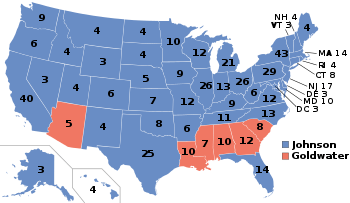
Fortunately, Lyndon Johnson beat Goldwater by 26 million votes (rather than 3 million) and by 61% to 27% (rather than 48% to 46%). Goldwater only won six states in the 1964 election: the five former slave states of the Deep South and his home state of Arizona.Ā That gave him 52 electoral votes compared to Johnson’s 486.Ā 

electoralcollege1964-svg

In addition to being a pseudo-conservative, Goldwater had no particular qualifications to be President. Before being elected to the Senate, he managed the family department store. In the Senate, he played no significant role. In Hofstadter’s words, “his main business there was simply to vote No”. He was stillĀ an “outsider” even after 12 years in Washington.

Goldwater’s extreme positions and lackluster qualifications contributed to his historic defeat. Fifty-two years later, due to a variety of circumstances, another pseudo-conservative, this time with no government experienceĀ at all, won narrow victories in enough states to win the White House. Given their appeal to the same sorts of voters, and given the fact that our next President is obviously suffering from a personality disorder (whereas Goldwater was relatively normal in that regard), it’s fair to say our democracy is showing signs of wear and tear thatĀ are beyond serious.

Addendum:

The journalist James Fallows recently reported the following conversation with a U.S. Senator:

Q: Ā How many of your colleagues know that there is something wrong with T***p?
A: Ā All of them, obviously.
Q: Ā Which Republican will be the first to say so?
A: Ā Ummmm….

At Least the Cop Wasn’t Thinking At the Time

A high school student in South Carolina disruptedĀ a class by talking on her phone. The teacher and a school administratorĀ demanded that she leave the room. She refused. AĀ police officer assigned to the school was summoned. He told her again to get out of her chair and leave the room.Ā She was now sitting quietly and no longer using her phone. She said she had done nothing wrong and wanted to stay.

He reacted by flipping her and herĀ chair upside down and dragging her across the floor. The white police officer, who is also one of the school’s assistant football coaches, did notĀ break the black girl’sĀ neck.

From the New York Times article, which includes a link to the video:

Witnesses to Monday’s incident said that in an Algebra 1 class, the girl, a sophomore, was on her phone, and the teacher told her to put it away. The teacher summoned an administrator, who brought in the deputy. The adults repeatedly asked the student to get up and leave the class, but she refused.

When the altercation occurred, students stood up, confused about what was happening, but the deputy told them, ā€œSit down, or you all will be next,ā€ said one student, Charles Scarborough, 16. Adding to the surprise and confusion, several students said the girl was usually quiet and not a troublemaker.

The deputy also detained a second student, Niya Kenny, 18, who told a local television station that her only offense was objecting to his treatment of the other girl.

ā€œI was crying, like literally screaming, crying like a baby,ā€ Ms. Kenny told WLTX. ā€œI’d never seen nothing like that in my life, a man use that much force on a little girl.ā€

As she protested, she said, ā€œhe said, ā€˜Since you’ve got so much to say, you’re coming, too.ā€™Ā ā€

I can almost understand the cop’s reaction. He got frustrated andĀ gave in to his worst impulses. He didn’t de-escalate the situation. He treated the girl as if she were a dangerous criminal. He treated her worse than he’d treat aĀ dog. But I presume he wasn’t using all his mental faculties at the time.Ā His lizard brain, his adrenaline and his racism took over.

What I can’t understand at all is that peopleĀ read the article and watched the video and then composedĀ a comment to the Times suggesting that the girl was responsible in any way whatsoever for what happened to her. She disrupted the class. She refused to get out of her chair. She wasn’t respectful of authority. Maybe she provoked the cop’s reaction. We shouldĀ wait for all the facts before passing judgment.

What total bullshit.Ā Let’s face it. ManyĀ of our fellow citizens here in the United StatesĀ would make good Nazis and there doesn’t seem to be much the rest of usĀ can do about it. (All right,Ā I do understand it.)

There’s more here, includingĀ how a police officerĀ using more of his brainĀ could have handledĀ the situation.