Class Warfare Is a Fact

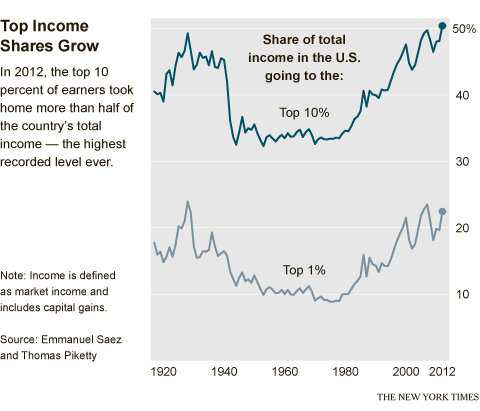
An updated study by economist Emanuel Saez of U.C. Berkeley shows that the the top 1% of earners in the United States received more than 20% of the country’s total income in 2012, while the top 10% of earners received more than half of the country’s income. The share of income going to the wealthiest Americans is now at or near the highest levels on record since the government began keeping the relevant statistics and the federal income tax was created in 1913.

What’s even more remarkable, perhaps, is that the income of the top 1% went up nearly 20% in 2012, while the income of the remaining 99% rose only 1%. Since 2009, the wealthiest 1% have taken 95% of the income gains in our supposedly classless society.

We should remember these statistics when we hear Republican politicians, who pretend to be friends of the middle class, claim that lower taxes for the wealthy benefit everyone. It’s past time to raise taxes on the rich, invest in America’s infrastructure and start creating decent jobs again. Otherwise we’re going to continue to get economically screwed.

Note the year 1980 in this chart, when class warrior and demagogue supreme Ronald Reagan was elected President:
10economix-sub-wealth-blog480

http://takingnote.blogs.nytimes.com/2013/09/11/the-rich-got-richer/

Periodic Update from Krugman the Indispensable

Paul Krugman was right about Bush’s tax cuts and the Iraq War. He was right about the 2009 stimulus. He’s been right about Europe’s austerity program. I’m sure he’s right about this too:

“The latest projections [from the Congressional Budget Office] show the combined cost of Social Security and Medicare rising by a bit more than 3 percent of G.D.P. between now and 2035, and that number could easily come down with more effort on the health care front. Now, 3 percent of G.D.P. is a big number, but it’s not an economy-crushing number. The United States could, for example, close that gap entirely through tax increases, with no reduction in benefits at all, and still have one of the lowest overall tax rates in the advanced world.

But haven’t all the great and the good been telling us that Social Security and Medicare as we know them are unsustainable, that they must be totally revamped — and made much less generous? Why yes, they have; they’ve also been telling us that we must slash spending right away or we’ll face a Greek-style fiscal crisis. They were wrong about that, and they’re wrong about the longer run, too.

The truth is that the long-term outlook for Social Security and Medicare, while not great, actually isn’t all that bad. It’s time to stop obsessing about how we’ll pay benefits to retirees in 2035 and focus instead on how we’re going to provide jobs to unemployed Americans in the here and now.”

http://www.nytimes.com/2013/06/03/opinion/krugman-the-geezers-are-all-right.html

Money Is Wasted On the Rich

At an art auction on Tuesday night, an anonymous buyer bid $43,800,000.00 (that’s 43.8 million dollars) for this painting (the blue thing with the white stripe, not the gentlemen in suits).

We could draw lots of conclusions from this latest Gilded Age moment. At a minimum, we ought to have a progressive sales tax, one that applies higher rates to more expensive purchases. For this particular purchase, I’d recommend a tax of at least 100%.

http://www.nytimes.com/2013/05/15/arts/design/record-auction-price-for-barnett-newman-at-sothebys.html?hp

$59 in 45 Years!

In case there was any doubt about the growth of inequality in America, a new study based on IRS data shows that:

Corrected for inflation, the average annual income of the bottom 90% of workers in 2011 was $30,437. In 1966, the average was $30,378. That’s an increase of $59 in 45 years.

Meanwhile, the average income of the top 10% almost doubled, rising from $138,793 to $254,864, an increase of roughly $116,000, while the average income of the top 1% rose by $628,000. For the top 0.1%, the increase was $18 million!

More recently, since 2009, the top 1 percent received 81% of  the growth in income. The top 0.1% received more than 50% of the growth.

The wealthiest Americans are pulling away from the rest of us because income has shifted from labor to capital, and because of lower taxes on capital gains, dividends, estates, and other income that is especially important to people with a lot of money.

Policies that especially benefit people with high incomes could be changed (in theory). Yet, in the words of economist David Cay Johnston:

“It has become widely understood that we cannot balance our federal budget by raising taxes only on those at the top, because there is not enough income there, even if we taxed away everything the top makes. What is equally true is that we cannot increase tax revenue if the incomes of the vast majority keep falling [or remain stagnant]. That, however, has yet to become part of the debate on how to finance government.”

http://www.taxanalysts.com/www/features.nsf/Articles/C52956572546624F85257B1D004DE3FC?OpenDocument

Death and Taxes

A recent article by Katherine Newman, a sociology professor at Johns Hopkins, highlights the effect of rising tax rates on the poor. She points out that for the past 30 years or so, many states in the South and the West have been raising sales taxes and fees for government services, both of which especially affect the poor. States in the Northeast and Midwest, on the other hand, have generally been more progressive in their tax policies, some even going so far as to create local versions of the federal Earned Income Tax Credit, which is specifically designed to assist people who don’t earn much money.

According to Professor Newman, the result of these policies, after correcting for other variables, like the local poverty rate, racial composition, diet and cost of living, is that there is a clear relationship between taxing the poor and “negative outcomes”, such as heart disease, infant mortality, dropping out of school, divorce, property crime and violent crime:

“The poor of the South — and increasingly the West — do worse because their states tax them more heavily. They have less money to buy medication, so their health problems get worse. High sales taxes make meals more expensive, so they shift to cheaper, unhealthy food. If people can’t make ends meet, they may turn to the underground economy or to crime.”

Partly for this reason, Southern and Western states receive more than their share of the federal budget (it’s not just because they have lots of military bases):

“Medicaid payments, food stamps, disability benefits — all of these federal programs swoop in to try to patch up a frayed safety net. Consequently, the Southern states reap more dollars in federal benefits than they pay in taxes (like Mississippi, which saw a net gain of $240 billion between 1990 and 2009), while the wealthier states — which do more to take care of their own — lose out for every dollar they pay (like New Jersey, which handed over a net of $706 billion over that same period)… We all pay for the damage done when states try to solve their fiscal problems, or score ideological points, on the backs of the poor.”

And yet the situation is getting worse, as states like Louisiana, Nebraska and North Carolina consider cutting income and corporate taxes, while raising sales taxes. 

http://opinionator.blogs.nytimes.com/2013/03/09/in-the-south-and-west-a-tax-on-being-poor/