Two Very Different Presidents, Two Very Different Paths

Like so many others, the historian Kruse Kruse now has a Substack newsletter. In this edition, he sheds light on a famous speech from 43 years ago that attempted to make America better but failed.

Today [July 15th] marks the anniversary of [President] Jimmy Carter’s deeply unpopular “Malaise speech,” which actually was not deeply unpopular and actually never used the word “malaise.”

In the late 1970s, the United States was reeling from crises on several fronts, ranging from economic “stagflation” (a new term coined to describe the previously unimaginable mix of high inflation and high unemployment) to an energy crisis sparked by the one-two punch of Middle Eastern oil embargoes and OPEC’s price hikes.

In early July, President Carter scrapped plans for an address on the energy crisis, deciding that he needed to dig deeper to diagnose what was ailing America. The president assembled a cast of political figures and public intellectuals for ten days of free-ranging discussion and frank deliberation at Camp David. The conversations covered a great deal of ground, but the president focused in on what became the actual title of his misremembered speech: the country’s “Crisis of Confidence.”

On July 15, 1979, Carter delivered the speech in a nationally televised address.

Pairing the Camp David conversations with feedback he’d gotten from “other Americans, men and women like you,” Carter rattled off a series of seemingly disconnected comments that, taken together, spoke to the dissatisfaction, distrust and discontent of the American people. “The erosion of our confidence in the future,” he warned, “is threatening to destroy the social and the political fabric of America.”

Carter offered a clear-eyed vision of how, and why, Americans had come to doubt their government and, as a result, to doubt themselves too:

We were sure that ours was a nation of the ballot, not the bullet, until the murders of John Kennedy and Robert Kennedy and Martin Luther King, Jr. We were taught that our armies were always invincible and our causes were always just, only to suffer the agony of Vietnam. We respected the Presidency as a place of honor until the shock of Watergate.

We remember when the phrase “sound as a dollar” was an expression of absolute dependability, until ten years of inflation began to shrink our dollar and our savings. We believed that our nation’s resources were limitless until 1973 when we had to face a growing dependence on foreign oil.

As he well understood, the general dissatisfaction and distrust in government had been a main reason for Carter’s own election. While presidential candidates had long campaigned on a résumé thick with political roles and posts in Washington D.C., Carter leveraged his identity as “an outsider” — in a move others would quickly copy — who bore no responsibility for creating these crises and who could therefore have a better shot at fixing them.

But two and a half years into his presidency, Carter was “Washington” and these problems were now his own. Still, he tried to ally himself with unhappy Americans: “You don’t like it, and neither do I. What can we do?”

The president offered a blunt assessment:

We are at a turning point in our history. There are two paths to choose. One is a path I’ve warned about tonight, the path that leads to fragmentation and self-interest. Down that road lies a mistaken idea of freedom, the right to grasp for ourselves some advantage over others. That path would be one of constant conflict between narrow interests ending in chaos and immobility. It is a certain route to failure.

All the traditions of our past, all the lessons of our heritage, all the promises of our future point to another path — the path of common purpose and the restoration of American values. That path leads to true freedom for our nation and ourselves. We can take the first steps down that path as we begin to solve our energy problem.

Energy will be the immediate test of our ability to unite this nation, and it can also be the standard around which we rally. On the battlefield of energy we can win for our nation a new confidence, and we can seize control again of our common destiny.

Carter then laid out a detailed plan for common action on the energy crisis, one that called for reducing oil imports, diverting resources to alternative fuels, imposing stark conservation efforts and rationing gasoline.

There were, as one might expect, calls for government programs — a version of the War Production Board of World War II that would focus on energy, a plan for greater investments in public transportation, a tax on windfall profits to fund it all, etc. — but the emphasis was on the private, voluntary action of the American people. President Carter was confident they would rise to the challenge. “With God’s help and for the sake of our nation, it is time for us to join hands in America,” he urged in closing. “Let us commit ourselves together to a rebirth of the American spirit. Working together with our common faith we cannot fail.”

Despite later memories of the speech as a disaster, it was actually a tremendous success. News coverage was generally positive, with political leaders heaping praise on the president for his mixture of blunt talk and bold faith.

Most notably, President Carter’s approval rating, which had been an abysmal 26% before the speech, shot up to 37% after the speech, an impressive 11-point bump that seemed to many to signal a turnaround in his political fortunes.

But that good luck was short-lived. As he moved from words to deeds, Carter made some serious missteps, most significantly securing formal offers of resignation from his entire Cabinet and several senior White House aides…. Carter meant this to be a sign of how serious his administration was taking the crisis, but most Americans saw it [as] a sign of chaos and confusion. The good will of the speech was quickly wiped away, and as additional problems arrived, like the Iran hostage crisis, Carter only found himself discredited again.

Meanwhile, an alternative vision — the first path of “self-interest” that the pious Carter had dismissed — was advanced by former California Governor Ronald Reagan as he secured the Republican nomination and challenged the incumbent president. Like Carter’s critics on both the left and right, Reagan ignored much of what Carter had actually said and instead latched onto a word the longtime Democratic operative Clark Clifford had casually tossed out to reporters in describing the speech: America’s sense of “malaise.”

“That is really the question before us tonight,” Reagan said the evening before the 1980 election. “For the first time in our memory many Americans are asking: does history still have a place for America, for her people, for her great ideals? There are some who answer no; that our energy is spent, our days of greatness at an end, that a great national malaise is upon us.”

Carter had offered a blunt assessment of the country’s problems but expressed a sharp faith in Americans’ ability to come together and conquer them, but in Reagan’s hands the underlying optimism of that message was spun into nihilistic pessimism. “I find no national malaise,” Reagan said. “I find nothing wrong with the American people.”

Carter called on the American people to join together in common cause and to make personal sacrifices for the sake of the nation. Reagan dismissed all that as needless pessimism and confirmed their complacency….

Seeking to echo FDR’s famous first inaugural address, Carter had bluntly addressed the nation’s “crisis of confidence” but expressed his faith that, with a little hard work and personal sacrifice, Americans could pull themselves out of their problem. There was, in effect, nothing to fear but fear itself.

In sharp contrast, Reagan simply insisted there was nothing to fear, nothing to sacrifice, nothing to work together to do — except show Jimmy Carter the door.

It’s not surprising which message ultimately resonated with voters, between the challenge of self-sacrifice and the comfort of self-interest.

And it’s not surprising that political leaders, from both parties, took notice.
Can Biden Finally Get Us Past Reagan?

God, I hope so. According to one view of American history, Joe Biden could be extremely important. He could be our first truly “post-Reagan” president. From Michelle Goldberg of The New York Times:

During Donald Trump’s presidency, I sometimes took comfort in the Yale political scientist Stephen Skowronek’s concept of “political time.”

In Skowronek’s formulation, presidential history moves in 40- to 60-year cycles, or “regimes.” Each is inaugurated by transformative, “reconstructive” leaders who define the boundaries of political possibility for their successors.

Franklin Delano Roosevelt was such a figure. For decades following his presidency, Republicans and Democrats alike accepted many of the basic assumptions of the New Deal. Ronald Reagan was another. After him, even Democrats like Bill Clinton and Barack Obama feared deficit spending, inflation and anything that smacked of “big government.”

I found Skowronek’s schema reassuring because of where Txxxx seemed to fit into it. Skowronek thought Txxxx was a “late regime affiliate” — a category that includes Jimmy Carter and Herbert Hoover. Such figures, he’s written, are outsiders from the party of a dominant but decrepit regime.

They use the “internal disarray and festering weakness of the establishment” to “seize the initiative.” Promising to save a faltering political order, they end up imploding and bringing the old regime down with them. No such leader, he wrote, has ever been re-elected.

During Txxxx’s reign, Skowronek’s ideas gained some popular currency, offering a way to make sense of a presidency that seemed anomalous and bizarre. “We are still in the middle of Txxxx’s rendition of the type,” he wrote in an updated edition of his book “Presidential Leadership in Political Time,” “but we have seen this movie before, and it has always ended the same way.”

Skowronek doesn’t present his theory as a skeleton key to history. It’s a way of understanding historical dynamics, not predicting the future. Still, if Txxxx represented the last gasps of Reaganism instead of the birth of something new, then after him, Skowronek suggests, a fresh regime could begin.

When Joe Biden became the Democratic nominee, it seemed that the coming of a new era had been delayed. Reconstructive leaders, in Skowronek’s formulation, repudiate the doctrines of an establishment that no longer has answers for the existential challenges the country faces. Biden, Skowronek told me, is “a guy who’s made his way up through establishment Democratic politics.” Nothing about him seemed trailblazing.

Yet as Biden’s administration begins, there are signs that a new politics is coalescing. When, in his inauguration speech, Biden touted “unity,” he framed it as a national rejection of the dark forces unleashed by his discredited predecessor, not stale Gang of Eight bipartisanship. He takes power at a time when what was once conventional wisdom about deficits, inflation and the proper size of government has fallen apart. That means Biden, who has been in national office since before Reagan’s presidency, has the potential to be our first truly post-Reagan president.

“Biden has a huge opportunity to finally get our nation past the Reagan narrative that has still lingered,” said Representative Ro Khanna, who was a national co-chair of Bernie Sanders’s presidential campaign. “And the opportunity is to show that government, by getting the shots in every person’s arm of the vaccines, and building infrastructure, and helping working families, is going to be a force for good.”

A number of the officials Biden has selected — like Rohit Chopra for the Consumer Financial Protection Bureau, Gary Gensler for the Securities and Exchange Commission and Bharat Ramamurti for the National Economic Council — would have fit easily into an Elizabeth Warren administration. Biden has signed executive orders increasing food stamp benefits, took steps to institute a $15-an-hour minimum wage for federal employees and contractors, and announced plans to replace the federal fleet with electric vehicles. His administration is working on a child tax credit that would send monthly payments to most American parents.

Skowronek told me he’s grown more hopeful about Biden just in the last few weeks: “The old Reagan formulas have lost their purchase, there is new urgency in the moment, and the president has an insurgent left at his back.”

This is the second Democratic administration in a row to inherit a country wrecked by its predecessor. But Biden’s plans to take on the coronavirus pandemic and the attendant economic disaster have been a departure from Obama’s approach to the 2008 financial crisis. The difference isn’t just in the scale of the emergencies, but in the politics guiding the administrations’ responses.

In “A Promised Land,” the first volume of his presidential memoir, Obama described a meeting just before he took office, when the economic data looked increasingly bleak. After an aide proposed a trillion-dollar rescue package, Rahm Emanuel, Obama’s chief of staff, began “to sputter like a cartoon character spitting out a bad meal.” Emanuel, according to Obama, said the figure would be a nonstarter with many Democrats, never mind Republicans. In Obama’s telling, Biden, then vice president, nodded his head in agreement.

Now Emanuel, hated by progressives, has been frozen out of Biden’s administration, and the new president has come out of the gate with a $1.9 trillion proposal. In addition to $1,400 checks to most Americans and an increase in federal unemployment aid to $400 a week, it includes a national $15-an-hour minimum wage, something dismissed as utopian when Bernie Sanders ran on it in 2016.

What has changed is not just the politics but the economic consensus. Recently I spoke to Jared Bernstein, a member of Biden’s Council of Economic Advisers . . .  When Biden was vice president, Bernstein was his chief economic adviser, and he said the meetings he’s in now are very different from those he was in during the last economic crisis.

Back then, Bernstein said, there was a widespread fear that too much government borrowing would crowd out private borrowing, raising interest rates. That thinking, he said, has changed. As Biden told reporters this month, “Every major economist thinks we should be investing in deficit spending in order to generate economic growth.”

It’s not just that the Democratic Party has moved left — the old Reaganite consensus in the Republican Party has collapsed. There’s nothing new about Republicans ignoring deficits — deficits almost never matter to Republicans when they’re in power. What is new is the forthright rejection of laissez-faire economics among populist nationalists like Senator Hawley of Missouri, who joined with Sanders to demand higher stimulus payments to individuals in the last round of Covid relief.

That doesn’t mean we should be optimistic about people like Hawley, who wouldn’t even admit that Biden won the election, helping the new administration pass important legislation. But Republicans are going to have an increasingly difficult time making a coherent case against economic mercy for the beleaguered populace.

“This idea that the inflation hawks will come back — I just think they’re living in an era that has disappeared,” Elizabeth Warren told me.

However popular it is, Biden’s agenda will be possible only if Democrats find a way to legislate in the face of Republican nihilism. They’ll have to either convince moderates to finally jettison the filibuster, or pass economic legislation through reconciliation, a process that requires only a majority vote. Where Congress is stalemated, Biden will have to make aggressive use of executive orders and other types of administrative action. But he has at least the potential to be the grandfather of a more socially democratic America.

A moderate president, says Skowronek, can also be a transformative one. “It’s a mistake to think that moderation is a weakness in the politics of reconstruction,” he said, noting that both Abraham Lincoln and Roosevelt were “viciously” attacked from the left. “Moderation can stand as an asset if it’s firmly grounded in a repudiation of the manifest failure and bankruptcy of the old order. In that sense, moderation is not a compromise or a middle ground. It’s the establishment of a new common sense.”

There is, of course, no guarantee that Biden will fully rise to the moment. Skowronek has always expected that eventually American politics will change so much that the patterns he identified will no longer apply. “All I can say is that so many of the elements, the constellation of elements that you would associate with a pivot point, are in place,” he said. In this national nadir, we can only hope that history repeats itself.

Class Warfare Is a Fact

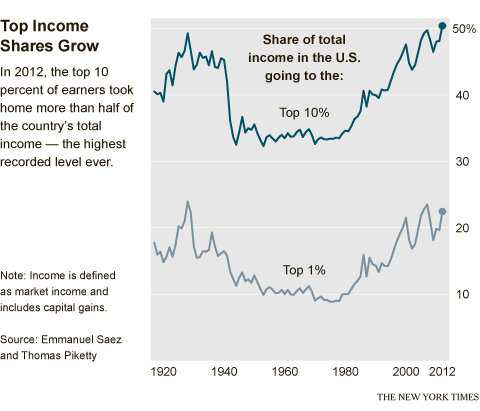
An updated study by economist Emanuel Saez of U.C. Berkeley shows that the the top 1% of earners in the United States received more than 20% of the country’s total income in 2012, while the top 10% of earners received more than half of the country’s income. The share of income going to the wealthiest Americans is now at or near the highest levels on record since the government began keeping the relevant statistics and the federal income tax was created in 1913.

What’s even more remarkable, perhaps, is that the income of the top 1% went up nearly 20% in 2012, while the income of the remaining 99% rose only 1%. Since 2009, the wealthiest 1% have taken 95% of the income gains in our supposedly classless society.

We should remember these statistics when we hear Republican politicians, who pretend to be friends of the middle class, claim that lower taxes for the wealthy benefit everyone. It’s past time to raise taxes on the rich, invest in America’s infrastructure and start creating decent jobs again. Otherwise we’re going to continue to get economically screwed.

Note the year 1980 in this chart, when class warrior and demagogue supreme Ronald Reagan was elected President:

10economix-sub-wealth-blog480

http://takingnote.blogs.nytimes.com/2013/09/11/the-rich-got-richer/