Faces of Fascism

First, they came for the Mexicans and Muslims…

Michael Barbaro, The New York Times:

Mr. Trump made no real case for his qualifications to lead the world’s largest economy and strongest military. He is, he said, a very successful man who knows how to make it all better.

Inside the Quicken Loans Arena, a thicket of American flags behind him, he portrayed himself, over and over, as an almost messianic figure prepared to rescue the country from the ills of urban crime, illegal immigration and global terrorism.

“I alone,” he said, “can fix it.”

Adam Gopnik, The New Yorker:

It is no surprise that the American face of fascism would take on the forms of celebrity television and the casino greeter’s come-on…What all forms of fascism have in common is the glorification of the nation, and the exaggeration of its humiliations, with violence promised to its enemies, at home and abroad; the worship of power wherever it appears and whoever holds it; contempt for the rule of law and for reason; unashamed employment of repeated lies as a rhetorical strategy; and a promise of vengeance for those who feel themselves disempowered by history.

It promises to turn back time and take no prisoners. That it can appeal to those who do not understand its consequences is doubtless true. But the first job of those who do understand is to state what those consequences invariably are. Those who think that the underlying institutions of American government are immunized against it fail to understand history. In every historical situation where a leader of Trump’s kind comes to power, normal safeguards collapse. Ours are older and therefore stronger? Watching the rapid collapse of the Republican Party is not an encouraging rehearsal. Donald Trump has a chance to seize power.

Hillary Clinton … has her faults, easily described, often documented—though, for the most part, the worst accusations against her have turned out to be fiction. No reasonable person, no matter how opposed to her politics, can believe for a second that Clinton’s accession to power would be a threat to the Constitution or the continuation of American democracy. No reasonable person can believe that Trump’s accession to power would not be. 

landscape-1468977724-rudy-giuliani

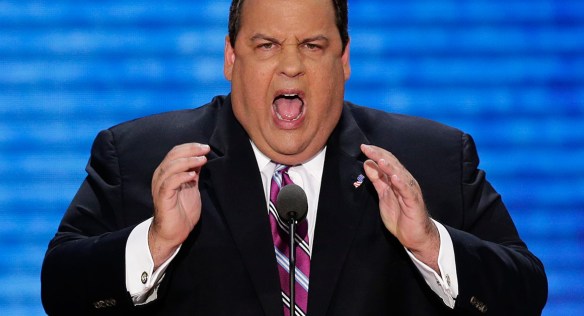
New Jersey Governor Chris Christie addresses the Republican National Convention in Tampa, Fla., on Tuesday, Aug. 28, 2012. (AP Photo/J. Scott Applewhite)

screen-shot-2016-07-21-at-50548-pm-1469135314

The Republican Party, Rush Limbaugh, Fox News, they all gave birth to Trump. Now we all have to get off our asses and vote a straight Democratic ticket in November. A Democratic President and a Democratic Congress are the only way to get our government working again and, therefore, the only way to stop the fire from spreading.

Because, yes, it could happen here. 

History Repeats Itself and Then Kind of Doesn’t

In 1964, Lyndon Johnson’s campaign hired an actor who was a registered Republican to do a four-minute commercial expressing his misgivings about Barry Goldwater, the Republican nominee for President. It was in black and white, of course, and the actor indulged in an unhealthy habit:

The ad was called “Confessions of a Republican”:

The actor, whose name is William Bogert, is still with us and has now made an ad for the Clinton campaign. It’s only a minute long, since our 2016 attention spans are 75% shorter. It’s also called “Confessions of a Republican”.

Also, here’s a related story that probably won’t appear on Fox News.That’s a pity. The ghost writer, who spent 18 months with Trump and wrote “his” popular book, The Art of the Deal, for the real estate developer, wishes it had been called The Sociopath instead:

“I feel a deep sense of remorse that I contributed to presenting Trump in a way that brought him wider attention and made him more appealing than he is,” Mr. Schwartz said. “I genuinely believe that if Trump wins and gets the nuclear codes, there is an excellent possibility it will lead to the end of civilization.”

Mr. Schwartz also says Trump has no attention span, is the most prolific liar he ever met and is running for President because he loves publicity. 

Meanwhile, the Republican National Conflagration began today in Cleveland, Ohio. The Never Trump faction tried to get Trump dumped. Yelling and confusion ensued, but the Trump Forever faction won with the help of the politician who held the gavel. A brief video records the disagreement:

God bless America.

PS — This is a longer article from The New Yorker about Trump’s ghost writer. The concluding quote:

“People are dispensable and disposable in Trump’s world.” If Trump is elected President, [Mr. Schwartz] warned, “the millions of people who voted for him and believe that he represents their interests will learn what anyone who deals closely with him already knows—that he couldn’t care less about them.”

And Another Thing (Not About Politics for the Most Part)

What follows may be the least important of the 522 posts I’ve written since beginning this blog. That’s saying a lot, I know, but here it is anyway:

One thing I learned from years of studying philosophy is the distinction between naming, mentioning or referring to a word and using it. One half of that distinction should be perfectly clear. We all use words when we write or speak them. For example, I used either nine or ten words in that last sentence, depending on how you want to count the word I used twice.

Brief tangent: If the same word is used twice in a sentence, should it be counted twice since it appears twice or should it be counted once, since it’s the same word both times? The answer to that question has to do with another distinction (the one between token and type). That distinction isn’t the subject of this post, however, so let’s keep going. 

As I was saying, it’s clear that we all know how to use a word. But how do you name it? It’s very simple, actually: you put quotation marks around it. For example, in order to refer to or mention the word “cat”, I put quotation marks around the three letters that spell it. Doing so allows me to ask you, for example, whether you can spell “cat”. If I asked you to spell the word cat, without the quotation marks, it wouldn’t mean the same thing at all. (The best I can figure is that it would mean to relieve the cat that’s good with words by taking its place.)

People, of course, have names like “Peter” and “Susan”. See how I just gave you the names of those fictional people by using quotation marks? In effect, I gave you the names of their names. If I’d said Peter knows Susan, I’d have simply used their names. I’m sure you get the idea.

My next point: We can also name, mention or refer to a sentence. How? Again, simply by putting quotation marks around it. For example, “This is a sentence” is a sentence. In that last sentence, I referred to the sentence “This is a sentence” in the same way I referred to the word “cat” above.

Okay, I’m now getting close to the point I wanted to make when I began this post several hours ago. When I was in school, I was taught a certain way to use quotation marks. It’s a rule that appears in a list Google presented when I asked their search engine how to use quotation marks correctly:

Rule 4. Periods and commas ALWAYS go inside quotation marks.

Examples:
The sign said, “Walk.” Then it said, “Don’t Walk,” then, “Walk,” all within thirty seconds.
He yelled, “Hurry up.”

If you follow this rule, you’ll write things like this:

I can spell “cat.” 

Instead of:

I can spell “cat”.

But the name of the word “cat” isn’t “cat.”. So what’s that period doing inside the quotation marks instead of being at the end of the sentence where it obviously belongs?

Likewise, if you follow Rule 4, you’ll write sentences like this:

This is a sentence: “This is a sentence.”

Instead of:

This is a sentence: “This is a sentence”.

Putting the period inside the quotation marks would be okay if you wanted to emphasize how declarative sentences are supposed to end with a period, but if that’s what you were doing, you’d need another period outside the quotation marks to mark the end of the whole sentence, like this:

This is a sentence: “This is a sentence.”.

Now take a look at the next rule in the list:

Rule 5a. The placement of question marks with quotation marks follows logic. If a question is within the quoted material, a question mark should be placed inside the quotation marks.

Examples:
She asked, “Will you still be my friend?”

The question Will you still be my friend? is part of the quotation.

But wait a second. We’re supposed to follow logic with respect to question marks, but not when it comes to periods? What this apparently means is that the question below should be written this way:

Can you spell “cat”?

Not this way:

Can you spell “cat?”

Which makes sense, because “cat?” is not a good way to refer to the word “cat”, in the same way “cat.” isn’t a good way either.

Sometimes you have an idea and wonder why you’ve never heard that idea before. Why hasn’t someone else concluded that Rule 4 is dumb? Why are we all taught to use logic when using quotation marks with question marks but not with periods? Was there a problem with typesetting many years ago that gave rise to Rule 4? Was it a solution to a perceived problem or simply someone like Ben Franklin or Noah Webster who had a few too many and thought Rule 4 would be a good idea? 

I decided somewhere along the line that I would ignore Rule 4 on this blog and in my other written communications. So far nobody has complained or, so far as I know, even noticed. 

But imagine my surprise and relief when I found this today at the website of Capital Community College of Hartford, Connecticut: 

Here is one simple rule to remember:

In the United States, periods and commas go inside quotation marks regardless of logic. 

In the United Kingdom, Canada, and islands under the influence of British education, punctuation around quotation marks is more apt to follow logic. In American style, then, you would write: My favorite poem is Robert Frost’s “Design.” But in England you would write: My favorite poem is Robert Frost’s “Design”.

Capital Community even offer an explanation of sorts for this discrepancy:

There are peculiar typographical reasons why the period and comma go inside the quotation mark in the United States. The following explanation comes from [a link that no longer works]: “In the days when printing used raised bits of metal, “.” and “,” were the most delicate, and were in danger of damage … if they had a [double quote] on one side and a blank space on the other. Hence the convention arose of always using ‘.”‘ and ‘,”‘ rather than ‘”.’ and ‘”,’, regardless of logic.”

This seems to be an argument to return to something more logical, but there is little impetus to do so within the United States.

That last sentence sums up the situation perfectly. There is little impetus to be more logical here in the United States. It’s not the entire English-speaking world that’s doing it wrong, it’s just us. And we’ll keep doing it wrong because, well, most of our Constitution is more than 200 years old and much of it is out-of-date. Why shouldn’t our punctuation be old and out-of-date too?

So, here we are. I’ve explained the situation and assured you that I’m committed to breaking Rule 4 at every opportunity. I call on the rest of America to do the same. Sometimes we have to stand up for what’s right, even if it means risking reprisals from illogical, conservative elements among us.

But, I know, I know, you probably think you’ve wasted the past several minutes reading this post. Maybe you’d rather have been reading about Trump and Congress and France and Baton Rouge.

Or maybe in retrospect it was good to get away from that for a bit? If you’ve missed it, here’s a long article about Trump’s even longer history of lies and exaggerations. The reporter says it’s hard to find a project Trump worked on that didn’t involve dishonesty or misinformation of some sort. I couldn’t stand to read the whole thing, but maybe you can. (By the way, there’s a poll out that says a majority of registered voters think Trump is more honest and trustworthy than Hillary Clinton. Amazing. This is what years of propaganda and intense ideology will do.)

And in case you want to submit a question to one of the speakers at the Republican Convention, which starts tomorrow, there’s a form you can fill out here. Posing as a fictitious reporter, I asked to interview a member of the Trump family on the topic: “Is Donald Trump a psychopath or merely a dangerous con man?” Still waiting for a reply.
On Growing Up, Politically Speaking

Kevin Baker writes for a living and voted for Bernie Sanders in the New York primary. In today’s New York Times, he calls on us liberals (aka progressives) to get serious: “Let’s Grow Up, Liberals”.

First, as preamble, he offers a critical analysis of the way Sanders endorsed Clinton this week: 

Senator Sanders’s embrace of the presumptive Democratic nominee included all the inclinations that many of us have come to find, shall we say, a tad grating about the man: his interminable, self-congratulatory stump speech, wearingly bereft of humor, argument, story or anecdote, more a listing of all bad things in the world and how they must be put right, delivered in his usual droning shout. The need to make it all about the platform concessions he had wrangled out of Mrs. Clinton, and the historical magnitude of the Senator himself: “Together we have begun a political revolution to transform America and that revolution continues.” Followed by about as short and perfunctory an actual endorsement as possible.

At least it was done. If Achilles had sulked this long in his tent we would all be speaking Trojan, but never mind. Bernie Sanders did, clearly and unequivocally, say that Hillary Clinton had won the most elected delegates, that she “will make an outstanding President and I am proud to stand with her here today” …

Mr. Kramer then diagnoses a continuing problem with left-wing politics:

Polling shows that 85 percent of Sanders supporters are willing to vote for Mrs. Clinton in November… Most of the remainder will likely come around over the next four months… yet there is a lingering problem here…

With Bernie out of the battle, what remains is the left’s odd, outmoded doctrine of purity, of revolutionary posturing. This is a philosophy alien to the long legacy of pragmatic American liberalism. Its perpetuation speaks directly to the reasons today’s liberals seem to have such difficulty holding and wielding power in this country. “The worse, the better,” went the Leninist saw. There is no reforming the rotten old system. Best to “let the empire burn,” and have the fires purify the new society….

Change — lasting, democratic change, which is the only kind worth fighting for — is hard, slow, often exasperating. And yet the theatrics of revolution seem to mesmerize the left, over and over again. The concept, all too similar to the religious fundamentalist’s obsession with the end times, is that cataclysm will bring redemption. There is inherent in this a deep indifference to the historical recognition that one thing proceeds from another … and that when we start down an unknown trail we cannot be sure where we will end up….

The corrosive effects of a political philosophy devoted to waiting for the revolution can be heard in the oddly passive demands of those speeches by Mr. Sanders that lay out always what he wants, but not how we can get it. It is reflected in the left’s distraction over presidential elections while failing to build democracy on a state or local level….

He concludes by quoting Barry Goldwater’s call to action after Goldwater lost the Republican nomination to Richard Nixon in 1960:

This country is too important for anyone’s feelings,” Goldwater thundered at his delegates. “This country, and its majesty, is too great for any man, be he conservative or liberal, to stay home and not work just because he doesn’t agree. Let’s grow up, conservatives. We want to take this party back, and I think some day we can. Let’s go to work.”

Goldwater backed up his words by campaigning hard in support of Nixon — and not incidentally, building a foundation for the right wing around the country. Four years later, he would use it to gain the nomination himself, and by 1980, Ronald Reagan had taken not only the party but the country for conservatism.

German Leaders Thought Hitler Was Trump

Jonathan Chait of New York Magazine asks why leading Republicans are supporting Trump and finds the answer in 1933:

“Like Hitler, Trump is a radical, authoritarian figure who lies outside the normal parameters of his country’s conservative governing class. Thus, there is a parallel between the two men’s unexpected rise to power that is worth considering: Why would traditional conservatives willingly hand power to a figure so dangerous that he threatened their own political and economic interests? Why, having failed in their halfhearted efforts to nominate an alternative candidate during the primaries, don’t they throw themselves behind a convention coup, a third-party candidacy, or defect outright to Hillary Clinton? Why do so many of them consider Trump the lesser rather than the greater evil?”

“….In January 1933, the Nazi party’s vote share had begun to decline, and its party was undergoing a serious internal crisis, with dues falling, members drifting off, and other leaders questioning Hitler’s direction. A widely shared belief across the political spectrum at the time held that Hitler would not and could not win the chancellorship….”

“Hindenburg and the German right viewed Hitler in strikingly similar terms to how Republican elites view Trump….Alfred Hugenberg, leader of the German-Nationals, deemed the Nazis “little better than a rabble, with dangerously radical social and economic notions…Hindenburg considered Hitler qualified to head the postal ministry at best. Hitler, in their eyes, was not a serious man, unfit to govern, a classless buffoon. His appeal, the German elite believed, came from his outsider status, which allowed him to posture against the political system and make extravagant promises to his followers that would never be tested against reality.”

“All this is to say that German conservatives did not see Hitler as Hitler — they saw Hitler as Trump. And the reasons they devised to overcome their qualms and accept him as the head of state would ring familiar to followers of the 2016 campaign. They believed the responsibility of governing would tame Hitler, and that his beliefs were amorphous and could be shaped by advisers once in office. They respected his populist appeal and believed it could serve their own ends….Their myopic concern with specifics of their policy agenda overcame their general sense of unease….Think of the supply-siders supporting Trump in the hope he can enact major tax cuts, or the social conservatives enthused about his list of potential judges, and you’ll have a picture of the thought process….”

“Whatever norms or bounds that we think limit the damage a president could inflict are likely to be exceeded if that president is Trump. Those Republicans who publicly endorse Trump because he probably won’t win may be making an error on a historic scale.”

The full article is here.