Calling These Senators Could Make a Difference

Someone who knows somebody shared this message somewhere. And now it’s here, slightly edited:

For those worried about ACA (“Obamacare”) coverage for themselves and their families:

After hearing about the midnight repeal of the pre-existing conditions clause, I called Senator Elizabeth Warren’s office. The woman I spoke to said they are being flooded with calls, as are the offices of Speaker Paul Ryan and Senate Majority Leader Mitch McConnell.

Senator Warren’s staff member told me what would help the most would be to call the five Republican senators who have broken away from their leadership to demand a slowdown of the repeal. Tell them how much you appreciate their efforts to stop the train wreck and maybe share your story.

Senator Bill Cassidy (Louisiana) – (202) 224-5824

Senator Susan Collins (Maine) – (202) 224-2523

Senator Bob Corker (Tennessee) – (202) 224-3344

Senator Lisa Murkowski (Alaska) – (202) 224-6665

Senator Rob Portman (Ohio) – (202) 224-3353

There is additional contact information for U.S. senators available here. People say ringing telephones and overloaded phone systems are the best way to impress politicians (they’re even more impressive than offering cash bribes or sexual favors).

Who Says Republicans Don’t Have a Sense of Humor?

Example 1:

“House Republicans have found a subject for their opening review of conflicts of interest under Donald Trump: the federal official in charge of investigating conflicts of interest.”

Yes, the Republican chairman of the House Oversight Committee, Jason Chaffetz of Utah, is mad at the head of the Office of Government Ethics for pointing out (as both Democratic and Republican ethics lawyers agree) that the President-elect’s “plan” to avoid his many, many conflicts of interest is “meaningless”. There are hysterical details here. 

Last night, I found the ethics official’s explanation of his negativity at the Office of Government Ethics site. It was a four-page PDF file, but the lawyer who wrote it isn’t nearly as funny as Rep. Chaffetz. Unfortunately, the link isn’t working at the moment (because of heavy traffic or those madcap Russians). But maybe it will work for you.

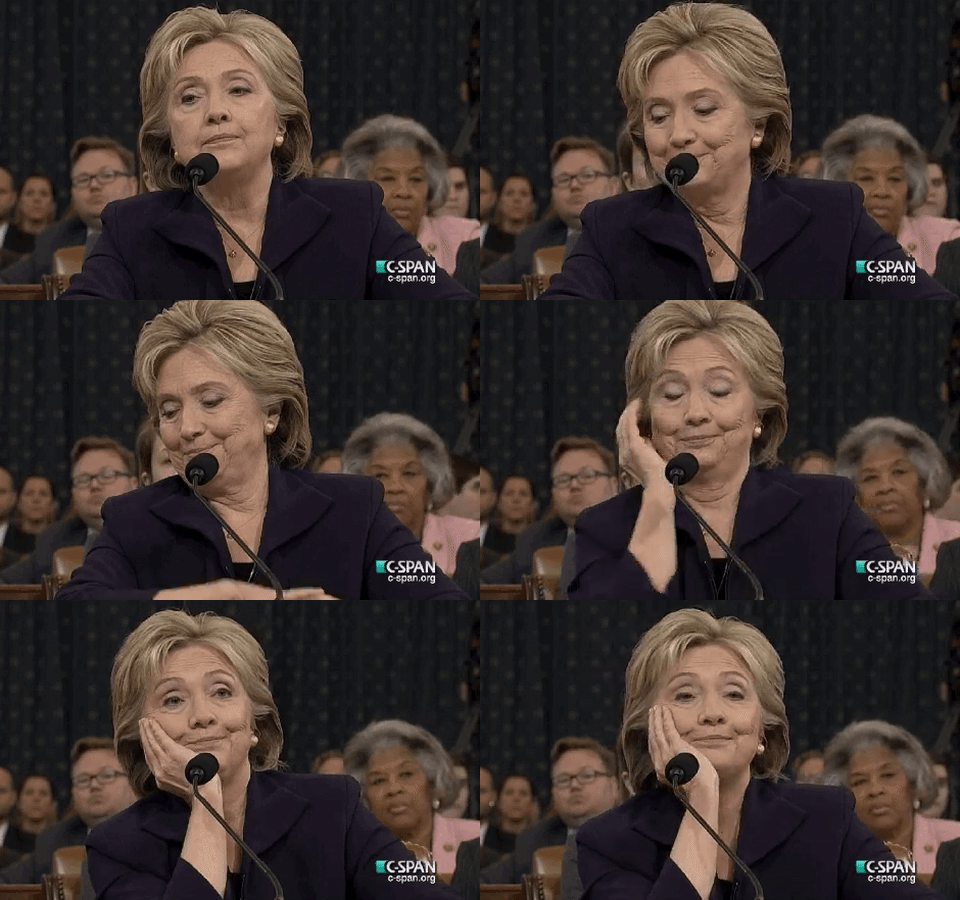
In a related, even more priceless development, Rep. Chaffetz announced a few days ago that he plans to keep investigating Hillary Clinton’s emails! This lovable scamp Chaffetz is relentless!

Yet:

When asked about T__p’s potential business conflicts, [chairman Chaffetz] noted that the law‎ exempts the president of the United States, calling the push from Democrats to launch a committee investigation on T__p’s business ties “premature at best.” [CNN]

I suppose “premature at best” implies “totally ridiculous at worst”!

best-dad-jokes

giphy

tumblr_me7cg67ys31raj8mk


All right, now that I’ve recovered my composure…

Example 2:

It might seem like yesterday, but it was almost seven years ago that America’s first step toward universal healthcare became law. It was officially called the Patient Protection and Affordable Care Act, but rapidly became known as Obamacare. The law included many (in fact, mostly) conservative ideas, but in the end not one Republican Senator voted for it. In fact, Republicans immediately began calling for the law’s repeal.

Now that the Republicans control Congress and are about to occupy the White House, they’re beginning the effort to repeal the ACA, but questions are being raised, even by Republicans. Should the law be repealed in toto, which would mean taking health insurance away from millions of people, including lots of Republican voters? Or should it be left in place until the law’s terrific right-wing replacement is all ready to go? 

Since they’ve had seven years to think about it, they must have something wonderful (“My God, it’s full of stars!”) waiting in the wings. So here’s what happened last night at Speaker of the House Paul Ryan’s nationally-televised “town hall”.

From the GQ site:

The event began with a question from a polite, middle-aged gentleman named Jeff Jeans, a small-business owner:

“I was a Republican, and I worked for the Reagan and Bush campaigns. Just like you, I was opposed to the Affordable Care Act. When it was passed, I told my wife we would close our business before I complied with this law. Then, at 49, I was given six weeks to live with a very curable type of cancer. We offered three times the cost of my treatment, which was rejected. They required an insurance card. Thanks to the Affordable Care Act, I’m standing here today, alive. Being both a small businessperson [and] someone with preexisting conditions, I rely on the Affordable Care Act to be able to purchase my own insurance. Why would you repeal the Affordable Care Act without a replacement?”

Chuckling nervously like a local-news anchor who suddenly lost his teleprompter feed, Ryan began explaining to Jeans that his party in fact does have a proposal—it’s just a secret one that he still hasn’t shared with his colleagues. Jeans, however, still needed to twist the knife.

RYAN: We wouldn’t do that. We want to replace it with something better. First of all, I’m glad you’re standing here! I mean, really, seriously, I—

JEANS: Can I say one thing? I hate to interrupt you.

RYAN: Yeah, yeah, yeah.

JEANS: I want to thank President Obama from the bottom of my heart, because I would be dead if it weren’t for him.

Seeking further information, I was led to a site called “A Better Health Care Plan”. It’s run by a bunch of Republicans who call themselves the “American Action Network”. The first thing you see is a link to a YouTube video: “A New Path Forward”. Here’s the video’s entire script: 

Imagine a new path forward. Health insurance that provides more choices and better care at lower costs. A system that puts patients and doctors in charge, provides peace of mind to people with pre-existing conditions, and paves the way for new cures by eliminating senseless regulations. House Republicans have a plan to get there without disrupting existing coverage, giving your family the health care they deserve.

You’re then invited to visit the very site you’re on, “A Better Health Care Plan”, for further information. And here it is: 

House Republicans have a plan to get there

Our Congress is fighting for us: lowering costs, providing more control and more choices to pick a plan that meets our needs, not a plan that Washington mandates.

That’s all the further information provided. In toto.

Now who doesn’t think Republicans have a terrific sense of humor? 

uxwwgnz


The Best Short Summary of the Affordable Care Act (ACA) Situation You’ll Find

In a blog post called “There Will Be No Obamacare Replacement”, Paul Krugman quotes himself from seven years ago. What he says deserves to be quoted at length and shared widely.

Quote:

“You may be surprised at the evident panic now seizing Republicans, who finally — thanks to [FBI Director] James Comey and [evil dictator] Vladimir Putin — are in a position to do what they always wanted, and kill Obamacare. How can it be that they’re not ready with a replacement plan?

That is, you may be surprised if you spent the entire Obama era paying no attention to the substantive policy issues — which is a pretty good description of the Republicans, now that you think about it.

From the beginning, those of us who did think it through realized that anything like universal coverage could only be achieved in one of two ways: single payer, which was not going to be politically possible, or a three-legged stool of regulation, mandates, and subsidies. Here’s how I put it exactly 7 years ago:

Start with the proposition that we don’t want our fellow citizens denied coverage because of preexisting conditions — which is a very popular position, so much so that even conservatives generally share it, or at least pretend to.

So why not just impose community rating — no discrimination based on medical history?

Well, the answer, backed up by lots of real-world experience, is that this leads to an adverse-selection death spiral: healthy people choose to go uninsured until they get sick, leading to a poor risk pool, leading to high premiums, leading even more healthy people dropping out.

So you have to back community rating up with an individual mandate: people must be required to purchase insurance even if they don’t currently think they need it.

But what if they can’t afford insurance? Well, you have to have subsidies that cover part of premiums for lower-income Americans.

In short, you end up with the health care bill that’s about to get enacted. There’s hardly anything arbitrary about the structure: once the decision was made to rely on private insurers rather than a single-payer system — and look, single-payer wasn’t going to happen — it had to be more or less what we’re getting. It wasn’t about ideology, or greediness, it was about making the thing work.

[Still quoting the professor here] It’s actually amazing how thoroughly the right turned a blind eye to this logic, and some — maybe even a majority — are still in denial. But this is as ironclad a policy argument as I’ve ever seen; and it means that you can’t tamper with the basic structure without throwing tens of millions of people out of coverage. You can’t even scale back the spending very much — Obamacare is somewhat underfunded as is.

Will they decide to go ahead anyway, and risk opening the eyes of working-class voters to the way they’ve been scammed? I have no idea….”

End Quote.

The Affordable Care Act really was the “conservative” approach to universal health insurance, a variation on the plan signed into law by the Republican Governor of Massachusetts, Mitt Romney. But the Republican Party decided to oppose everything President Obama did. That meant they had to oppose the ACA too. Now they’re stuck trying to replace a major law they should have been in favor of all along. 

Almost final word from Prof. Krugman:

…if Republicans do end up paying a big political price for their willful policy ignorance, it couldn’t happen to more deserving people.

I’d change that last sentence to read “pay a big political price for playing extremely partisan politics with the health and well-being of the American people”, but the part about the “more deserving people” is perfect.

It’s Been With Us For Years, But Gotten Worse

The historian Richard Hofstadter (1916-1970) is known outside academic circles for having written a particular book and a particular essay. The book was Anti-intellectualism in American Life from 1963. The essay was “The Paranoid Style in American Politics” from 1964. I read the essay a few days ago in a collection of Hofstadter’s work. Anyone who wants to understand how we got to this point in American history will benefit from reading Richard Hofstadter.

He explains, for example, the basis for “economic individualism”, the idea that it’s not only more efficient but more ethical that everyone should sink or swim on their own. Thus, poor or working-class conservatives are often against anyone receiving help from the government, even though they could use that help themselves:

On many occasions they approach economic issues as matters of faith and morals rather than matters of fact. For example, people often oppose certain economic policies not because they have been or would be economically hurt by such policies, or even because they have carefully calculated views about their economical efficacy, but because they disapprove on moral grounds of the assumptions on which they think the policies rest….Deficit spending might work to their advantage; but the moral  and psychological effect, which is what they can really understand and feel, is quite otherwise: when society adopts a policy of deficit spending, thrifty [conservatives] feel that their way of life has been officially and insultingly repudiated [“Pseudo-Conservatism Revisited – 1965”].

Hofstadter borrowed the term “pseudo-conservative” from the German thinker Theodore Adorno. He explained why in an earlier essay written in response to McCarthyism:

There is a dynamic of dissent in America today…The new dissent is based upon a relentless demand for conformity… Its exponents, although they believe themselves to be conservatives and usually employ the rhetoric of conservatism, show signs of a serious and restless dissatisfaction with American life, traditions and institutions. They have little in common with the temperate and compromising spirit of true conservatism in the classical sense of the word…Their political reactions express rather a profound … hatred of our society and its ways – a hatred which one would hesitate to impute to them if one did not have suggestive evidence from clinical techniques and from their own modes of expression [From “The Pseudo-Conservative Revolt”, 1954].

Remind you of anyone you know? I mean, who in public life expresses more contempt for America in the 21st century than the next President and his fans, the vocal minority that wants to make this country “great” (i.e. “white”) again? Maybe the Democrats should have revived those popular bumper stickers from the 1960s, the ones aimed at Volkswagen-driving hippies and protesters.  

download-4

Finally, here’s what Hofstadter said about the Republicans’ first pseudo-conservative Presidential nominee, Senator Barry Goldwater:

Unquestionably, Goldwater’s ideas do retain some shreds and scraps of genuine conservatism, but the main course of his career puts him closer to the right-wing ideologues who were essential to his success, who shaped his tactics, who responded to his line of argument… How are we to explain the character of a “conservative” whose whole political life has been spent urging a sharp break with the past, whose great moment as a party leader was marked by a repudiation of our traditional political ways, whose followers were so notable for their destructive and divisive energies, and whose public reputation was marked not with standpattism or excessive caution but with wayward impulse and recklessness? [“Goldwater and Pseudo-Conservative Politics”, 1964].

Again, remind you of anyone you know?

Fortunately, Lyndon Johnson beat Goldwater by 26 million votes (rather than 3 million) and by 61% to 27% (rather than 48% to 46%). Goldwater only won six states in the 1964 election: the five former slave states of the Deep South and his home state of Arizona. That gave him 52 electoral votes compared to Johnson’s 486. 

electoralcollege1964-svg

In addition to being a pseudo-conservative, Goldwater had no particular qualifications to be President. Before being elected to the Senate, he managed the family department store. In the Senate, he played no significant role. In Hofstadter’s words, “his main business there was simply to vote No”. He was still an “outsider” even after 12 years in Washington.

Goldwater’s extreme positions and lackluster qualifications contributed to his historic defeat. Fifty-two years later, due to a variety of circumstances, another pseudo-conservative, this time with no government experience at all, won narrow victories in enough states to win the White House. Given their appeal to the same sorts of voters, and given the fact that our next President is obviously suffering from a personality disorder (whereas Goldwater was relatively normal in that regard), it’s fair to say our democracy is showing signs of wear and tear that are beyond serious.

Addendum:

The journalist James Fallows recently reported the following conversation with a U.S. Senator:

Q:  How many of your colleagues know that there is something wrong with T***p?
A:  All of them, obviously.
Q:  Which Republican will be the first to say so?
A:  Ummmm….

Stating the Obvious – It Should Be Stated Again and Again

Although this may be the last time I state it. The election was five weeks ago. Its otherworldly result is likely to be set in stone by 300 members of the Electoral College next week (despite their duty to do otherwise). In the weeks ahead, therefore, I hope to turn my attention to the election’s aftermath, and possibly even other topics of interest, like Brian Wilson’s very good memoir, what to look for in a snow shovel and how to leave the U.S. without a passport. Or maybe where to acquire body armor and the safest way to throw a Molotov cocktail.

Nevertheless, Amanda Marcotte has a very good summary at Salon of how the Russians got away with hacking the election. The long headline is:  

The big problem isn’t that Russian hackers tried to influence our election — it’s more that we let them – Media lameness, a gullible public, useful idiots on the left and the GOP all helped enable Russian propaganda

She makes an excellent point. It’s not a new point, but it bears repeating over and over again (by someone else, not me). Assuming we escape the clutches of the Orange Menace one day, how do we avoid going through something like this again if we don’t understand how it happened? 

She begins:

(The Russian’s apparent) strategy worked because too many power players in the American political ecosystem were too shortsighted, lazy and selfish to look past their own immediate self-interest and consider the big picture. What the purported Russian email hack ended up doing was illustrating the various weaknesses in our political systems and culture — weaknesses that Trump, likely with Vladimir Putin’s assistance, was able to exploit to claw his way into the White House.

First, “mainstream media outlets are more interested in appearing fair than actually being fair”. Fox News, of course, being a propaganda machine, doesn’t care about being balanced. They simply claim to be. Reputable news sources like CNN and the New York Times, however, want to provide “balanced” coverage. They want to acquire and retain customers all along the political spectrum. But, in 2016, their lame attempts to be balanced led to disaster: 

Trump is so corrupt that he coughs up more genuine scandals before breakfast than most dirty politicians can come up with in a lifetime. Hillary Clinton, in contrast, is a clean politician, which we know because she’s been under some kind of dogged investigation for the better part of three decades, without a speck of real dirt coming up on her.

But to report this basic truth — that one candidate was irredeemably corrupt and the other was not — would have drawn accusations from the right that the media was in the tank for Clinton. So, in order to appear fair, mainstream media outlets embraced a policy of being incredibly unfair to Clinton, blowing every non-scandal out of proportion.

Marcotte then points her finger at the average American voter:Most people don’t really read the news, but just glean general themes from headlines and cable TV”. One of the example she cites from Vanity Fair magazine:

juicy

But in the actual text, writer T.A. Frank admitted that “you’ll find nothing close to a scandal in itself” and “Clinton’s campaign is, mostly, reassuringly plodding and rules-bound.”

An honest headline written by someone whose goal was to inform the public would have looked something like this: 

PODESTA EMAILS SHOW PLODDING, SCANDAL-FREE CAMPAIGN

Sensationalism like Vanity Fair‘s is one reason most voters thought Clinton was more corrupt than T—p:

All these stories about “leaked” emails left the indelible impression with voters that there must have been something in them that was worth leaking, even if they had no idea what it was. 

Marcotte then points out that people on the left are open to conspiracy theories, too. Emails stolen from the Democratic National Committee convinced some Sanders supporters that the primary elections were rigged:

The email hack did not actually reveal any evidence that the Democratic National Committee had treated Sanders unfairly during the primary. It did find that some DNC employees expressed negative thoughts about him after his campaign repeatedly accused party officials of dirty pool, but there was no dirt beyond private grousing.

Nevertheless, the impression grew that somehow Sanders had been cheated. That led some who would ordinarily vote Democratic to stay home or vote for a third party. Consider, for example, that in Michigan, Pennsylvania and Wisconsin, the Green Party candidate got more than 133,000 votes. Clinton lost those three states and, as a result, the Electoral College by 78,000. 

Lastly, of course, most Republican politicians put party over country. In particular, Senator McConnell’s refusal to condemn or even acknowledge the Russian hacking was, in Marcotte’s words:

… a neat distillation of Republicans’ attitude toward any Trump-based corruption: They’re happy to look the other way as Trump and his supporters plunder the country, spread racism and bigotry and undermine our democracy, so long as they get a crack at destroying Social Security and Medicare.

So, putting the election aside and looking to the future, Kurt Eichenwald of Newsweek has a long article that shows how T—p’s business would (or will) lead to major conflicts of interest. They even have a 3-minute video that summarizes the sad story.