The Grand Old Party No Longer Exists — It’s Something Else Now

The future of the Republican Party is a hot topic, now that its Congressional cohort has finally and formally announced its support for insurrection. In reaction, the relatively sensible members of the party could gain more support, but it seems much more likely that the party will become more extreme as its anti-insurrection minority drifts away. America will have an even more extreme right-wing party, even though that’s hard to believe. As the number of Republicans goes down, the number of Democrats should go up. That in turn would lead to the Democratic Party winning more elections, but simultaneously shifting somewhat to the right (the conservative wing of the Democratic Party would grow).

Will Bunch of The Philadelphia Inquirer isn’t looking that far ahead. For now, he thinks “bipartisanship is dead — and so is the immoral Republican Party”. This is most of his latest column, with my italicized modifications [note: a certain person’s name doesn’t appear below and if I’m careful, will never again appear on this blog]:

The Republican Party was born on March 20, 1854, the green shoots of a political spring. Unlike America’s other parties that were often shotgun weddings of convenience, the Republicans burst forth around moral ideas that were so powerful — ending slavery and making America a world industrial power — that the tail of this supernova lasted for more than 166 years and inspired its eventual nickname, the Grand Old Party.

That GOP died — morally, if not officially — in the late afternoon gloaming of a grey and bitterly cold winter’s day, Feb. 13, 2021. After 43 Republican senators who’d been given a green light to “vote their conscience” on impeachment still managed to come up empty — thus enshrining the notion that an end-of-term president can foment a deadly insurrection to thwart a peaceful transition of power and not face any consequences — Senate Minority Leader Mitch McConnell strolled to the well of the Senate. He was presumably holding the bloody knife with which he’d repeatedly stabbed American democracy for a dozen years hidden behind his back.

It turns out that McConnell’s past moments of political shamelessness — the years of hurting America’s recovery just to electorally thwart our first Black president, the theft of a Supreme Court pick from Barack Obama so it could be made by a dangerous demagogue whom the Kentuckian then helped pack the judiciary — were just an audition for Saturday’s GOP eulogy.

“There’s no question — none — that President [so and so] is practically and morally responsible for provoking the events of the day,” said McConnell, referring to the Jan. 6 storming of the Capitol that had endangered McConnell’s colleagues, his staffers and himself. “No question about it.” But his faux moment of moral clarity was all a sham, as shown by leading the Feckless 43 in acquitting [Dear Leader] as well as his pretzel logic to justify his vote, a lie-based misreading of the U.S. Constitution that he’d already shredded into 10,000 pieces as he turned the Party of Lincoln into an authoritarian cult with no moral standing and no ideology beyond realpolitick to protect white identity politics.

But McConnell’s effort to obfuscate was in fact one of the most revelatory moments in the long, muddled history of American politics. The unbearable nothingness of his failure — and that of most of his party — to hold [their boss] to account for a full-frontal assault on America’s core ideals was the final flatlining in the long slow death of a political party that is no longer grand, just old. On paper, the Republican Party may live on — but the GOP as an idea and a moral force is deader than a parrot in a Monty Python sketch, nailed to its perch in a gross caricature of what it once was.

And it’s time for the rest of us — the 57%, the rough number who support the launch of the President Biden era, equal to the percentage of senators who voted to convict — to act accordingly. There is no place for bipartisanship when half of that proposed arrangement is no longer a functioning political party within a working democracy.

“I think our country needs a strong Republican party — it’s very important,” a visibly shaken House Speaker Nancy Pelosi said Saturday, crashing a news conference of House impeachment managers to rebut McConnell and his intentionally misleading account of how the process went down. But Pelosi was only partially right. America will indeed need a vigorous two-party (if not multiparty) system to have real, honest debates about how to defend democracy and advance the interests of a forgotten working class. But today’s Republican Party jumped the guardrails of that highway a long time ago.

In many ways, the buffoonery, corruption, and incitements to mob violence that was [the ex-president and unindicted co-conspirator] was just a gross symptom, a massive tumor that resulted from the disease that has been coursing through the Republican Party for decades. In the Nixon and Reagan eras, the GOP abandoned any and all former principles for a self-preservation ethos of tax breaks for a wealthy donor class and stirring up the social resentments of the white working class . . . “the Southern strategy” that barely hid its white-supremacist roots.

The energy that was needed to keep [the strategy going] — including a lie-based media infrastructure of talk radio and Fox News that eroded trust in fact-based journalism and eventually even the science needed to fight pandemics or climate change — was a road map to first demagoguery and, when unchecked, dictatorship. . . .

Is it any wonder, then, to see the mainstream of such a Republican Party come up morally bankrupt, as in the acquittal votes by the likes of McConnell or Ohio Sen. Rob Portman? Portman is the epitome of the last era of “serious Republicans” as a former acolyte of George W. Bush (who, as Bush’s budget chief, presumably at least believes in math) and yet the kind of politician who ultimately can’t see past himself — famously supporting gay marriage only after his own son came out. Today, Portman is walking away from the Senate but is still too fearful of the angry mob that he helped create to vote his own conscience on Txxxx. His cowardice is typical of the Feckless 43.

. . . The 17 Republicans (10 in the House, and seven Saturday in the Senate) who voted to impeach or convict [the orange creep] for the most heinous high crime ever committed by a president. But in today’s climate they are islands in the stream, not the makings of a new or revived Republican Party, whose implosion matches the slavery-tied collapse of the Whig Party in the 1850s. There is, arguably, a large opening for a completely new second political party — one that actually promotes the economic interests of a multiracial working class and some of its social conservatism, but embraces ethics and eschews racism — but the stench of the GOP’s corpse may have to get worse before that can happen.

In 2021, the only hope for American salvation is not bipartisanship with a dead body but instead a Democratic Party that is every bit as bold as the Republicans are cowardly. That is easier said than done . . .

But let’s look at this glass as half-full rather than half-empty. Since Biden took office, the push to use the controversial 51-Senate-votes reconciliation process to move full steam ahead on coronavirus relief for everyday Americans, and Democrats’ bold move to strip GOP Rep. Marjorie Taylor Greene of her committee assignments over her dangerous pro-QAnon statements, are signs that the Democrats know they must govern for the 57%.

Now, in the wake of the Republicans’ blocking of accountability for [their party’s cult leader], Democrats must see the light and go even deeper. The failure to get 60 votes, let alone 67, in the open-and-shut case of the ex-president’s insurrection incitement, should not only be the death knell for the GOP but also for the filibuster. Without the ability to represent the 57% of Americans who believe in a morally good and progressive nation on a straight up-or-down vote, Republicans will block voting rights reforms — which is their best hope for gaming the elections of 2022 and 2024.

What’s more, a failure to enact laws backed by a majority of the public — most notably, the $15 minimum wage — [could] open the door to [another Republican president]. Saturday’s vote — and McConnell’s acknowledgement of likely criminal conduct by the ex-president — should be a green light for incoming Attorney General Merrick Garland to finally bring [this world-class scoundrel] to justice in our criminal courts.

That truth may be a hard pill for the likes of President Biden, who was raised on the quasi-sacred altar of bipartisanship. But the only way to save the country from the American carnage of 2021 is for the Democrats to use their narrow majority to push for what is right — politically, economically, morally — and invite any principled Republicans like Sen. Mitt Romney or Rep. Jaime Herrera Beutler to join them. Real aid for struggling, regular folks, and the bloody shirt of Jan. 6, could help Democrats defy the political wisdom and gain more seats in 2022. And that would speed the inevitable — to declare the Republican Party legally dead, and move on with our lives.
This Really Is Breaking News

There’s talk about the impeachment trial ending this weekend, but that might not be possible. New accounts of what happened are appearing daily. In terms of the impeachment, this story is, to put it mildly, explosive. Maybe some Republicans in Congress want to give members of their party the courage to convict and disqualify the creep. That could result in the House managers calling witnesses. From CNN:

In an expletive-laced phone call with House Republican leader Kevin McCarthy while the Capitol was under attack, then-President Donald Trump said the rioters cared more about the election results than McCarthy did.

“Well, Kevin, I guess these people are more upset about the election than you are,” Trump said, according to lawmakers who were briefed on the call afterward by McCarthy.

McCarthy insisted that the rioters were Trump’s supporters and begged Trump to call them off.

Trump’s comment set off what Republican lawmakers familiar with the call described as a shouting match between the two men. A furious McCarthy told the President the rioters were breaking into his office through the windows, and asked Trump, “Who the f–k do you think you are talking to?” according to a Republican lawmaker familiar with the call.

The newly revealed details of the call, described to CNN by multiple Republicans briefed on it, provide critical insight into the President’s state of mind as rioters were overrunning the Capitol. The existence of the call and some of its details have been previously reported and discussed publicly by McCarthy.

The Republican members of Congress said the exchange showed Trump had no intention of calling off the rioters even as lawmakers were pleading with him to intervene. Several said it amounted to a dereliction of his presidential duty.

“He is not a blameless observer, he was rooting for them,” a Republican member of Congress said. “On January 13, Kevin McCarthy said on the floor of the House that the President bears responsibility and he does.”

Speaking to the President from inside the besieged Capitol, McCarthy pressed Trump to call off his supporters and engaged in a heated disagreement about who comprised the crowd. Trump’s comment about the would-be insurrectionists caring more about the election results than McCarthy did was first mentioned by Rep. Jaime Herrera Beutler, a Republican from Washington state, in a town hall earlier this week, and was confirmed to CNN by Herrera Beutler and other Republicans briefed on the conversation.

“You have to look at what he did during the insurrection to confirm where his mind was at,” Herrera Beutler, one of 10 House Republicans who voted last month to impeach Trump, told CNN. “That line right there demonstrates to me that either he didn’t care, which is impeachable, because you cannot allow an attack on your soil, or he wanted it to happen and was OK with it, which makes me so angry.”

“We should never stand for that, for any reason, under any party flag,” she added, voicing her extreme frustration: “I’m trying really hard not to say the F-word.”

“I think it speaks to the former President’s mindset,” said Rep. Anthony Gonzalez, an Ohio Republican who also voted to impeach Trump last month. “He was not sorry to see his unyieldingly loyal vice president or the Congress under attack by the mob he inspired. In fact, it seems he was happy about it or at the least enjoyed the scenes that were horrifying to most Americans across the country.”

As senators prepare to determine Trump’s fate, multiple Republicans thought the details of the call were important to the proceedings because they believe it paints a damning portrait of Trump’s lack of action during the attack. At least one of the sources who spoke to CNN took detailed notes of McCarthy’s recounting of the call.

Trump and McCarthy did not respond to requests for comment.

It took Trump several hours after the attack began to eventually encourage his supporters to “go home in peace” — a tweet that came at the urging of his top aides.

At Trump’s impeachment trial Friday, his lawyers argued that Trump did in fact try to calm the rioters with a series of tweets while the attack unfolded. But his lawyers cherry-picked his tweets, focusing on his request for supporters to “remain peaceful” without mentioning that he also attacked then-Vice President Mike Pence and waited hours to explicitly urge rioters to leave the Capitol.

It’s unclear to what extent these new details were known by the House Democratic impeachment managers or whether the team considered calling McCarthy as a witness. The managers have preserved the option to call witnesses in the ongoing impeachment trial, although that option remains unlikely as the trial winds down.

The House Republican leader had been forthcoming with his conference about details of his conversations with Trump on and after January 6.

Trump himself has not taken any responsibility in public. [Actually, he’s said his behavior was “totally appropriate”.]

Two Questions for Those 44 Republican Senators

I’d love to ask 44 distinguished minority members of the U.S. Senate these questions:

After hearing the evidence that shows how much effort the former president put into changing the result of the election by repeatedly lying about winning; urging his followers to “fight like hell” to protect their country by keeping him in office; putting pressure on election officials, members of his administration and Congress; calling for his supporters to come to Washington at the same time Congress was meeting to certify the election; telling the crowd — some of whom had histories of violence and had discussed plans to storm the Capitol — to march to that very building, saying he would accompany them, it being his last chance to stop Congress from certifying Joe Biden’s election, do you think the president hoped or expected that he would keep his job because the angry crowd would arrive at the Capitol and “stop the steal” by peacefully protesting the transfer of power, or that they would do something more dramatic?

After hearing the evidence above, and knowing that the president watched the riot on television for hours while failing to intervene and failing to summon help, ignoring numerous pleas to do so, while wondering why other people at the White House weren’t as excited as he was; and that he eventually told the violent mob that they were “patriots” and “special people” whom he loved, after finally telling them to go home peacefully, but never once condemning the violence, do you think he should ever be allowed to become president again?

I don’t know how the 44 Republican senators who voted this week to stop the trial, based on an absurd reading of the Constitution, would answer these questions. I assume they’ll use that reading of the Constitution to say their hands are tied. They’ll claim the Constitution just won’t allow them to convict him and disqualify him from ever holding office again. That’s even though, after being exposed to all the evidence, they could accept the verdict of the Senate that the trial is perfectly appropriate or announce that they have reconsidered their earlier vote. They could do either of those things, because, yes, it’s so often easier to think the best of people rather than the worst.

A Few Pertinent Items

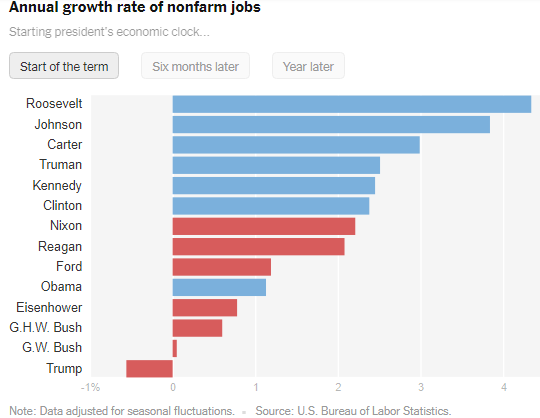
From: The Economy Does Much Better Under Democrats. Why? – The New York Times

“A president has only limited control over the economy. And yet there has been a stark pattern in the United States for nearly a century. The economy has grown significantly faster under Democratic presidents than Republican ones.”

“It’s true about almost any major indicator: gross domestic product, employment, incomes, productivity, even stock prices. It’s true if you examine only the precise period when a president is in office, or instead assume that a president’s policies affect the economy only after a lag and don’t start his economic clock until months after he takes office. The gap “holds almost regardless of how you define success,” two economics professors at Princeton, Alan Blinder and Mark Watson, write. They describe it as ‘startlingly large’.”

Untitled

” . . . if the causes are not fully clear, the pattern is. The American economy has performed much better under Democratic administrations than Republican ones, over both the last few decades and the last century.” 

From: AOC isn’t going to forget about the insurrection and move on – The Washington Post

“Alexandria Ocasio-Cortez says she was told that trauma victims should ‘tell their stories’ as a part of their healing. And that is what she did Monday night . . . The New York congresswoman initiated a live stream on Instagram and . . . recounted what had happened to her during the violent invasion of the U.S. Capitol on Jan. 6.’

“She talked about flattening herself behind her bathroom door as someone entered her office, screaming, ‘Where is she? Where is she?’ It turned out to be a police officer, but until she learned that, ‘I thought I was going to die’.”

“She talked about eventually escaping to the office of Rep. Katie Porter (Calif.), where the two Democratic congresswomen rifled through staffers’ gym bags, searching for sneakers they could change into in case they needed to jump out a window or run. . . .” 

“Ocasio-Cortez, her voice wavering, revealed during the live stream that she was a survivor of sexual assault, something she said many people did not know, because there were only so many times she’d wanted to tell that story. But she was mentioning it now, she said, because of its relevance to the attack at the Capitol.”

“Almost immediately after Jan. 6, she said, people began implying . . . that reconciliation depended on ‘moving on’. Those words, she said, were the tactics of ‘an abuser’.”

“She compared it to a sexual harasser telling his victim that the quickest path to normalcy would be her forgiving him. Or to parents telling the child they once abused that the mistreatment had happened in the past. . . .”

“There needs to be accountability, she said, because forgiveness does not happen when a perpetrator wants to move on. It happens when a victim is ready. . . .”

From: It’s Marjorie Taylor Greene’s Party Now – The New York Times

“Some decent Republicans imagine they’re in a battle for their party’s soul. Representative Adam Kinzinger, who . . . voted to impeach Txxxx, recently started a PAC devoted to fighting the forces that led . . . the Capitol rampage. “The time has come to choose what kind of party we will be,” he said in an introductory video. The thing is, Republicans already have chosen.

Just look at the party’s state affiliates. On Jan. 4, the Arizona G.O.P. retweeted a “Stop the Steal” activist who’d pronounced himself willing to “give my life” to overturn the election. Said the party’s official account: “He is. Are you?” An Arizona lawmaker has since introduced a bill that would let the Legislature, controlled by Republicans, override the presidential vote of the state’s increasingly Democratic citizenry. The Oregon Republican Party approved a resolution suggesting that the Capitol siege was a “false flag” attack. The Texas Republican Party has adopted the QAnon slogan “We are the storm” as its motto, though it insists there’s no connection. . . . 

[QAnon supporter Marjorie Taylor Greene] is not the outlier in this party. Kinzinger is.

“American conservatism — particularly its evangelical strain — has fostered derangement in its ranks for decades, insisting that no source of information outside its own self-reinforcing ideological bubble is trustworthy.”

“If you’re steeped in creationism and believe that elites are lying to you about the origins of life on earth, it’s not a stretch to believe they’re lying to you about a life-threatening virus. If what you know of history is the revisionist version of the Christian right, in which God deeded America to the faithful, then pluralism will feel like the theft of your birthright. If you believe that the last Democratic president was illegitimate, as Trump and other birthers claimed, then it’s not hard to believe that dark forces would foist another unconstitutional leader on the country.”

“There was a moment, after the Capitol riot, when it seemed as if a critical mass of the Republican Party was recoiling at what it had created. But the moment passed, because it would have required the party’s putative leaders to defy too many of their followers.”

From: More than two-thirds of Americans side with Biden on COVID relief — and most support the rest of his agenda – Yahoo News/YouGov Poll

“When asked about the 20 policies that define President Biden’s agenda, more Americans support than oppose all 20 of them, according to a new Yahoo News/YouGov poll.”

“The margins are decisive. The majority of Biden’s proposals garner at least twice as much support as opposition. Nearly half are favored by more than 60 percent of Americans.”

Facing the Truth about American Politics

Chris Hayes of MSNBC summed it up tonight:

Today, [House Minority Leader] Kevin McCarthy made a deeply humiliating, almost too awful to watch pilgrimage down to Mar-a-Lago to kiss the ring of the twice-impeached, possibly soon-to-be-indicted ex-president. Because there is no line to cross that goes too far for him or for them or for the party. This is where we are, folks, this is what everyone has to acknowledge. There will be no self-regulation. No self-governance. No, “Did we go too far?” No mea culpas. There will be no growth. This is what the contemporary Republican Party and conservative movement right now is, so now the question is, the question becomes “What do you do with that?” There are people like that who are part of the government of this country, who believe what they believe.

Paul Krugman expanded on the topic:

Here’s what we know about American politics: The Republican Party is stuck, probably irreversibly, in a doom loop of bizarro. If the Txxxx-incited Capitol insurrection didn’t snap the party back to sanity — and it didn’t — nothing will.

What isn’t clear yet is who, exactly, will end up facing doom. Will it be the [Republican Party] as a significant political force? Or will it be America as we know it? Unfortunately, we don’t know the answer. It depends a lot on how successful Republicans will be in suppressing votes.

Even I had some lingering hope that the Republican establishment might try to end Txxxxism. But such hopes died this week.

On Tuesday Mitch McConnell, the Senate minority leader, who has said that [the ex-president’s] role in fomenting the insurrection was impeachable, voted for a measure that would have declared [an impeachment] trial unconstitutional . . . 

On Thursday, the House minority leader — who still hasn’t conceded that Joe Biden legitimately won the presidency, but did declare that Txxxx “bears responsibility” for the attack on Congress . . . — visited Mar-a-Lago, presumably to make amends.

In other words, the G.O.P.’s national leadership, after briefly flirting with sense, has surrendered to the fantasies of the fringe. Cowardice rules.

And the fringe is consolidating its hold at the state level. The Arizona state party censured the Republican governor for the sin of belatedly trying to contain the coronavirus. The Texas G.O.P. has adopted the slogan “We are the storm,” which is associated with QAnon, although the party denies it intended any link. Oregon Republicans have endorsed the completely baseless claim, contradicted by the rioters themselves, that the attack on the Capitol was a left-wing false flag operation.

How did this happen to what was once the party of Dwight Eisenhower? Political scientists argue that traditional forces of moderation have been weakened by factors like the nationalization of politics and the rise of partisan media, notably Fox News.

This opens the door to a process of self-reinforcing extremism . . .  As hard-liners gain power within a group, they drive out moderates; what remains of the group is even more extreme, which drives out even more moderates; and so on. A party starts out complaining that taxes are too high; after a while it begins claiming that climate change is a giant hoax; it ends up believing that Democrats are Satanist pedophiles.

This process of radicalization began long before Dxxxx Txxxx; it goes back at least to Newt Gingrich’s takeover of Congress in 1994. But Txxxx’s reign of corruption and lies, followed by his refusal to concede and his attempt to overturn the election results, brought it to a head. And the cowardice of the Republican establishment has sealed the deal. One of America’s two major political parties has parted ways with facts, logic and democracy, and it’s not coming back.

What happens next? You might think that a party that goes off the deep end morally and intellectually would also find itself going off the deep end politically. And that has in fact happened in some states. Those fantasist Oregon Republicans, who have been shut out of power since 2013, seem to be going the way of their counterparts in California, a once-mighty party reduced to impotence in the face of a Democratic supermajority.

But it’s not at all clear that this will happen at a national level. True, as Republicans have become more extreme they have lost broad support; the G.O.P. has won the popular vote for president only once since 1988, and 2004 was an outlier influenced by the lingering rally-around-the-flag effects of 9/11.

Given the unrepresentative nature of our electoral system, however, Republicans can achieve power even while losing the popular vote. A majority of voters rejected Txxxx in 2016, but he became president anyway, and he came fairly close to pulling it out in 2020 despite a seven million vote deficit. The Senate is evenly divided even though Democratic members represent 41 million more people than Republicans.

And the Republican response to electoral defeat isn’t to change policies to win over voters; it is to try to rig the next election. Georgia has long been known for systematic suppression of Black voters . . . the Republicans who control the state are doubling down on disenfranchisement, with proposed new voter ID requirements and other measures to limit voting.

The bottom line is that we don’t know whether we’ve earned more than a temporary reprieve. A president who tried to retain power despite losing an election has been foiled. But a party that buys into bizarre conspiracy theories and denies the legitimacy of its opposition isn’t getting saner, and still has a good chance of taking complete power in four years.

Three more items:

Pennsylvania G.O.P. leaders have made loyalty to the defeated ex-president the sole organizing principle of the party, and would-be candidates are jockeying to prove they fought the hardest for him (NY Times).

After an election filled with misinformation and lies about fraud, Republicans have doubled down with a surge of bills to further restrict voting access in recent months, according to a new analysis . . .  There are currently 106 pending bills across 28 states that would restrict access to voting (The Guardian).

Arizona G.O.P. lawmaker introduces bill to give Legislature power to toss out election results (NBC News).

With the presidency and small majorities in the House and Senate, Democrats have an opportunity to deliver on many of their campaign promises, not just a few. That will almost certainly require ending or severely limiting the ability of the Republican minority in the Senate to kill legislation. If Democrats don’t have the foresight and courage to do that, we may be facing a very bleak future.