Whereof One Can Speak đŸ‡ș🇩

Nothing special, one post at a time since 2012

Fascist? Semi-fascist? You Be the Judge

You may have heard that Joe Biden said something impolite recently. At a fundraiser, he said:

What we’re seeing now is either the beginning or the death knell of an extreme MAGA philosophy. It’s not just T____, it’s the entire philosophy that underpins the — I’m going to say something — it’s like semi-fascism.

Later, at a rally, he added:

The MAGA Republicans don’t just threaten our personal rights and economic security. They’re a threat to our very democracy. They refuse to accept the will of the people. They embrace — embrace — political violence. They don’t believe in democracy.

Today, the Guardian published an interview with Jenna Griswold, who chairs the Democratic Association of Secretaries of State (the officials who, among other things, administer state elections):

Colorado’s secretary of state, Jena Griswold, is warning anyone who will listen that the fate of free and fair elections in the United States hangs in the balance in this November’s midterm contests.

In many of the most competitive races for offices with authority over US elections, Republicans nominated candidates who have embraced or echoed [the] myth of a stolen election in 2020.

Griswold … is urging Americans to pay attention to the once-sleepy down-ballot contests for secretary of state – lest they lose their democracy.

“What we can expect from the extreme Republicans running across this country is to undermine free and fair elections for the American people, strip Americans of the right to vote, refuse to address security breaches and, unfortunately, be more beholden to Mar-a-Lago than the American people,” Griswold, 37, said….

Dana Milbank of The Washington Post welcomed Biden’s language:

Good for him. Those who cherish democracy need to call out the proto-fascist [my emphasis] tendencies now seizing the T____-occupied GOP.

Republican candidates up and down the November ballot reject the legitimate outcome of the last election — and are making it easier to reject the will of the voters in the next. Violent anti-government rhetoric from party leaders targets the FBI, the Justice Department and the IRS. A systemic campaign of disinformation makes their supporters feel victimized by shadowy “elites.” These are hallmarks of authoritarianism.

President Biden still apparently thinks most Republican politicians are “mainstream”. They haven’t fallen under Dear Leader’s spell. But the past six years have shown that the Republican “mainstream” is now the Republican minority.

So what about fascism or semi-fascism? How should we describe today’s Republican Party?

The internet has lots of descriptions of fascism. I found one from six years ago, published two weeks before the disastrous 2016 election. “How fascist is D____ T____?” was written by J. R. McNeill, a history professor:

Since the 1950s, dozens of top historians and political scientists have put fascism, especially the Italian and German versions, under the microscope. They’ve come up with a pretty solid agreement on what it is, both as a political ideology and as a political movement, factoring in all the (sometimes contradictory) things its progenitors said as they ascended to power. As a political ideology, fascism has eight main traits. As a political movement, it has three more. So: Just how fascist is T____?

Prof. McNeill then lists eleven fascistic traits and grades the Republican’s two-time  presidential candidate and favorite to run again on each trait, using a scale of 1 to 4, with 4 being Hitler or Mussolini-level fascism. Keep in mind that in 2016 the professor hadn’t yet seen the “billionaire” candidate in action as president.

1 — Hyper-Nationalism: “By the standards of American politics, he is a hyper-nationalist, but by the standards of historical fascism, he is not in the upper echelon”: 2 points

2 — Militarism: “By and large, [he] does not blithely recommend military action and often lambastes his rivals for allegedly incompetent military adventurism. He does not dress his followers in ersatz military garb” (well, that’s something): 2 points

3 — Glorification of violence and readiness to use it in politics: “[His behavior is] well short of the standard of Mussolini’s blackshirts or Hitler’s brownshirts, who not only called for political violence but resorted to it extensively”: 1 out of 4, but knowing what we know now, let’s give the professor the benefit of the doubt. It has to be 2 or 3 now, so let’s say 2 1/2.

4 — Fetishization of youth: 0 points. He has nothing like the Hitler Youth, for example.

5 — Fetishization of masculinity: “On swaggering machismo he gets full marks”: 4 points.

6 — Leader cult: “Fascists always looked to a leader who was bold, decisive, manly, uncompromising and cruel when necessary — because the parlous state of the nation required such qualities. Mussolini and Hitler … encouraged their followers to idolize them as Il Duce and der FĂŒhrer.” (Remember “I alone can fix it” at the Republican convention? That should have immediately disqualified him): 4 points

7 — Lost-golden-age syndrome: Did someone say “Make America great again?”: 4 points

8 — Self-definition by opposition: Considering the myriad groups and individuals he’s condemned, it’s hard to believe he didn’t earn 4 points. But as Prof. McNeil says, “he does not advocate their annihilation, as Hitler did” (at least not in public): 3 points

9 — Mass mobilization and mass party: “He made a venerable [political party] into his vehicle” and “likes to refer to his following as a movement”. The professor only gave him 2 points, but since he later got 46% and 47% of the vote in two national elections (137 million votes in all, although less than his opponents), let’s bump his number up: 3 points

10 — Hierarchical party structure and tendency to purge the disloyal: “Fascist movements, like revolutions, ate their children. Anyone who displayed only tepid loyalty to the leader or who showed the potential to outshine the leader risked being purged or killed. So did followers who outlived their usefulness.” Prof. McNeil only gave him 1 point (no Night of the Long Knives), but given the fate of “moderate” Republicans these days: 2 points

11 — Theatricality: “In style and rhetoric, fascism was highly theatrical. Film and audio of Mussolini and Hitler make them seem like clownish buffoons, with their exaggerated gestures, their salutes, their overheated speeches full of absolutes and superlatives”. That sounds like somebody: 3 points

Prof. McNeil ended up giving the first-time presidential candidate 26 points out of a possible 44 on the fascist scale. His conclusion is interesting, especially given Biden’s recent remarks:

T____ is semi-fascist: more fascist than any successful American politician yet, and the most dangerous threat to pluralist democracy in this country in more than a century, but — thank our stars — an amateurish imitation of the real thing.

Having recent history in mind, I gave him 29 1/2 points. No Adolph or Benito, but definitely semi-fascist. And since nobody better represents today’s Republican Party, we should apply the same label to the outfit that should no longer be called the “Grand Old Party”.
Some Perspective on the Renegade Supreme Court Majority

We know they’re corrupt, but are they so out of the ordinary? David Cole is a law professor and the legal director of the ACLU. These are excerpts from a longer article from the New York Review of Books:

Over the course of the Supreme Court’s 232-year history, 110 men and six women have served as justices. Just a small handful of them have been “originalists,” holding the view that the only appropriate way to interpret the Constitution is to ask how its provisions were specifically understood at the time they were adopted. But in 2020 that handful became, for the first time, a majority of the Court when Amy Coney Barrett was confirmed, joining fellow originalists Clarence Thomas, Samuel Alito, Neil Gorsuch, and Brett Kavanaugh. (Chief Justice John Roberts is sometimes an originalist and sometimes not.) During the 2020–2021 term—Barrett’s first—the Court proceeded cautiously, mostly seeking consensus across ideological lines through narrow decisions.

But this past term, which concluded on June 30, these five individuals abandoned caution and exerted their newfound authority like few justices ever have. The Court eliminated the right to abortion, struck down a century-old New York law that limited the public carrying of guns, required Maine to fund religious education and a Washington State public school to allow its football coach to pray publicly at the fifty-yard line after games, blocked President Biden’s Covid vaccine mandate for large businesses, and denied the Environmental Protection Agency the authority to require power plants to shift away from coal in order to slow global warming. Compromise, consensus, and the rule of law are out; the radical exercise of power is in.

In several of its most controversial decisions, including those on abortion, gun control, and prayer, the Court invoked originalism to overturn long-standing law and precedent. That approach, if applied consistently, would upend virtually all of constitutional law. Because so few justices throughout American history have been originalists, constitutional law as it stands today, especially with respect to its open-ended guarantees of liberty, equality, and due process, bears little resemblance to how it was originally understood. To revert to that understanding would be plainly unacceptable; it would mean, for example, reviving “separate but equal” [schools for blacks and whites] and depriving women of equal protection. For better or worse, even the most committed originalists don’t apply originalism consistently, so it’s unlikely that the Court will resurrect Plessy v. Ferguson, the 1896 decision upholding segregation. But this past term, the new majority aggressively applied originalism to disastrous effect, and only they know how far they will go.

The biggest case of the term, and thus far of the century, was Dobbs v. Jackson Women’s Health Organization, in which five justices, including all three of [the previous president’s] nominees—Gorsuch, Kavanaugh, and Barrett—voted to overrule Roe v. Wade and about twenty other Supreme Court cases that had followed and applied Roe over nearly half a century. Dobbs will almost certainly be included among the Court’s worst decisions in history. Never has the Court eliminated a constitutional right so central to the equality and autonomy of half the nation. And never has the Court overturned precedent on such a transparently thin basis….

The majority’s conclusion that Roe was “egregiously wrong” rested on its view that the only appropriate way to interpret the Constitution is by reference to its “original understanding.” But there is another way to read the Constitution. It’s sometimes called the “living Constitution” or “common-law constitutionalism,” and it is the method used by virtually every justice in the Court’s history other than the five in the Dobbs majority, the late Antonin Scalia, and sometimes Chief Justice Roberts. Under that approach, the Court starts with the text of the Constitution but recognizes that its broad, open-ended terms—such as “liberty,” “due process,” and “equal protection”—were designed to evolve over time, through the accretion of precedent, the articulation of principle and fundamental norms, and reasoning by analogy. Under that approach, Roe is not “egregiously wrong” but plainly correct.

In a series of decisions over the last century, the Court has interpreted “liberty” in the Fourteenth Amendment in this way, and not exclusively by reference to its original understanding or “history and tradition.” It has relied on the provision to bar stomach-pumping to search for drugs and forced sterilization, and to protect the rights to use contraception, to marry someone of a different race or the same sex, to choose how to educate one’s children, and to engage in consensual sexual relations with adults of one’s own sex, despite the fact that none of these rights is expressly provided in the Constitution. The right to choose whether to bear a child is of a piece with these decisions and is therefore protected for the same reason. Roe is “egregiously wrong,” then, only if the methodology used by virtually every justice to have ever served on the Court is egregiously wrong….

Overturning precedent requires more than a determination that the prior ruling is wrong, because otherwise the Constitution would change each time the makeup of the Court does. Justice Alito conceded that the Court must also ask whether people have relied on the prior ruling before overturning it. But he callously dismissed such concerns… This is stunningly obtuse….While the majority opinion in Dobbs declared that “the most striking feature of the dissent is the absence of any serious discussion of the States’ interest in protecting fetal life,” the dissent quoted the majority’s own language back at it: “‘The most striking feature of the [majority] is the absence of any serious discussion’ of how its ruling will affect women.”

In New York State Rifle & Pistol Association, Inc. v. Bruen, the Court similarly elevated adherence to a crabbed view of history over both standard constitutional methodology and present-day reality….By the increasingly common margin of 6–3, struck down a New York law dating from 1911 that required individuals to demonstrate that they had a need to carry a gun in public before they could be licensed to do so….

The Second Amendment did not even protect an individual right to own a gun until the Court’s District of Columbia v. Heller decision in 2008. Before then, the courts, the Justice Department, and historians had long viewed the Second Amendment as protecting only the rights of states to field a militia, as a check on federal tyranny. In Heller, after a long and carefully orchestrated campaign by the National Rifle Association, the Supreme Court for the first time announced that the Second Amendment protected an individual right to possess a firearm in one’s home for self-defense…..At the time, however, the Court reassured the public that the Second Amendment right was not absolute and was subject to reasonable regulations…..

In Bruen, however, the Court went much further. In a decision written by Justice Thomas, it announced that the only gun regulations that the Constitution permits are those that have a direct analogue in laws that existed in the eighteenth century, when the Second Amendment was adopted, or possibly the nineteenth century, when Congress adopted the Fourteenth Amendment….In the absence of a specific historical precedent, any restrictions on the right to bear arms are unconstitutional—no matter how serious the threat guns pose to public safety or how reasonable the regulation…..

The Court’s approach is contrary to common sense, constitutional precedent, and the very history it purports to rely upon. Most fundamentally, why should states in the twenty-first century be limited to what states did centuries earlier, particularly when conditions have radically changed?

… The particular historical approach Justice Thomas announced, in which the only laws that are valid are those that mirror eighteenth- and nineteenth-century laws, applies to no other constitutional right. …With respect to virtually all other rights, courts also ask whether the state has a strong enough interest to limit the right, and whether it has done so in a sufficiently narrow way. This “means-ends” scrutiny, pervasive in constitutional law, governs free speech, free exercise, and equal protection claims, among others, and expressly allows for the assessment of contemporary needs and conditions….

But it gets worse. Defenders of New York’s law cited boatloads of historical examples of laws restricting the public carrying of weapons, spanning nearly seven hundred years. They include the Statute of Northampton, first enacted in 1328, which made it a crime to carry arms in public without the king’s permission and which was copied by several American colonies. Limits on carrying weapons continued through the founding era, and before and after the enactment of the Fourteenth Amendment. It should hardly be surprising that governments have long restricted the carrying of weapons in public.

Justice Thomas, however, found ways to reject each and every historical example. As Justice Breyer pointed out in a devastating dissent, Thomas found some “too old,” others “too recent.” “Some were enacted for the wrong reasons,” others “arose in historically unique circumstances.” Thomas’s wide-ranging set of excuses for rejecting analogues only underscores the subjective character of the enterprise and belies any claim that the historical method of interpretation significantly restrains judicial discretion….

Judging, especially at the Supreme Court level, requires not just a theory for interpreting constitutional law. It requires statesmanship, humility, an open mind, and, perhaps most importantly, respect for the institution and the accumulated judgment of one’s predecessors. As the Dobbs dissent noted, Justices Kennedy, O’Connor, and Souter [all nominated by Republican presidents] understood that:

The American public … should never conclude that its constitutional protections hang by a thread—that a new majority, adhering to a new “doctrinal school,” could “by dint of numbers” alone expunge their rights. It is hard—no, it is impossible—to conclude that anything else has happened here.

Next term the Court takes up the constitutionality of affirmative action, racial discrimination in redistricting, a sweeping challenge to the Indian Child Welfare Act, a claim that “expressive” businesses have a right to discriminate against gay couples … and an unprecedented and dangerous claim that state courts cannot police their legislatures when they gerrymander congressional districts. Whether the Court will continue its headstrong approach to all that has gone before it is likely to depend on how we as citizens respond to its initial salvos. If Americans mobilize, demonstrate, and vote on issues like abortion, gun control, and climate change, the Court will at some point have to take heed. But if we sit back and allow it to take away our rights and safety without a fight, there’s no telling how far the five [or six] justices who now exercise majority control will go.

Unquote.

It’s an excellent article, but I disagree with the author’s contention that this Court “will at some point have to take heed” of what the majority of American voters want. Short of Congress doing something like adding Supreme Court justices or limiting the Court’s ability to declare laws unconstitutional, this renegade Republican majority has absolute power. They can rule however they want and can always make up reasons for doing so.

Almost Anyone Can Be a U.S. Senator (There May Be New Evidence Pretty Soon)

The Constitution has three requirements to be a member of the U.S. Senate. You have to be at least 30 years old, have been a U.S. citizen for at least 9 years, and — by the time of the election — live in the state you will represent (so it’s perfectly fine if you live in New Jersey but, for some vague reason, are running for the Senate in Pennsylvania). Competence and interest in the job aren’t required.

Paul Waldman of The Washington Post asks what it means that a well-known, former football player (who meets the three qualifications) is running for the Senate in Georgia:

In the race for U.S. Senate in Georgia, Republican nominee Herschel Walker is forcing people to ask: Just how clueless is too clueless to serve in Congress? And what would it mean if our national legislature was filled with people like Walker?

The former football star’s campaign has been a series of howlers and head-scratchers, the latest of which is his argument against the recently passed Inflation Reduction Act: “They continue to try to fool you that they are helping you out. But they’re not … Because a lot of money it’s going to trees … Don’t we have enough trees around here?”

The possibility that Georgians are fed up with all their trees notwithstanding, no one says that Walker is the first office-seeker to lack even the most rudimentary understanding of policy or the issues he would confront. And there is in fact some money in the IRA to promote trees, including urban “heat islands” where a lack of shade trees increases temperatures.

But Walker’s comments on policy have been particularly colorful, including his thoughts on China hurting our environment by taking “our good air” and his proposal to address school shootings with “a department that can look at young men that’s looking at women that’s looking at social media.” Then there’s his recent debunking of evolution: “If that is true, why are there still apes? Think about it.”

Senate Minority Leader Mitch McConnell (R-Ky.) recently predicted his party might not win control of the chamber, saying “candidate quality has a lot to do with the outcome” of these races. No one doubted that Walker was one of the candidates he had in mind.

Yet Walker is hardly the only one; since so much rides on former president T____’s endorsement in Republican primaries and the most important qualification for winning that endorsement is an embrace of his conspiracy theories about the 2020 election, from coast to coast we’ve seen the party’s nominations won by crackpots and halfwits, perhaps more than ever before.

What would it mean if a bunch of these people actually won?

The greatest danger lies in executive positions such as governor and secretary of state, where they would have the power to steal elections and create all kinds of other disasters. But it’s not immediately clear that a Republican-controlled Congress dominated by the party’s worst and dimmest would be appreciably different from one led by its best and brightest, or at the very least its marginally clever.

There are multiple ways to be a terrible legislator, and being a dolt is only one of them. For instance, until 2021, Georgia was represented in the Senate by Republican David Perdue, who in his six years in the chamber wrote just a few bills that became law, including one to create a parking lot at the National Zoo and another renaming a post office. Georgians were left to wonder what, if anything, Perdue was actually doing in Washington, and when given the chance they tossed him out.

Perdue wasn’t too dumb to legislate; the job just didn’t seem to grab his interest. The truth is that while it doesn’t hurt to be smart if you’re a senator, you don’t have to be. You can let other people write the laws, and just have your party’s leadership or the hosts on Fox News tell you which way to vote when the time comes.

Today’s Republican Party also contains a cadre of extremely smart politicians educated at the most prestigious universities, people such as Sens. Ted Cruz of Texas (Princeton undergrad, Harvard Law School), Tom Cotton of Arkansas (Harvard undergrad and law school) and Josh Hawley of Missouri (Stanford undergrad, Yale Law School), who spend most of their time trying to Own the Libs, because they see that as the path to success in their party.

Which may be the smart thing to do if you’re a Republican who wants to run for president. And it shows the problem: When there are few incentives to do the hard work of legislating to address complex policy challenges, even the smart people see advantage in pretending to be stupid.

There’s a critical imbalance here as well: As members of the party that believes in government, Democrats know their supporters expect them to produce results, and as we’ve seen this year, that takes a lot of doing. Some may be better at it than others, but all are expected to demonstrate their commitment to the process.

Liberal voters also tend to value intellect in a way conservative voters just don’t. They may not always choose the smartest person (if they did, Sen. Elizabeth Warren would have been their 2020 presidential nominee). But they’re far less likely to fall for a politician telling them that all their problems can be solved by nurturing their resentment of supposedly snooty “elites.”

So the truth is that while Walker would probably displace Ron Johnson (R-Wis.) as the widely acknowledged dopiest member of the Senate if he were elected, that’s not why he’s such a threat. It’s not even Walker’s extraordinary record of telling easily disprovable lies. It’s the fact that if he wins it could mean Congress being in control of a party that elevates people like him.

The problem isn’t Walker, it’s that the Republican Party is dominated by politicians who in one way or another resemble him. His party doesn’t just tolerate ignorance and dishonesty, it often seems to want nothing more….

Unquote.

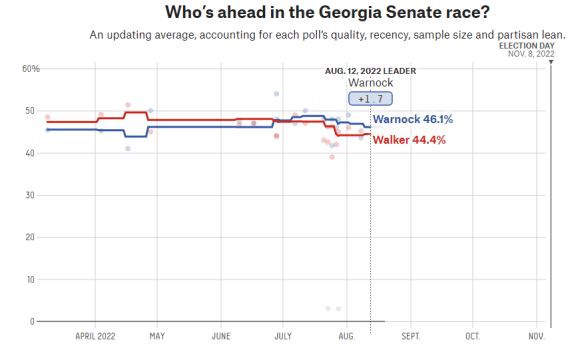
According to the FiveThirtyEight site, Georgia opinion polls say the incumbent, Democratic Sen. Raphael Warnock (a longtime Baptist minister and political activist with a PhD in theology, who has never threatened his wife with a gun, hasn’t lied about how many children he has and has never played football for the University of Georgia), has a small lead over Herschel Walker, after trailing in the Spring.

Untitled

What the Hell Is Their Problem?

I mean, what’s going on with these people?

Theda Skocpol, a sociologist and political scientists, explains the roots of right-wing resentment in America in this interview from The Atlantic:

Starting in 2008, a widely circulated conspiracy theory was that Barack Obama was not actually born in America…. Proof of this theory was never a requirement for subscribing to it; you could simply choose to believe that a Black liberal with a Muslim-sounding middle name was not one of us….

The country has not changed much…. Now, as then, you can take the right’s scramble for evidence of fraud with a grain of salt, she told me. The election deniers who say they are perturbed by late-night ballot dumps or dead people voting are actually concerned with something else.

“‘Stop the Steal’ is a metaphor,” Skocpol said, “for the country being taken away from the people who think they should rightfully be setting the tone.” More than a decade later, evidence remains secondary when what you’re really doing is questioning whose vote counts—and who counts as an American…..

Elaine Godfrey: Tell me what connection you see between the Tea Party movement that you studied and the T____-inspired Stop the Steal effort.

Theda Skocpol: There’s a definite line. Opinion polls tell us that people who participated in or sympathized with the Tea Party … were disproportionately angry about immigration and the loss of America as they know it. They became core supporters of T____. I’m quite certain that some organizations that were Tea Party–labeled helped organize Stop the Steal stuff.

T____ has expanded the appeal of an angry, resentful ethno-nationalist politics to younger whites. But it’s the same outlook.

Godfrey: So how do you interpret the broader Stop the Steal movement?

Skocpol: I don’t think Stop the Steal is about ballots at all. I don’t believe a lot of people really think that the votes weren’t counted correctly in 2020. They believe that urban people, metropolitan people—disproportionately young and minorities, to be sure, but frankly liberal whites—are an illegitimate brew that’s changing America in unrecognizable ways and taking it away from them. Stop the Steal is a way of saying that. Stop the Steal is a metaphor. And remember, they declared voting fraud before the election.

Godfrey: A metaphor?

Skocpol: It’s a metaphor for the country being taken away from the people who think they should rightfully be setting the tone. [Pennsylvania gubernatorial candidate] Doug Mastriano said it in so many words: It’s a Christian country. That doesn’t mean we’ll throw out everybody else, but they’ve got to accept that we’re the ones setting the tone. That’s what Hungary has in mind. Viktor Orbán has been going a little further. They’re a more muscular and violence-prone version of the same thing.

People [in Wisconsin] in 2016 who were otherwise quite normal would say, There’s something wrong with those votes from Milwaukee and Madison. I’d push back ever so gently and say, Those are big places; it takes a while to count the votes. I’d get a glassy-eyed stare at that point: No, something fishy is going on.

They feel disconnected from and dominated by people who have done something horrible to the country. And T____ gave voice to that. He’s a perfect resonant instrument for that—because he’s a bundle of narcissistic resentments. But he’s no longer necessary.

Godfrey: Elaborate on that for me.

Skocpol: He’s not necessary for an authoritarian movement to use the [Republicans] to lock in minority rule. The movement to manipulate election access and counting is so far along. I think it’s too late, and we’re vulnerable to it because of how we administer local elections.

What’s happened involves an interlocking set of things. It depends not just on candidates like T____ running for president and nationalizing popular fears and resentments, but also on state legislatures, which have been captured, and the Supreme Court. The Court is a keystone in all of this because it’s going to validate … manipulations that really are about locking in minority rule. In that sense, the turning point in American history may have happened in November 2016.

Godfrey: The turning point toward what?

Skocpol: Toward a locking-in of minority rule along ethno-nationalist lines. The objective is to disenfranchise metro people, period. I see a real chance of a long-term federal takeover by forces that are determined to maintain a fiction of a white, Christian, T____pist version of America.

That can’t work over the long run, because the fastest-growing parts of the country are demonized in that scheme of things. But a lot of things liberals do play into it: Democrats are the party of strong government, and they’re almost as fixated on the presidency as T____ists are…. The hour is late. This election this fall is critical.

Godfrey: Why so?

Skocpol: We’ve got about five pivotal states where election deniers—the culmination of the Tea Party–T____pist strand of the [Republican Party]—are close to gaining control of the levers of voting access and counting the results. If that happens, in even two of those places, it could well be enough. The way courts are operating now, they will not place limits on much of anything that happens in the states.

Godfrey: So what would you say is on the ballot in 2022?

Skocpol: The locking-in of minority authoritarian rule.

People talk about it in racial terms, and of course the racial side is very powerful. We had racial change from the 1960s on, and conservative people are angry about Black political power. But I wouldn’t underestimate the gender anger that’s channeled here: Relations between men and women have changed in ways that are very unsettling to them…..

This is directed at liberal whites, too. Tea Partiers talked about white people in college towns who voted Democratic the way the rulers of Iran would speak of Muslims that are liberal—as the near-devil.

Godfrey: What are the roots of that resentment?

Skocpol: The suspicion of cities and metro areas is a deep strand in America. In this period, it’s been deliberately stoked and exploited by people trying to limit the power of the federal government. They can build on the fears that conservatives have—about how their children leave for college and come back thinking differently. As soon as you get away from the places where upper-middle-class professionals are concentrated, what you see is decay. People see that. They’re resentful of it.

Anti-immigrant politics is very much at the core of this. Every time in the history of the U.S., when you reach the end of a period of immigration, you get a nativist reaction. When the newcomers come, they’re going to destroy the country. That’s an old theme in this country.

Godfrey: The 2016 election was surrounded by a lot of discussion about whether T____’s supporters were motivated by racism or economic anxiety. What’s your view on that?

Skocpol: That whole debate tends to be conducted with opinion polls. I’m in a minority, but I don’t find them very helpful for understanding American politics…. In American politics, everything is about the where.

If you drive into a place in Iowa or Nebraska where immigration is happening, it’s changed the shops downtown, it’s changed the language, it’s changed the churches, it’s changed the schools. And people’s jobs have changed—so it’s also about economics. In our 2011 interviews, Tea Party members were angry about immigrants. I’m not saying everybody in those communities is angry at newcomers, but it creates tensions that rabble-rousing politicians can take advantage of.

We know that T____ supporters, Stop the Steal supporters, are much more likely than other Republicans and conservatives to resent immigrants and fear them. In my 2017–2019 period of research, I visited eight pro-T____ counties. Tea Party types were just furious about immigrants. T____’s emphasis on immigration interjected the idea that the debate is about what the nature of America is.

T____ism is nativism. It’s also profoundly resentful of independent women, and it’s resentful of Black people whom it considers out of place politically. T____channeled that and fused it into one big, angry brew.

Godfrey: How organic have these movements been? At a certain point, we heard a lot about how the Tea Party movement became a Koch-funded operation, not a true grassroots movement.

Skocpol: The Tea Party was not created by the Koch brothers; it was taken advantage of by the Kochs. But the Kochs were not anti-immigrant. The Tea Partiers really were. The Kochs didn’t control the results. The Kochs didn’t select D____ T____. They didn’t even like him. Marco Rubio was their guy. The Chamber of Commerce crowd wanted a Bush. Both were easily dispatched by T____.

Republican leaders could have done something—and they still could. The real story is about Republican Party elites and their willingness to go along with what they’ve always known was over the top. That’s a mystery that’s a little hard to completely solve. A lot of the opportunists think they can ride that tiger without it devouring them, even though sometimes it does. But nobody seems to learn…..

Flooding the Zone with Bullshit

All politicians lie. So do the rest of us. What separates our two main political parties is that only one of them lies a lot. It’s part of their modus operandi. You won’t find Republicans admitting it’s their guiding strategy, but at least one did. From VOX:

We’re in an age of manufactured nihilism…..I call this “manufactured” because it’s the consequence of a deliberate strategy. It was distilled almost perfectly by Steve Bannon, the former head of Breitbart News and chief strategist for D____ T____. “The Democrats don’t matter,” Bannon reportedly said in 2018. “The real opposition is the media. And the way to deal with them is to flood the zone with shit.”

What we’re facing is a new form of propaganda that wasn’t really possible until the digital age. And it works not by creating a consensus around any particular narrative but by muddying the waters so that consensus isn’t achievable.

My theory is that Republicans lie so much for two reasons. Big elements of their policy agenda — like low taxes on the rich and cutting Social Security and Medicare — aren’t popular, so it helps to avoid the truth. It’s also the easiest way to stop Democrats from getting anything done. Democrats tend to think government can make people’s lives better. Republicans tend to disagree. Republican icon Ronald Reagan once said the most terrifying words in the English language are “I’m from the government and I’m here to help”. No Democrat would ever say that. The result is that some people, helped along by Fox News, Facebook, etc., believe the lies and others don’t know what to believe.

We’re witnessing an example of Republican lies and obfuscation right now. So far, the Lord of Mar-a-Lago and his supporters have suggested that Biden personally ordered the FBI search of the premises; that T____ had a perfect right to take those highly sensitive documents to Florida and not return them when the government wanted them back; that he needed them for his work; that he didn’t take them, the FBI agents planted them there during the “search”; that T____ could have declassified all those documents; yet there was an informal standing order that any document taken from the White House was automatically declassified (although nobody in the White House followed up on that informality and it would be irrelevant even if it were true, since the laws in question don’t say anything about whether documents are classified); and one of the latest: the White House staff didn’t pack them up, it was the General Services Administration, so I guess it was their fault the stuff went to Mar-a-Lago and were never returned.

Flooding the zone with bullshit.

Here are two other recent examples that got me thinking about this. The first pertains to the mysterious Mar-a-Lago documents. From The Washington Post:

When it comes to the sheer embrace of innuendo and a concerted lack of logical consistency, it’s difficult to top the latest entry….. In recent days, D____ T____ and conservative media have debuted a new whataboutism defense: What about Obama?

Several Fox News shows on Wednesday picked up on a New York Post column that noted Barack Obama at the end of his presidency had 30 million records shipped to Chicago for his presidential library. “They shipped 30 million pages of sensitive and possibly classified materials to Chicago, and, by the way, he has yet to return any of it to the National Archives. Not one page,” Fox host Sean Hannity intoned. “So is his house about to get raided?”

Former T____ campaign legal adviser Harmeet Dhillon added: “Are there SWAT teams descending on Chicago to get those documents? No. And so the double standard and triple standard here is very apparent”….

But there’s no evidence Obama has hidden anything from the Archives or that he didn’t go through the processes required to share and protect those documents once they left Washington.

And on Friday, after T____ raised the issue again, the Archives sought to put an end to the charade. It issued a statement outlining these facts and assuring that it has custody of classified documents:

The National Archives and Records Administration (NARA) assumed exclusive legal and physical custody of Obama Presidential records when President Barack Obama left office in 2017, in accordance with the Presidential Records Act (PRA). NARA moved approximately 30 million pages of unclassified records to a NARA facility in the Chicago area where they are maintained exclusively by NARA. Additionally, NARA maintains the classified Obama Presidential records in a NARA facility in the Washington, DC, area. As required by the PRA, former President Obama has no control over where and how NARA stores the Presidential records of his Administration.

In other words, there’s no parallel.

And from the Crooked Media newsletter, one more:

Two days ago, House Minority Leader Kevin McCarthy tweeted “Do you make $75,000 or less? Democrats’ new army of 87,000 IRS agents will be coming for you—with 710,000 new audits for Americans who earn less than $75k.” He was parroting talking points from basically every conservative politician and commentator that the Inflation Reduction Act’s $80 billion appropriation for the Internal Revenue Service means more taxes and more audits for middle-class Americans.

And it’s just not fucking true. The 87,000 agents figure was plucked from a Treasury report from May 2021, not even used in the Inflation Reduction Act. The facts are these: the IRS has been systematically defunded for decades, and total staff is currently equal to what it was during World War II, when the U.S. population was less than half what it is now. Much of the funding will go towards rehiring due to the fact that over half(!) the current IRS staff is eligible for retirement in the next five years.

Onto the audits: IRS Commissioner Charles Rettig, who was appointed by D____ T____, said in an August 4 letter to lawmakers that after the bill was approved, “audit scrutiny” would not be raised on small businesses or middle-income Americans. Rettig, I repeat: a T____ appointee, said, “The proposal would direct that additional resources go toward enforcement against those with the highest incomes, rather than Americans with actual income of less than $400,000.” Which is, you know, exactly what Democrats have been saying this whole time…..

Wealthy Republican lawmakers and pundits have a vested interest in killing any tax bill that targets them, and they use this same playbook of spuriously insisting that the middle class will suffer every time.