A Tax Break That Will Never Die

Democrats are on the verge of passing a major bill that will attack the climate crisis, expand healthcare, slow down inflation, reduce the deficit, and even deal with tax evasion. In order to get all fifty Democratic senators to support the bill, a piece of the bill that would have raised taxes on a small number of very wealthy people was dropped. It’s a classic example of the way money corrupts American politics. From The New York Times:

Once again, carried interest carried the day.

The last-minute removal by Senate Democrats of a provision in the climate and tax legislation that would narrow what is often referred to as the “carried interest loophole” represents the latest win for the private equity and hedge fund industries. For years, those businesses have successfully lobbied to kill bills that aimed to end or limit a quirk in the tax code that allows executives to pay lower tax rates than many of their salaried employees.

In recent weeks, it appeared that the benefit could be scaled back, but a last-minute intervention by Senator Kyrsten Sinema, the Arizona Democrat, eliminated what would have been a $14 billion tax increase targeting private equity.

Lawmakers’ inability to address a tax break that Democrats and some Republicans have called unfair underscores the influence of lobbyists for the finance industry and how difficult it can be to change the tax code….

On Friday, the private equity and hedge fund industries applauded the development, describing it as a win for small business [of course they did].

“The private equity industry directly employs over 11 million Americans, fuels thousands of small businesses and delivers the strongest returns for pensions,” said Drew Maloney, the chief executive of the American Investment Council, a lobbying group. “We encourage Congress to continue to support private capital investment in every state across our country”….

Carried interest is the percentage of an investment’s gains that a private equity partner or hedge fund manager takes as compensation. At most private equity firms and hedge funds, the share of profits paid to managers is about 20 percent [so the people who manage these small investment firms take around 20% of the firm’s investment profits as their salaries, not because they invested their own money but because they expect to be paid for their labor].

Under existing law, that money is taxed at a capital-gains rate of 20 percent for top earners. That’s about half the rate of the top individual income tax bracket, which is 37 percent….

An agreement reached last week by Senator Joe Manchin III, Democrat of West Virginia, and Senator Chuck Schumer of New York, the majority leader, would have [made it more harder for the managers of these firms] to take advantage of the lower 20 percent tax rate.

But Ms. Sinema, who has received political donations from wealthy financiers who usually donate to Republicans and who was cool to the idea of targeting carried interest last year, objected.

In the past five years, the senator has received $2.2 million in campaign contributions from investment industry executives and political action committees, according to OpenSecrets, a nonprofit group that tracks money in politics. The industry was second only to retired individuals in giving to Ms. Sinema and just ahead of the legal profession, which gave her $1.8 million. Executives of some of those firms have made campaign contributions to Ms. Sinema, including George Roberts, Henry Kravis and Joseph Bae at KKR and Sean Klimczak and Eli Nagler at Blackstone.

For years, carried interest has been a tax policy piñata that never cracks open.

During the 2016 presidential campaign, D____  J. T____ said, “We will eliminate the carried interest deduction, well-known deduction, and other special-interest loopholes that have been so good for Wall Street investors and for people like me but unfair to American workers.”

When President Biden ran for president in 2020, his campaign said he would “eliminate special tax breaks that reward special interests and get rid of the capital gains loophole for multimillionaires.” To do that, he said, he would tax long-term capital gains at the ordinary top income tax rate, essentially wiping away the special treatment of carried interest.

A similar proposal appeared in Mr. Biden’s budget last spring, but, as Democrats tried unsuccessfully to pass their Build Back Better legislation in the summer and fall, carried interest disappeared.

Jared Bernstein, a member of the White House’s Council of Economic Advisers, lamented that outcome. “This is a loophole that absolutely should be closed,” Mr. Bernstein told CNBC last September. “When you go up to Capitol Hill and you start negotiating on taxes, there are more lobbyists in this town on taxes than there are members of Congress”….

Opinions on the carried interest tax treatment vary even within the financial industry. In posts on Twitter in late July, Bill Ackman, the founder of Pershing Square Capital Management, a New York hedge fund, said that while “favorable tax treatment” for the founders of new businesses was essential, people who manage funds that own many companies should not be entitled to the same benefit.

“The carried interest loophole is a stain on the tax code,” he wrote in one post. “It does not help small businesses, pension funds, other investors in hedge funds or private equity and everyone in the industry knows it. It is an embarrassment and it should end now.”

Some analysts were skeptical all along that lawmakers would actually change the carried interest tax treatment in the final bill. While it has become a high-profile target, the change Democrats were seeking would have raised little tax revenue compared with other provisions in the legislation, known as the Inflation Reduction Act….

“The proposal that was in the bill until last night made a technical adjustment [regarding] assets that qualified for carried interest treatment,” said Jean Ross, a senior fellow at the Center for American Progress, a liberal research group in Washington. “A better approach would tackle the issue head-on and say that compensation for services managing an investment fund should be taxed like work and subject to ordinary tax rates”….

Ms. Sinema herself has said little about why she considered it so important to preserve the carried interest tax treatment [could that possibly mean she has no good reason for doing that?]. She has said that she plans to work on legislation with Senator Mark Warner, Democrat of Virginia, to address the loophole. But if the legislation is not included in the current package, which is being fast-tracked under an arcane budget process, any reform will require support from at least 10 Republicans [which everyone, including Sinema, knows will mean nothing is done, since Republican politicians don’t like rich people to be taxed].

“I think we reached agreement that there are areas where there’s been abuse,” Mr. Warner said in an interview, adding, “I’m disappointed it didn’t get in this bill, but I’m looking forward to working with Senator Sinema — and others — to see if we can address this [news flash: you can’t and you won’t address it].

Unquote.

To summarize, if you’re an accountant that works at one of these firms, you get a salary and pay income tax at the rate for regular income. If you’re a customer at one of these firms and your investment did well, the profits you get are taxed at the lower rate for capital gains. If you run the firm, you take some of the profits from your customers’ investments as your compensation, but the government taxes your compensation as if you made the investment with your own money, so you get to pay significantly less income tax. If Democrats try to fix this absurdity, Republicans and even some Democrats will stand in the way, while you claim that your compensation should be taxed at the lower rate because, well, because your customers get the lower rate and the investments you make help other businesses (while sometimes destroying others).

Which shows once again that too many politicians work for their donors, not the people they represent.


In Conclusion: On Corruption

From “The Golden Age of White Collar Crime by Michael Hobbes:

Over the last two years, nearly every institution of American life has taken on the unmistakable stench of moral rot. Corporate behemoths like Boeing and Wells Fargo have traded blue-chip credibility for white-collar callousness. Elite universities are selling admission spots to the highest Hollywood bidder. Silicon Valley unicorns have revealed themselves as long cons (Theranos), venture-capital cremation devices (Uber, WeWork) or straightforward comic book supervillains (Facebook). Every week unearths a cabinet-level political scandal that would have defined any other presidency. From the blackouts in California to the bloated bonuses on Wall Street to the entire biography of Jeffrey Epstein, it is impossible to look around the country and not get the feeling that elites are slowly looting it.

And why wouldn’t they? The criminal justice system has given up all pretense that the crimes of the wealthy are worth taking seriously. In January 2019, white-collar prosecutions fell to their lowest level since researchers started tracking them in 1998. Even within the dwindling number of prosecutions, most are cases against low-level con artists and small-fry financial schemes. Since 2015, criminal penalties levied by the Justice Department have fallen from $3.6 billion to roughly $110 million. Illicit profits seized by the Securities and Exchange Commission have reportedly dropped by more than half. In 2018, a year when nearly 19,000 people were sentenced in federal court for drug crimes alone, prosecutors convicted just 37 corporate criminals who worked at firms with more than 50 employees.

Unquote.

But we had a presidential candidate focused on corruption.

From “Elizabeth Warren Was More of a Threat to the Money Power Than Bernie Sanders” by Charles Pierce:

… I’m not going to dwell on the sexism that so regularly cropped up during Elizabeth Warren’s now-suspended presidential campaign. Proud, accomplished women, writing about what happened to this proud and accomplished woman, already have done so thoroughly enough that what little I could add would have to walk a tightrope between repetition and presumption that I am not able to navigate. This one hurts them in ways I can’t even imagine….

Instead, and accepting that sexism and misogyny were marbled throughout everything about the campaign, I think what did her in was her ideas. She committed herself to a campaign specifically to fight political corruption, both the legal and illegal kind. As an adjunct to that, she marshaled her long fight against the power of money in our politics and monopoly in our economy. And, opposed to Bernie Sanders, whose answer to how to wage the fight is always the power of his “movement,” which so far hasn’t been able to break through against Joe Biden, she put out detailed plans on how to do it. That made her much more of a threat to the money power than Sanders, who is easily dismissed as a fringe socialist by the people who buy elections and own the country.

If I were Jeff Bezos, and I heard Elizabeth Warren talk about how monopoly can distort an economy, I’d have been worried. If I were Mark Zuckerberg, and I heard Elizabeth Warren talk about how the concentration of social media perverts our public ideals, I’d have been worried. If I were the folks at Comcast, and I heard Elizabeth Warren talk about how media concentration damages the national dialogue, I’d have been worried. I’d have been worried not simply because a presidential candidate was saying this, but because she was able to make people understand it, and because she was able to show people how she would do it. That would keep me up nights.

There always has been a touch of Cassandra to her career. As she said on Thursday, “Ten years ago, I was teaching a few blocks from here, and talking about what was broken in America and how to fix it, and pretty much nobody wanted to hear it.” Along with several other proud and accomplished women, whose advice was ignored by the likes of Larry Summers and Robert Rubin, Warren sounded the alarm on the mortgage crisis years before it crashed the economy. She was then brought in to help clean up the damage. There’s an obvious life lesson in there that I hope I need not explain. However, if she says something is breaking in the economy, listen to her next time, OK? This was most obvious in the campaign’s most curious episode—how she was “disappeared” from news coverage after finishing third in Iowa. This was the period in which an NBC poll refused to even include her because, basically, the pollster didn’t want to. Amy Klobuchar was included, but Amy Klobuchar wasn’t going around explaining how media monopolies gouge their consumers and marginalize certain issues and the people fighting for them.

However, this is not a country that is ready for what she called … “big, structural change”. This is a country fearful of any kind of change at all, a country longing for a simpler time—which, these days, does not mean the flush 1950s or the pastoral 1850s, but 2015. The election of D— T—- has lodged in so many minds a longing for the status quo ante that there’s no room for intelligent experimentation….

The problem is that the damage done by this administration* is so deep and lasting that the last thing we need to follow this president* is a humble president with a humble agenda. For example, Joe Biden has no desire to break the monopoly power, and Bernie Sanders doesn’t have the first idea how to do it. But it’s still going to be there, distorting the economy and perverting the public discourse, no matter who gets elected in the fall. You might be frightened by the idea of Big, Structural Change but, without it, the deterioration of the republic will continue apace. We have been rendered such a timorous people that even someone as open and lively and welcoming as Elizabeth Warren was considered too much of a risk.

Oh, and she wasn’t “likable” either. Remember? God, what a load of bollocks that is.

As if to prove that Fate is the ultimate troll, this story broke in The New York Times on the morning that Elizabeth Warren suspended her campaign.

House Democrats say the bank found an ally in Eric Blankenstein, a political appointee high up in the Consumer Financial Protection Bureau, the agency created to guard against the abuse of mom-and-pop customers. Mr. Blankenstein, an enforcement official at the agency, privately offered reassurances to Wells Fargo’s chief executive at the time that there would be “political oversight” of its enforcement actions, according to a report issued Wednesday by the House Financial Services Committee. The report said the agency had promised that the unresolved regulatory matters, such as an inquiry into the bank’s aggressive practice of closing customers’ accounts, would be settled in private, without further fines.

For those of you who may be joining politics late, the CFPB is the agency created by Elizabeth Warren and Wells Fargo is her personal bete noire. (Here she is, telling its CEO that he ought to be clapped in irons.) My guess? She already knows about this bit of news and she’s gearing up—one might even say “planning”—to chew someone out over it. Stay buckled up, America. Senator Professor Warren is not through with you yet.

Unquote.

A Bright Spot on the Distant Horizon?

Things are not getting better in Washington. To put it mildly. The T@@@p administration continues to resist any congressional oversight. Democrats direct witnesses to appear, sometimes issue subpoenas, the administration refuses to cooperate and the disputes vanish into the glacially-slow bowels of the federal courts.

The Treasury Department has refused to give the president’s tax returns to Congress, as required by law. The Director of National Intelligence is refusing to transmit a whistle blower’s complaint to Congress, even though it pertains to national security and the law says Congress shall receive it. The Judiciary Committee finally got a T@@@p associate to appear yesterday and it got very little coverage, even though the witness confirmed that the president obstructed justice. There is now more evidence that the administration’s last appointment to the Supreme Court lied to Congress and the FBI’s vetting investigation was a sham. The leading Democrat in the Senate doesn’t want to talk about it.

Congressional committees can hold people in contempt and fine them thousands of dollars a day or put them in jail. They have gone to court instead. The Speaker of the House could create a special committee devoted to impeaching the president, but she resists even saying the word “impeachment”. Meanwhile, the Judiciary Committee’s impeachment inquiry is just one item on their agenda. They may have another hearing next week.

Meanwhile, the president is using money Congress appropriated for the Defense Department to build his wall. It’s going to damage environmentally-sensitive areas along the border. The Justice Department is investigating automakers because they agreed with the state of California to protect air quality. Now the president wants to remove California’s ability to set its own air quality standards, as California has been permitted to do for decades. T@@@p is also threatening to round up homeless people in Los Angeles and put them who knows where, even though he has no authority to do so. His Immigration and Customs Enforcement police force is training for urban warfare. And there may be war around the Persian Gulf.

There are too many scandals and other offenses for most mortals to keep track of. Unlike Hillary’s emails, which were beaten to death, journalists and pundits jump from one topic to the next. Los Angeles writer Amy Siskind continues to document as much as she can at The Weekly List, but there is too much to digest (if you’re interested, she accepts small donations to support her work).

So is there a bright spot on the horizon? Here’s a hint.

EErknsGXYAULWGSgettyimages-1168719088merlin_160921611_f00988a6-ab58-471d-92d4-cc721bc3810c-jumbomerlin_160921593_4121a1d9-ed39-4363-bc05-36f6443a5267-jumbo

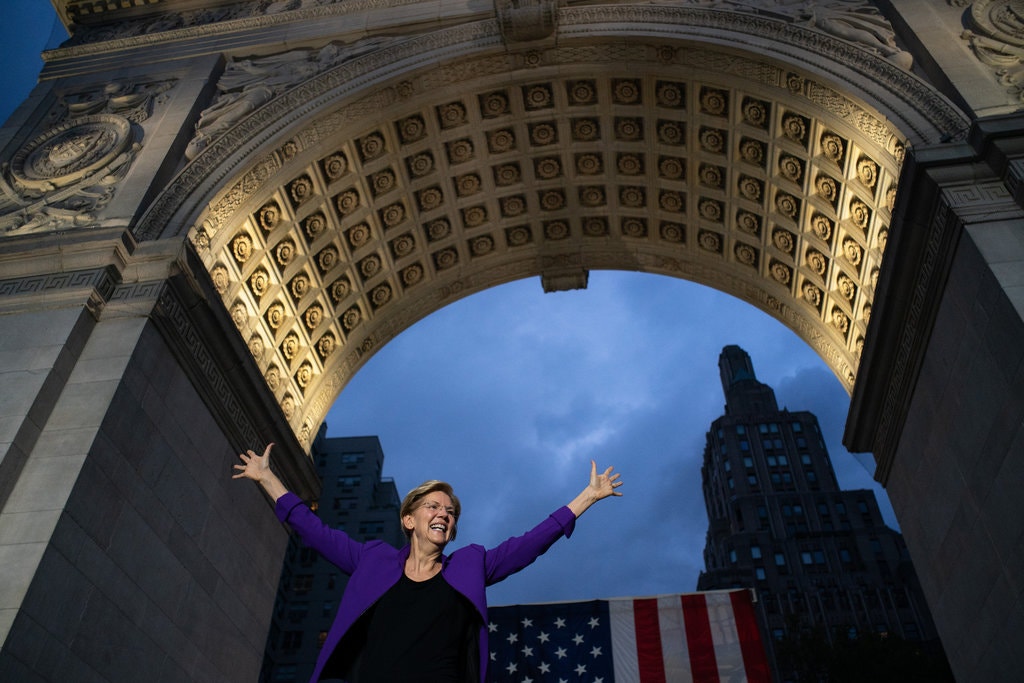
She gave a speech in New York this week. Up to 20,000 people attended. She called for big, structural change to address the corruption in our politics (she called our president “corruption in the flesh”). She believes that corruption is the fundamental reason Washington doesn’t work for average people. She spent four hours after the speech having her picture taken with a very long line of people. When complimented on her stamina, she said she stayed for four hours but so did the last guy in line. Polls now show her in second place for the Democratic nomination. The latest poll in Iowa, where the first votes will be cast, has her in the lead. Her campaign slogan is “Dream Big, Fight Hard”. She’ll make a great president if we make it that far.

Political Corruption in America, Then and Now

Zephyr Teachout is a law professor at Fordham University. She recently ran against Governor Andrew Cuomo in the Democratic primary, a quixotic venture if her goal was to become the Governor of New York. Her more realistic goals included calling attention to Cuomo’s political shenanigans, highlighting ways to improve our politics and maybe selling a few copies of her book (we all have to eat).

The book is Corruption in America: From Benjamin Franklin’s Snuff Box to Citizens United. The snuff box was a diamond-encrusted gift that Louis XVI gave to our ambassador to France. “Citizens United” is the recent Supreme Court decision allowing corporations and other organizations to influence elections as much as possible by spending unlimited amounts of money.

From a review of Corruption in America by the journalist Thomas Frank:

Today’s [Supreme Court] understands “corruption” as a remarkably rare malady, a straight-up exchange of money for official acts. Any definition broader than that, the justices say, transgresses the all-important First Amendment. Besides, as Justice Anthony Kennedy announced in the Citizens United decision, the court now knows that “independent expenditures, including those made by corporations, do not give rise to corruption or the appearance of corruption” — a statement that I guess makes sense somehow in law-land but sounds to the layman’s ear like the patter of a man who has come unzipped from reality….

Our current Supreme Court, in Citizens United, “took that which had been named corrupt for over 200 years” — which is to say, gifts to politicians — “and renamed it legitimate.” Teachout does not exaggerate. Here is Justice Kennedy again, in the Citizens United decision: “The censorship we now confront is vast in its reach. The government has ‘muffle[d] the voices that best represent the most significant segments of the economy.’ ”

You read that right: The economy needs to be represented in democratic politics, or at least the economy’s “most significant segments,” whatever those are, and therefore corporate “speech,” meaning gifts, ought not to be censored. Corporations now possess the rights that the founders reserved for citizens, and as Teachout explains, what used to be called “corruption becomes democratic responsiveness.”

Being “unzipped from reality” aptly describes much of our politics, including a series of decisions by our Republican-dominated Supreme Court.

Did it matter that the Supreme Court helped George Bush get elected in 2000, which made it possible for him to be reelected in 2004? David Cole, writing in the New York Review of Books, reminds us:

… when Justice [Sandra Day] O’Connor announced her retirement and Chief Justice Rehnquist died in office in 2005, President Bush, not Al Gore or a successor, had the privilege of appointing two new justices and shaping the Court for years to come. Had a Democratic president been able to replace Rehnquist and O’Connor, constitutional law today would be dramatically different. Affirmative action would be on firm constitutional ground. The Voting Rights Act would remain in place. The Second Amendment would protect only the state’s authority to raise militias, not private individuals’ right to own guns. Women’s right to terminate a pregnancy would be robustly protected. The validity of Obamacare would never have been in doubt. Consumers and employees would be able to challenge abusive corporate action in class action lawsuits. And Citizens United v. Federal Election Commission, which struck down regulations on corporate political campaign expenditures and called into question a range of campaign spending rules, would have come out the other way. But it was not to be.

Returning to Thomas Frank’s review of Zephyr Teachout’s book, it’s hard to believe that political lobbying used to be shameful, even criminal, not a multi-billion-dollar industry:

Once upon a time, lobbying was regarded as obviously perfidious; in California it was a felony; and contracts to lobby were regarded as reprehensible by the Supreme Court. Here is a justice of that body in the year 1854, delivering the court’s decision in a case concerning lobbyists and lobbying contracts:

“The use of such means and such agents will have the effect to subject the state governments to the combined capital of wealthy corporations, and produce universal corruption, commencing with the representative and ending with the elector. Speculators in legislation, public and private, a compact corps of venal solicitors, vending their secret influences, will infest the capital of the Union and of every state, till corruption shall become the normal condition of the body politic, and it will be said of us as of Rome —omne Romae venale [in Rome, everything is for sale].”

Well, folks, it happened all right, just as predicted. State governments subject to wealthy corporations? Check. Speculators in legislation, infesting the capital? They call it K Street. And that fancy Latin remark about Rome? They do say that of us today. Just turn on your TV sometime and let the cynicism flow.

And all of it has happened, Teachout admonishes, because the founders’ understanding of corruption has been methodically taken apart by a Supreme Court that cynically pretends to worship the founders’ every word. “We could lose our democracy in the process,” Teachout warns, a bit of hyperbole that maybe it’s time to start taking seriously.

Considering how money pollutes our politics, and how gerrymandering, vote suppression, low turnout (especially among the young and the poor) and the Constitution itself skew the results, the idea that America is an oligarchy, not a democracy, doesn’t sound hyperbolic at all.  

Nevertheless, quixotic or not, I’m still going to vote in a couple weeks for the Democratic candidates for the U.S. Senate (he’s sure to win) and the House (she’s sure to lose), as well as for bail reform and more environmental funding. It’s the least I can do.