Good and Bad Behavior From a Perspectivist Perspective

And God said: “Take now thy son, thine only son Isaac, whom thou lovest, and get thee into the land of Moriah; and offer him there for a burnt offering.”

A few days later: “They came to the place which God had told him of; and Abraham built an alter there, and laid the wood in order, and bound Isaac his son, and laid him on the alter upon the wood…And Abraham stretched forth his hand, and took the knife to slay his son.”

But God presented Abraham with a ram to sacrifice instead!

Now, some people think God would never have let Isaac be sacrificed. God does not or cannot do bad things. Other people think God could have let the sacrifice proceed. In that case, depending on who you ask, Abraham should have killed Isaac, because that was God’s will, or he shouldn’t have, because it would have been immoral (and maybe God was hoping Abraham would spare Isaac anyway, just like the tricky aliens in Star Trek often test the humans). Then there are people like me who think these verses from Genesis are nothing but a provocative story.

What makes the story provocative, of course, is that it sets up a supposed conflict between God’s commands and morality. On one hand, disobeying a direct order from God might be a very big mistake, not just because of the lighting bolt thing, but because the Supreme Being presumably knows what’s best for all of us. On the other hand, morality is often thought to be the ultimate perspective from which to evaluate behavior, whether human or divine. The ethical thing to do is always the right thing to do. 

So what should Abraham have done? It’s relatively easy for the non-religious or anti-supernatural among us, comfortably moralizing in 2015, to say Abraham should have refused to sacrifice Isaac. But from a religious perspective, one can easily conclude the opposite. From that perspective, our fundamental responsibility is to obey God’s commandments, whether they’re truly ethical or not. The theologians who argue that God can’t do anything immoral seem to be trying to glorify God, rationalizing like those of us who do bad things but want to believe our actions are ethically justified. If the religious perspective is different from the ethical perspective, perhaps the ethical perspective isn’t supreme after all. Not for everyone anyway.

If you don’t think a religious perspective could ever trump the ethical one, consider a perspective we might call the “relational”. In 1793, William Godwin asked his readers to consider which of two people they would rescue from a fire: a great humanitarian who would serve mankind for years to come or a lowly chambermaid who would never rise above her station. Godwin thought it was obvious from an ethical perspective that the humanitarian should be saved first, risking the life of the chambermaid, since that would have the best consequences for the most people. You might agree, but what if the chambermaid was your mother? 

It could be argued that saving your mother would be the ethical choice because of your special relationship. What kind of unfeeling, disloyal child would let his or her mother burn to death instead of some stranger, even a world-famous humanitarian? But giving special consideration to the members of one’s family is questionable from an ethical perspective. We can try to explain how favoritism can be ethical but that’s simply more rationalization.

Kant, for example, took morality so seriously that he once claimed we should never tell a lie, not even to “a murderer who asks us whether a friend of ours whom he is pursuing has taken refuge in our house”. If there is an absolute ethical prohibition against telling a lie, and the ethical perspective is the supreme guide to life, so much the worse for your relatives hiding in the basement when the Nazis show up. Or consider the ethical argument for donating much of your income to help refugees in Africa or the Middle East. Is it ethical to pay for music lessons for your children when you could use that money to make a Somali child’s life more bearable? Perhaps favoritism should trump morality sometimes (where the “should” isn’t meant in the ethical sense). We know it often does.

Of course, I’m not saying that the ethical perspective is unimportant. Society could hardly exist without it. But I think there are other perspectives that are also important. They come into play whenever we make a decision or evaluate behavior. In fact, the only way to justify ethical behavior as a whole is by appealing to non-ethical perspectives (just as you cannot justify being practical from a practical perspective or viewing the world scientifically from a scientific perspective). 

Why should we concern ourselves with morality at all? Historically, it’s often been justified from a religious perspective (God commands us to behave ethically) or from a practical perspective (society couldn’t function without it; you’ll get into trouble if you’re unethical) or from a personal perspective (I want to act like a virtuous person). Another justification that’s been popular among philosophers is from a rational or logical perspective (we should treat all people equally since there are no relevant differences between us).

I think it’s important to understand the various perspectives from which we view the world and try to live in it, as well as the relationships between those perspectives. Admitting that we don’t always behave as if the ethical perspective is paramount is a good first step. We might then do a better job figuring out how to balance our many perspectives, such as the ethical, religious, “relational”, practical and scientific; as well as my perspective, your perspective and the perspectives of other living things. After all, even when it comes to morality, the fundamental rule we first learned is to evaluate behavior from other people’s perspectives as well as our own.

It’s a Matter of Perspective

One afternoon, about four years ago, I was walking along in our neighborhood when it occurred to me that every perception or thought we have, every emotion we feel, every conclusion we reach, every command we issue or question we ask is from our particular, individual perspective.

Well, of course. That’s a truism, a statement so obviously true it’s hardly worth stating. We each have our own perspective. So what?

I don’t know, but ever since then I’ve been thinking about what it means to have a perspective or be from a perspective, and how different perspectives relate to each other. Not every waking moment, of course. But you might be surprised how often you’ll see the word “perspective” or a similar expression like “point of view” or “frame of reference” once you start paying attention.

For instance, there’s the way paintings or drawings give the impression that a two-dimensional surface has three dimensions. Turner used perspective when he painted Oxford’s High Street: 

high_turner

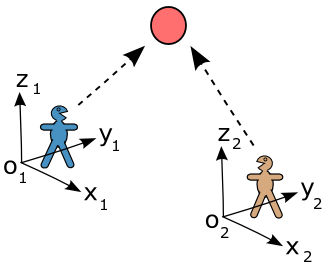
Underlying the artistic technique is the fact that we each have a physical perspective from which we observe the world. Each observer has what physicists call a “reference frame”, a “coordinate system attached to [the] individual observer’s perspective”, from which measurements are made. It’s one of the key concepts in Einstein’s theory of relativity.

Frame_of_reference

In addition to our physical perspective, we each have what our own “personal” perspective. It includes our particular desires, needs and interests. Personally speaking, It seems like a good idea — from my perspective — to be writing this (I have my reasons). From your personal perspective, it might be better to take a walk or go to bed.

Another type of perspective depends on what conceptual schemes or ways of thinking. We usually deal with the world from what we think is a practical or prudential perspective, but sometimes opt for a perspective that’s ethical or religious. We complain about politicians who function from a purely political perspective and celebrate those who champion a scientific or global perspective. There are so many perspectives that library shelves sag under books with inviting (?) subtitles like “Ecological and Experimental Perspectives”, “A Probabilistic Perspective”, “Perspectives from Philosophy, Psychology and Theology”, “Multicultural Perspectives” and “A Supply-Chain Perspective”.

In future posts, I’d like to occasionally discuss perspective from various perspectives. For example, why choose one perspective instead of another? Are multiple perspectives always better? How can a perspective be justified? Can it only be done from another perspective? Is there or should there be a hierarchy of perspectives? Is it really possible to adopt someone else’s perspective? Does morality depend on being able to do so? How does the philosophical position called “perspectivism”, associated with Nieztsche, differ from relativism? And is perspectivism preferable to the better-known view? 

For now, here’s a passage from Sarah Bakewell’s How to Live: Or a Life of Montaigne in One Question and Twenty Attempts at an Answer:

In the view of William James, as of Leonard Woolf and Montaigne, we do not live immured in our separate perspectives, like Descartes in his room.We live porously and sociably. We can glide out of our own minds, if only for a few moments, in order to occupy another being’s point of view. This ability is the real meaning of “Be convivial”, this chapter’s answer to the question of how to live, and the best hope for civilization.

Scientific Perspectivism by Ronald N. Giere

Scientific perspectivism, as Professor Giere describes it, is a somewhat weak form of scientific realism: “For a perspectival realist, the strongest claims a scientist can legitimately make are of a qualified, conditional form: ‘According to this highly confirmed theory (or reliable instrument), the world seems to be roughly such and such’. There is no way legitimately to take the further objectivist step and declare unconditionally: ‘This theory (or instrument) provides us with a complete and literally correct picture of the world itself'” (pp. 5-6).

Even the most accurate instrument gives us just one perspective on the world, since it picks out some feature(s) of interest, it’s subject to some margin of error, and its output is subject to interpretation according to some theory. 

Giere begins by discussing color vision and other sense perception, then moves on to the use of various instruments for scientific purposes, and finally discusses the creation of scientific models and theories. He is especially concerned with how scientists actually do their work. His conclusion is that all truth claims are relative to a perspective, even the claim that all truth claims are relative to a perspective (p. 81). “The strongest possible conclusion is that some model provides a good but never perfect fit to aspects of the world” (p. 93). Giere’s own theory of scientific perspectivism “may be regarded as a set of models of various scientific activities … these models exhibit a good fit to actual scientific practices. That … is as much as anyone can do” (p. 95). 

Some models fit the world better than others, however, meaning that they better serve our purposes. Perspectivism might be considered a kind of relativism, but not the kind that says all perspectives are equally valid.

One of the most interesting parts of this book is the discussion of “distributed cognitive systems”. Giere argues that much of science involves the operation of such systems, most of which involve instruments and models that are perspectival. A simple example of a distributed cognitive system is a student’s use of pencil and paper to perform long division. The student making the calculation is part of a system that includes the pencil and paper. The system generates a calculation. This doesn’t mean that the pencil and paper are part of the student’s mind, as some philosophers who talk about “extended” or “embedded” cognition have argued. It’s not necessary to go that far in order to describe human cognition.

This is the first book I’ve read in a long time that I want to read again.  (4/24/12)

Nietzsche’s Perspectivism by Steven D. Hales and Rex Welshon

Nietzsche is generally credited with (or accused of) inventing or popularizing a philosophical view known as “perspectivism”. Philosophers, of course, disagree about what perspectivism is, but, roughly speaking, perspectivism is the idea that all knowledge and belief involves interpretation and all interpretation is carried out from a particular perspective. The fact that all of our ideas are bound up with some perspective or other is then taken to show that our ideas are somehow limited or unreliable. There is no perspective-free knowledge, science or morality. Another way of putting this claim is that we have no access to a “God’s-eye” view of the world.

Perspectivism seems to be one step away from relativism, which might be characterized as the view that no perspective is better than any other. Nietzsche believed that some perspectives are definitely better than others, which is why he was not a relativist.

Hales and Welshon discuss Nietzsche’s views on several different kinds of perspectivism, including perspectivism about truth, knowledge and morality. They also try to explain Nietzsche’s views about the fundamental nature of reality. Although Nietzsche severely criticized those metaphysicians who tried to characterize the world as it is “in itself”, he apparently believed that the world is composed of “quanta of power” and that every quantum of power is associated with a perspective. Hales and Welshon argue that this does not make Nietzsche a metaphysician. Maybe a better explanation is that these ideas came to Nietzsche late in life and are somewhat peripheral to his philosophy.  (3/11/12)

Relativism by Maria Baghramian

Relativism is, roughly speaking, the idea that statements can be true or actions can be right for one person and not another, because people have different points of view, possibly because they grew up in different cultures or live in different societies. So you and I might be in similar circumstances, but if you belong to the Mafia, it might be right for you to beat up your competition, although it wouldn’t be right for me to do the same thing. 

There are many kinds of relativism. Professor Baghramian considers relativism about truth, rationality, logic, concepts and morality. She says that “we can admit one of the philosophical intuitions informing relativism: that our encounters with the world, our beliefs and judgments, are always perspectival” (p. 313). But she argues that some perspectives are better than others. The morality of the Red Cross is better than the morality of the Mafia, not just from her point of view or the Red Cross’s point of view, but in some objective, non-relativistic sense. 

Baghramian calls her view “pluralism”. She acknowledges the existence of various points of view, and agrees with the relativist that there is no way to choose between some of them, but believes that our common humanity allows us to see that some points of view are clearly better than others. 

I think that Professor Baghramian would agree that we cannot say that one perspective is better than another one, without speaking from some perspective or other. That’s why I think that “perspectivism” might be preferable to pluralism (and relativism). We each have our own physical perspective, and each of us can employ many different perspectives, that is, consider the world from different points of view.

From my single physical perspective, I can evaluate an idea from the perspective of morality, physics, practicality, simplicity, rationality or personal satisfaction. But any perspective can only be evaluated from some other perspective(s). That doesn’t mean that some perspectives are objectively better than others. But it does mean that we can offer reasons for preferring one to another.  (1/24/12)