Trying to Understand Hamas, Part 2

The New York Times published an article on Sunday called “Despite Gains, Hamas Sees a Fight for Its Existence and Presses Ahead”. I read it in an effort to understand Hamas’ motivations, given the likelihood that attacking Israelis – justified or not – will always result in greater injury to Palestinians. The first Palestinian quoted is a professor of political science at a university in East Jersualem. He thinks Hamas is acting in order to achieve some concrete benefits for the Gaza Strip, most importantly an end to the trade and travel restrictions imposed by Israel. Presumably referring to Hamas’ relatively minor military achievements, the professor says:

All these achievements of Hamas, if they strike a deal without achieving something for the people of Gaza, they will lose everything and will bury themselves….It’s a very critical moment; Hamas is to be or not to be. If they don’t reach what they promised to reach, it will be like a balloon, just punctured.

Everyone seems to agree that Hamas’ overall position has weakened in recent years. In the words of the Times reporter:

Politically isolated after breaks with Syria, Iran and especially Egypt, and its effort at reconciling with the Palestinian factions that rule the West Bank having failed to bear fruit, Hamas has all but given up on governing Gaza to focus on the battlefield…In Gaza, where many see violence as the only language that works. 

Though weary of war, many Gazans see the so-called resistance as the only possible path to pressing Israel and Egypt to open border crossings, and to ending Israel’s “siege” on imports and exports and naval “blockade.” Hamas and its backers in Qatar and Turkey have also been calling for a seaport and airport in the coastal enclave.

Two other Palestinians are then quoted. According to a former Hamas official:

The only option left for us was to defend ourselves and to make Israel bleed the way that we have been bleeding all these years. It is not acceptable to go back to a situation where we are being squeezed to death and where the whole society is being paralyzed.

A plumber shopping for vegetables is said to echo the feelings of other residents that “life is so miserable” in Gaza that they are “willing to suffer the high costs of war” if it can bring change:

We want a cease-fire, of course, but it has to be based on the demands of the resistance. If they refuse to open the crossings, then we’ll all become martyrs, God willing.

Finally, a political analyst based in Jordan, is quoted:

When Israel started attacking the Gaza Strip, Hamas saw an opportunity not only to stand up to Israel but to seek to resolve … broader issues. This conflict for them is a struggle to lift the blockade of Gaza more than anything else.

Assuming the statements of the three Palestinians and the Jordanian analyst are representative of Hamas’ thinking, Hamas’ actions don’t seem so mysterious.

From all accounts, Gaza is a hellhole: almost 2 million people (13,000 per square mile) living in the desert, with 50% unemployment, heavy restrictions on travel, imports and exports, widespread malnutrition, a contaminated water supply and a spotty electrical system (made even worse today by Israel’s destruction of Gaza’s only power plant). Attacking the country they view as their tormentors may not be the best solution, but it doesn’t seem crazy either. (I recommended non-violent resistance in an earlier post, but I’m not sure how feasible that is for people in an enclave like Gaza.)

The Times article also quotes three Israelis, giving one of them the last word on the subject.

Prime Minister Netanyahu is quoted as calling for the demilitarization of Gaza, including enforcement of that demilitarization by international authorities (a view some in Hamas would consider unilateral disarmament). A former chief of Israeli military intelligence is skeptical: “This is their ideology, this is what they believe in; it’s the resistance. To ask Hamas to demilitarize Gaza is like asking a priest to convert to Judaism”. Or to ask a rabbi to convert to Islam? (By the way, this is the same former officer who wrote an op-ed column for the Times a couple days earlier calling for the destruction of Hamas: “Israel has every right to intensify its campaign until Hamas’s leaders agree to a cease-fire”. Or until they’re all dead?)

An Israeli political scientist is also quoted:

The way to understand the Hamas decision-making calculus is not by Western perspective but by their own perspective. Hamas, the leadership does not care so much about the civilian casualties; what he looks at is the military balance. They think they can gain more. They do not feel pressure as much as we perceive.

These last remarks are especially problematic. The speaker contrasts a “Western” perspective, presumably held by reasonable people like Israelis and Americans, according to which life is precious, with a foreign perspective that we probably shouldn’t even bother to understand. That’s the perspective that was frequently attributed to the American Indians, the Japanese in World War 2, and the Viet Cong. What it boils down to is the idea that our enemies are somehow less than human. That, of course, makes it more palatable to kill them in large numbers.

But in light of the massacre that’s occurring in the Gaza Strip (some 1200 Palestinians killed so far, mostly civilians, vs. 53 Israeli soldiers and 3 civilians), which side in this conflict is behaving as if life is precious? Not Israeli or Palestinian life, but human life in general?

It isn’t good enough to insist that “they started it”.

Update from the NY Times:

Israel’s aerial assaults on targets in Gaza broadened on Tuesday, with barrages that destroyed Hamas’s media offices, the home of a top leader and what Palestinians said was a devastating hit on the only electricity plant, plunging the enclave of 1.7 million into deeper deprivation with no power, running water or sewage treatment.

The shutdown of the power plant … threatened to turn the situation in Gaza into a major humanitarian crisis. The facility powers water and sewage systems as well as hospitals, and it had been Gaza’s main source of electricity in recent days after eight of 10 lines that run from Israel were damaged.

“Today there is no electricity in Gaza,” said Jamal Dardasawi of Gaza’s electricity distribution company, noting that the power supplied by Egypt is not even enough for the southern city of Rafah. Rafiq Maliha, director of Gaza’s power plant, said it would probably take “months or a year” to repair it. Mr. Maliha said the shells had hit the main fuel tank, the fuel-treatment facility and two turbines.

Trying to Understand Hamas, Part 1

It isn’t easy to understand what Hamas is trying to accomplish in this latest conflict. The rockets they launch toward Israel are quickly followed by destruction in Gaza. Don’t the leaders of Hamas care about the hundreds of Palestinian deaths, the thousands of injuries and the obliteration of entire neighborhoods in places like Gaza City?

28HAMAS-superJumbo

One way to attempt to understand Hamas’ actions is to consider how this latest round of violence started. The events below are taken from Wikipedia’s detailed timeline, except for two interesting additions, the first for June 11th and the second for June 30th.

6/11: It’s not part of the Wikipedia timeline, but a weekly report for June 10-16th from the United Nations Office for the Coordination of Humanitarian Affairs states on page 4:

On 11 June, the Israeli Air Force targeted an alleged member of an armed group riding on a motorcycle together with a ten-year old child, in the Beit Lahiya area. The man died instantly and the child, who sustained serious injuries, died three days later; two civilian bystanders were also injured. 

The last targeted killing in the Gaza Strip was reported in early March. Following this incident and through the rest of the week, Palestinian armed groups launched a number of rockets at southern Israel.

6/12: Three Israeli teenagers are kidnapped in the West Bank.

6/14: Israel sends troops and police officers into the West Bank to conduct searches and arrests.

6/15: The Israeli Prime Minister claims to know “for a fact” that Hamas was responsible for the kidnappings. Israel further restricts border crossings for both the West Bank and Gaza.

6/16: At least 150 Palestinians have been arrested. The Chief of Staff of the Israeli Defense Force (IDF) announces that many of the arrests are unrelated to the search for the kidnappers. Instead, they are meant to put pressure on Hamas.

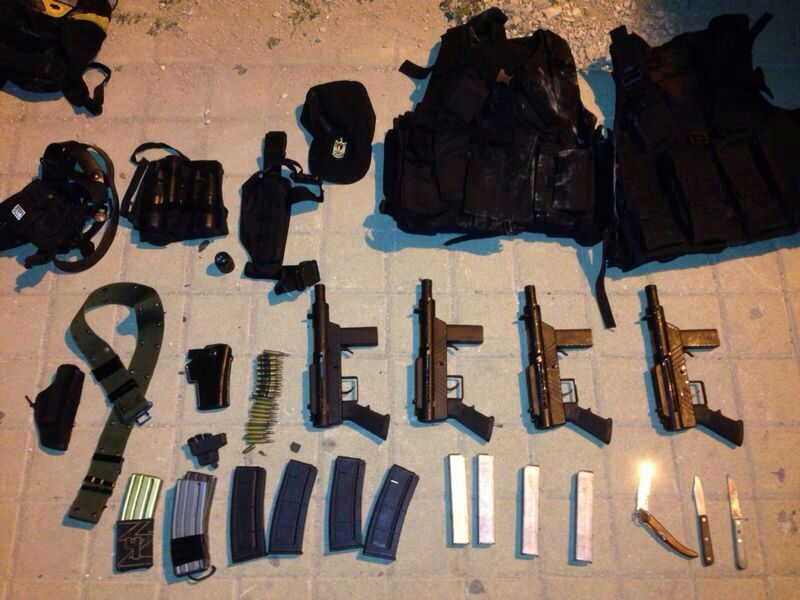
Photograph of weapons said to have been found by the IDF after a search:

Palestinian_Weapons_Exposed_During_Operation_Brother’s_Keeper_(14256563989)

6/18: After six days, Israeli forces have made 240 arrests, searched 800 structures, put 300,000 Palestinians under curfew and restricted the movements of 600,000.

6/20: Palestinians commit sporadic violence in the West Bank. At least two Palestinians are killed by Israeli forces. Some 1000 buildings have been damaged during searches, mostly private dwellings.

6/22: Three more Palestinians are dead. The Palestinian Authority calls on the U.N. to intervene and stop what it calls “collective punishment”.

6/23: An Israeli officer states that the operation has been a success because it has crippled Hamas’ infrastructure, although no progress has been made in locating the three teenagers. Prime Minister Netanyahu again affirms that Hamas was clearly responsible for the kidnapping.

6/24: Photograph of a nursery said to have been taken after an IDF search:

Nursery_after_search_24_June_2014

6/26: “According to Israel figures, state detentions number 381, of whom 282 are affiliated to Hamas. The number of locations searched rose to 1,955, including 64 Hamas institutions. Palestinian figures state that 566 were detained, 6 were shot dead, and over 120 wounded; 2 elderly people died of heart attacks during Israeli operations, and over 1,200 homes were searched.”

6/30: According to the Times of Israel, but not mentioned in the Wikipedia timeline:

At least 16 rockets were fired at Israel Monday morning [on June 30], most of them hitting open areas in the Eshkol region, the army said. The security sources, who spoke on condition of anonymity, assessed that Hamas had probably launched the barrage in revenge for an Israeli airstrike several hours earlier which killed one person and injured three more. A member of Hamas’s militant wing was killed in the attack, Gaza health official Ashraf al-Kidra said….

Hamas hasn’t fired rockets into Israel since Operation Pillar of Defense ended in November 2012, and has yet to take responsibility for this latest barrage.

Also 6/30: The bodies of the teenagers are found. That night, Israeli forces destroy the homes of two Palestinian suspects.

7/1: “Israeli jets and helicopters struck 34 locations in the Hamas-run Gaza Strip in response to over 20 rockets being fired at Israel from Gaza.” Another Palestinian is shot and killed.

7/2: A Palestinian teenager is abducted and killed. “Palestinians fired nine rockets into Israeli territory, three of which heavily damaged residential buildings”, but no casualties were reported.

7/3: “The Israeli Air Force conducted 15 air strikes in Gaza.”

7/8: Israel announces plans to call up 50,000 reserves as part of Operation Protective Edge. In the early morning, Israel strikes at 50 targets in Gaza, injuring 17. PM Netanyahu instructs the IDF to “take their gloves off” against Hamas and take any means necessary to restore peace to Israeli citizens.

“The Geneva-based nonprofit, nongovernmental human rights organization Euro-Mid Observer for Human Rights, [reports that] the Israeli government has been accused of having stolen around $370,000 in cash and $2.5 million in property, in search of the abducted youths. In 387 incidents throughout the West Bank, the Israeli government has confiscated goods ranging from computers, cars, mobile phones and jewelry, taken from a wide variety of localities, including private homes, clinics, companies and universities, says the report. Spokespersons for the Israeli government say that goods were confiscated from sources that were using them to fund or support terrorism.

Note: On July 25th, a BBC journalist reported that Israeli police spokesman Micky Rosenfeld informed him that the killers of the three teenagers were “definitely” from a “lone cell”, affiliated with Hamas but not under Hamas’ direct leadership. Further, if the kidnapping had been ordered by Hamas’ ledership, the Israelis would have know about it in advance. Later, in seeking to explain his remarks, Rosenfeld reiterated that the suspects were affiliated with Hamas. 

So, given the extreme military imbalance, what moved Hamas to launch those rockets at Israel for the first time since 2012?

Considering the timeline above, one explanation that seems fairly reasonable is that the people in the Gaza Strip who control those rockets got very angry and decided to fight back, whatever the consequences might be. 

Tomorrow: a shorter part 2 regarding different perspectives, real and imagined.

Haaretz’s Correspondent for the Occupied Territories and Israel’s Prime Minister Each Have Something to Say

Amira Hass was born in Jerusalem in 1956 and has been covering Gaza and the West Bank for the Israeli newspaper Haaretz since 1993. She lived in Gaza for three years and has lived in the West Bank for the past seventeen.

Below is most of a recent article of hers. Her thesis is that “Israel’s attack on Gaza is revenge for the Palestinians’ refusal to accept occupation”. 

Quote: 

“There is method in madness, and the Israeli insanity, which refuses to grasp the extent of its revenge in Gaza, has very good reasons for being the way it is. The entire nation is the army, the army is the nation, and both are represented by a Jewish-democratic government and a loyal press. The four of them work together to stave off the great betrayal: the Palestinians’ refusal to recognize the normalcy of the situation.

The Palestinians are disobedient. They refuse to adapt….The insistent, steadfast demonstrations in West Bank villages have not even scratched the surface of the Israeli faith in the normalcy of our domination of another people. The boycott, divestment and sanctions movement did manage to confuse our ego a bit, but it is still not enough to make Israelis want to get the message. The Palestinian reconciliation government seemed to move us another step forward; it had the potential to embark on the path of rejecting the show of normalcy dictated by Israel, but too many forces within Fatah and Hamas did not support it.

Then it was the turn of Hamas’ rockets to disturb the occupier’s rest. Say what you will about it, but they succeeded in doing what the demonstrations, the boycott of Tapuzina orange drink and the concert cancellations did not….

Nation, army, government and press: You have eyes and ears, yet you will not see and you will not hear. You still hope that the Palestinian blood we have already shed and have yet to shed will win a long-term lull, which will bring us back to occupation as usual….

And boy, are you competent when you want to be. The armed Hamas operatives who emerged from the tunnel shaft on Kibbutz Nir Am on Monday were dressed as Israeli soldiers….“Finally, thanks to an aerial photograph taken by a drone, they were found to be Hamas operatives” because “they were carrying Kalashnikov rifles, which the Israeli army does not use”.

So the photographs taken by the drone can be very precise when its operators wish. It can discern whether there are children on the seashore or on the roof — children who, even for the legal acrobats in the Justice Ministry and the army, are not a justifiable target for our bombs. The drone can also discern that a rescue team has arrived to pull out wounded people, that families are fleeing their homes… But for some reason, the eye of the drone that can tell the difference between various makes of rifles cannot tell that this figure over here is a child, and that is a mother or a grandmother….

The Israeliness of the moment is like that drone. It chooses to see blearily. It clings closely to the good, comfortable life of a master nation, unwilling to allow its subjects to interfere with it. Defense Minister Moshe Ya’alon translated that into political language when he said, “We will not agree to recognize the reconciliation government, but other arrangements such as controlling crossing points is something we can accept. [Palestinian Authority Prime Minister Mahmoud] Abbas will control the crossing points, but he will not control the Gaza Strip itself.”

That is the routine we are cultivating. Gaza and the West Bank are cut off. Hamas controls the Gaza Strip, but under conditions that we dictate, just as Fatah and the Palestinian Authority “rule” in their pockets in the West Bank, in accordance with our conditions. If the Palestinians need to be tamed at times, we will tame them with blood and with more blood. And peace be upon Israel.”

End quote.

Concurrently, Israeli Prime Minister Netanyahu brought up Nazi Germany, comparing Israel being bombarded by those troubling but generally ineffective Palestinian rockets to England’s suffering at the hands of the Germans in World War II. From Jerusalem Online:

PM Benyamin Netanyahu met British Foreign Affairs Minister Philip Hammond and compared Israel’s condition in these days to the condition in Britain in World War 2. “Israel’s condition is similar to Britain’s when it was bombed as well”, said Netanyahu, clarifying that Israel’s intention is to go forth with the operation: “There is no guarantee of a hundred percent success, however IDF has shown impressive achievements in the field and we are moving forward with this operation… We aim our fire at those who fire rockets at us”.

An estimated 40,000 people died in England during the Blitz. Since the latest hostilities began, three Israeli civilians have been killed by Hamas and fewer than 30 in the past 14 years. The Palestinian death toll just this month is now over 1,000, mostly civilians, with bodies still being recovered during the temporary cease-fire.

If we’re going to talk about the Nazis, a more apt comparison is to their infamous response to resistance movements in occupied countries. From Wikipedia:

The Kragujevac massacre was the murder of Serbian, Jewish and Roma men and boys in Serbia by German Wehrmacht soldiers on 20 and 21 October 1941. All males from the town between the ages of sixteen and sixty were assembled by German troops and [Serbian collaborators]  and the victims were selected from amongst them.

Field Marshal Wilhelm Keitel had issued an order on 16 September 1941, applicable to all of occupied Europe, to kill 50 communists for every wounded German soldier and 100 for each German soldier killed.

The victims have become victimizers.

beit hanoun

Unorthodox Views on Israel and Gaza

Below are some unorthodox views on what’s happening in Israel and Gaza. They’re not necessarily unorthodox in the religious sense, and they’re definitely not unorthodox in most of the world, but they’re out of the mainstream with respect to public opinion and government behavior in both Israel and the United States. 

To back up a little: I’ve been struggling this week to write another post about the massacre in the Gaza Strip. “Massacre” is a more appropriate term than “war” given the numbers published today by Haaretz (Israel’s oldest daily newspaper):

In Gaza, the Palestinian death toll in Gaza since Israel launched Operation Protective Edge surpassed the 800 mark, most of them since Israel entered Gaza a week ago. Israel military fatalities stand at 35 since the operation commenced.

It should also be noted that at least one Israeli civilian has been killed as the result of a Hamas rocket attack.

I’m not sure why this subject has got such a hold on me, since people are being massacred in other places, but I think it’s because so many apparently sensible people insist on defending what Israel is doing. For example, here are selections from three letters printed in The New York Times a few days ago (two other letters were critical of Israel’s behavior):

As to Israel’s response to Hamas [the “Islamic Resistance Movement” voted into power in Gaza in 2006], it is proportional to the number of missiles launched against us. Whether these missile attacks are successful or not is not the point… They have the potential to wreak havoc…So far Israel has been concentrating on destroying tunnels that cross the border and missile stockpiles. I consider that a “proportional” response. As in any war, sometimes people are hurt or killed. Israel has nothing to apologize for.

It is a credit to Israel’s moral stature that it is doing everything it can to limit the killings of innocent civilians in Gaza…

Please report about the civilian bomb shelters in Gaza. Wait, there are none. Instead, Hamas uses its citizens as human shields for munitions and to increase Israeli casualties for the media.

It’s true that Hamas has launched thousands of rockets toward Israel in the past 14 years, which is clearly a violation of international law, but those rockets have caused fewer than 30 civilian deaths. That’s why the author of the first letter only claims that Israel’s actions have been proportional to the missiles launched and not to the actual effect of those missiles, which are unguided and usually don’t hit anything. 

Meanwhile, the Israeli Defense Force (the IDF) announced a few days ago that it had already struck more than 3000 targets in Gaza using its very high-tech weaponry. Since Gaza is about the size of Philadelphia, that’s more than 20 targets per square mile. And since 1.8 million people live in Gaza (300,000 more than in Philadelphia), it shouldn’t be a surprise to anyone that the bulk of the Palestinians casualties have been civilians and a large percentage of those civilians have been children. 

Stating that “sometimes people are hurt or killed in war”, as the author of the first letter does, obviously (I’d say “obscenely”) downplays the extent of this massacre. If the Israeli armed forces are truly doing everything possible to limit civilian casualties, as the second author claims, their efforts are clearly failing. As for whether it’s all Hamas’ fault for not building bomb shelters and storing weapons near people (remember, we’re talking about an area the size of Philadelphia but with a bigger population), the powers that be in Hamas are certainly at fault. But that doesn’t change the fact that it’s the Israelis who have chosen to proceed with their massive assault anyway.

All of which finally brings me to the other unorthodox opinions I wanted to share.

First, after seriously considering the consequences, an Israeli named Etgar Keret wrote an article for his fellow citizens that’s been translated and reprinted by The New Yorker (the full article, which isn’t long, is well worth reading):

In the past week I’ve seen and heard the popular statement “let the I.D.F. win” more and more frequently. It’s been posted on social media, spray-painted on walls, and chanted in demonstrations. Lots of young people are quoting it on Facebook, and they seem to think it’s a phrase that arose in response to the current military operation in Gaza. But I’m old enough to remember how it evolved: first formulated as a bumper sticker, …it contains within it the twisted world view that has been guiding Israel for the past twelve years….

Twelve years, five operations against Hamas (four of them in Gaza), and still we have this same convoluted slogan…. In each of these operations there have been right-wing politicians and military commentators who pointed out that “this time we’ll have to pull all the stops, take it all the way, until the end.” Watching them on television, I can’t help but ask myself, What is this end they’re striving toward? Even if each and every Hamas fighter is taken out, does anyone truly believe that the Palestinian people’s aspiration for national independence will disappear with them?

It’s an awful thing to make a truly tragic mistake, one that costs many lives. It’s worse to make that same mistake over and over again….The only thing that actually changes is Israeli society’s tolerance for criticism. It’s become clear during this operation that the right wing has lost its patience in all matters regarding that elusive term, “freedom of speech.” In the past two weeks, we’ve seen right wingers beating left wingers with clubs, Facebook messages promising to send left-wing activists to the gas chambers, and denunciations of anyone whose opinion delays the military on its way to victory….This road is not a circle, it’s a downward spiral, leading to new lows….

More optimistically, Peter Beinart, an American Jew who is a professor at New York University, suggests a way out of this situation for both Israel and the Palestinians in an article for Haaretz called “Israel’s Best Weapon Against Hamas”, which is also well worth reading in full:

The short answer is that I’d treat the [Hamas] rockets as military symptoms of a political problem. That doesn’t mean Israel shouldn’t return fire. If Hamas and Islamic Jihad can attack Israel with impunity, they may never stop. But returning fire—or even invading Gaza—will never make Israel safe….

So what would I do? First, I’d seek a cease-fire that eases those aspects of Israel’s blockade that have no legitimate security rationale. (That doesn’t mean acceding to Hamas’ cease-fire demands but it means recognizing that a cease-fire that does nothing to address the blockade – as Israel wants – won’t last). [Note: Israel has maintained a land, air and sea blockade of Gaza since 2007. Most observers, including officials representing the United Nations and the Red Cross, consider the blockade to be illegal.] 

Since 2010, Israel has made it easier for goods to enter Gaza. But it still makes it extremely difficult for goods to leave….Essentially barring Gazan exports to Israel and the West Bank — historically Gaza’s biggest markets — is both inhumane and stupid. It’s helped destroy the independent business class that could have been a check on Hamas’ power, and left many in Gaza with the choice of working for Hamas or receiving food aid. In addition to goods, Israel should make it easier for people to leave Gaza, too.

Second, I’d let Hamas take part in a Palestinian unity government that prepares the ground for Palestinian elections. That doesn’t mean tolerating Hamas attacks, to which Israel should always reserve the right to respond. But it means no longer trying to bar Hamas from political participation because of its noxious views.

Without free elections — which means elections in which all major Palestinian parties can run — Palestinian leaders will never enjoy authority in both Gaza and the West Bank nor the legitimacy to make painful compromises on behalf of their people….

Finally, Israel should do everything it can — short of rigging the elections — to ensure that Hamas doesn’t win. Already, polls show that [Palestine President Mahmoud] Abbas would defeat Hamas leader Ismail Haniyeh easily…. But Israel could also help ensure Hamas’ defeat by showing Palestinians that Abbas’ strategy of recognizing Israel, and helping it combat terrorism, actually works. It could do so by freezing settlement growth and publicly committing to a Palestinian state near the 1967 lines with a capital in East Jerusalem. That would give Abbas an instant boost.

Hamas’ great ally is despair…Nothing would weaken Hamas more than growing Palestinian faith that through nonviolence and mutual recognition, they can win the basic rights they’ve been denied for almost half a century. Israel’s best long-term strategy against Palestinian violence is Palestinian hope.

By the way, the unemployment rate in Gaza is roughly 50%. Malnutrition is widespread and the water supply is contaminated.

If you’d like a more complete view of what’s happening in Israel, Gaza and the West Bank, and also be exposed to a broader range of opinion than what generally appears in American media, Haaretz was recently offering a one-month subscription to its website for one dollar. There is a much more vigorous and critical debate regarding the Israeli government’s policies in Israel than in the United States, even though the U.S. contributes billions of dollars in military aid to Israel (a practice that should stop right now).

Criticizing Israel and the Fundamental Problem

Max Blumenthal is the 35-year-old son of former Clinton adviser Sidney Blumenthal. The younger Blumenthal published his second book in October. It’s called Goliath: Life and Loathing in Greater Israel.

In an interview at Salon, he discusses the right-ward shift in Israeli politics, the rise of some scary racism and the reaction to his book. The Amazon reviews indicate the reaction the book is getting:

5 stars…………71
4 stars…………..7
3 stars…………..3
2 stars…………..4
1 star…………..65

That’s what’s called a “distinct pattern”.

What interested me most about the interview was Blumenthal’s description of Israel as a “settler colonial ethnocracy”. That is, after all, an accurate description of colonial America’s treatment of both the native population and African slaves. It’s doubtful that the Indians or slaves would have considered the United States to be a straightforward constitutional democracy.

Blumenthal points out an important difference between America and Israel, however. He says that the Israeli government’s official policy is to maintain a Jewish population in the country of at least 70%. The United States has controlled immigration, but has never had a policy aiming at a specific percentage of the population being, for example, white Christians.

This demographic policy, Blumenthal argues, leads to oppressive policies toward Palestinians, non-Jewish Africans and, most recently, Bedouins:

The Jewish state requires [holding non-Jews] in detention centers like the Saronim, where thousands of non-Jewish Africans are staying right now in shipping containers in the Negev desert; or the Prawer Plan, which mandates the removal of 30- to 40,000 veteran [Bedouin] citizens of Israel to Indian reservation-style communities from their ancestral lands; or the fact that Palestinians face constant home demolitions — we’re talking about 26,000 home demolitions since 1967. The Jewish state mandates the creation of the separation wall, which is said to prevent “demographic spillover”; and it requires the Gaza Strip to be under siege perpetually, because 80 percent of its population is refugees who have legitimate claims to the land and property inside what is now the state of Israel.

(Note: Demonstrations against the Prawer Plan were in the news recently.)

I haven’t been able to confirm Israel’s 70% demographic target, but did find an article by Israel’s most respected demographer, Sergio DellaPergola, a professor at Hebrew University. He lays out the basic existential issue Israel faces (putting aside any threats from its neighbors):

…it has been suggested that [Israel] faces a conundrum because it has three fundamental goals, but can achieve only two of the three at the same time. The three goals are to preserve the Israeli state’s Jewish identity, democratic character, and territorial extent.

Thus, Israel can choose to apply a Jewish cultural identity to the whole territory and population between the Mediterranean Sea and the Jordan River, but in that case it cannot be a democracy. Israel can opt for the same territorial extension and apply to all residents the democratic principle of “one man, one vote,” but in that case it will not be a Jewish state. Or Israel can choose to be a Jewish and democratic state, but in that case it will have to withdraw sovereignty from significant parts of the territory and population.

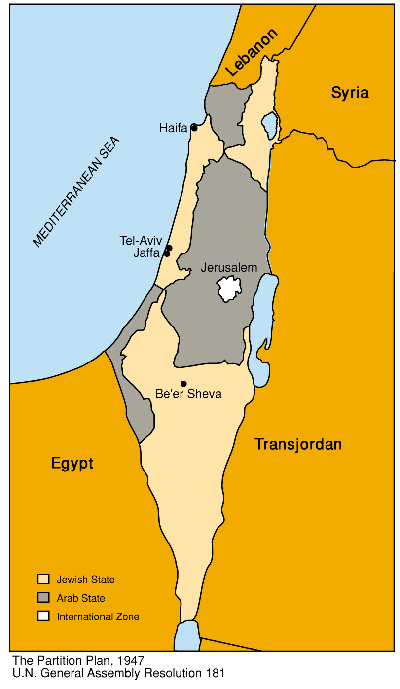
Professor DellaPergola points out that 1947’s U.N. resolution 181 called for the establishment of a Jewish state, an Arab state and a U.N.-administered area around Jerusalem (in the diagram below, the proposed Jewish state is yellow and the Arab state is gray). The 1948-49 war resulted in Israel expanding its borders beyond those in the U.N. resolution. DellaPerfogla believes that “the real bone of contention is what happened in 1947-1949, not the outcome of the Six Day War in June 1967”.

MFAG007y0

If the non-Jews living in Palestine and surrounding regions back in 1947 had welcomed the creation of Israel, the Middle East would be a much calmer place today. They didn’t and it isn’t.