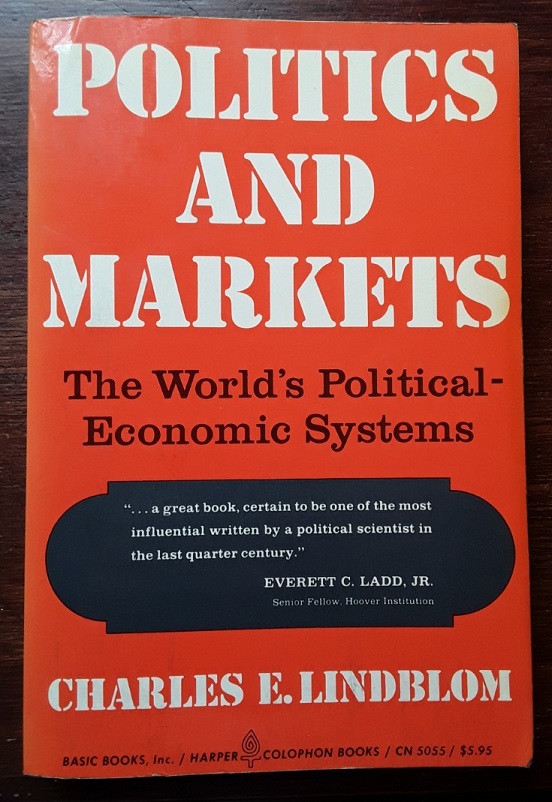
Around 40 years ago, I bought a book called Politics and Markets: The World’s Political-Economic Systems. It was written by Yale professor Charles Lindblom. I read about half of it before putting it aside. I don’t know why I stopped reading, because I thought it was excellent and intended to finish it. Instead, I treated the book like a kind of talisman. For some time, I kept it on my desk at work. It was there so long that someone asked me if I was still reading “that book”. I suppose I didn’t have the mental energy to finish it, but having it around was nice. Maybe it reminded me of my aborted attempt at an academic career.
A few days ago, I thought I might go around the house and find books I’ve always thought about reading but never did. An obvious candidate was a biography of Ralph Waldo Emerson called Emerson: The Mind on Fire. Just like Politics and Markets, I read about half of it years ago and have often thought of finishing it. Unlike Politics and Markets, however, Emerson still had a decades-old bookmark showing where I stopped reading (it wasn’t even at the start of a chapter).
I’m now reading Politics and Markets again. I was immediately impressed.
This is how the 1977 edition above begins:
Relentlessly accumulating evidence suggests that human life on the planet is headed for a catastrophe. Indeed, several disasters are possible, and if we avert one, we will be caught by another. At present rates of population growth, another century will put 40 billion people on Earth, too many to feed. If industrial production grows at present rates during the next century, resource requirements will multiply by a thousand. And energy emission, some scientists say, will over a longer period of time raise Earths’ temperature to a level unsuitable for human habitation. All this assumes that a nuclear catastrophe does not spare us the long anguish of degeneration.
However fearful one may be that the fallible and dilatory intelligence of the human species will somehow either end human life or reduce it to unbearable squalor, the decline of the human condition is not inevitable. It is for us to decide whether we will continue to reproduce at disastrous rates, plunder the planet of resources, or burn ourselves from the face of the earth through either thermal pollution or a few quick blasts. The world is man’s doing, not something done to him.
Assuming that men and women wish to give some thought to their futures, what are the fundamental politico-economic mechanisms they can employ in order to maintain — indeed greatly enlarge — the humane qualities of life on Earth? That is the question of this book. Some will doubt that political and economic mechanisms matter. They will say that man’s future hinges on a moral regeneration. Or science and technology. Or inner awareness. Or a new form of family or other small-group association. Or organic foods — the list is open to nominations. This book is for those who believe that politics and economics will turn out to matter.
Well, some good news is that world population isn’t climbing as fast as people expected in 1977. It was 4.2 billion back then. Now it’s 7.8 billion, but the rate of increase is going down. It’s projected that there will be 10 billion of us by 2077, not 40 billion. And since the fertility rate is expected to keep dropping, world population may actually decline in the next century (even without the help of killer viruses, nuclear wars, giant meteors, etc.).
Along with population, resource requirements continue to grow, although some experts believe that we won’t run out of the things we need, since as resources become scare, they’ll become more expensive and we’ll find substitutes (I don’t know what the substitute for oxygen or water would be).
The bad news, of course, is that the “energy emission” that “some scientists” were worried about in 1977 is now out of control. If you want a scary update, see Bill McKibben’s article “130 Degrees” at the New York Review of Books site:
What [the 10 to 15% drop in emissions during the pandemic] seems to indicate is that most of the momentum destroying our Earth is hardwired into the systems that run it. Only by attacking those systems—ripping out the fossil-fueled guts and replacing them with renewable energy, even as we make them far more efficient—can we push emissions down to where we stand a chance.
As for “nuclear catastrophe”, it’s easy to think that the danger subsided with the end of the Cold War. That’s not the message from “The New Nuclear Threat”, an article by Jessica Matthews in the same issue of The New York Review of Books (I’ve subscribed for a long time — the subscription is almost worth the price):
In part because of effective deterrence, fear of their destructiveness, and a growing taboo against their use, and in part because of dumb luck, nearly a century has passed without nuclear weapons being used again in conflict. . . . But we are not safer today—quite the reverse. . . . A second nuclear arms race has begun—one that could be more dangerous than the first. . . .
The single step from which profound policy change could flow, domestically and internationally, would be formal endorsement by the five original nuclear powers—the US, Russia, the UK, France, and China—of the Reagan-Gorbachev principle, jointly articulated by the two leaders at their 1985 summit. It states simply, “a nuclear war cannot be won and must never be fought.” International adoption would simultaneously indicate the nuclear powers’ recognition of the rising dangers of nuclear conflict and the need to move toward nuclear forces around the world that are structured for deterrence, not war fighting. . . . Eventually, these eleven words could underlie the next generation of arms control negotiations, strengthen the global nonproliferation regime, and help short-circuit a second nuclear arms race.
I don’t know if Prof. Lindblom’s old book might help with any of this. I’ll let you know if I finish it.
 Whereof One Can Speak 🇺🇦
You must be logged in to post a comment.