Stating the Obvious – It Should Be Stated Again and Again

Although this may be the last time I state it. The election was five weeks ago. Its otherworldly result is likely to be set in stone by 300 members of the Electoral College next week (despite their duty to do otherwise). In the weeks ahead, therefore, I hope to turn my attention to the election’s aftermath, and possibly even other topics of interest, like Brian Wilson’s very good memoir, what to look for in a snow shovel and how to leave the U.S. without a passport. Or maybe where to acquire body armor and the safest way to throw a Molotov cocktail.

Nevertheless, Amanda Marcotte has a very good summary at Salon of how the Russians got away with hacking the election. The long headline is:  

The big problem isn’t that Russian hackers tried to influence our election — it’s more that we let them – Media lameness, a gullible public, useful idiots on the left and the GOP all helped enable Russian propaganda

She makes an excellent point. It’s not a new point, but it bears repeating over and over again (by someone else, not me). Assuming we escape the clutches of the Orange Menace one day, how do we avoid going through something like this again if we don’t understand how it happened? 

She begins:

(The Russian’s apparent) strategy worked because too many power players in the American political ecosystem were too shortsighted, lazy and selfish to look past their own immediate self-interest and consider the big picture. What the purported Russian email hack ended up doing was illustrating the various weaknesses in our political systems and culture — weaknesses that Trump, likely with Vladimir Putin’s assistance, was able to exploit to claw his way into the White House.

First, “mainstream media outlets are more interested in appearing fair than actually being fair”. Fox News, of course, being a propaganda machine, doesn’t care about being balanced. They simply claim to be. Reputable news sources like CNN and the New York Times, however, want to provide “balanced” coverage. They want to acquire and retain customers all along the political spectrum. But, in 2016, their lame attempts to be balanced led to disaster: 

Trump is so corrupt that he coughs up more genuine scandals before breakfast than most dirty politicians can come up with in a lifetime. Hillary Clinton, in contrast, is a clean politician, which we know because she’s been under some kind of dogged investigation for the better part of three decades, without a speck of real dirt coming up on her.

But to report this basic truth — that one candidate was irredeemably corrupt and the other was not — would have drawn accusations from the right that the media was in the tank for Clinton. So, in order to appear fair, mainstream media outlets embraced a policy of being incredibly unfair to Clinton, blowing every non-scandal out of proportion.

Marcotte then points her finger at the average American voter:Most people don’t really read the news, but just glean general themes from headlines and cable TV”. One of the example she cites from Vanity Fair magazine:

juicy

But in the actual text, writer T.A. Frank admitted that “you’ll find nothing close to a scandal in itself” and “Clinton’s campaign is, mostly, reassuringly plodding and rules-bound.”

An honest headline written by someone whose goal was to inform the public would have looked something like this: 

PODESTA EMAILS SHOW PLODDING, SCANDAL-FREE CAMPAIGN

Sensationalism like Vanity Fair‘s is one reason most voters thought Clinton was more corrupt than T—p:

All these stories about “leaked” emails left the indelible impression with voters that there must have been something in them that was worth leaking, even if they had no idea what it was. 

Marcotte then points out that people on the left are open to conspiracy theories, too. Emails stolen from the Democratic National Committee convinced some Sanders supporters that the primary elections were rigged:

The email hack did not actually reveal any evidence that the Democratic National Committee had treated Sanders unfairly during the primary. It did find that some DNC employees expressed negative thoughts about him after his campaign repeatedly accused party officials of dirty pool, but there was no dirt beyond private grousing.

Nevertheless, the impression grew that somehow Sanders had been cheated. That led some who would ordinarily vote Democratic to stay home or vote for a third party. Consider, for example, that in Michigan, Pennsylvania and Wisconsin, the Green Party candidate got more than 133,000 votes. Clinton lost those three states and, as a result, the Electoral College by 78,000. 

Lastly, of course, most Republican politicians put party over country. In particular, Senator McConnell’s refusal to condemn or even acknowledge the Russian hacking was, in Marcotte’s words:

… a neat distillation of Republicans’ attitude toward any Trump-based corruption: They’re happy to look the other way as Trump and his supporters plunder the country, spread racism and bigotry and undermine our democracy, so long as they get a crack at destroying Social Security and Medicare.

So, putting the election aside and looking to the future, Kurt Eichenwald of Newsweek has a long article that shows how T—p’s business would (or will) lead to major conflicts of interest. They even have a 3-minute video that summarizes the sad story.

When Balance Is Just Wrong

Jeff Zucker is in charge of CNN. Before that, he helped the Orange Monster become a reality TV star. More recently, he helped the Orange Monster become President-elect. Zucker gave the O.M. millions and millions of dollars of free advertising. CNN broadcast unfiltered everything the O.M. had to say. They broke away from other news, including other candidates talking, to show the empty podium where the O.M. might later share his thoughts.

This explains why Zucker was yelled at by both Republicans and Democrats at a recent conference. The angry Republicans had worked for the O.M.’s opponents in the primaries. The angry Democrats had worked for someone who actually loves America. But they all agreed that Zucker and CNN had given the O.M. special, advantageous treatment.

Here’s what Zucker said in response:

Half the people want to blame us for Trump, and half the people want to say that we’re terrible to Trump. That’s how I always think we’re doing the right thing.

Zucker has made a lot of money in his career, so he must have a brain in his head. But that is one lazy, dumb justification for misbehavior. The correct, honest answer would have been:

We gave him special treatment because he’s so damn entertaining. We make money by getting people to watch our so-called “news” network and people watch that bastard whether they like him or not.

But isn’t it fair for Zucker to parrot the journalistic clichĂ©, according to which half the audience says we’re too mean and half says we’re too nice, so we must be doing something right?

Imagine a country that takes ice cream very, very seriously, much more seriously than the Germans take beer. The whole country loves ice cream. It’s the official national food. Then along comes an ambitious politician with a brilliant idea. Let’s have a referendum! Let’s choose our nation’s official ice cream flavor! The nation erupts in controversy. Should it be chocolate or should it be vanilla?

Conscientious journalists air both sides, delving into the pros and cons of each flavor. Nevertheless, the vanilla-lovers are angry because they don’t think the journalists are being fair to the flavor that’s clearly the best. The chocolate-lovers are angry for the very same reason.

When the votes are counted, one flavor comes out slightly ahead (I hope it was vanilla). A bunch of journalists, hanging out in their favorite ice cream bar, look back and decide they must have done a pretty good job. After all, half the people thought they were terrible to vanilla and half thought they were terrible to chocolate. Fair enough.

But suppose there’s a country that’s less concerned with ice cream and more concerned with the shape of the Earth. The flat-Earthers look around and see the Earth is flat. The round-Earthers, well, you know. So they decide to take a vote! Journalists report and analyze. Both sides are heard from and criticized in equal measure, because the journalists want to be balanced. One side wins (if it were modern-day America, it would be a close election), but neither side is happy with the news coverage. The flat-Earthers hated hearing they were wrong, especially by smarty pants scientists. The round-Earthers hated that anyone took the flat-Earthers seriously at all. But the self-satisfied journalists look back and say, well, we must have done something right!

To make a long story short, the assumption that you must be doing something right if both sides are displeased only applies when the subject is a matter of taste. Vanilla is better than chocolate! No, everyone loves chocolate! Or a matter of vague philosophy. Small government is better than big government! But a big country needs a big government! Or with the unknown. We aren’t alone in the universe! So where is everybody?

When you’re dealing with known facts, however, balance isn’t necessary. In fact, it’s seriously bad.

Imagine, for example, that a pathological liar runs for President. Or a strange old man who knows next to nothing about America’s history and government. Let’s call him Donald. When Donald spends 30 minutes in front of an enthusiastic crowd telling lies and making crap up, journalists broadcast every word, even though they know he’s plain wrong about so much. News networks even pay people to come on the air to repeat his fabrications, because it’s hard to find anyone who will lie in public for free. In the spirit of journalistic balance, however, they also let Donald’s opponents appear. Journalists even point out that Donald is often careless with the truth.

And what’s the result? Both sides are unhappy. Donald’s supporters are unhappy because they didn’t like hearing bad things about their hero. Donald’s opponents are unhappy because so much of what Donald said wasn’t challenged and he was treated with respect he didn’t deserve. Nobody is satisfied with the news coverage except the journalists. They congratulate themselves, citing “evidence” like this:  

Half the people want to blame us for Donald, and half the people want to say that we’re terrible to Donald. That’s how we know we’re doing the right thing.

If your goal as a news organization is to make both sides unhappy, all you need to do is what CNN and others did this year. Give a loudspeaker to a demagogue and his propaganda machine, but sometimes admit he’s a demagogue. Both sides will be unhappy, because your coverage is “balanced”.

On the other hand, telling the unvarnished truth would anger one side and please the other. Congratulations would be in order for the conscientious journalists, because they didn’t strike a balance between what was plainly true and what plainly wasn’t.

Whatever Happened to the Scandal of the Century?

It seems to have disappeared right after the election. I guess because it was only of titanic importance when it supposedly revealed everything rotten about one of the candidates. Now nobody cares. 

But for anyone still wondering what happened, below are two word clouds that summarize Gallup’s interviews with 30,000 voters between July and September. Voters were asked “What specifically do you recall reading, hearing or seeing about <Donald T—p> or <Hillary Clinton> in the last day or two?”

Words associated with the Orange Menace are on the left. Words associated with Clinton are on the right.

trump-word-cloud-getty

That one big blue word sure leaps off the page!

But notice some of the other memorable words that came up when people thought of Hillary Clinton: “lie”, “health”, “scandal”, “FBI”, “pneumonia”, “foundation”. Is it any wonder that the lying, corrupt, scandal-plagued, secretive, sickly candidate lost Florida, Pennsylvania, Minnesota and Wisconsin by less than 1% of the vote? Move two or three of those states into Clinton’s column and January suddenly looks much brighter for America and the world.

While we’re on the subject, consider “Don’t Call Clinton a Weak Candidate: It Took Decades of Scheming to Beat Her” in The Guardian. It’s a brief but tragic summary of the obstacles Clinton faced and almost overcame two weeks ago.

We’re at the Brink, So We Need to Get Serious

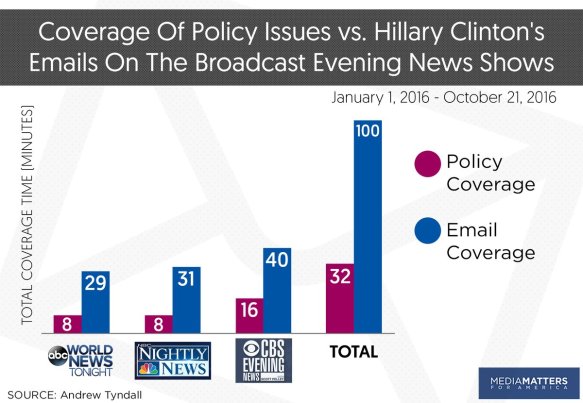
If you’re familiar with American politics and mass media, you probably won’t be surprised to hear that, between January 1st and October 24th of this year, the nightly news programs on ABC, CBS and NBC devoted three times as much coverage to Hillary Clinton’s emails than to all issues of government policy combined (from the Tyndall Report):

cwrzmtrweaacwe5

It’s safe to say this imbalance has grown even larger since October 28th. That’s when the Republican FBI Director Robert Comey sent Congress his cryptic letter regarding Anthony Weiner’s laptop. As Comey should have realized (and no doubt did), releasing that letter eleven days before the election led to an explosion of speculation and related discussion, none of which has revealed relevant facts about anything at all except that Trump and his supporters will use any excuse to paint Clinton as corrupt.

The incessant email stories on the broadcast networks and cable news and in leading newspapers has had a bizarre result. From the Gallup polling company:

We found that “email” was by far the most frequently used word when we asked Americans what they had read or heard about Clinton back in August 2015.…As [we] put it then: “When Gallup recently asked Americans to say what they recall reading or hearing about her, one word — ’email’ — drowned out everything else.”

Now we are asking Americans every day the same basic question — what they have read, seen or heard about Clinton — and once again, “email” dominates. For interviews conducted Oct. 28-31, “email” drowns out everything else, particularly anything relating to policy or substance. Indeed, the second-, third- and fourth-most-frequently used words associated with Clinton also relate to emails: “FBI,” “investigation” and “scandal.”

Believe it or not, 46% of voters in a recent poll said that Trump, the most obvious con man ever to run for the Presidency, is more trustworthy than Clinton (only 38% gave her higher marks). When people are asked to explain why they don’t trust Clinton, the most frequent response is, of course, “emails”.

As a minuscule corrective to the mountain of email nonsense that the media, Wikileaks (assisted by Russia, of course) and the FBI (officially and via politically-motivated leaks) have disseminated, here are an article and a video worth considering. You might also share them with friends, acquaintances, antagonists and random citizens before the voting ends on Tuesday.

First, Matthew Yglesias of Vox analyzes the Clinton email story with the aptly titled: “The Real Clinton Email Scandal Is That a Bullshit Story Has Dominated the Campaign”. He explains what Clinton did and shows why we shouldn’t care. An excerpt:

Clinton broke no laws according to the FBI itself. Her setup gave her no power to evade federal transparency laws beyond what anyone who has a personal email account of any kind has. Her stated explanation for her conduct is entirely believable, fits the facts perfectly, and is entirely plausible to anyone who doesn’t simply start with the assumption that she’s guilty of something.

Given [Secretary Colin] Powell’s conduct, Clinton wasn’t even breaking with an informal precedent. The very worst you can say is that, faced with an annoying government IT policy, she used her stature to find a personal workaround rather than a systemic fix that would work for everyone. To spend so much time on such a trivial matter would be absurd in a city council race, much less a presidential election. To do so in circumstances when it advances the electoral prospects of a rival who has shattered all precedents in terms of lacking transparency or basic honesty is infinitely more scandalous than anything related to the server itself.

And here is an eight-minute video uploaded today by Humanity for Hillary. It features Daveed Diggs and is called “Clinton vs. Trump on the Issues”:

Finally, a few words from Jonathan Chait of New York Magazine: 

However low my opinion of the Republican Party, it was not low enough….This is not a joke. This is one of the moments in history when the republic is at the brink.

Republican voters chose Trump. Republican donors have supported Trump. Republican politicians, even those who condemned him as a charlatan totally unfit to be President, have endorsed Trump. Others have remained silent. There are no excuses for what they’ve done. But now we have the chance to teach them a lesson. We need to vote for Democrats up and down the ballot. Only an historic, stinging defeat for the Republican Party will protect America and the world from getting this close to the brink the next time someone as dangerously abnormal as Trump wants the ability to launch nuclear missiles.

Our Next President Demonstrates Again Why She Should Be Our Next President

She spoke about recent events and took questions from reporters this morning:

By the way, her airplane is white and blue, not whatever color that is.