Wednesday night’s Republican “debate” should have convinced journalists to tell the truth about how dangerous and divorced from reality Republicans have become. They’re no longer “conservative” in any way and shouldn’t be treated like a normal political party.
Ben Rhodes, an author and former Obama official, captured the flavor of the event:
… A stage full of people acted like a bunch of kids trying to get admitted to some fascist costume party. Kill people at the border! Prohibit women from any agency over their bodies! Side with Putin! Etc. Etc.
Six of the eight prospective presidents (!!!) said they would support their party’s 2024 nominee even if he’s a convicted felon, even if one of his crimes was trying to overthrow the government.
But coverage of the 2024 presidential election is looking a lot like what we were fed in 2016 and 2020. The New York Times, for example, published this on Thursday: “Our Writers Pick the Winners, Losers and ‘the Star of the Evening’ From the First Republican Debate”. Ten of their well-paid opinion writers ranked the night’s performers on a scale of 0 to 10.
Politics as sports or entertainment.
Margaret Sullivan, the Public Editor at the Times before the management decided they didn’t like the idea of a Times employee being allowed to criticize the paper in public, wrote about Wednesday night for The Guardian. Her principal focus was on a rising star in MAGA World:
He thinks the climate crisis is a hoax, supports Vladimir Putin’s aggression in Ukraine and would gladly pardon D____ T____ on day 1 of his would-be presidency. A wealthy biotech entrepreneur, the 38-year-old has never before run for public office.
Despite all of this (or maybe because of it), this week’s Republican debate became a national coming-out party for Vivek Ramaswamy.
Suddenly, this inexperienced and dangerous showoff is almost a household name.
Many in the Republican base ate up his showmanship and blatant fanboying of their hero, [the individual now charged with 91 felonies]. In CNN’s post-debate focus group of Republican voters in Iowa, for example, Ramaswamy got the most favorable response.
… Many in the mainstream media declared him victorious. The Washington Post put him up high in its “winners” column, trailing only behind [the individual facing four criminal trials], who wasn’t even there. (Choosing not to enter this particular clown car showed some uncharacteristic good sense on the former president’s part.)
The New York Times analyzed the situation under a glowing headline “How Vivek Ramaswamy Broke Through: Big Swings With a Smile”, with emphasis on his style: “unchecked confidence and insults”.
For this millennial tech bro, his performance on the Fox News stage in Milwaukee couldn’t have gone much better.
As a glimpse of America’s future, it couldn’t have gone much worse….
Certainly, Ramaswamy has the essentials covered. No, not foreign policy chops or a background in public service, but a mocking aversion to social justice and equality….
His night in the spotlight, and its aftermath, shows that neither Republican voters nor many in the mainstream media have learned much since [the leader of the cult] came down the elevator in 2015 and proceeded to wreak havoc on the country.
In case there was any doubt, now we know: they will always fall for the attention-seeking, the policy-unencumbered, the candidate quickest with a demeaning insult. That’s a “winner”, apparently.
And it’s all too familiar.
“Ramaswamy is like T____ in the larva stage, molting toward the full MAGA wingspan but not quite there yet,” wrote Frank Bruni in his New York Times newsletter. “His narcissism, though, is fully evolved.”
Not everyone in the media, of course, was buying it. Charlie Sykes, editor in chief of the right-leaning Bulwark, was blunt, calling Ramaswamy “facile, clownish, shallow, shameless, pandering”, but, then again, “exactly what Republican voters crave these days”.
Given that the Republican party – still firmly in the grip of a twice-impeached con man – has lost its mind, this craving makes a certain amount of sense.
But it makes the endless media normalization even more cringe-inducing. Shouldn’t mainstream journalists be able to step back a tiny bit, providing critical distance rather than the same old tricks?
How can there be “winners” in yet another milestone on the way to fascism?
The Orange Menace, campaigning for president for the third time, spoke at a gathering of rabid reactionaries this weekend. A reporter for HuffPost captured the scene:
Within minutes of taking the stage, [he] went into his typical remarks, disparaging the United States as a “filthy communist country” and attacking Democrats and the news media. “They’re not coming after me. They’re coming after you. I’m just standing in their way,” he said. “We will drive out the globalists. We will kick out the communists.”
And even though dozens of rows in the back remained empty, [he] thanked the fire marshal for letting in so many of his supporters. “Look at all these people. They’re up to the rafters,” he said.
[He] called prosecutors investigating him “racist” — the ones in New York and Georgia are Black — and claimed they only went after him because he is likely to win the presidency again. He continued lying about the 2020 election having been stolen from him: “We did much better in 2020 than we did in 2016.” He added later, “I won that second election, and I won it by a lot.”
He relitigated, at length, his two impeachments… And he promised that if he won reelection, he would take revenge on those who didn’t respect his followers. “I am your retribution,” he said….
He promised that if he won the White House, he would quickly end the war because he “gets along great with Putin.”
“I’m the only candidate who can make this promise: I will prevent — and very easily — World War III. Very easily. And you’re going to have World War III, by the way, you’re going to have World War III if something doesn’t happen fast,” he said.
His aides had promised reporters that [he] would offer a forward-looking vision for his return to the White House. Instead, his 105-minutes on stage was largely a repeat of his oft-repeated lies and grievances.
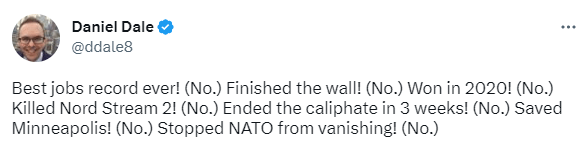
Even this relatively accurate description doesn’t capture what went on. CNN’s Daniel Dale added this (see here for his fact check of the “wildly dishonest speech”):
But Jennifer Rubin of The Washington Postpoints out that we still have a big problem.
We saw throughout [the Orange Menace’s] two presidential campaigns and four years in the White House a symbiotic relationship between mainstream media outlets and Republicans, in which both made [him] out to bea far more normal politician than he was.
On the one hand, there was Republican denial (Didn’t see the crazy tweet! I’m sure he’s learned his lesson!). On the other, there was the media’s determination to avoid claims of bias and maintain a false balance — which often resulted in their obscuring how loony he sounded….
Apparently, neither the media nor supposedly sober Republicans have learned anything from the past. [He] gave a bonkers speech on Saturday, musing about Russia blowing up NATO headquarters, claiming President Biden had taken the border wall and “put it in a hiding area,” and telling the crowd, “I am your warrior. I am your justice. And for those who have been wronged and betrayed: I am your retribution.”
We do not get headlines acknowledging this is unhinged. Instead, we get from the New York Times: “[T] Says He Would Stay in 2024 Race if Indicted.” And a similar angle from CNN. ABC started its website report this way:“Former President [DT] continues to reign supreme over the conservative wing of the Republican Party.” From The Washington Post: “[T] takes victory lap at conservative conference”.
CBS intoned that [he] “aired grievances with his familiar foes: President Biden, the Department of Justice, and the litany of legal fights he is embroiled in.” Politico went with: “[T] ties a ribbon on the most MAGA CPAC [conference] yet.” Hmm.
From the coverage, you would never understand how incoherent he sounds, how far divorced his statements are from reality, and how entirely abnormal this all is. Talk about burying the lede.
The press and Republicans’ mutual distaste for candidly acknowledging [his] break with reality and the danger he poses to democracy was on full display on the Sunday shows [where Republican politicians said they’d support whoever the party nominates in 2024].
Coverage can be so bland and innocuous as to mislead. The audience — that is, potential voters — might easily come away from such coverage believing that [T] acted like a normal candidate, not a figure plainly unfit to handle any public position. And interviews can be so inept as to allow Republicans to repeatedly avoid explaining how in the world they could support someone so unfit for office.
If you put cowering Republicans together with media unwilling to accurately describe what is going on in front of them, you wind up gaslighting voters, who come away with the impression that [T’s] carnival of crazy is acceptable. We know how this ends: If [too few of us are] willing to call [him] out for what he is — and the danger he poses to the United States — we risk returning him to the Oval Office.
Whereupon, expect the headlines: “How did this happen?”
Murc’s Law is “the widespread assumption that only Democrats have any agency or causal influence over American politics”. In other words, Democrats are responsible for Republicans being the way they are and doing the things they do, either because Democrats provoked them or failed to control them.
It came up recently because of an opinion piece in the New York Times entitled “My Liberal Campus Is Pushing Freethinkers to the Right”. (This widely-ridiculed article was written by a young man the Times identified as a “senior at Princeton”, not mentioning he’s a Republican activist).
Remember when people who live in the real world, especially Democrats, pointed out that not getting vaccinated would cause more people do die from Covid? And that hearing such a thing supposedly upset many Republicans who then decided not to get vaccinated?
Amanda Marcotte wrote about this peculiar phenomenon for Salon last year:
Republicans are about to take power in the House of Representatives once again, and so, with exhausting predictability, we return to a Beltway narrative where none of the choices they will make with that power are their fault: It is somehow all because Democrats have failed to manage Republicans properly. Unsurprisingly, the latest example comes from Politico, which pins the blame for the rise of right-wing superstar Rep. Marjorie Taylor Greene not on the voters who sent her to Congress or the GOP leaders who indulge her or the conservative media that celebrates her. Instead, Greene’s popularity with Republicans is laid at the feet of Joe Biden and the Democrats.
“Biden World once ignored Marjorie Taylor Greene. Now it’s making her the face of the GOP,” announces a headline in Politico. But of course Biden had nothing to do with that, because Republicans had already done it.
Going back to the Times article, David Roberts of the Volts podcast says it’s a perfect example:
Murc’s Law says, basically: only the left has agency; the right is merely reacting, having its hand forced, being “pushed” or “shaped.”
This is not some quirk, it is central to reactionary psychology. Every fascist (and fascist-adjacent) movement ever has told itself the same story: our opponents are destroying everything, they’re forcing us to this, we have no choice but violence.
It is, at a base level, a way of denying responsibility, of saying, “we know the shit we’re about to do is bad, but it’s not our fault, you made us.” Once you recognize the pattern it shows up *everywhere*. (If you know an abuser, you’ll also find it in their rhetoric.)
It’s one thing for reactionaries to cling to this … but what’s irksome is that right-wingers playing the refs have basically trained mainstream political journalists to echo it. It is laced throughout US political coverage.
One of my favorite examples … is the notion that Al Gore “polarized” climate change and thereby forced the right into decades of lies and demented conspiracy theories…. Why’d you do that to them, Al?!
Another instance is when it’s assumed that Democrats could have stopped Republicans from doing something bad if only they’d tried or tried harder or made stronger arguments. A commentator once joked:
… A few more BLISTERING speeches [from Democrats] and Mitch McConnell and Paul Ryan would have totally realized that upper-class tax cuts are wrong!
Headlines that obscure who did what are consistent with Murc’s Law. “Supreme Court overturns Roe v. Wade, ending right to abortion upheld for decades” — no, it was Supreme Court Republicans who did that. “Out of 18 pro-democracy bills in 2022, the US Senate filibuster torpedoed 17 of them” — no, it was Senate Republicans who torpedoed them. “What could happen if Congress doesn’t raise the debt limit?” — no, what could happen if House Republicans don’t vote to raise it?
Likewise, there are events that mysteriously take place. I had one in the blog a few days ago:
The Washington Post said “the [train] derailment [in Ohio] erupted into a culture battle”, as if culture battles simply happen without any help from the people who specialize in starting them and getting them in “the news”.
Here’s an even more recent one. From Investopedia:
Environmental, social, and governance (ESG) investing refers to a set of standards for a company’s behavior used by socially conscious investors to screen potential investments.
Environmental criteria consider how a company safeguards the environment, including corporate policies addressing climate change, for example. Social criteria examine how it manages relationships with employees, suppliers, customers, and the communities where it operates. Governance deals with a company’s leadership, executive pay, audits, internal controls, and shareholder rights.
Senate Republicans and two Democrats (Manchin and Tester) voted to kill a Labor Department rule that allows investment managers to consider ESG. From Talking Points Memo:
We talk about this stuff a lot as part of the “culture wars,” but that bestows a legitimizing gloss on it, as if there is some deeper, truer cultural dispute. There’s not. This a Republican tactic, and a highly effective one… It gets treated like these things just happen, as if Democrats or Fortune 500 companies stumble into previously unseen cultural war ambushes because they lack a feel for flyover country….
This doesn’t just happen. Republicans and right-wing activists make it happen. They devote a lot of time, energy and resources to it.
By almost any measure, Republicans have already won once they’ve “made it a partisan issue.” What seems to get misunderstood is that that’s the actual goal. Corporations and institutions don’t want to pick sides. They want to play it down the middle. So Republicans keep shifting the “middle” farther and farther right. By this point in these controversies, the game is basically over already. What’s maddening is that everyone keeps getting played.
Highly-respected journalist James Fallows has a site called Breaking the News. In the interesting installment below, he discusses journalistic screwups and how to avoid being taken in by them:
We all make mistakes. People, organizations, countries. The best we can do is admit and face them. And hope that by learning from where we erred, we’ll avoid greater damage in the future.
Relentless and systematic self-critical learning is why commercial air travel has become so safe. (As described here, and recent posts about the JFK close call here and here.) Good military organizations conduct “lessons learned” exercises after victories or defeats. Good businesses and public agencies do the same after they succeed or fail.
We in the press are notably bad at formally examining our own errors. That is why “public editor” positions have been so important, and why it was such a step backward for the New York Times to abolish that role nearly six years ago….
Here’s an [example of a journalistic mistake]: the buildup to the “Red Wave” that never happened in the 2022 midterms.
Pundits and much of the mainstream press spent most of 2022 describing Joe Biden’s unpopularity and the Democrats’ impending midterm wipeout. As it happened, Biden and the party nationwide did remarkably well….
In its news coverage, not the opinion page, the New York Times had been among the most certain-sounding in preordaining the Democrats’ loss. [On] its front page just one day before the election, one lead-story had the sub-head “Party’s Outlook Bleak,” referring to Biden and the Democrats. It mentioned forecasts of “a devastating defeat” in the midterms. The other story’s sub-head was “G.O.P Shows Optimism as Democrats Brace for Losses.” The first paragraph of that story said voters “showed clear signs of preparing to reject Democratic control.” Again, these were news, not opinion, pieces.
Seven weeks later, the Times ran a front-page story on why so many people had called the election wrong—and how the Red Wave assumption, fed by GOP pollsters, hampered Democrats’ fund-raising in many close races. The only mention of the paper’s own months-long role in fostering this impression was a three-word aside, in the 13th paragraph of a thousand-word story. According to the story, the GOP-promoted Red Wave narrative …
…spilled over into coverage by mainstream news organizations, including The Times, that amplified the alarms being sounded about potential Democratic doom.
The three words, in case you missed them, were “including The Times.”
An NYT public editor like Margaret Sullivan or Daniel Okrent might have gone back to ask the reporters and editors what they should learn.
What are signs of lessons-unlearned that readers can look for, and that we reporters and editors should avoid?
An easy one is to spend less time, space, and effort on prediction of any sort, and more on explaining what is going on and why.
Here are a few more:
1) Not everything is a “partisan fight”.
[A NY Times story about the debt ceiling] illustrates the drawbacks of reflexively casting issues as political struggles, by describing a potential debt-ceiling crisis as a “partisan fight.”
In case you have forgotten, the “debt ceiling” is a serious problem but not a serious issue. In brief:
-The debt-ceiling is a problem, because failing to take the routine step of raising it has the potential to disrupt economies all around the world, starting with the U.S.
-It is not an issue, because there are zero legitimate arguments for what the Republican fringe is threatening now. (See Thomas Geoghegan’s recent article….
It’s like threatening to blow up refineries, if you don’t like an administration’s energy policy, or threatening to put anthrax into the water supply, if you don’t like their approach to public health. These moves would give you “leverage,” just like a threat not to raise the debt ceiling. But they’re thuggery rather than policy.
If you prefer a less violent analogy: since these payments are for spending and tax cuts that have already been enacted, this is like refusing to pay the restaurant check after you’ve finished dinner.
This is not a “partisan fight” or a “standoff.” Those terms might apply to differences on immigration policy or a nomination. This is a know-nothing threat to public welfare, by an extremist faction that has put one party in its thrall.
Reporters: don’t say “standoff” or “disagreement,” or present this as just another chapter of “Washington dysfunction.”
Readers: be wary when you see reporters using those terms.
2) Not everything is a “perceptions” narrative.
[Note: I was going to avoid this silly non-scandal but Mr. Fallows is very good on the subject.]
Here are some more phrases that should make you wary as a reader. They are phrases like “a picture emerges” or “paints a picture.” These are clichés a reporter uses to state a conclusion while pretending not to do so. Others in the same category: “sure to raise questions”; “suggest a narrative”; “will be used by opponents”; and so on.
Consider again from the NYT, this new “inside” report on Joe Biden’s handling of classified documents.
It was a classic legal strategy by Mr. Biden and his top aides — cooperate fully with investigators in the hopes of giving them no reason to suspect ill intent. But it laid bare a common challenge for people working in the West Wing: The advice offered by a president’s lawyers often does not make for the best public relations strategy.
This might be a “classic legal strategy.” It might also be following the rules. The presentation reflects a choice about how to “frame” a story.
The mainstream press makes things an “issue,” by saying they are an issue. Or saying “raises questions” “suggests a narrative,” “left open to criticism,” “eroded their capacity,” and so on. This gives them the pose of being “objective”—we’re just reporters, But it is a choice.
My long-time friend Jonathan Alter [had] an op-ed column in the NYT arguing that the narrative about Biden’s handling of the few classified documents will be hugely destructive to him and the Democrats. Even though, as he says, the realities of his classified-documents case are in no way comparable to [the former president’s]. (More on the differences here.)
As a matter of prognostication, maybe Jon Alter is right. I hope he isn’t. As he notes, Biden in office has time and again beaten pundit expectations [and now it turns out Mike Pence had documents too].
But as a matter of journalistic practice, I think our colleagues need to recognize our enormous responsibility and “agency” about what becomes an issue or controversy. “Raises questions,” “suggests a narrative,” “creates obstacles”—these aren’t like tornados or wildfires, things that occur on their own and we just report on. They are judgments reporters and editors make, “frames” they choose to present. And can choose not to.
Which leads us to…
3) Not all “scandals” are created equal.
Here are things enormously hyped at the time, that look like misplaced investigative zeal in retrospect:
I would be amazed if more than 1% of today’s Americans could explain what this “scandal” was about. I barely can myself. But as these authors point out, it led domino-style to a zealot special prosecutor (Kenneth Starr, himself later disgraced), and to Paula Jones, and to Monica Lewinsky, and to impeachment. It tied up governance for years.
—(b) The but-her-emails “scandal” involving Hillary Clinton in 2016. A famous Gallup study showed that the voting public heard more about this than anything else.
Will any historian ever say that the Whitewater land deal was reasonable grounds for paralyzing the government? Or that “her emails” were reasonable grounds for bringing D____ T____ to the White House? Can people today explain what the Hillary Clinton email “scandal” actually involved?
I doubt it. Yet it was what our media leaders emphasized. I’m not aware that any of them has publicly reckoned with what they should have learned from their choices in those days.
But today’s news gives us a chance to learn, with:
—(c) The Biden classified-documents “scandal”.
What unites these three “scandals” is that there was something there. Possibly the young Bill and Hillary Clinton had something tricky in their home-state real estate deal. Probably Hillary Clinton did something with her emails that she shouldn’t have. Apparently Joe Biden should have been more careful about the thousands of documents that must be in his offices, libraries, etc.
But “something” does not mean “history-changing discovery.” In the 50 years since the original Watergate, the political press has palpably yearned for another “big one.” So every “scandal” or “contradiction” gets this could be the big one treatment. And this in turn flattens coverage of all “scandals” as equivalent. It’s a slurry of “they all do it,” “it’s always a mess,” “they’re all lying about everything” that makes it hard to tell big issues from little ones.
We see this with bracketing of the T____ and Biden “classified document” cases. They both have special prosecutors, so they can be presented as a pair.
Human intelligence involves the ability to see patterns. (Two cases involving classified documents!) But also the ability to see differences. (In one case, a president “played politics” by cooperating with the authorities. In another, by lying to and defying them.)
The similarities are superficial. The differences are profound.
From past errors of judgment, we in the media can learn which to emphasize.
It looks like women and voters under 30 saved the day. Pro-insurrection Republicans mostly lost. Forced birth was rejected in several states. Democrats have added two governors so far.
Depending on results still to come in Arizona, Nevada and Georgia, the Democrats will end up with 49 senators (giving control to the Republicans), 50 (keeping the relative control Democrats have now) or 51 (meaning Manchin and Sinema won’t be as important, since they’ll have to vote together in order to make trouble).
As predicted, Republicans will apparently take control of the House of Representatives. But it appears they’ll have a tiny majority. That means trouble ahead. Author Brynn Tannehill explains:
[The Republicans are] probably going to end up with between 218 and 220 seats in the House. This means only a 1, 3, or 5-seat advantage… Whoever the Speaker of the House is, they’re going to have a pretty unmanageable situation. The right wing of House [Republicans] is detached from reality, intransigent, incapable of compromise, will make insane demands, and is large enough to derail EVERYTHING.
There will be crazies in key positions on all the plum committees. Wall to wall nutso hearings on Fauci putting 5G in vaccines and other nonsense, actual legislation won’t happen. Which is a problem. Because you still have to pass budgets and raise the debt ceiling.
So, whoever is Speaker is going to face a dilemma: (a) Cut deals with Democrats to get critical bills through or (b) go with the crazy and accept government shut downs [and] debt default….
Given how the crazies ran off [the previous Republican Speakers of the House] John Boehner and Paul Ryan, … the Speaker will more or less hand over the agenda to [the crazies] because it’s the path of least resistance….
But wait, it gets even more unstable… On average, in any given Congress about 3 members die. Others retire for whatever reason (such as getting caught with a sex worker), or go to the pokey for white collar crime. All of which result in special elections. Given the age, hypocrisy, and lack of real morals on the part of Republican politicians, they’re disproportionately likely to be the ones who leave office and cause a special election. Which means control of the House may be up for a vote several times in the next two years….
A [Republican] House is going to propose a lot of legislation that’s going nowhere [and make sure Democratic legislation goes nowhere too].
[We can expect] the next two years to be unpredictable, chaotic, radical and illogical as the House goes far to the right in order to keep the crazies placated, and the government gets shut down for long periods.
While they still control the agenda in Congress, Democrats need to do something about the debt limit. Republicans are already threatening to vote against honoring the government’s debts as a bargaining chip. A federal government default would lead to a global financial panic. It would be a good idea, therefore, to contact your representatives in the House and Senate, as well as President Biden, and demand that they address this problem before it’s too late, meaning before the end of the year. (Last year’s explanations still apply since nothing has been done since then.)
As we wait for further developments, it’s worth noting that pre-election coverage in this country is practically worthless. From Judd Legum of Popular Info:
Political media is broken Major outlets spent weeks PREDICTING there would be a “red wave” and EXPLAINING its causes It was all based on polls, which are unreliable This kind of coverage is not just pointless, it’s harmful.
“Democrats’ Feared Red October Has Arrived” — @nytimes, 10/19/22
“Democrats, on Defense in Blue States, Brace for a Red Wave in the House” — @nytimes, 10/25/22
“Why the midterms are going to be great for Dxxxx Txxxx” — @CNN, 10/26/22
All of these forecasts, and many similar predictions published in other outlets, turned out to be wrong. But even if media predictions were correct, they represent a style of political reporting that is dysfunctional. Prediction-based coverage comes at a high cost because it crowds out the coverage that voters actually need. To make an informed decision, voters need to know the practical impact of voting for each candidate.
While outlets ran story after story about the [Republican] red wave, [their] pledge to use the threat of a global economic collapse to try to force benefit cuts to Social Security and Medicare went virtually ignored.
The political media has substituted polling analysis, which is something only people managing campaigns really need, for substantive analysis of the positions of the candidates, something that voters need.
You and I don’t control what the “experts” say about upcoming elections, but we can try to ignore the polls and speculation next time.


 Whereof One Can Speak 🇺🇦
You must be logged in to post a comment.