For Those Interested in Interest Rates

If there’s one thing it’s hard to predict, it’s the future. (So, apparently, Yogi Berra once said.)

That didn’t stop Prof. Paul Krugman from writing about the future of interest rates in his New York Times newsletter (I’m leaving out most of his charts):

From a financial point of view, 2022 has, above all, been the year of rising interest rates. True, the Federal Reserve didn’t begin raising the short-term interest rates it controls until March, and its counterparts abroad acted even later. But long-term interest rates, which are what matter most for the real economy, have been rising since the beginning of the year in anticipation of central bank moves.

These rising rates correspond, by definition, to a fall in bond prices, but they have also helped drive down the prices of many other assets, from stocks to cryptocurrencies to, according to early indications, housing.

So what will the Fed do next? How high will rates go? Well, there’s a whole industry of financial analysts dedicated to answering those questions, and I don’t think I have anything useful to add. What I want to talk about instead is what is likely to happen to interest rates in the longer run.

Many commentators have asserted that the era of low interest rates is over. They insist that we’re never going back to the historically low rates that prevailed in late 2019 and early 2020, just before the pandemic — rates that were actually negative in many countries.

But I don’t see that happening. There were fundamental reasons interest rates were so low three years ago. Those fundamentals haven’t changed; if anything, they’ve gotten stronger. So it’s hard to understand why, once the dust from the fight against inflation has settled, we won’t go back to a very-low-rate world.

Some background: The low interest rates that prevailed just before the pandemic were the end point of a three-decade downward trend:
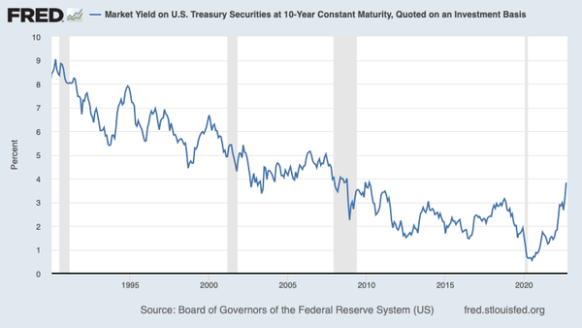
krugman041022_2-articleLarge

What do we think caused that trend? Some commentators say that it was artificial, that the Fed kept pushing rates down by printing money. But basic macroeconomics says that this shouldn’t be possible: If you keep rates artificially low for an extended period, the result should be high inflation. And until the price surge of 2021-22, inflation stayed subdued year after year.

A useful concept here, going back more than a century to the work of the Swedish economist Knut Wicksell, is that of the so-called “natural rate of interest”. Wicksell defined the natural rate either as the interest rate that matched saving with investment or as the rate consistent with overall price stability. These definitions are actually consistent with each other: An interest rate that is too low, so that investment spending exceeds the supply of savings, will cause inflationary overheating of the economy.

And the fact that we didn’t see inflationary overheating over the course of a 30-year trend of falling interest rates suggests that the decline wasn’t artificial — that the natural rate must have been falling over that period.

Why might the natural rate have declined? The most likely culprit is a decline in investment demand, driven by a combination of demographic and technological stagnation.

The key insight is that investment spending is driven in large part by growth — growth in the number of workers and in technological progress. A growing labor force needs more office space, more houses, and so on; a stagnant work force only needs to replace structures and equipment as they wear out. Technological progress can also contribute to investment by making it worthwhile to replace outmoded capital goods, and also by making people richer so they can demand more living space, and so on; if technological progress slows down, investment spending tends to fall.

Since the 1990s, both of these drivers of investment lost a lot of their momentum.

Once the last of the baby boomers reached their mid-20s, the number of Americans in their prime working years, which had risen rapidly for decades, flattened out:

This demographic downturn was even stronger in other wealthy countries. The working-age population in Europe has been declining since 2010, and it has fallen in Japan at a fairly rapid clip.

Technological change is harder to pin down, but it’s difficult to escape the sense that major innovations are becoming increasingly rare…. And for what it’s worth, estimates of total factor productivity, a measure meant to capture the economy’s overall technological level, have grown slowly since the mid-2000s:

So is there any reason to expect either demography or technology to be more favorable for investment in, say, 2024 than they were in 2019? I don’t see it.

It’s true that there has been a lot of recent technological progress in green energy, and it’s possible that an energy transition, helped by Joe Biden’s climate policies, will contribute to investment in the years ahead. But that aside, the same factors that kept interest rates low before the pandemic still seem to be in place.

What about inflation? Another old principle in thinking about interest rates is the Fisher effect, which implies that an increase in expected inflation should normally lead to an equal rise in interest rates. And inflation has spiked in the past year and a half.

That spike is, however, probably temporary. There’s a huge amount to say about inflation, but the 30,000-foot view goes like this: During the pandemic slump, governments gave households huge amounts of aid to maintain their incomes in the face of economic lockdowns. This meant that consumer purchasing power remained high despite a temporary reduction in productive capacity, causing a surge in prices — and leading central banks to hike rates to bring inflation back down.

But there doesn’t seem to be much question about whether they will, in fact, control inflation. Certainly, financial markets expect inflation to revert to pre-pandemic norms:

In summary, then, low interest rates weren’t artificial; they were natural. And it’s hard to see anything that will cause the natural rate to rise once the current inflation spike is over. So the era of low interest rates probably isn’t over after all.

Unquote.

Prof. Krugman may be underestimating the effect of progress in green technologies and how much work will be needed in order to implement them. He may be underestimating the effects of the worsening climate crisis. Or advances in artificial intelligence or biotechnology or nuclear fusion. Or the benefits of advanced technologies given to us by visitors from another world. 

But if the recent trend continues, interest rates will go down again. Since interest rates affect both borrowing and saving, and thereby the world’s economy, that’s interesting.

So Crazy, It Might Just Work

Two facts: Democrats need a more compelling message and New York Times editorials are boring. The subject of yesterday’s editorial, however, is interesting and would give the Democrats a more powerful message. It’s called “Let’s Talk About Higher Wages”:

One of the great successes of the Republican Party in recent decades is the relentless propagation of a simple formula for economic growth: tax cuts.

The formula doesn’t work, but that has not affected its popularity. In part, that’s because people like tax cuts. But it’s also because people like economic growth, and while the cult of tax cuts has attracted many critics, it lacks for obvious rivals.

Democratic politicians have tended to campaign on helping people left behind by economic growth, the difficulties caused by economic growth and the problems that cannot be addressed by economic growth. When Democrats do talk about encouraging economic growth, they often sound like Republicans with a few misgivings — the party of kinder, better tax cuts.

This is not just a political problem for Democrats; it is an economic problem for the United States. The nation needs a better story about the drivers of economic growth, to marshal support for better public policies. The painful lessons of recent decades, along with recent economic research, point to a promising candidate: higher wages.

Raising the wages of American workers ought to be the priority of economic policymakers and the measure of economic performance under the Biden administration. We’d all be better off paying less attention to . . . the nation’s gross domestic product and focusing instead on . . . workers’ paychecks.

Set aside, for the moment, the familiar arguments for higher wages: fairness, equality of opportunity, ensuring Americans can provide for their families. The argument here is that higher wages can stoke the sputtering engine of economic growth.

Perhaps the most famous illustration of the benefits is the story of Henry Ford’s decision in 1914 to pay $5 a day to workers on his Model T assembly lines. He did it to increase production — he was paying a premium to maintain a reliable work force. The unexpected benefit was that Ford’s factory workers became Ford customers, too.

The same logic still holds: Consumption drives the American economy, and workers who are paid more can spend more. The rich spend a smaller share of what they earn, and though they lend to the poor, the overall result is still less spending and consumption.

For decades, mainstream economists insisted that it was impossible to order up a sustainable increase in wages because compensation levels reflected the unerring judgment of market forces. “People will get paid on how valuable they are to the enterprise,” [according to] the Treasury secretary under President George W. Bush.

The conventional wisdom held that productivity growth was the only route to higher wages. Through that lens, efforts to negotiate or require higher wages were counterproductive. Minimum-wage laws would raise unemployment because there was only so much money in the wage pool, and if some people got more, others would get none. Collective bargaining similarly was derided as a scheme by some workers to take money from others.

It was in the context of this worldview that it became popular to argue that tax cuts would drive prosperity. Rich people would invest, productivity would increase, wages would rise.

In the real world, things are more complicated. Wages are influenced by a tug of war between employers and workers, and employers have been winning. One clear piece of evidence is the yawning divergence between productivity growth and wage growth since roughly 1970. Productivity has more than doubled; wages have lagged far behind. . . .

The importance of rewriting our stories about the way the economy works is that they frame our policy debates. Our beliefs about economics determine what seems viable and worthwhile — and whether new ideas can muster support.

Preaching the value of higher wages is a necessary first step toward concrete changes in public policy that can begin to shift economic power. It can help to build support for increasing the federal minimum wage — a policy that already has proved popular at the state level, including in conservative states like Arkansas, Florida and Missouri, where voters in recent years have approved higher minimum wages in referendums.

A focus on higher wages is not a sufficient goal for economic policy. . . .

But a focus on wage growth would provide a useful organizing principle for public policy — and an antidote to the attractive simplicity of the belief in the magical power of tax cuts. . . .

That won’t be easy. The affluent live in growing isolation from other Americans, which makes it harder for them to imagine themselves as members of a broader community. Their companies derive a growing share of profits from other countries, which makes it easier to ignore the welfare of American consumers. The nation’s laws, social norms and patterns of daily life all have been revised in recent decades to facilitate the suppression of wage growth.

But we can begin by telling better stories about the way the economy works.

Unquote.

If the minimum wage had kept up with inflation it would be around $12 today, instead of $7.25  If it had kept up with productivity, it would be more than $24. So it makes sense that Democratic politicians want to raise the minimum wage. Although doing so would indirectly raise the wages of better-paid workers, Democrats rarely, if ever, emphasize that fact. 

There are other ways for national and local government to help wages rise, such as paying government workers more, requiring higher wages in government contracts, making government subsidies contingent on higher wages, reducing Social Security and Medicare taxes for lower-paid workers (while raising them for the very well-paid) and making it easier to form and sustain unions. The Times editorial is saying that Democrats should make higher wages — higher take-home pay — an overarching message. That would convince more of the working class to stop electing Republicans and vote in their economic interest.

Money: a Better Explanation for the NJ Bridge Scandal

The biggest mystery about the Fort Lee, New Jersey, bridge scandal isn’t whether our governor, who is well-known as a loudmouthed, hotheaded bully, was behind the whole thing. The biggest mystery is why Christie or his inner circle would bother messing with Fort Lee at all. Why was it “time for some traffic in Fort Lee”? Because the Democratic mayor of Fort Lee (population 35,000, the 23rd largest city in the state) didn’t endorse Christie’s reelection? It doesn’t make any sense.

No, a much better explanation is offered by Steve Kornacki, a journalist who knows New Jersey politics. He suggests that the reason for creating that massive days-long traffic jam may have been to interfere with a billion-dollar real estate development that just happens to sit at the Fort Lee entrance to the George Washington Bridge.

As Kornacki explains, the development is premised on excellent access to the bridge and New York City. With one access lane instead of three, the location would be significantly less valuable. If the closure lasted any length of time, the deal might have collapsed. If the deal collapsed, the lanes could then be reopened, allowing some other real estate developer to jump in.

Or maybe it was merely a way to extort some campaign contributions from the kind of people politicians love – in this case, rich people who develop real estate.

One way or another, those traffic lanes involve serious money!

On top of that, it’s clear from Kornacki’s report that Christie and his minions knew about the development and access to the bridge. They’re on record suggesting the access should be limited. That’s why they keep bringing up the “traffic study” nobody else knows anything about. 

But it wasn’t a traffic study at all. It looks more like a traffic demonstration: this is what will happen to your major real estate development if we cut access to the bridge by 67%. This would explain why they kept the traffic jam going for days. They had to show they meant business!

Of course, it isn’t clear yet why Christie or his pals would want to use their power this way. But it shouldn’t be surprising if it’s eventually revealed that the fate of a billion dollar real estate deal – and who will profit from that deal – had much more to do with it than some stupid revenge against a Democratic mayor who didn’t endorse the reelection of our Republican governor (even though our governor is known to be a especially vindictive).

Chalk one up for the freedom of the press, even if money had nothing to do with it.

The video with Steve Kornacki’s quite interesting report is here at the aptly-named Crooks and Liars site.

Update:  The New York Times reports that the Christie administration became very cooperative with Jersey City’s Democratic mayor, even setting up a whole day of meetings with top state officials, after Christie asked the mayor for his endorsement. When the mayor announced he wasn’t going to endorse Christie’s reelection, the state officials immediately canceled their day of meetings. So maybe Christie and his inner circle were just playing politics in Fort Lee (although playing it very badly).

Meanwhile, the Federal government is looking into Christie’s use of hurricane Sandy relief funds, some of which were used to run TV advertising encouraging tourists to return to the Jersey Shore. Two ad agencies bid on the project. Christie picked the campaign in which he himself would appear, even though it cost a couple million dollars more than the other bid. Christie was running for reelection at the time, so he must have figured it was federal money well-spent.Â