They’ve Got a Great Name for Voter Suppression and One Party Rule

From Fox News last month:

The Republican National Committee is launching a new panel on election integrity that it says is dedicated to restoring transparency and confidence to future elections.

The RNC announced their new Committee on Election Integrity on Wednesday, sharing the news first with Fox News.

Because everybody is in favor of election integrity.

From Greg Sargent of The Washington Post:

The New York Times has a remarkable new report that exposes the breadth of Republican voter suppression efforts. Party leaders and their conservative allies are seeking to coordinate the passage of bills — in multiple states — designed to make it harder to vote, justified by mythic voter fraud.

For instance, the Times reports, those efforts played a role in a radical package of bills moving forward in Georgia, which includes ending vote-by-mail for most voters and limiting Sunday voting drives, which are heavily utilized by African Americans.

Republican leaders and their allies plan to export statutory language restricting voting to other states, and in many of them, extensive such efforts are already underway.

“The widespread coordination underscores the extent to which the dogma of voter fraud is embedded in the Republican Party,” the Times reports, bluntly noting that the Republican “views its path to regaining a foothold in Washington” through “an intense focus on re-engineering the voting system in states where it holds control.”

The focus-grouped phrase justifying all this is “election integrity.” That’s the name of the new group, run by the Republican National Committee, that is developing more such proposals for export to states.

But [the former president] has already told us what standing for “election integrity” really means: making it harder to vote for the express purpose of making it easier for Republicans to win future elections.

[He] made this explicit during his Conservative Political Action Conference speech. He declared that the Republican must be the party of “election integrity” and that this means reversing efforts to make it easier to vote wherever possible and that this is an “urgent” matter facing the Republican. . . .

Importantly, this is not [their leader] projecting his own corrupt motives on to what Republicans are doing. Rather, it’s that Republicans are acting on precisely that very same [rationale]:

[According to the Times:]

To head its election integrity committee, the Republican National Committee tapped Joe Gruters, the Florida Republican Party chairman who in January used a #stopthesteal hashtag and advertised ways for Republicans to attend the Jan. 6 rally that ended with a riot at the Capitol. . . .

Like nearly all of the Republicans involved in the party’s voter integrity efforts, Mr. Gruters declined to characterize Mr. Biden’s victory as legitimate, despite there being no evidence of widespread fraud and multiple state audits reaffirming the results. “There are a lot of people who have a lot of questions about the 2020 race.”

The call for “election integrity” is now inseparable from the claim that the election was stolen from Trump. That’s a lie, but the fact that so many Republican base voters believe it — which Trump and Republican officials [got them to believe] — is itself the stated justification to continue.

But we are not obliged to pretend that these Republican officials actually believe their lies about the election. Once we liberate ourselves of that notion, the plain truth comes into view: The same justification used to incite an effort to violently subvert the 2020 election’s conclusion is now being used to manipulate future elections, by preventing as many Democratic-aligned voters, untold numbers of them African American, from voting as possible. . . .

Unquote.

Choosing a positive phrase to describe a blatant power grab is a great bit of marketing. Journalists will tend to adopt the Republican terminology, just like the authors of the Times article when they refer to the “election integrity committee” and “the party’s voter integrity efforts” in the quote above. We need to keep in mind that, in this case, “election integrity” means stuff like making it a crime in Georgia to give food or water to voters standing in line for hours to vote because there are so few polling places in their neighborhoods.

What the Majority Wants vs. the Minority Rule Party

The American Rescue Plan the House of Representatives passed early Saturday morning has so much in it that one amazing provision is hardly being mentioned:

President Biden and Democratic lawmakers want to fight child poverty by giving U.S. families a few hundred dollars every month for every child in their household — no strings attached. A kind of child allowance. . . . Experts say it could cut child poverty nearly in half (NPR).

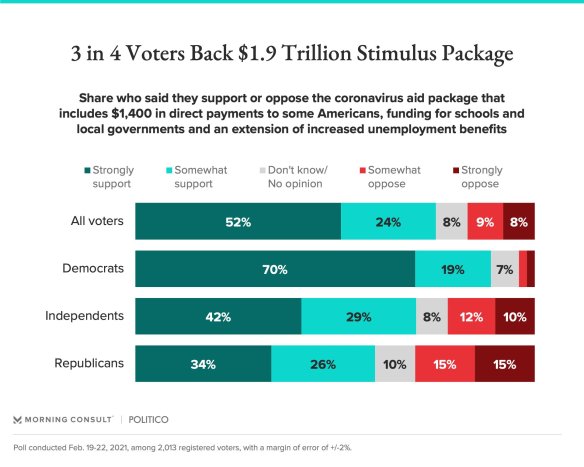
It’s understandable, therefore, that polls say an overwhelming majority of Americans support the Democrats’ Covid relief bill. One poll says 76% — even 60% of Republicans — support it. But not a single Republican in the House of Representatives voted for it. 

EvPxyZ5XYAQ9PJP

Paul Waldman and Greg Sargent of The Washington Post both have columns about the bill and the politics. Here’s a mixture from what they wrote:

If I asked you to explain the Republican case against the Covid relief bill, what would you say? Well, they think it’s too expensive, and they’d rather not give too much help to states and localities. But their arguments against it seem halfhearted, anemic, almost resigned. . . .

This ought to be a moment when the GOP is back in its comfort zone. It’s not a party built for governing; Republicans no longer have much of a policy agenda, their leaders have become much more skilled at obstruction than at passing laws, and they have an enormous propaganda machine with a talent for creating fear and outrage. The party’s specialty is opposition.

One of the things they’ve done in the past is cast every new Democratic or liberal move as a harbinger of an impending apocalypse. Obamacare, they said in 2010, would destroy the American health care system. If gay people are allowed to marry, they said in 2004, the result would be the end of families and the breakdown of society. Both predictions proved ludicrously wrong, but at the time, they were highly effective means of motivating opposition. Today you can still find such rhetoric, but you have to look for it. . . .

Back in 2009, [Republican congressman Paul Ryan] made a very public case against a stimulus a fraction this big, making an actual argument (if a fraudulent one) about what debt Armageddon would mean for American society.

These days it’s harder to make that case. Republicans blew up the deficit with a huge tax cut for the rich, and cheered along as the pre-Covid economy was rocket-fueled with stimulus. Economists no longer fear the long-term risks of massive deficit spending amid big crises.

As a result, there’s nothing close to the same kind of public argument this time. As Paul Krugman points out:

Republicans appear to be losing the economic argument in part because they aren’t even bothering to show up

It’s as if they know they don’t have to.

They may well fully expect Democrats to . . . get the economy booming again, even as the vaccine rollout and other policies successfully tame the pandemic.

Yet Republicans know that even if this happens, they still have a good chance at recapturing the House at a minimum, helped along by a combination of voter suppression and other counter-majoritarian tactics and built-in advantages.

[Outside of Washington] they’re racing forward with an extraordinary array of new voter suppression efforts. Such measures are advancing in Georgia, Florida and Iowa, and in many other states.

In a good roundup of all these new efforts, Ari Berman notes:

After record turnout in 2020, Republican-controlled states appear to be in a race to the bottom to see who can pass the most egregious new barriers to voting.

On top of that, Republicans are openly boasting that their ability to take back the House next year will gain a big lift from extreme gerrymanders. Some experts believe they can do that even if Democrats win the national House popular vote by a margin similar to that of 2020.

So is there any reason to doubt that they’re primarily counting on more of the same as their path back to power this time?

[But controlling the White House and both houses of Congress] presents an extraordinary opportunity for Biden and congressional Democrats if they can see their way clear to take advantage of it.

Right now, Democrats are tying themselves in knots trying to figure out how to increase the minimum wage, something President Biden ran on, their entire party believes in, and which is overwhelmingly popular with the public. Some want $15 an hour, while others would prefer $11.

Yet the Senate parliamentarian has ruled that a straight minimum wage increase can’t pass via the reconciliation process — the only way to pass a bill with a simple majority vote — the details of which are incomprehensible, or endlessly maddening, or both.

So Democrats have to find some kind of fiscal somersault to try to get the minimum wage increase into the Covid relief bill. 

This is no way to make laws. And what’s even worse is that it’s happening at a moment when Republicans — who in the past have been nothing if not skilled at undermining, vilifying, and sabotaging Democratic presidents — have seldom looked more feckless.

Republicans just haven’t been able to take the hatred and fear their hardcore base feels for Biden and scale it up and out, which then affects their ability to whip up frenzied opposition to the things he’s trying to do. And the broader context matters, too: When we’re caught in a pandemic and an economic crisis, only so many people will get worked up about whether a transgender girl is allowed to play softball.

That gives Democrats the chance to move forward confidently with their agenda, an agenda that is enormously popular. Yet some in the party are still in the grip of the nonsensical belief that it’s more important to retain a Senate procedure whose purpose is to thwart progress than to pass laws that solve problems.

In every American state legislature and in most every legislature around the world, if there’s majority support for a bill, it passes. In almost all cases supermajorities are only required, if ever, on things like constitutional amendments.

And every argument the filibuster’s defenders make about it — that it produces deliberative debate, that it encourages bipartisanship, that it makes for cooperation and compromise — is simply wrong, as anyone who has been awake for the last couple of decades knows perfectly well.

The Covid relief bill will pass, because it’s the only thing Democrats can do without a supermajority. It’s a vital, popular bill that could have been done in cooperation with Republicans had they wanted, but instead they’ve decided to oppose it. Which is their right, but it also shows how a simple majority should be the requirement for more legislating — which can only happen if the filibuster is eliminated.

The first weeks of the Biden presidency show the path Democrats can take: Push forward with the popular and consequential parts of your agenda, don’t be distracted by bleating from Republicans, act as though the public is behind you (because it is), and you might find that the Republican opposition machine isn’t as potent as it used to be.

But none of that will be possible unless Democrats can deliver on their promises. If they let themselves be handcuffed by the filibuster, the Biden presidency will fail and Republicans will take control of Congress. In other words, Democrats will have done the job Republicans couldn’t do themselves.

Unquote.

Neither of the columnists mentioned two key parts of the Democratic agenda.

The John Lewis Voting Rights Advancement Act would strengthen the Voting Rights Act of 1965. It would protect voters from racial discrimination and voter suppression.

The For the People Act would expand voting rights, overhaul our campaign finance system, and end extreme partisan gerrymandering.

All that stands in the way of these bills becoming law is the current requirement that ten Republican senators vote for them. That’s why the 50 Democratic senators need to end or severely limit the filibuster, thereby restoring majority rule to the US Senate. That’s how we can help restore majority rule to the United States of America.

Majority Rule Would Reveal How United We Are

Conservative columnist Jennifer Rubin of The Washington Post has given up on the Republican Party (“How Do We Hold the Traitors to Democracy Accountable?”):

The degree to which the Republican Party embraced an attempted coup is both chilling and unsurprising given the GOP’s descent into authoritarianism. It should prompt some soul-searching by Republicans who did not join the coup. Is this a party I should be associated with? Is this a party that can be trusted with power? If the answer to either question is no, they should form a new party whose only requirement is loyalty to the Constitution.

But she sees positive possibilities ahead (“America Isn’t Hopelessly Divided. It Only Looks That Way Because of Our Constitution”):

I get it — and agree with it to some extent: Americans are deeply divided, inhabiting two parallel political universes, ingesting different media and adhering to contradictory visions of America. One increasingly defines the United States as a bastion of White Christianity; the other sees a creedal nation defined by its founding documents. But perhaps the “civil war” perspective is overwrought and distorted.

First, let’s get some perspective. Yes, a shift of a mere 39,000 votes in a few close swing states in 2016 would have made Hillary Clinton president. And yes, an even slimmer shift of about 33,000 votes would have kept President Txxxx in office this year. But a shift of 269 votes in Florida in 2000 would have given the election to Al Gore. Were we more divided then?

More generally, we can see that it is the Electoral College that transforms President-elect Joe Biden’s margin of 7 million votes into a multistate nail-biter. But forget the Electoral College for a moment: Democrats have won the popular vote in the past four consecutive elections with margins ranging from 2.9 million (Clinton in 2016) to 10 million (Obama in 2008). And Al Gore, by the way, won by more than half a million votes nationally. One “solution” to the deep division problem, then, would be to junk the Electoral College.

A similar lack of majority rule gives Republicans control of the Senate, despite having support from a minority of the population. The disproportionate power of lightly populated states turns significant majority rule by Democrats into persistent minority rule by Republicans. Gerrymandering offers many Republicans a similar artificial advantage in their House seats.

In other words, we have an enduring and significant majority in favor of Democrats nationally, but our constitutional system consistently hands that advantage over to a Republican Party that is increasingly radical, irrational and racist. (As The Post’s Dan Balz writes, “For Txxxx supporters, cultural preservation of an America long dominated by a White, Christian majority remains a cornerstone of their beliefs.” That is the definition of white supremacy.)

We could get rid of the Electoral College by constitutional amendment or through the National Popular Vote Interstate Compact (which would instruct each state’s electors to cast their votes for the national popular vote winner). But there is an alternative answer, which is also a function of our constitutional system.

One positive aspect of the Txxxx era is that it made many Democrats understand the value of federalism. State lawmakers and election officials prevented a coup by the Txxxx campaign. State attorneys general, over the course of 138 cases, also blocked Txxxx on an array of issues. As NBC News reported, this includes: “the ‘travel ban’; the Deferred Action for Childhood Arrivals program, or DACA; family separations at the U.S.-Mexico border; the ‘national emergency’ declaration to build the border wall; international student visas; student loan protections; clean water rules; transgender health care protections; automobile emissions; a citizenship question on the 2020 census; U.S. Postal Service operations; and Obamacare.”

Federalism is not an unalloyed benefit to progressives, as we saw when states banned same-sex marriage, access to abortion and common sense precautions to prevent the spread of covid-19. But, if you combine the “laboratories of democracy” with local activism (which prevailed in one state after another on same-sex marriage) and a Democratic president’s persuasion, you might make real progress on everything from police reform to health care to education.

The other benefit of pushing decision-making down to the states is that state governments are less polarized and more functional than the federal government. Democratic governors work with Republican legislatures; Republican governors work with Democrats. Budgets get passed and balanced — without the backstop of printing money.

So where does that leave us? Our divisions are considerable — aggravated not solely by “polarization,” but also by the descent of one party into nuttery and by a Constitution that gives that party disproportionate power. Where possible, lawmakers should reduce that distortion (e.g., the National Popular Vote Interstate Compact) and deploy federalism.

Finally, our politics is more fluid than we imagine. Virginia and Colorado used to be dependable red states. No more. Stacey Abrams showed Georgia politics can shift as well. We need not accept that states are fated to remain in one partisan column. Activism, outreach and demography can change the electorate, and hence the result of elections.

The bottom line: Democrats have a small but stubborn national popular vote majority. The electorate as a whole agrees with their positions on gun safety, climate change and health care. The trick is expanding democracy, maximizing the benefits of federalism and working hard to create an electorate that resembles the increasingly diverse — and progressive — population.

Unquote.

Ms. Rubin doesn’t mention statehood for Washington, D.C. (pop. 685,000) and Puerto Rico (3.2 million), but giving full voting rights to citizens there would help restore majority rule to the Senate.

The Pessimistic View May Be Realistic

A headline this morning in The Washington Post:

Trump uses power of presidency to try to overturn the election

Fintan O’Toole is an Irishman who teaches at Princeton. This is two-thirds of his article for The New York Review of Books:

At 2:23 AM on the morning after Election Day, Txxxx turned the key and locked American democracy into an undetermined, perhaps indeterminable, condition. When he declared an election that was still very much alive to be a dead thing, over and done with—“Frankly we did win this election”—he made the United States a liminal space in which a supposedly epic moment in its history both happened and did not happen.

Txxxx has long framed the immediate post-election period as a temporal no-man’s-land. Neither in his first nor in his second campaigns for the presidency did he ever commit himself clearly to accepting the result of the vote. Asked in the third presidential debate of 2016 whether he would do so, he replied, “What I’m saying is that I will tell you at the time. I’ll keep you in suspense. Okay?” What is being suspended now is both the disbelief of his supporters in the possibility of his defeat and the very concept of a transition of power.

In this frame of mind, there can never be a result of the 2020 election. One thing we can be sure of is that for Txxxx and his followers there are not five stages of grief, leading from denial to acceptance. The furthest their sense of it can go is to the second stage, anger. Just as there is “long Covid,” there is long Txxxx. The staying power of his destructiveness lies in the way that disputed defeat suits him almost as much as victory. It vindicates the self-pity that he has encouraged among his supporters, the belief that everything is rigged against them, that the world is a plot to steal from them their natural due as Americans.

He has created for them a wide space to occupy, that great prairie of paranoia that stretches between what happened and what really happened. What really happened is what always occurs in every Txxxx story: he won big. Losing, for Txxxx, is not possible. It is a category of humanity that he calls in The Art of the Deal “life’s losers.” As he exclaimed to his fans at one of his final rallies in Grand Rapids, Michigan, after showing them a video of Joe Biden stammering, “The concept of losing to this guy!” When you define your opponent as a contemptible wretch, that thought is inconceivable.

Usually, at this point, we get the postmortem. But there is no body. The malignant presidency of Dxxxx Txxxx seems moribund, but also vigorously alive. . . . We have, after all, already witnessed the Good Friday and Easter Sunday of Donald Trump. In a grotesque parody of the Christian narrative, Trump presented his contraction of Covid-19 not as a consequence of his own narcissistic recklessness but as a Jesus-like self-sacrifice—he caught the virus on behalf of the people. Trump “died,” was in the “tomb” of Walter Reed hospital for three days and then rose again and appeared to many. This fable seems to have worked for his supporters, electrifying them with its evidence of their leader’s indefatigability. The deaths of others—230,000 victims of Covid-19 by election day—did not prompt a turn against the president who presided over them. His base acted, rather, as the foil for his miraculous, manic display of vivacity in the last days of the campaign.

During the pandemic, Txxxx defied death but did not acknowledge it; Biden acknowledged death but did not pretend to defy it. Txxxx’s demeanor and bluster sought to suggest that the US had barely been touched by the virus, Biden’s to show that he himself had been deeply touched by the suffering it had inflicted. These were physical contrasts—swagger versus caution, masked against unmasked. But they also played out as starkly different attitudes toward death and time. Txxxx, at his first rally after his resurrection, posed as an immortal (“I went through it. Now they say I’m immune. I feel so powerful.”)

. . . Biden’s whole bearing, on the other hand, spoke of vulnerability and mortality. This dichotomy may have been accidental but is also highly expressive of a deeper divergence: autocracy (as it imagines itself) is forever; democracy’s outcomes are always temporary. This is where the election has ended up, as a clash between Txxxx’s immunity to its results and Biden’s fragile appeal to democratic decency.

It is impossible not to think, in this in-between moment, of Antonio Gramsci: “The crisis consists . . . in the fact that the old is dying and the new cannot be born. . . .” Something is dying, but we do not yet know what. Is it the basic idea of majority rule or is it the most coherent attempt to destroy that idea since the secession of the Confederacy? Something is trying to be born, but we cannot yet say what it is either. Is it an American version of the “managed democracy” or “electoral autocracy” that is the most rapidly expanding political form around the world? Or is it a radically renewed republic that can finally deal with the unfinished business of its history? The old is in a state of suspended animation; the new stands at a threshold it cannot yet cross.

In 1974 upon his inauguration as president, just half an hour after the resignation of Richard Nixon, Gerald Ford declared, “My fellow Americans, our long national nightmare is over.” [He] suggested that Nixon’s departure had left the country in a good place: “Our Constitution works; our great Republic is a government of laws and not of men.” With its institutions intact, the US could quickly return to its natural condition of mutual benevolence: “Let us restore the golden rule to our political process, and let brotherly love purge our hearts of suspicion and of hate” . . . .”

But long national nightmares do not end in real life as they do in Oz. Dxxxx Txxxx himself crawled out of Nixon’s political grave, more lawless, more shameless, more openly unhinged. And he will not lie down. Joe Biden, like Ford before him, hoped to arrive in the Oval Office, not just as a healer, but as an exorcist, driving out the evil spirits of suspicion and hate. For many of those who voted for him, the end of the Txxxx regime, like the banishing of Nixon, would prove that, after all, “our Constitution works.” There could be a great sigh of relief: the system has corrected itself. That was not really true in 1974 and it is emphatically false now. . . .

The American republic has come close to being overthrown by a discontented multimillionaire. Biden failed to say with sufficient force that America needed . . . to wake up to the urgent meaning of that threat. . . .

Its core appeal is necromantic. It promised to make a buried world rise again: coal mines would reopen in West Virginia, lost car plants would return to Detroit. Good, secure, unionized muscle jobs would come back. The unquestionable privilege of being white and male and native would be restored. Txxxx did not manage to do any of this, of course. But, in a sense, that very failure keeps the promise pure, unadulterated by the complexities of reality. We have seen in Txxxx’s triumph in Ohio and very strong performance in Wisconsin, Michigan, and Pennsylvania that it still has great purchase on the imagination of millions. . . .

Txxxx, in 2016, was the child in Hans Christian Andersen’s “The Emperor’s New Clothes,” with the twist that rather than blurting out that the monarch was walking around naked, he shouted out the truth that, as a force capable of winning presidential elections, the Republican Party was extinct. He held its cadaver up before his baying crowds. And he presented himself as its sweet (or rather extremely sour) hereafter. Whatever else the 2020 election shows, it proves that he was right.

Txxxxism now is the GOP’s death warmed over. Like a political remake of The Invasion of the Body Snatchers, it has fully assimilated the outward appearances and forms of the dead Republican Party to a new body, a duplicate that looks the same but that has in fact been hollowed out. Txxxx’s White House speech on election night made explicit that what has been excised in this process is the most basic assumption of electoral democracy: that the majority wins and the minority, however, disappointed, accepts the legitimacy of its victory and its right to govern.

This invasion is thrilling for Republicans because it is also a kind of liberation. As the agonized tone of the 2013 autopsy report [commissioned by the party’s leadership] makes clear, the transformations of gender, class, race, and ethnicity necessary for them to be reborn as the voice of a genuine national majority, even if they had been possible, would have been extremely painful. Txxxx’s delivery of the death certificate freed the GOP from this torment. There was nothing to revive. What Txxxx stumbled on was that the solution to the party’s chronic inability to win a majority of voters in presidential elections was to stop trying and instead to embrace and enforce minority rule. This possibility is built into the American system. The electoral college, the massive imbalance in representation in the Senate, the ability to gerrymander congressional districts, voter suppression, and the politicization of the Supreme Court—these methods for imposing on the majority the will of the minority have always been available. Txxxx transformed them from tactical tools to permanent, strategic necessities.

As we are now seeing, the difference for a democracy is existential. A tactic of maneuvering to hold power against the wishes of the majority of voters is contingent, opportunistic, reactive. It is innately time-limited. It will advance when it can and retreat when it must. But when the tactic becomes the strategy, there can be no retreat. A program of consolidating the means by which a minority can gain and retain power must try to institutionalize itself, to become so embedded that it can withstand the majority’s anger. To do that, it must not merely evade the consequences of losing the popular vote in this or that election. It must, insofar as it can, make those elections irrelevant.

This is the most important thing to understand about the postmortem Republican Party. The logic is not that a permanently minority party may move toward authoritarianism but that it must. Holding power against the wishes of most citizens is an innately despotic act. . . . When Txxxx said on Fox & Friends at the end of March that Democrats want “levels of voting that, if you ever agreed to it, you’d never have a Republican elected in this country again,” he was openly redefining the meaning of the vote. Voting, in this formulation, is something to be “agreed to”—or not—by Txxxx himself. Democracy is no longer rooted in the consent of the governed, but in the contingent permission of the indispensable leader.

In all the noise of the 2020 election, it was easy to miss the signal that was not being sent. The incumbent president made no effort even to go through the motions of presenting a future open to deliberation by citizens. He had no policy agenda for a second term—the GOP merely readopted its platform from 2016, without even bothering to delete its multiple attacks on “the current president.” Why? Because arguments about policy are the vestiges of a notion that Txxxx has killed off: the idea that an election is a contest for the support, or at least the consent, of a majority of voters. Such arguments implicitly concede the possibility that there is another, equally legitimate choice. That is precisely what the posthumous Republican Party cannot and does not accept.

This refusal is shaped by a functioning redefinition of “we, the people.” When Txxxx spoke on election night about “a fraud on the American public,” he meant that the “public” consists only of his voters. . . .

This is the election behind the election—the GOP’s decision to imaginatively dissolve the American majority and elect another. This has been done in two ways, coarsely and a little more subtly. The coarse method is to simply deny that the majority exists. This is what Txxxx did on election night and the probability is that his supporters believe it to be true. After the 2016 election, he obliterated the majority by claiming that “in addition to winning the Electoral College in a landslide, I won the popular vote if you deduct the millions of people who voted illegally.” A plurality of his voters actually believed that there was no “if” about it. A Politico/Morning Consult poll of Txxxx voters in July 2017 found that 49 percent believed that he really did win the popular vote. Now, in 2020, it is not just that the majority does not count, it is that it is actively criminal, engaged as it is in a vast conspiracy to steal his victory.

This could be written off as the usual despotic delusion were it not buttressed by the slightly subtler method of choosing another “people.” The method is to shift between two implicitly contradictory meanings of the same word: elect. Without a capital E, it indicates what is supposed to happen in a democracy—all citizens can vote and whoever wins the most votes is the president. Capitalize the initial letter and it signifies the righteous, those chosen by God for salvation. . . .He himself generally does this in a secular form: the typical populist slippage from “the people” to “the real people.” Before he ran for president, when Txxxx tweeted about “Patriots,” it was almost always in relation to the football team. After 2015, it was almost always about the “great American patriots” who attend his rallies. The anti-Txxxx majority is neither great, nor patriotic, nor in fact American.

This exclusion overlaps with a religious version promulgated most notably by the attorney general, William Barr, according to whom religious belief is the entire foundation of the American political community, so those who are not religious (in a very narrow sense) cannot properly belong in the polity.

In effect, of course, the secular and religious versions overlap and support each other. The majority, deficient in both patriotism and sanctity, is unworthy. If it seems to have won, that can only be because, being outside the polity, it has subverted the real polity by fraud. To deny its validity is both patriotic and righteous. Voter suppression, gerrymandering, and the use of the Supreme Court to hand electoral victories to the Republicans are no longer dirty tricks. They are patriotic imperatives. They are not last resorts but first principles.

The great comfort of this mentality is that, when the majority can be conjured out of existence, so can the whole idea of defeat. The old norm, whereby the beaten party retreats into a period of reflection and considers why it lost, is gone. The only possible response to Biden’s apparent victory is that of Satan in John Milton’s Paradise Lost:

All is not lost; the unconquerable will,
And study of revenge, immortal hate,
And courage never to submit or yield . . .

If [Note: when] Txxxx is eventually removed from the Oval Office, the study of revenge and immortal hate, not sober self-criticism, will be the response in Txxxxworld. There will be no chastening, just a further injection of resentment and conspiracy-mongering.

This is zombie politics—the life-after-death of a former conservative party. And as Gothic stories tell us, it is very hard to kill the undead. One half of a two-party system has passed over into a post-democratic state. This reality has to be recognized, and a crucial aspect of that recognition is to accept that the claim Ford could make in 1974—“Our Constitution works”—no longer applies. After the long national nightmare of Watergate, America could rub its eyes and awaken to a renewed confidence in its system of checks and balances.

But the Txxxx presidency has been no nightmare. It has been daylight delinquency, its transgressions of democratic values on lurid display in all their corruption and cruelty and deadly incompetence. There may be much we do not yet know, but what is known (and in most cases openly flaunted) is more than enough . . . There can be no awakening because the Republicans did not sleep through all of this. They saw it all and let it happen. In electoral terms, moreover, it turns out that they were broadly right. There was no revulsion among the party base. The faithful not only witnessed his behavior, they heard Txxxx say, repeatedly, that he would not accept the result of the vote. They embraced that authoritarianism with renewed enthusiasm. The assault on democracy now has a genuine, highly engaged, democratic movement behind it.

. . . But Biden, by contrast, is explicitly transitory. In April he said: “I view myself as a transition candidate.”

His reasons did not need to be stated. . . . It is not just that a Biden presidency would, presumably, accept the limits placed on the office by constitutional propriety and common decency. It is that it is limited by the remorseless effects of time on the body.

Yet in this very temporal constraint, there is a danger. The idea of a transitional presidency implies a drawing of breath, a period of calm after the Txxxxian tempest, America as a giant field hospital devoted to the binding of wounds. This would be a reprise of Ford’s emollient speech in 1974: our self-correcting system has worked its magic and now we may all love one another again. Biden’s entire political persona has been shaping itself toward such a moment. But it cannot be. Txxxx will not allow it, and the whole structure of permanent minority rule that he has brought to the fore works against it. Biden must continue to fight Txxxx and, if and when he takes power, he must dismantle that structure, piece by piece.

The historic question that must be addressed is: Who is the aberration? Biden and perhaps most of his voters believe that the answer could not be more obvious. It is Txxxx. But this has been shown to be the wrong answer. The dominant power in the land, the undead Republican Party, has made majority rule aberrant, a notion that transgresses the new norms it has created. From the perspective of this system, it is Biden, and his criminal voters, who are the deviant ones. This is the irony: Txxxx, the purest of political opportunists, driven only by his own instincts and interests, has entrenched an anti-democratic culture that, unless it is uprooted, will thrive in the long term. It is there in his court appointments, in his creation of a solid minority of at least 45 percent animated by resentment and revenge, but above all in his unabashed demonstration of the relatively unbounded possibilities of an American autocracy. As a devout Catholic, Joe Biden believes in the afterlife. But he needs to confront an afterlife that is not in the next world but in this one—the long posterity of Dxxxx Txxxx.

Unquote.

Or maybe that’s too pessimistic. Maybe America will finally tame the virus, the economy will rebound, the Democrats will add seats in Congress, changes will be made in support of majority rule and the 2024 presidential election will be relatively sane. Otto von Bismarck was no dope and he once supposedly said: “God has a special providence for fools, drunkards, and the United States of America”. We shall see.
Minority Rule in America

The Electoral College system was established under Article II and Amendment 12 of the U.S. Constitution more than 200 years ago. What it means is that Americans vote for president indirectly. We see a candidate’s name on the November ballot, but we’re actually voting for a group of electors who will pick the winner in December. From Jamelle Bouie of The New York Times:

Under the Constitution, states can allocate electors — meaning electoral votes — in “such Manner as the Legislature thereof may direct.” Beginning after the Civil War, every state in the union has used direct popular election to choose electors. The modern process is straightforward. After the vote, election officials certify results and prepare “certificates of ascertainment” that establish credentials for each elector. There are multiple copies, and the governor signs each one. The electors meet, record their votes, and those votes and certificates . . . are sent to state and federal officials, including the vice president, who will preside when Congress counts electoral votes early next year. 

Under the theory of legislative supremacy over elections, however, . . . state legislatures could possibly circumvent governors and election officials to create different slates of electors to send to Congress, forcing a choice between the people’s electors and those of the legislature. If a state submits conflicting electoral votes, the House and Senate may choose which ones to accept or reject.

It has to be said that there is almost no chance of this happening . . .

[Note: I’d say there’s zero chance of it happening in enough states to change the result of the election. However:

We are living through a period in which, for reasons of geographic polarization in particular, the Republican Party holds a powerful advantage in the Senate and the Electoral College, and a smaller one in the House of Representatives. Twice in 20 years they’ve won the White House without a majority of votes. A few shifts here and there, and Txxxx might have won a second term while losing by a popular vote margin nearly twice as large as the one he lost by in 2016.

The Republican Party, in other words, can win unified control of Washington without winning a majority of the vote or appealing to most Americans. Aware of this advantage, Republicans have embraced it. They’ve pinned their political hopes on our counter-majoritarian institutions, elevated minority government into a positive good (rather than a regrettable flaw of our system) and attacked the very idea that we should aspire to equality in representation. “Democracy isn’t the objective; liberty, peace, and prosperity are,” Senator Mike Lee of Utah tweeted last month. “We want the human condition to flourish. Rank democracy can thwart that.”

“Rank democracy.” Perhaps Lee, one of the leading intellectual lights of the Republican Party, is alone in his contempt for political equality between citizens. But I doubt it. And a Republican Party that holds that view is one that will do anything to win power, even if it breaks democracy. It’s a Republican Party that will suppress voters rather than persuade them, degrade an office rather than allow the opposition to wield it and create districts so slanted as to make it almost impossible for voters to remove them from office.

For that Republican Party, the Electoral College is a loaded gun, waiting to be fired. We’ll disarm and disassemble it as soon as possible, if we value this democracy of ours.

Unquote.

The good news is that there is an effort underway to practically eliminate the Electoral College. From NBC News:

[By approving Proposition 113 last week,] Colorado voters have decided to join a growing list of states that hope to decide a president by popular vote, the latest move in a national chess match over the way the United States elects its presidents.

Called the National Popular Vote Interstate Compact, the agreement calls for states to award their electoral votes to the winner of the national popular vote, once enough states join the agreement.

So far, 15 states and the District of Columbia have approved the pact, covering 196 electoral votes of the required 270 to win the presidency.

That 270 matters: The states that have approved legislation to join the compact agreed it would not take effect until the 270 threshold is reached. Once it does, those states will have the power to use their Electoral College votes to elect a winner, according to the popular vote. This uses the Electoral College to effectively phase out the Electoral College . . . 

Unquote.

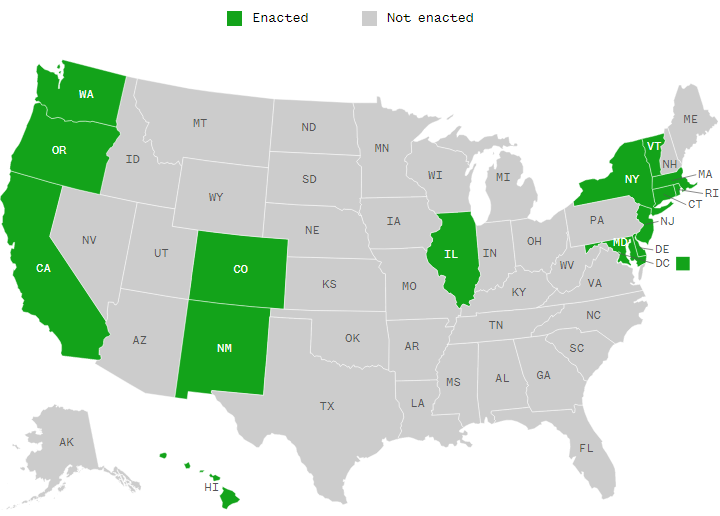
These are the states that have enacted the Interstate Compact. Will enough voters, legislatures or governors one day agree to elect presidents by majority rule? It’s not a sure thing, but it’s more feasible than eliminating the Electoral College by amending the Constitution.

Untitled