The Tyranny of the Minority

The authors of How Democracies Die have a new book coming out called Tyranny of the Minority. Zack Beauchamp of Vox has a review that’s worth reading in full. These are selections:

In The Odyssey, Odysseus and his crew are forced to navigate a strait bounded by two equally dangerous obstacles: Scylla, a six-headed sea serpent, and Charybdis, an underwater horror that sucks down ships through a massive whirlpool. Judging Charybdis to be a greater danger to the crew as a whole, Odysseus orders his crew to try and pass through on Scylla’s side. They make it, but six sailors are eaten in the crossing.

In their new book Tyranny of the Minority, Harvard political scientists Steven Levitsky and Daniel Ziblatt — the authors of How Democracies Die — argue America’s founders faced an analogous problem: navigating between two types of dictatorship that threatened to devour the new country.

The founders, per Levitsky and Ziblatt, were myopically focused on one of them: the fear of a majority-backed demagogue seizing power. As a result, they made it exceptionally difficult to pass new laws and amend the constitution. But the founders, the pair argues, lost sight of a potentially more dangerous monster on the other side of the strait: a determined minority abusing this system to impose its will on the democratic majority.

“By steering the republic so sharply away from the Scylla of majority tyranny, America’s founders left it vulnerable to the Charybdis of minority rule,” they write.

This is not a hypothetical fear. According to Levitsky and Ziblatt, today’s America is currently being sucked down the anti-democratic whirlpool.

The Republican Party, they argue, has become an anti-democratic institution, its traditional leadership cowed by Trump and a racially reactionary base. As such, it is increasingly willing to twist legal tools designed to check oppressive majorities into tools for imposing its policy preferences on an unwilling majority. The best way out of this dilemma, in their view, is radical legal constitutional reform that brings the American system more in line with other advanced democracies.

Tyranny of the Minority is an exceptionally persuasive book. I think it is almost inarguably correct about both the nature of the modern Republican Party and the ways in which it exploits America’s rickety Constitution to subvert its democracy.  I come to some similar conclusions in my own forthcoming book on democracy, The Reactionary Spirit ….

In the US, Levitsky and Ziblatt see a democracy made vulnerable by its own Constitution.

The Constitution’s framers were the first to take Enlightenment ideas about freedom and translate them to an actual political system. The only historical democratic experiences they looked at were from antiquity, in places like Athens and Rome. Classical sources repeatedly chronicled threats to democracy, even outright collapse, emanating from mob rule.

Though the founders knew that democracy was at heart about majority rule, they took the Greco-Roman experience seriously and designed a system where majorities were severely constrained. The tripartite separation of powers, bicameral legislature, indirect election of the president and senators, lifetime Supreme Court tenure, the laborious process for amending the Constitution: all of these were built, in whole or in part, as limitations on the ability of majorities to impose their will on minorities.

Some American counter-majoritarian institutions emerged not from well-intentioned design but political necessity. Leading founders like James Madison bitterly resented the basic structure of the Senate, where each state gets two seats regardless of size; Alexander Hamilton called it “preposterous” during a constitutional convention debate. It was included purely to mollify small states like Delaware and Rhode Island, who were refusing to join the Union absent sufficient protections for their interests.

Over time, the US shed some of these minoritarian trappings — senators are now directly elected, thanks to the 17th Amendment — but deepened others. In 1803’s Marbury v. Madison, the Supreme Court gave itself expansive power to strike down legislation that was not explicitly granted in the Constitution. More recently, the filibuster emerged as a de facto 60-vote requirement for passing legislation in the Senate — a practice similar to the supermajority vote that the founders explicitly rejected early on.

Levitsky and Ziblatt show that almost every other peer democracy went in the opposite direction.

The United States is “the only presidential democracy in the world in which the president is elected via an Electoral College,” “one of the few remaining democracies that retains a bicameral legislature with a powerful upper chamber,” and “the only democracy in the world with lifetime tenure for Supreme Court justices.” Moreover, they note, “the U.S. Constitution is the hardest in the world to change” — making it extremely difficult for reformers to do anything about America’s minority-empowering institutions.

These institutions allow the Republican Party to rule despite being a distinctly minority faction — one that holds extreme positions on issues like taxes and abortion, and has lost the popular vote in seven out of the last eight presidential elections.

So long as the party retains appeal among a hard core of racially resentful supporters, efficiently distributed around the country to take advantage of the Senate and Electoral College’s biases, it can remain nationally competitive. The right’s control over the Supreme Court will likely last decades, thanks to lifetime tenure, allowing it to remake American policy and institutions with impunity. The GOP’s disproportionate national power enables its cadres at the state and local level to pursue explicitly undemocratic policies for holding power, like felon disenfranchisement and extreme gerrymandering, without fear of federal intervention.

Hence the titular “tyranny of the minority”: The Republican Party, having broken with its core commitment to democracy, has now embraced a peculiarly American strategy for taking and wielding power undemocratically.

“America’s countermajoritarian institutions can manufacture authoritarian minorities into governing majorities,” they write. “Far from checking authoritarian power, our institutions have begun to augment it.”

Levitsky and Ziblatt are absolutely right that its outdated constitution makes it easier for the GOP to travel down an authoritarian path.

But “easier” doesn’t mean “necessary.” While Levitsky and Ziblatt ultimately take an institutions-first approach, seeing their reform as our way out of America’s crisis, I take a more society-first view: that America’s problems are primarily the result of deep social fissures exacerbated by outdated and poorly designed institutions. Even if the United States had a more authentically democratic institution, we’d still be riven by divides over race and identity that have unerringly produced the worst political conflicts in the country’s history.

It follows from this that institutional reforms are not enough: In addition to policies for political reform, we also need to think about ways to reduce the social demand for extreme politics. More bluntly: If widespread hostility to social change enables the Republicans’ far-right authoritarian lurch, we need to figure out ways to shift Americans’ beliefs in a more egalitarian direction.

But such a proposal should be considered in addition to Levitsky and Ziblatt’s proposals, not in replacement of them …

Unquote.

Fundamental changes to the Constitution are unlikely, but the success of Democrats in recent special elections justifies some optimism regarding 2024. The Republican tendency to overreach (e.g. by trying to legislate forced birth) is also a positive factor.

Today’s oldest voters are more conservative than the Baby Boomers who will soon replace them. Young voters are more motivated than they’ve been in years. There may come a time when there are enough sensible Democratic senators to change the Senate’s various anti-democratic procedures. Two more Democrats on the Supreme Court would make it a very different institution (the two oldest Supreme Court justices, Thomas and Alito, are especially evil Republicans).

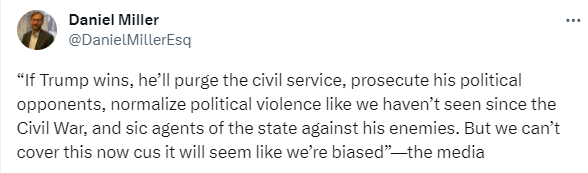
But our antiquated Constituion is a major stumbling block. So is the corporate news media:
Untitled

Good-bye, Supreme Court. Hello, Super Legislature.

President Biden doesn’t think we should expand the Supreme Court because it would “politicize” it. Pick a metaphor. That train has already left the station? That ship has sailed? That horse has left the corral? Republican senators destroyed the notion that the Court isn’t political when they refused to let Obama appoint a justice almost one year before the 2016 election and then rammed one through in 2020 when people were already voting.

The president needs to review recent events. Mehdi Hasan of MSNBC summarizes while asking “who died and made the Supreme Court a legislature?”

… It’s one of Republicans’ longest-running talking points: “Don’t legislate from the bench.

Now that Republican appointees are a supermajority on the Supreme Court, you would think that this majority would steer clear of anything that might look like it was writing laws and thereby undermining the people’s representatives in Congress.

But you’d be wrong.

Today’s conservative justices are happily imposing their reactionary legislative vision on America, not just by interpreting laws, but by effectively rewriting them, in order to implement unpopular policies that could never get passed through Congress. Separation of powers be damned.

Take some of the biggest, most divisive, most consequential issues in American life right now: student loan relief, climate change, voting rights, labor laws and gun control. Now the Supreme Court decides what happens on those issues. Not you. Not me. Not our elected representatives.

Like on Friday when the Supreme Court decided 6-3 that 43 million Americans would not receive student loan relief under President Joe Biden’s plan.

The conservatives ruled the program had not been explicitly approved by Congress in the Higher Education Relief Opportunities for Students Act, or HEROES Act.

But that law allows the Education Department to “waive or modify” financial assistance programs “as the Secretary deems necessary” in a national emergency.

Like the Covid pandemic we were still in when Biden announced his plan last year.

In her dissent, liberal Justice Elena Kagan slammed her conservative colleagues, writing: “The result here is that the Court substitutes itself for Congress and the Executive Branch in making national policy about student-loan forgiveness.”

Got crippling student debt from predatory loans? Tough. The Supreme Court says you can’t get relief.

On climate change, the Supreme Court has undermined Congress and the Environmental Protection Agency twice in the last year alone.

In West Virginia v. EPA, a 6-3 majority ruled the EPA exceeded its authority by regulating carbon emissions from power plants. Chief Justice John Roberts wrote for the majority: “It is not plausible that Congress gave EPA the authority to adopt on its own such a regulatory scheme. … A decision of such magnitude and consequence rests with Congress itself.”

Except that Congress did explicitly give the EPA the authority to use the “best system of emission reduction” when it passed the Clean Air Act in the ’60s.

As Kagan put it in her dissent, “The Court will not allow the Clean Air Act to work as Congress instructed. The Court, rather than Congress, will decide how much regulation is too much.”

Then in May in Sackett v. EPA, Justice Samuel Alito wrote for the majority in a precedent-setting opinion that the Clean Water Act only allows the EPA to regulate wetlands that have “a continuous surface connection” to “waters of the United States.”

Except that’s not what the law says. The law applies to “all waters of the United States” and explicitly wetlands “adjacent” to those waters. But instead of applying the law as written, Alito just changed the meaning of the word “adjacent” to mean “adjoining.”

You want Congress to decide how to protect our air and water? Tough. The Supreme Court decides that now.

Next, look at voting rights, where in the last 10 years, the Supreme Court effectively rewrote the core protections of the historic Voting Rights Act, first passed by Congress in 1965.

Congress passed the VRA explicitly to force southern states with a history of disenfranchising Black  voters through seemingly neutral voting requirements to get approval from the federal government before they could implement any new voting laws.

This “preclearance” was such a crucial part of the VRA that Congress voted overwhelmingly to extend the preclearance provision in 1982 and again in 2006.

But in 2013, a 5-4 majority led by Roberts decided that voter suppression laws were no longer a problem in those states. That ruling in Shelby County v. Holder effectively voided the preclearance provisions that Congress had voted overwhelmingly to extend just seven years earlier.

In Brnovich v. Democratic National Committee in 2021, the 6-3 majority upheld an Arizona election law that imposed burdens upon Native Americans living on reservations because the majority felt the burdens alleged were “modest when considering Arizona’s ‘political processes’ as a whole.”

As Kagan noted in her dissent, “The Court has (yet again) rewritten—in order to weaken—a statute that stands as a monument to America’s greatness, and protects against its basest impulses.”

Do you want Congress to protect voting rights and stop racist rules from suppressing minority votes? Tough. The Supreme Court is writing the laws now.

Now look at labor rights, where this anti-worker, anti-union court has legislated from the bench to create new rights for corporations, and against their employees, in two major cases.

In 1935, Congress passed the National Labor Relations Act, which enshrined the right of workers to join unions and to organize orderly strikes. To resolve disputes between workers and employers, the law also established the National Labor Relations Board.

This court has hacked away at that system.

This happened most crucially in 2018 with Janus v. AFSCME, when the Roberts court struck down the long-standing practice of mandatory union “agency fees” being deducted from employees’ paychecks.

“There is no sugarcoating today’s opinion,” Kagan wrote in her dissent. “The majority overthrows a decision entrenched in this Nation’s law—and in its economic life—for over 40 years.”

You want Congress to protect labor rights? Tough. The Supreme Court has other policy ideas.

In the absence of much meaningful action by Congress, this Supreme Court has done more than any legislature to radically alter gun policy.

In Washington, Chicago and New York state, over more than a century, lawmakers passed tailored gun regulations, but in recent years, the Supreme Court has gutted them.

In 2008, in District of Columbia v. Heller, five justices struck down a Washington, D.C., handgun ban, deciding that the Second Amendment wasn’t about colonial militias but about the right of the average Joe to brandish a Glock.

In 2010, that ruling was extended to the rest of the country with McDonald v. Chicago.

Then in 2022, in New York State Rifle & Pistol Association Inc. v. Bruen, the court went a step further and decided that the Second Amendment also says Americans are guaranteed a right to carry guns in public, contradicting New York’s century-old law requiring gun owners to show proper cause for doing so and obtain a license.

As liberal Justice Sonia Sotomayor put it during oral arguments, describing the implications of a court stepping in on a state’s legal turf, “You’re asking us to make the choice for the legislature.”

The six conservative Supreme Court justices were more than happy to make that choice for the state Legislature. States only get to put limits on really dangerous things, like voting rights and abortion.

You want Congress to stop mass shootings? Tough. This Supreme Court is calling the shots.

Making the choice for the legislature — that’s exactly what this Supreme Court now does, on a regular basis, and on a range of key issues. It takes issues decided by the people’s representatives and then re-decides them in a manner that pleases the conservative supermajority on the bench. So an elected, and Democratic-controlled, Congress can write and pass a progressive law, but an unelected and very conservative Supreme Court can just rewrite it.

Confidently. Brazenly. Shamelessly.

These are not neutral judges. These are politicians in robes.

Unquote.

Too late for Hasan’s article, a radical judge appointed by the last president has issued an injunction that stops various parts of the Executive Branch from talking to social media companies on the ludicrous theory that right-wing voices are being censored. It may be the most ridiculous ruling yet from the recent batch of Republican federal judges.

It was 1869 when Congress and President Grant increased the Supreme Court from 8 to 9 justices. At the same time, they created 9 circuits or courts of appeal spread around the country, one for each Supreme Court justice to partly administer.

There are now 13 circuits and many more Americans, lawyers and cases. The Democrats should add 4 justices next time they hold the White House and both houses of Congress. Thirteen circuits, thirteen justices.

That will require at least 50 Democratic senators who are willing to ignore a Republican filibuster. Let the Republicans complain that the Democrats are politicizing a Court that’s already political.

What You Can Get Away With When the System Gives You an Edge

The Republican governor of Arkansas was chosen to give the party’s response to President Biden’s State of the Union address. Jamelle Bouie of The New York Times says she wasn’t speaking to most voters and she didn’t care:

… Sanders’s folksy affect notwithstanding, this was harsh and hard and was delivered with an edge. But then, there’s nothing wrong with giving a partisan and ideological State of the Union address; that is part of the point. The problem was that most of [her] complaints were unintelligible to anyone but the small minority of Americans who live inside the epistemological bubble of conservative media. Sanders’s response, in other words, was less a broad and accessible message than it was fan service for devotees of the Fox News cinematic universe…..

It was not the kind of speech you give if you’re trying to build a political majority. The best evidence for this is that her speech was a version of the message Republicans used in last year’s midterm elections. The result was a historic disappointment, if not a historic defeat, for an opposition party [in a midterm election]… The most unsuccessful candidates … were, in the main, the right-wing culture warriors who tried to make the midterms a referendum on their reactionary preoccupations.

I should say that this critique of Sanders’s response rests on the supposition that Republican politicians want to build a national political majority. And why wouldn’t they? Political parties are supposed to want to win the largest possible majority….“Unless there’s a countervailing force,”  the historian Timothy Shenk notes [that] “parties bend toward majorities like sunflowers to the light.

But what if there is a countervailing force? What if the structure of the political system makes it possible to win the power of a popular majority without ever actually assembling a popular majority? What if, using that power, you burrow your party and its ideology into the countermajoritarian institutions of that system so that, heads or tails, you always win?

In that scenario, a political party might drop the quest for a majority as a fool’s errand. There’s no need to build a broad coalition of voters if — because of the malapportionment of the national legislature, the gerrymandering of many state legislatures, the Electoral College and the strategic position of your voters in the nation’s geography — you don’t need one to win. And if your political party also has a tight hold on the highest court of constitutional interpretation, you don’t even need to win elections to clear the path for your preferred outcomes and ideology.

Sanders did not deliver a broad and accessible response to the State of the Union for the same reason that congressional Republicans refuse to moderate or even acknowledge the existence of the median voter; she doesn’t have to, and they don’t have to. The American political system is so slanted toward the overrepresentation of the Republican Party’s core supporters, rural and exurban conservatives, that even when their views and priorities are far from those of the typical voter, the party is still more competitive than not….

People in Congress Vote, But They Don’t All Believe in Democracy

Yesterday, I posted part of a pro-democracy, pro-majority rule speech given this week by a Democratic congressman, Sean Casten of Illinois. He argues that Congress doesn’t do what most voters want it to do because our government has a built-in bias toward minority-rule. Given how we elect presidents and members of Congress and how the Supreme Court functions, a minority of voters and a minority in Congress can make it difficult, sometimes impossible, for the government to do things most of us want it to do. He therefore recommends changes to the House of Representatives, Senate, Supreme Court and Electoral College that would make each of those institutions more democratic, i.e. more responsive to the will of the majority.

At the beginning of his speech, however, he said something about his colleagues in the House that just isn’t true:

Now everybody in this body has different policy views, different ideas of what a better position in that relay might look like. But I submit that we do have some universal goals that we all agree on or else we wouldn’t be in this line of work.

We all want a government that delivers the greatest good for the greatest number. We all want a government that upholds our founding promise of freedom and equality.

We all, I think, believe Abraham Lincoln’s admonition to us that a government of, by, and for the people should not perish from this Earth. And we all, also, I think agree that on those really hard questions, … the single best way to resolve those disputes is through a democratic process.

A few bedrock principles of democracy are that the vast majority of adult citizens get to vote, each of their votes counts the same, the person or proposal getting the most votes wins and people should be encouraged to vote (otherwise we won’t know what the majority wants).

It’s hard to know what Rep. Casten was thinking when he suggested that everybody in Congress believes in democracy. Maybe he was being collegial or sarcastic. But it simply isn’t true that his Republican colleagues accept the democratic principles he thinks are universal.

I just finished a book by two sociologists called The Flag and the Cross. It’s a great book if you want to understand American politics, since it deals with the rise of White Christian nationalism, the ideology that’s become dominant in the Republican Party. In a nutshell, White Christian nationalists think America should be a Christian country and White people who profess to support Christianity (mainly White men) should be in charge. You can immediately see there’s a conflict here with democracy and majority rule. Republicans don’t always admit they oppose majority rule, but sometimes they do. This is from The Flag and the Cross (pp. 96-98):

White Christian nationalism designates who is “worthy” of the freedom it cherishes, namely, “people like us.” But for the “others” outside that group, white Christian nationalism grants whites in authority the “freedom” to control such populations, to maintain a certain kind of social order that privileges “good people like us”….

Both legal and illegal voter suppression have long been a tactic of white conservatives to tilt elections in their favor. Yet political scientists and sociologists often forget the ideological support for such efforts since the civil rights movement has come from white Christian nationalism. Just months before the 1980 election, Paul Weyrich, cofounder of the American Legislative Exchange Council and the Moral Majority, spoke at a Dallas conference to an audience that included evangelical leaders … as well as GOP presidential candidate Ronald Reagan.

Weyrich told his audience, “Now many of our Christians have what I call the ‘goo-goo syndrome.’ Good government. They want everybody to vote. I don’t want everybody to vote. Elections are not won by a majority of people. They never have been from the beginning of our country, and they are not now.” He went on, explaining: “As a matter of fact, our leverage in the elections quite candidly goes up as the voting populace goes down.”

Here before his Christian Right audience, Weyrich explained the strategy: our group stays in power if fewer people—especially our opponents—are able to vote. The policy implication is clear: make it harder for “problem” populations to vote, or at least don’t make it easier.

Weyrich’s antidemocratic sentiment has been repeated on the Christian Right for decades since. Also among those in attendance at that 1980 meeting was longtime conservative activist Phyllis Schlafly. Leading up to the 2012 presidential election, Schlafly underscored why limiting early voting was so critical. “The reduction in the number of days allowed for early voting is particularly important because early voting plays a major role in Obama’s ground game. The Democrats carried most states that allow many days of early voting.”

Several years later, former Baptist pastor, governor of Arkansas, and GOP presidential candidate Mike Huckabee echoed Weyrich’s words: “I know that most politicians say we want everyone to vote, I’m gonna be honest with you, I don’t want everyone to vote. If they’re so stupid—that’s right, if they’re gonna vote for me they need to vote, if they’re not gonna vote for me they need to stay home. I mean, it’s that simple . . . But in the big picture, there are people who vote and they have no idea what our Constitution says.” This last part of Huckabee’s quote is instructive in that he ties citizens’ worthiness to vote not only to their support for him, but to their knowledge of the Constitution.

Undergirding these views is an understanding of democratic participation that has deep historical roots, namely, that only certain groups (i.e., people like us) are “worthy” to have a say in government and it is perfectly acceptable to make it more difficult to vote, and particularly for those who might be “undeserving” (i.e., people like them). Indeed, we find the connection between white Christian nationalism and these attitudes is exceptionally strong.

In October 2020, just before the election, we asked Americans a series of questions about voter access…. Christian nationalism is the strongest predictor that white Americans believe we already make it too easy to vote in this country and that they would support hypothetical laws restricting the vote….By contrast, as white Americans’ affirmation of our Christian nationalism indicators increases, their likelihood of believing voter suppression in presidential elections is a real problem plummets.

Why would we see these patterns even after we account for relevant political characteristics? Because White Christian nationalism is fundamentally antidemocratic for “others,” that is, those who are “unworthy” of participation. This is how order is maintained: freedom for us, restraint for them.

If you’d like to see more recent examples, this (gift) Washington Post article from two years ago quotes several Republican politicians who admit their party “needs voting restrictions to win”. It concludes:

In this age, in which one party in particular has embraced an all’s-fair-in-politics approach, they’re bothering less with arguing that this is the right policy for government, and more that it’s the right policy for Republicans being able to control government.

We Have a Millstone Around Our National Neck

It’s good to have a constitution, but not every constitution is good. Charles Blow of The New York Times evaluates ours:

… I have been thinking about what I would say to Biden about the threats to American democracy. The most acute threat, it’s true, comes from election deniers and the authoritarian mass movement led by the previous president….. But the long-term threat is less an imposition from bad actors and more a constitutive part of our political system. It is, in fact, the Constitution. Specifically, it is a set of fundamental problems with the structure of our government that flow directly from the Constitution as it currently exists.

We tend to equate American democracy with the Constitution as if the two were synonymous with each other. To defend one is to protect the other and vice versa. But our history makes clear that the two are in tension with each other — and always have been. The Constitution, as I’ve written before, was as much a reaction to the populist enthusiasms and democratic experimentation of the 1780s as it was to the failures of the Articles of Confederation.

The framers meant to force national majorities through an overlapping system of fractured authority; they meant to mediate, and even stymie, the popular will as much as possible and force the government to act with as much consensus as possible.

Unfortunately for the framers, this plan did not work as well as they hoped. With the advent of political parties in the first decade of the new Republic — which the framers failed to anticipate in their design — Americans had essentially circumvented the careful balance of institutions and divided power. Parties could campaign to control each branch of government, and with the advent of the mass party in the 1820s, they could claim to represent “the people” themselves in all their glory.

Americans, in short, had forced the Constitution to accommodate their democratic impulses, as would be the case again and again, up to the present. The question, today, is whether there’s any room left to build a truly democratic political system within the present limits of our constitutional order.

In his new book “Two Cheers for Politics: Why Democracy is Flawed, Frightening — and Our Best Hope,” the legal scholar Jedediah Purdy says the answer is, essentially, no“Our mainstream political language still lacks ways of saying, with unapologetic conviction and even patriotically, that the Constitution may be the enemy of the democracy it supposedly sustains,” Purdy writes.

This is true in two ways. The first (and obvious) one is that the Constitution has enabled the democratic backsliding of the past six years. Founding-era warnings against demagogues — used often to justify our indirect system of choosing a president — run headfirst into the fact that [the last one] was selected constitutionally, not elected democratically….

And consider this: In the 2020 presidential election, a clear majority of Americans voted against [the incumbent] in the highest turnout election of the 21st century so far. But with a few tens of thousands of additional votes in a few states, [he] would have won a second term under the Constitution. “A mechanism for selecting a chief executive among propertied elites in the late eighteenth century persists into the twenty-first,” Purdy writes, “now as a key choke point in a mass democracy.”

The Constitution subverts democracy in a second, more subtle way. As Purdy notes, the counter-majoritarian structure of the American system inhibits lawmaking and slows down politics, “making meaningful initiatives hard to undertake”…..

Even if you keep MAGA Republicans out of office (including [their leader]), you’re still left with a system the basic structure of which fuels dysfunction and undermines American democracy….

What makes this all the worse is that it has become virtually impossible to amend the Constitution and revise the basics of the American political system. The preamble to the Constitution may begin with “We the People,” but as Purdy writes, “A constitution like the American one deserves democratic authority only if it is realistically open to amendment.” It is only then that we can “know that what has not changed in the old text still commands consent.” Silence can have meaning, he points out, “but only when it is the silence of those free to speak.”

There is much more to say about the ways that our political system has inhibited democratic life and even enabled forms of tyranny. For now, it suffices to say that a constitution that subverts majority rule, fuels authoritarian movements and renders popular sovereignty inert is not a constitution that can be said to protect, secure or even enable American democracy.

In a speech in Philadelphia last month, Biden did speak publicly on the threats to American democracy. He focused, as almost any president would, on the Constitution. “This is a nation that honors our Constitution. We do not reject it. This is a nation that believes in the rule of law. We do not repudiate it. This is a nation that respects free and fair elections. We honor the will of the people. We do not deny it.”

The problem, and what this country must confront if it ever hopes to turn its deepest democratic aspirations into reality, is that we don’t actually honor the will of the people. We deny it. And it’s this denial that sits at the root of our troubles.