T—p slithered into the offices of The New York Times this week for an on-the-record chat with the paper’s publisher and a few editors, reporters and columnists. Times columnist Charles Blow didn’t attend. He explains why:
I will say proudly and happily that I was not present at this meeting. The very idea of sitting across the table from a demagogue who preyed on racial, ethnic and religious hostilities and treating him with decorum and social grace fills me with disgust, to the point of overflowing. Let me tell you here where I stand on your “I hope we can all get along” plea: Never.
Mr. Blow concludes:
No, Mr. Trump, we will not all just get along. For as long as a threat to the state is the head of state, all citizens of good faith and national fidelity — and certainly this columnist — have an absolute obligation to meet you and your agenda with resistance at every turn.
I know this in my bones, and for that I am thankful.
Amen to that and thank you, Charles Blow.
His column, which deserves reading in its entirety, is here.
It seems to have disappeared right after the election. I guess because it was only of titanic importance when it supposedly revealed everything rotten about one of the candidates. Now nobody cares.
But for anyone still wondering what happened, below are two word clouds that summarize Gallup’s interviews with 30,000 voters between July and September. Voters were asked “What specifically do you recall reading, hearing or seeing about <Donald T—p> or <Hillary Clinton> in the last day or two?”
Words associated with the Orange Menace are on the left. Words associated with Clinton are on the right.
That one big blue word sure leaps off the page!
But notice some of the other memorable words that came up when people thought of Hillary Clinton: “lie”, “health”, “scandal”, “FBI”, “pneumonia”, “foundation”. Is it any wonder that the lying, corrupt, scandal-plagued, secretive, sickly candidate lost Florida, Pennsylvania, Minnesota and Wisconsin by less than 1% of the vote? Move two or three of those states into Clinton’s column and January suddenly looks much brighter for America and the world.
While we’re on the subject, consider “Don’t Call Clinton a Weak Candidate: It Took Decades of Scheming to Beat Her” in The Guardian. It’s a brief but tragic summary of the obstacles Clinton faced and almost overcame two weeks ago.
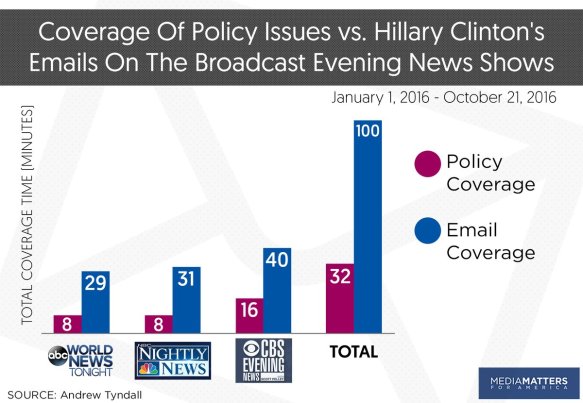
If you’re familiar with American politics and mass media, you probably won’t be surprised to hear that, between January 1st and October 24th of this year, the nightly news programs on ABC, CBS and NBC devoted three times as much coverage to Hillary Clinton’s emails than to all issues of government policy combined (from the Tyndall Report):
It’s safe to say this imbalance has grown even larger since October 28th. That’s when the Republican FBI Director Robert Comey sent Congress his cryptic letter regarding Anthony Weiner’s laptop. As Comey should have realized (and no doubt did), releasing that letter eleven days before the election led to an explosion of speculation and related discussion, none of which has revealed relevant facts about anything at all except that Trump and his supporters will use any excuse to paint Clinton as corrupt.
The incessant email stories on the broadcast networks and cable news and in leading newspapers has had a bizarre result. From the Gallup polling company:
We found that “email” was by far the most frequently used word when we asked Americans what they had read or heard about Clinton back in August 2015.…As [we] put it then: “When Gallup recently asked Americans to say what they recall reading or hearing about her, one word — ’email’ — drowned out everything else.”
Now we are asking Americans every day the same basic question — what they have read, seen or heard about Clinton — and once again, “email” dominates. For interviews conducted Oct. 28-31, “email” drowns out everything else, particularly anything relating to policy or substance. Indeed, the second-, third- and fourth-most-frequently used words associated with Clinton also relate to emails: “FBI,” “investigation” and “scandal.”
Believe it or not, 46% of voters in a recent poll said that Trump, the most obvious con man ever to run for the Presidency, is more trustworthy than Clinton (only 38% gave her higher marks). When people are asked to explain why they don’t trust Clinton, the most frequent response is, of course, “emails”.
As a minuscule corrective to the mountain of email nonsense that the media, Wikileaks (assisted by Russia, of course) and the FBI (officially and via politically-motivated leaks) have disseminated, here are an article and a video worth considering. You might also share them with friends, acquaintances, antagonists and random citizens before the voting ends on Tuesday.
First, Matthew Yglesias of Vox analyzes the Clinton email story with the aptly titled: “The Real Clinton Email Scandal Is That a Bullshit Story Has Dominated the Campaign”. He explains what Clinton did and shows why we shouldn’t care. An excerpt:
Clinton broke no laws according to the FBI itself. Her setup gave her no power to evade federal transparency laws beyond what anyone who has a personal email account of any kind has. Her stated explanation for her conduct is entirely believable, fits the facts perfectly, and is entirely plausible to anyone who doesn’t simply start with the assumption that she’s guilty of something.
Given [Secretary Colin] Powell’s conduct, Clinton wasn’t even breaking with an informal precedent. The very worst you can say is that, faced with an annoying government IT policy, she used her stature to find a personal workaround rather than a systemic fix that would work for everyone. To spend so much time on such a trivial matter would be absurd in a city council race, much less a presidential election. To do so in circumstances when it advances the electoral prospects of a rival who has shattered all precedents in terms of lacking transparency or basic honesty is infinitely more scandalous than anything related to the server itself.
And here is an eight-minute video uploaded today by Humanity for Hillary. It features Daveed Diggs and is called “Clinton vs. Trump on the Issues”:
However low my opinion of the Republican Party, it was not low enough….This is not a joke. This is one of the moments in history when the republic is at the brink.
Republican voters chose Trump. Republican donors have supported Trump. Republican politicians, even those who condemned him as a charlatan totally unfit to be President, have endorsed Trump. Others have remained silent. There are no excuses for what they’ve done. But now we have the chance to teach them a lesson. We need to vote for Democrats up and down the ballot. Only an historic, stinging defeat for the Republican Party will protect America and the world from getting this close to the brink the next time someone as dangerously abnormal as Trump wants the ability to launch nuclear missiles.
Okay, this isn’t specifically about Hillary Clinton’s goodness, but sometimes Paul Krugman says something so important, everybody in America ought to hear him speak.
His new blog post is in the context of Trump’s neo-birther performance yesterday, described so well in the brilliant words of journalist Greg Sargent:
Donald Trump once again urinates on the cable [networks], and once again they hold out cups to catch the precious fluids.
Prof. Krugman:
But the print media appear to have finally found their voice (which may shape cable coverage over time). The Times and the AP, in particular, have put out hard-hitting stories that present the essence in the lede, not in paragraph 25.
What’s so good about these stories? The fact that they are simple straightforward reporting.
First, confronted with obvious lies, they don’t pretend that the candidate said something less blatant, or … views differ on shape of planet — they simply say that what Trump said is untrue, and that his repetition of these falsehoods makes it clear that he was deliberately lying.
Second, the stories for today’s paper are notable for the absence of what I call second-order political reporting: they’re about what Trump said and did, not speculations about how it will play with voters.
Doing these things doesn’t sound very hard — but we’ve seen very little of this kind of thing until now.
Please read the whole thing here. It’s a blog entry, so it’s short (and very sweet).
But Charles Blow, op-ed columnist for The New York Times, is a (probably) highly-paid professional. He begins his column today recounting how Trump vigorously objected to “disabled veterans vending their wares on Fifth Avenue, home of Trump Tower”. Trump hated the idea that people like that were cluttering up the sidewalk in front of his fantastic building. He, the supposed friend of veterans, called the situation “very deplorable”.
Mr. Blow continues:
….it does point to the staggering, unabashed hypocrisy of the man and the degree to which his entire campaign is engaged in an elaborate ruse of deflection — accusing his opponent of the very things of which he is guilty….
Trump has called Clinton “a world-class liar,” but there is no bigger liar than Trump himself — just look at PolitiFact. The man is pathological.
Trump attacks Clinton for a lack of transparency, but this is the same man who has yet to release his tax returns, something every major party nominee in modern American politics has done. And he is telling a flat-out lie about why he can’t do it.
Trump calls Clinton “crooked,” but this is the same man who — along with his businesses — has been sued more than 1,300 times.
This is the same man who is at this moment the subject of three class-action lawsuits over the sham that was Trump University — two cases in California and one in New York.
Trump calls the Clinton Foundation the “most corrupt enterprise in political history,” but this is a man who donated $100,000 to the Clinton Foundation.
This is a man whose own foundation, the Trump Foundation, has recently been accused in news reports of breaking the law by being used essentially as a political slush fund….
Trump clearly understands that in politics, it is far better to be on offense than defense, but his offense is ultimately offensive because he is pointing out a perceived — or even concocted — flaw in another person to distract from the very same flaw in himself.
You might call the strategy masterly if it were not also maleficent, if the future of the country were not on the line, and if this country’s standing in the world were not on the line.
It cannot be said often or loudly enough: Donald Trump is the worst kind of person who brings out the worst in other people.
Now it’s true Mr. Blow didn’t offer as many details of Trump’s nefariousness as I did yesterday, but give him credit. He has editors. And space limitations. And knows how to write!
Proving that he’s his father’s son, D. Trump Jr. shared these thoughts today:
The media has been [Clinton’s] number one surrogate in this. Without the media, this wouldn’t even be a contest, but the media has built her up. They’ve let her slide on every indiscrepancy [sic], on every lie, on every DNC game trying to get Bernie Sanders out of this thing. If Republicans were doing that, they’d be warming up the gas chamber right now.
I have no idea why he brought a gas chamber into the discussion, but the rest of this statement represents an amazingly accurate description of how the media built up his father by giving him wall-to-wall coverage for months and months, rarely challenging the barrage of lies, hatred and nonsense he was spewing. It’s clear that Trump Jr. is himself a talented projectionist, just like Daddy.

 Whereof One Can Speak 🇺🇦
You must be logged in to post a comment.