A Scandal of Enormous Proportions — And It’s Funny, Too

Along with Paul Krugman, Stephen Colbert and his writers are among the best analysts of current affairs working today. Here, the brilliant Mr. Colbert discusses a recent discovery: the principal academic evidence for cutting government spending during a serious economic downturn is baloney, and not the nourishing kind. The Harvard professors who issued the study didn’t share their data with other economists, ignored data that didn’t fit their hypothesis and made a crucial Excel coding error.

The mind reels. And workers and families worldwide suffer.

(For some reason, I couldn’t get the video to embed, so you’ll probably have to put up with a brief commercial.)

http://www.colbertnation.com/the-colbert-report-videos/425748/april-23-2013/austerity-s-spreadsheet-error?xrs=share_copy

Paul Krugman discusses the same issue with fewer laughs:

http://www.nytimes.com/2013/04/19/opinion/krugman-the-excel-depression.html?_r=0

One Plain Hot Dog and a Medium Coke

At one of my favorite hamburger establishments this afternoon, there were only a few customers and four people behind the counter, all of whom looked to me like they were from Mexico or Central America. One of the workers came to the cash register and took my order. It went relatively smoothly, although his English wasn’t great and I’d never seen him handle the register before. He’s one of the people who usually does the cooking.

The price was $6.19, so I gave him a $20 bill. He handed me the receipt, which showed that my change was supposed to be $13.81. Presumably the cash register said the same thing.

Anyway, the guy seemed to be having trouble figuring out how much change to give me. He kept taking bills out and putting them back. At one point, he had a $10 bill and some ones in his hand, which was encouraging, but he put the $10 back in the register and took out a $5. Then he picked out some coins and handed me my change.

Since he’d only given me $7.45 or so, I told him it was wrong and showed him the receipt that said $13.81. I told him he needed to give me a 10 and three ones and 81 cents. While he thought about this for a while, I asked the other three people behind the counter if any of them could do arithmetic or make change. We all smiled at each other. Apparently the answer was “No”.

I next suggested that maybe he could get the manager to come out and help. He must have thought this was a good idea, so he went in the back room. He returned shortly and looked at my change again, which was lying on the counter. Then he went in the back again.

This time he came out, smiled and handed me a penny.

I would have gotten impatient if I’d been in a hurry or there had been other customers waiting. But I wasn’t and there weren’t and he was clearly trying to do the right thing.

So I told him again what he should give me and suggested that he really should get the manager to come out front. Which he finally did.

The manager apologized and gave me the correct change and said: “I’m training him” (really?).

I said “O.k., thanks” and the rest of my visit was uneventful.

As I’m sitting there eating, I’m wondering what it must be like to come to America, not speaking the language very well and not being too clear about arithmetic or American money. Then being able to find a job, while hoping to get a better job some day. It takes a certain amount of bravery, and some optimism, possibly combined with desperation. It’s not something I’d want to do.

I also wondered about the manager who said he was training this employee. Was he really training him? Did he just assume that the guy could make change? Was this the first time he’d ever had to deal with cash? Had other customers used credit cards? Was I his first customer?Β Did the manager have a pressing engagement somewhere in the back and tell his crew to handle the register while he was gone? And this guy was the bravest or most confident or most reckless among them?

The food was fine and I didn’t ask.
Brother, Can You Spare a Dime?

People who didn’t like Margaret Thatcher at all have driven “Ding-Dong! The Witch Is Dead” to the top of the charts in Great Britain (the British can be rude to their politicians, and good for them!).

In addition to writing the lyrics to that one, as well as “Over the Rainbow” (the actual title), Yip Harburg, born Isidore Hochberg, also wrote the words to this terrific song about the Great Depression. The music was composed by Jay Gorney, based on a Russian lullaby.

Bing Crosby recorded the most famous version back in 1931. This one is by James Crowley and the Top Hat Orchestra. It was released in 2011, in the continuing aftermath of the Great Recession.

If anyone in Great Britain records a new version of “The Witch Is Dead”, this would make a great flip side, if we still had flip sides.Β 

Do You Want Fries With That?

Most of the jobs lost during the Great Recession paid relatively decent wages. Most of the jobs added since then pay low wages.

From a report by the National Employment Law Project:

We find that three low-wage industries (food services, retail, and employment services) added 1.7 million jobs over the past two years, fully 43 percent of net employment growth. At the same time, better-paying industries (like construction; manufacturing; finance, insurance and real estate; and information) did not grow, or did not grow enough to make up for recession losses. Other better-paying industries (like professional and technical services) saw solid growth, but not in their mid-wage occupations. And steep cuts in state and local government have hit mid- and higher-wage occupations the hardest.

http://www.nelp.org/index.php/content/content_about_us/tracking_the_recovery

Same As It Ever Was

Romney’s plan to fix the economy is the same plan offered by his predecessors (and his goal of 12 million new jobs is the number forecast by economists as normal job growth).

Mike Konczal of the Roosevelt Institute:

The same exact playbook is there in 2006, as it was in 2004 and 2008, and as it is in 2012. Domestic oil production, school choice, trade agreements, cut spending and reduce taxes and regulations — it’s been the conservative answer to times of deep economic stress, times of economic recovery, times of economic worries, and times of economic panic. Which is another way of saying that the Republicans have no plan for how to actually deal with this specific crisis we face.

http://www.nextnewdeal.net/rortybomb/romney-will-solve-crisis-exact-same-gop-plan-2008-2006-2004

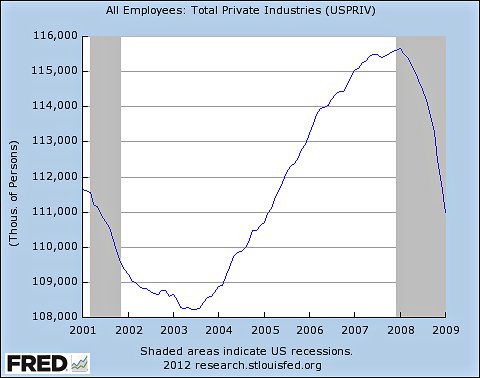
Paul Krugman (today’s best political columnist by far) concurs and offers a chart showing the pathetic history of job growth during the two terms of our last Republican president:

We should ask how the identical policies worked out in Bush’s two terms. And the answer is: zero job growth in term one (and a fall in private sector employment), one million in term two. Oh, and private sector employment lower when Bush left office than when he arrived.

083112krugman1-blog480

http://krugman.blogs.nytimes.com/2012/08/31/the-definition-of-insanity/