End Poverty and Bring Back the 90% Income Tax!

If you’re feeling too optimistic about the future and want a bracing jolt of economic reality, you might want to read Paul Krugman’s latest column. It’s called “A Permanent Slump?

Professor Krugman considers the possibility that the normal state of our economy is now mild depression (what psychiatrists call “chronic dysthymia” in another context). He describes it as “a persistent state in which a depressed economy is the norm, with episodes of full employment few and far between”.

Krugman points out that the economy hasn’t done especially well for most people in recent decades, even when we were in the midst of a housing bubble and consumers were taking on increasing amounts of debt. By now, the economy should have recovered nicely from the financial crisis of 2007-2009, but it hasn’t. As he puts it:

The evidence suggests that we have become an economy whose normal state is one of mild depression, whose brief episodes of prosperity occur only thanks to bubbles and unsustainable borrowing.

I went out to rake leaves after reading this. It was a beautiful fall day, very conducive to deep thoughts about politics and the economy. After ruling out the violent overthrow of the government, I concluded that there are a couple of things we need to do.

1) Establish a guaranteed minimum income, like Switzerland is considering. If too many people can’t find a decent job in this country, let’s at least make sure the worst off have a reasonable amount of money to live on. Maybe we don’t need as many people working as we used to, back before the “Information Revolution” and the “Global Economy”. Danny Vinik of the Business Insider makes a strong case here. He argues, for example, that most people would still want to work. I think one important result would be that the economy as a whole would benefit if people with low incomes had more money to spread around.

2) Bring back the progressive income tax, like we used to have when this country worked well for the majority of people. As recently as 1963, the highest tax rate was 90%. Of course, that doesn’t mean that someone making a million dollars a year (who made that kind of money back then?) had to pay $900,000 in federal taxes. The 90% rate applied to income above a certain threshold. As recently as 1980, the highest rate was 70%. Now, after the “Reagan Revolution”, it’s 35%. We’re still waiting for the wealth to trickle down. It might be the case that lots of billionaires and multi-millionaires would move to the Bahamas. (Good riddance.) But it would allow us to move away from being a “Winner Take All Society“.
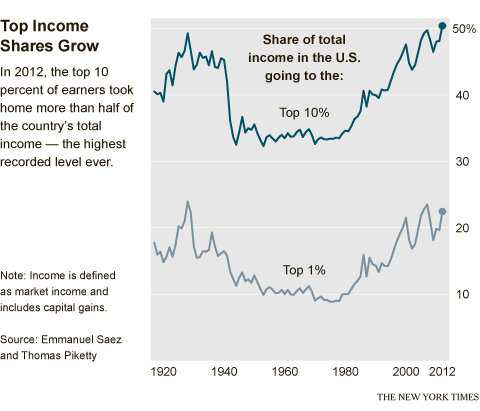
Class Warfare Is a Fact

An updated study by economist Emanuel Saez of U.C. Berkeley shows that the the top 1% of earners in the United States received more than 20% of the country’s total income in 2012, while the top 10% of earners received more than half of the country’s income. The share of income going to the wealthiest Americans is now at or near the highest levels on record since the government began keeping the relevant statistics and the federal income tax was created in 1913.

What’s even more remarkable, perhaps, is that the income of the top 1% went up nearly 20% in 2012, while the income of the remaining 99% rose only 1%. Since 2009, the wealthiest 1% have taken 95% of the income gains in our supposedly classless society.

We should remember these statistics when we hear Republican politicians, who pretend to be friends of the middle class, claim that lower taxes for the wealthy benefit everyone. It’s past time to raise taxes on the rich, invest in America’s infrastructure and start creating decent jobs again. Otherwise we’re going to continue to get economically screwed.

Note the year 1980 in this chart, when class warrior and demagogue supreme Ronald Reagan was elected President:

10economix-sub-wealth-blog480

http://takingnote.blogs.nytimes.com/2013/09/11/the-rich-got-richer/

Periodic Update from Krugman the Indispensable

Paul Krugman was right about Bush’s tax cuts and the Iraq War. He was right about the 2009 stimulus. He’s been right about Europe’s austerity program. I’m sure he’s right about this too:

“The latest projections [from the Congressional Budget Office] show the combined cost of Social Security and Medicare rising by a bit more than 3 percent of G.D.P. between now and 2035, and that number could easily come down with more effort on the health care front. Now, 3 percent of G.D.P. is a big number, but it’s not an economy-crushing number. The United States could, for example, close that gap entirely through tax increases, with no reduction in benefits at all, and still have one of the lowest overall tax rates in the advanced world.

But haven’t all the great and the good been telling us that Social Security and Medicare as we know them are unsustainable, that they must be totally revamped — and made much less generous? Why yes, they have; they’ve also been telling us that we must slash spending right away or we’ll face a Greek-style fiscal crisis. They were wrong about that, and they’re wrong about the longer run, too.

The truth is that the long-term outlook for Social Security and Medicare, while not great, actually isn’t all that bad. It’s time to stop obsessing about how we’ll pay benefits to retirees in 2035 and focus instead on how we’re going to provide jobs to unemployed Americans in the here and now.”

http://www.nytimes.com/2013/06/03/opinion/krugman-the-geezers-are-all-right.html

The Cutting vs. Spending Argument Should Be Over

In a recent blog post, the (indispensable) economist and columnist Paul Krugman has summarized his view of our economic predicament and what we should do to get out of it. He did this in response to a billionaire who went on TV and spoke like a simpleton. Krugman makes his case as clearly as possible, so it’s worth reading if you have any doubts at all about whether the government should be cutting or increasing spending in our present circumstances. 

http://krugman.blogs.nytimes.com/2013/04/27/the-ignoramus-strategy/

Henry Blodget, who isn’t an economist and was convicted of securities fraud when he was a research analyst at Merrill Lynch, argues that the argument about cutting vs. spending is over and Krugman won.

http://www.businessinsider.com/paul-krugman-is-right-2013-4

It’s clear that Krugman and his like-minded Keynesian colleagues have won the argument in the sense of having offered enough evidence to prove their thesis to reasonable people. Whether they’ve won the argument in the sense of getting politicians to change their policies isn’t clear yet. The most we can reasonably expect is that the tide has turned.

As we know, most people, especially politicians and pundits, hate to be proven wrong. Admitting that they were wrong to promote government austerity in response to the Great Recession would require a lot of character.

What I would love to see is President Obama, who is said to be a reasonable person, admit that his search for a “Grand Bargain” with the Republicans has been a terrible mistake. He should admit that we need to repeal the Sequester immediately (not just as it affects air travelers) and increase spending on infrastructure, education, research, grants to local government, etc. etc.

If it would help, Obama could have Krugman sit next to him and explain the situation in terms that even billionaires would understand! Not everyone would be convinced (there are plenty of simpletons and others with their own agendas), but it would be a step in the right direction.

Postscript 4/29/13 —

This is a sensible summary from Washington Post columnist E. J. Dionne (although it’s not really a “whodunit?” because we know who done it):

http://www.washingtonpost.com/opinions/ej-dionne-the-economic-whodunit/2013/04/28/6948f9a4-aea9-11e2-8bf6-e70cb6ae066e_story.html

One Plain Hot Dog and a Medium Coke, Part 2

Two weeks ago, I had an interesting experience with a cashier after handing him a $20 bill to pay for one plain hot dog and a medium coke.

It’s possible it was the longest, most complex act of “giving change” ever performed by a cashier anywhere, anytime, putting aside incidents involving heart attacks, power failures, armed robbery, tornadoes, and other intervening events of similar proportions.

It was such an interesting experience that I wrote about it here:

https://whereofonecanspeak.com/2013/04/15/one-plain-hot-dog-and-a-medium-coke/

This past Monday, one week after Part 1 occurred, I went back to this snack bar, wondering how my purchase of one plain hot dog and a medium coke would go this time.

The guy who is usually at the cash register — I think he’s the assistant manager — was sitting at a table in the corner talking with someone — I think she’s the manager. He looked up when I approached the counter — the place was almost empty at the time — and called out to one of the cooks, who immediately walked toward the register.

Of course, it was the same cook who had so much trouble making change the week before. I think he recognized me — he gave me a slight smile. I certainly recognized him.

I admit I had a quick thought — maybe I should use a credit card this time.

But then I had another quick thought — no, that would be condescending.

I didn’t really speak the word “condescending” to myself, but that was the thought I had. It was more of a feeling than a thought — I should give this young man, who is apparently new to our country, a chance to do his job correctly. I shouldn’t assume that he’s still very bad at giving change. And it’s only by meeting challenges that we grow as human beings. (I take my actions rather seriously at times (no!) and tend toward self-analysis (yes, it’s true!).)

Anyway, I placed my order — again with the same slight difficulty understanding the question about french fries — and handed him a $10 bill (actually wondering to myself whether changing the denomination from a $20 would throw him a curve).

I know you’re on the edge of your seat, whether you’re sitting down or not, so I won’t drag this out any further (by the way, they make really good hot dogs at Five Guys):

His fingers (or finger) flew over the cash register — he glanced at the amount of change required — and with barely a hint of hesitation pulled out three dollar bills, three quarters, a nickel and a penny. $3.81, perfectly done! (Their hot dogs are kind of expensive.)

I know you’re relieved. I was and still am.