Brief Political Commentary

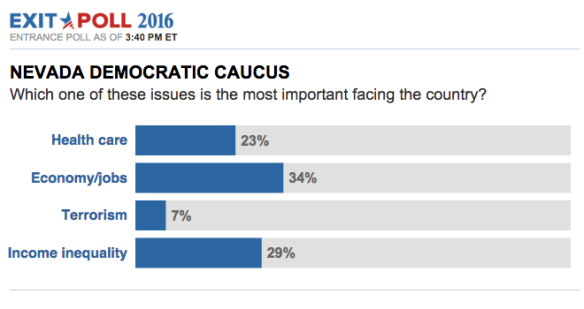
Voters who attended the Democratic caucuses in Nevada yesterday were asked to identify the most important issue facing America. 34% said the economy and jobs; 7% said terrorism.

NVDem_Issues_02202016

Voters in the Republican primary in South Carolina were asked the same question. 28% said the economy and jobs, but 32% said terrorism.

SGOP_IssuesV2_02202016I haven’t been able to determine whether the Democrats and Republicans were given the same list of issues to choose from, but it’s still remarkable that one-third of Republican voters chose terrorism as the most important issue we face. In fact, it’s remarkable that 7% of the Democrats said the same thing.

Unless these people think there is a strong chance that terrorists (of whatever political persuasion, not just Islamic fundamentalists) will attack America with nuclear or biological weapons, it’s silly to put terrorism at the top of the list. (In fact, given how silly it is, I have to wonder – mostly facetiously – whether some of those Democrats were devious Republicans attending the Democratic caucuses in order to make trouble, something the rules in Nevada allowed).

Here in New Jersey, we don’t get to participate in the nomination process until June, when it won’t matter what we think or how we vote. But if anyone asked me, I’d put global warming first, because of its possibly catastrophic consequences. After that, it would be hard to choose between the economy and jobs; money in politics; and the number of Americans who have lost their minds and vote for Republicans.

A Few Reasons We’re Getting Screwed

It’s one thing to get screwed. It’s another thing to know why. From recent reading:

Instead of raising wages, hiring more workers or investing in research and new equipment, corporations are increasingly accumulating cash and buying their own stock. This raises the corporation’s stock price, enriching the people in charge (who receive much of their compensation in the form of stock and stock options) and shareholders (who tend to be the wealthiest among us), but does little to improve the lives of most Americans. Some statistics from The Atlantic‘s “Stock Buybacks Are Killing the American Economy”:

Over the past decade, the companies that make up the S&P 500 have spent an astounding 54 percent of profits on stock buybacks. Last year alone, U.S. corporations spent about $700 billion, or roughly 4 percent of GDP, to prop up their share prices by repurchasing their own stock.

Instead of doing something productive.

The Atlantic article is by Nick Hanauer, a very successful capitalist who acknowledges that inequality is a problem that needs to be addressed. A poorly-named article from Salon called “Let’s All Screw the 1 Percent” cites an article Hanauer wrote last year about overtime pay.

We all know that wages have stagnated for many workers or even declined when adjusted for inflation. In order to have the same buying power it had in 1968, the federal minimum wage would have to be raised from $7.25 to almost $11.00 (see this attempt at myth-busting from the Department of Labor). What isn’t as well-understood and what Hanauer pointed out is that millions of workers would and should be receiving overtime pay, even though they aren’t paid by the hour (declaring workers to be “exempt” and giving them a salary is, of course, a great way to force people to work long hours without extra compensation). From the Salon article by Paul Rosenberg:

…there’s a wage level below which everyone qualifies for mandatory time-and-a-half overtime, even if they’re on a salary, and that level has only been raised once since 1975, with the result that only 11 percent of salaried Americans are covered today, compared to over 65 percent of them in 1975. If you make less than $23,660 a year as a salaried worker, you qualify for mandatory overtime—if not, you’re out of luck.  … Just adjusting the wage level for inflation since 1975—an act of restoration, not revolution—would be as significant an income increase for millions of middle-class Americans as a $10.10 or even $15 minimum wage is for low-wage workers.  It would cover an additional 6.1 million salaried workers (by one account) up to $970 per week, about $50,440 annually—the vast majority of those it was originally designed to protect, but who have slowly lost their protections since the 1970s. Hanauer proposes a slightly greater increase, intended to cover roughly all the workforce that was covered in 1975. That would raise the threshold to $69,000 annually, and would cover an added 10.4 million workers.

What was also surprising to me is that the President can raise the $23,660 threshold without the approval of Congress. Last year, in fact, President Obama promised to do just that. This website for Human Resources specialists predicts that the threshold for overtime pay will be increased in 2016, but only to around $45,000 (they also predict that the rules for declaring an employee to be “exempt” will be tightened, making more workers eligible for overtime pay).

In a related article at the Alternet site, a postal worker explains why the people delivering your mail during the week or a package from Amazon on Sunday may not look as official as they used to (jeans and a sweatshirt seem to have replaced those blue uniforms in my neighborhood). Paul Barbot says that he is a City Carrier Assistant:

City Carrier Assistants are a brand new classification of employee within the postal ranks; we are the low-wage, non-career, complement workforce at the USPS. Before [a 2013] reclassification, we were called Transitional Employees and made a respectable $23.52 hourly rate, only several dollars per hour less than what the average career employee made. But with the USPS management’s financial woes … a low-wage workforce was needed to help entice big business into choosing the postal service to partner up with. City Carrier Assistants now perform the same work they did when they were called [“Transitional Employees”], but now they get to do that work for 31 percent less pay ($16.68 per hour)….Newly hired CCAs will make even less —starting at $15 per hour.

Barbot argues that this lower-wage workforce helped the Postal Service and Amazon reach a “Negotiated Service Agreement” regarding special treatment for Amazon packages. 

And finally, The Guardian reports (no surprise) that:

Poor Americans are less likely to vote and more likely to distrust government, study shows… Political engagement, it appears, is a privilege for those who aren’t struggling to make ends meet…

while the right-wing Koch brothers, who aren’t struggling at all (not even with their consciences), plan to spend almost $900 million in 2016 in support of reactionary candidates, almost twice what they spent in 2012.
Some Progress, But We Could Be Doing Much More

Jonathan Chait of New York Magazine sums up the continuing success of the Affordable Care Act here :

The Commonwealth Fund has a new survey showing that the proportion of adults lacking health insurance has fallen by a quarter, from 20 percent of the population to 15 percent. (Most respondents, including 74 percent of newly-insured Republicans, report liking their plan.) Also, this week, the Congressional Budget Office again revised down its cost estimates for Medicare, which now spends $50 billion a year less than it was projected to before Obamacare passed. Also, the New England Journal of Medicine recently estimated that 20 million Americans gained insurance under the new law.

Just think what we’d be able to do in this country if the Republicans were reasonable or if there were fewer of them in office. We could have boosted the economy, for example, by investing in our infrastructure during this terrible recession instead of going crazy about the deficit. Below is a chart from Paul Krugman’s blog showing the “Great Disinvestment”, how public spending on construction has dropped in the past four years when it should have increased:

070314krugman1-blog480

Dollars and Poverty

Republican Congressman Paul Ryan, chairman of the House Budget Committee, is worried that the federal government spends too much money trying to help poor people:

“The question isn’t whether the federal government should help; the question is how,” Mr. Ryan said at [a committee] hearing on Wednesday. “How do we make sure that every single taxpayer dollar we spend to reduce poverty is actually working?” 

Can you imagine someone like Ryan ever wanting to make sure that every single dollar spent on the military is actually working? I can’t.

The quote above comes from a New York Times article called “Changed Life of the Poor: Better Off But Far Behind”. The article describes the economic situation facing the poor today: 

Two broad trends account for much of the change in poor families’ consumption over the past generation: federal programs and falling prices.

Since the 1960s, both Republican and Democratic administrations have expanded programs like food stamps and the earned-income tax credit….

As a result, the differences in what poor and middle-class families consume on a day-to-day basis are much smaller than the differences in what they earn.

“There’s just a whole lot more assistance per low-income person than there ever has been,” said … a senior research fellow at the conservative Heritage Foundation. “That is propping up the living standards to a considerable degree,” he said, citing a number of statistics on housing, nutrition and other categories.

[At the same time], the same global economic trends that have helped drive down the price of most goods also have limited the well-paying industrial jobs once available to a huge swath of working Americans. And the cost of many services crucial to escaping poverty — including education, health care and child care — has soared.

So, for example:

Tammie Hagen-Noey, a 49-year-old living in Richmond, Va., tapped at an iPhone as she sat on the porch of the group home where she lives… She earns $7.25 an hour at a local McDonald’s, and makes a little extra money on the side from planting small plots of land for neighbors….A few months ago, she sold her car for $500 to make rent.

Almost everybody could manage their spending better (even members of Congress) and that woman in Virginia presumably didn’t spend hundreds of dollars to buy the latest iPhone. Human beings get into all kinds of trouble, because of their own mistakes or through no fault of their own, and will continue to need help from the rest of us, even if every single dollar intended to help them doesn’t “work”. Republicans claim that cutting taxes and reducing regulations will create lots of better-paying jobs, allowing us to spend less on government assistance for the poor. What they’re really advocating is a race to the bottom, with more inequality, dangerous workplaces, pollution and unsafe food. Since we have to compete in a global economy, we’ll end up closer to the economic middle in future decades (nobody stays on top forever), but we shouldn’t race to become worse off.

Being Paid What You’re Worth

Robert Reich is an economist who was Secretary of Labor in the 90s and is now a Professor of Public Policy at UC Berkeley. He’s also a blogger who knows what he’s talking about (unlike some of us). I doubt he would mind this extended quote from RobertReich.org:

“Paid-what-you’re-worth” is a dangerous myth.

Fifty years ago, when General Motors was the largest employer in America, the typical GM worker got paid $35 an hour in today’s dollars. Today, America’s largest employer is Walmart, and the typical Walmart workers earns $8.80 an hour.

Does this mean the typical GM employee a half-century ago was worth four times what today’s typical Walmart employee is worth? Not at all. Yes, that GM worker helped produce cars rather than retail sales. But he wasn’t much better educated or even that much more productive. He often hadn’t graduated from high school. And he worked on a slow-moving assembly line. Today’s Walmart worker is surrounded by digital gadgets — mobile inventory controls, instant checkout devices, retail search engines — making him or her quite productive.

The real difference is the GM worker a half-century ago had a strong union behind him that summoned the collective bargaining power of all autoworkers to get a substantial share of company revenues for its members. And because more than a third of workers across America belonged to a labor union, the bargains those unions struck with employers raised the wages and benefits of non-unionized workers as well. Non-union firms knew they’d be unionized if they didn’t come close to matching the union contracts.

Today’s Walmart workers don’t have a union to negotiate a better deal. They’re on their own. And because fewer than 7 percent of today’s private-sector workers are unionized, non-union employers across America don’t have to match union contracts. This puts unionized firms at a competitive disadvantage. The result has been a race to the bottom.

By the same token, today’s CEOs don’t rake in 300 times the pay of average workers because they’re “worth” it. They get these humongous pay packages because they appoint the compensation committees on their boards that decide executive pay. Or their boards don’t want to be seen by investors as having hired a “second-string” CEO who’s paid less than the CEOs of their major competitors. Either way, the result has been a race to the top.

Professor Reich doesn’t say anything about the effects of globalization in this post, but it’s obviously a factor. Our economic bottom isn’t in West Virginia or Mississippi anymore, it’s in Guatemala and Bangladesh. Even so, a strong labor movement would help slow down the race to the bottom and to the top.

There’s a question worth asking, however: Would it be better from an ethical point of view if workers in places like Guatemala were paid more at the cost of American workers being paid less? In other words, are we in rich countries automatically entitled to a better standard of living than people in poor countries? After all, for a worker in Guatemala, our race to the bottom is his or her race to the middle. If work can be performed just as well but more cheaply in Guatemala, why should it be performed in California?

I don’t know the answer to that question. Although it’s clear we should slow down the race to the very top (it’s gotten completely ridiculous), I’m not sure what should be done for the rest of us. Maybe the answer is to provide a reasonable minimum income for those of us in the rich countries, while doing more to improve the lives of those at the bottom. 

Update:

For example, as suggested here:  Considering a No-Strings-Attached Basic Income for All Americans