The Truth Still Matters

Will be going to North Dakota today to discuss tax reform and tax cuts. We are the highest taxed nation in the world – that will change.

— Donald J. Trump (@realDonaldTrump) September 6, 2017

But the truth still matters:
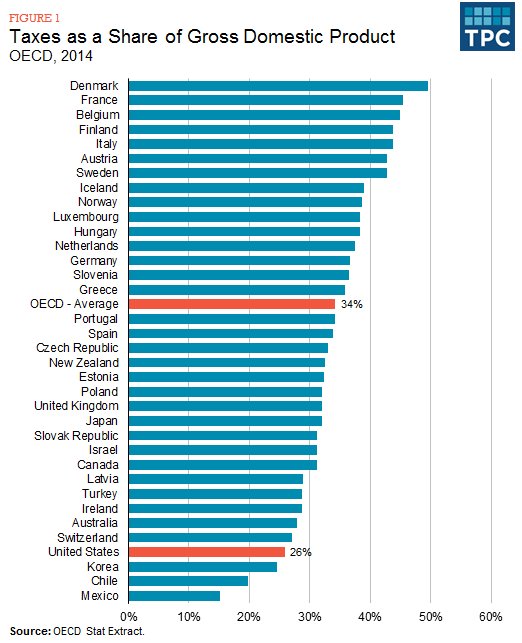
oecd tax burdens

The chart includes individual and corporate taxes, as well as local taxes, as reported by the 35-nation Organisation for Economic Co-operation and Development.

For some historical perspective, consider “When the Rich Said No to Getting Richer” by from David Leonhardt of The New York Times:

A half-century ago, a top automobile executive named George Romney — yes, Mitt’s father — turned down several big annual bonuses. He did so, he told his company’s board, because he believed that no executive should make more than $225,000 a year (which translates into almost $2 million today).

He worried that “the temptations of success” could distract people from more important matters, as he said to a biographer, T. George Harris. This belief seems to have stemmed from both Romney’s Mormon faith and a culture of financial restraint that was once commonplace in this country.

Romney didn’t try to make every dollar he could, or anywhere close to it. The same was true among many of his corporate peers. In the early 1960s, the typical chief executive at a large American company made only 20 times as much as the average worker, rather than the current 271-to-1 ratio. Today, some C.E.O.s make $2 million in a single month.

The old culture of restraint had multiple causes, but one of them was the tax code. When Romney was saying no to bonuses, the top marginal tax rate was 91 percent. Even if he had accepted the bonuses, he would have kept only a sliver of them.

The high tax rates, in other words, didn’t affect only the post-tax incomes of the wealthy. The tax code also affected pretax incomes. As the economist Gabriel Zucman says, “It’s not worth it to try to earn $50 million in income when 90 cents out of an extra dollar goes to the I.R.S.”

The tax rates helped create a culture in which Americans found gargantuan incomes to be bizarre.

A few years after Romney turned down his bonuses from the American Motors Corporation, Lyndon B. Johnson signed legislation that lowered the top marginal tax rate to 70 percent. Under Ronald Reagan, it dropped to 50 percent and kept falling. Since 1987, the top rate has hovered between 30 percent and 40 percent.

For more than 30 years now, the United States has lived with a top tax rate less than half as high as in George Romney’s day. And during those same three-plus decades, the pay of affluent Americans has soared. That’s not a coincidence. Corporate executives and others now have much more reason to fight for every last dollar.

And fight they do (it’s called “class warfare”).

Meanwhile, the president* is unnecessarily threatening hundreds of thousands of young people brought to this country by their parents and another extremely dangerous hurricane is on its way. This is further evidence that Republicans are evil and global temperatures are rising, but you already knew that.

Update:  John McCain, the Republican senator who talks a good game but can’t be relied on, has changed his mind about repealing the Affordable Care Act. He now says he’d vote Yes on what is “in may ways … the most radical” repeal bill yet. Further evidence for [see above]. 

2nd Update: McCain now says he would only vote for repeal if the legislation survived committee hearings and was subject to amendments proposed by both sides. That’s not what the 81-year old senator implied earlier today. This latest announcement is good news, because the repeal legislation is extremely unlikely to pass if it’s subject to “normal order” in the Senate instead of being rushed through. 

First They Came for the Muslims

Image

c3tze5nvuaervyf

One Week and Floundering

Eight days ago, before the inauguration, we already knew a couple of things (roughly quoting Richard Yeselson of Dissent):

  1. Our new President is an authoritarian, mentally-ill ignoramus, uniquely unfit and dangerous.
  2. The Republican Party is morally and intellectually bankrupt.

Given (1) and (2), I can’t think of anything since the inauguration that’s been more than a mild surprise. Given who he is and who his fellow Republicans are, what did we expect?

I’ll mention a few things anyway:

He gave an interview to a TV network other than Fox. Many observers thought he came across like a crazy person. One said it was the scariest thing he’d ever seen. Although many of his supporters probably enjoyed it. There’s a transcript of the interview here.

He’s still using Twitter and his outdated, easy-to-hack phone. He still spends a lot of time watching television and occasionally tweets in response to what he just heard, sometimes repeating exact phrases. One reporter said the tsunami of leaks from the White House make the President sound like a “clueless child”. I think he sounds more like an angry old fool with a severely damaged ego.

He has signed some executive orders, as new Presidents always do. For the most part, these have been aimed at impressing his supporters and may never amount to anything (he can’t get billions of dollars to build a wall by issuing an executive order). An exception is the one that will limit funding for overseas healthcare providers (the abortion “gag-rule”). It’s even worse than similar orders issued by other Republican Presidents. (Vice President Pence, who is an extreme foe of abortion rights, probably had a lot to do with it.)

Of course, that terrific replacement for the Affordable Care Act that he promised to announce in a day or two hasn’t been announced yet. But someone in the administration did take a concrete step regarding the ACA: they canceled an advertisement intended to get people to sign up for health insurance by the January 31st deadline. 

Meanwhile, The Washington Post obtained a secret recording of Congressional Republicans talking about the Affordable Care Act. It demonstrates what we already knew: they don’t know what parts of the ACA to repeal or what to replace those parts with. It’s great to hear them speak honestly for a change, so I’ve attached some choice excerpts at the bottom of this post. 

On the impeachment front, the President isn’t bothering to hide his eagerness to cash in on his new position. He doubled the membership fee at his Florida resort from $100,000 to $200,000; announced plans to build several more hotels in the US; and only plans to stop immigration from Middle Eastern countries where he doesn’t do business or doesn’t plan to (Iran bad; Saudi Arabia – where the 9/11 hijackers came from – good). A lawsuit has already been filed against the President regarding his foreign business dealings. You can read an explanation by one of the lawyers involved here and can see the formal complaint here.

Finally, the President’s spokesman announced that Mexico would reimburse us for the Wall sometime in the future, but in the meantime, companies that import stuff from Mexico (like fruits and vegetables, beer and cars) would pay for the wall through a new 20% import tariff. After it was pointed out that the tariff would be passed along to American consumers in the form of higher prices, the proposal was discounted as merely one of several ways we, not Mexico, could pay for the Wall, which, by the way, Republican politicians in Texas aren’t crazy about anyway.

As a result, and maybe in recognition of the fact that the Executive Branch of our government is now in the hands of knavish fools and foolish knaves, the President of Mexico canceled his visit to Washington.

Oh, and the President wants an investigation of the 3 million people, all of whom he knows voted for his opponent, because that’s how many more people voted for Hillary. Buenas noches, amigos.

As promised, excerpts from the Washington Post article based on that secret recording:

[A Representative] worried that one idea floated by Republicans — a refundable tax credit — would not work for middle-class families that cannot afford to prepay their premiums and wait for a tax refund…

[Another said] “It sounds like we are going to be raising taxes on the middle class in order to pay for these new credits.”

 … A freshman congressman … warned strongly against using the repeal of the ACA to also defund Planned Parenthood…

Of particular concern to some Republican lawmakers was the plan to use the budget reconciliation process — which requires only a simple majority vote — to repeal the existing law, while still needing a filibuster-proof vote of 60 in the Senate to enact a replacement….

… They did not have a clear plan on how to keep markets viable while also requiring insurers to cover everyone who seeks insurance.

[A Senator asked:] Will states have the ability to maintain the expanded Medicaid rolls provided for under the ACA, which now provide coverage for more than 10 million Americans, and can other states do similar expansions?

[A Representative] worried that the plans under GOP consideration could eviscerate coverage for the roughly 20 million Americans now covered through state and federal marketplaces and the law’s Medicaid expansion: “We’re telling those people that we’re not going to pull the rug out from under them, and if we do this too fast, we are in fact going to pull the rug out from under them.”

They are also still wrestling with whether Obamacare’s taxes can be immediately repealed, a priority for many conservatives, or whether that revenue will be needed to fund a transition period.

And there seems to be little consensus on whether to pursue a major overhaul of Medicaid — converting it from an open-ended entitlement that costs federal and state governments $500 billion a year to a fixed block grant…. doing so would mean that some low-income Americans would not be automatically covered by a program that currently covers 70 million Americans.

This Week of All Weeks, Jane Addams Is Worth Thinking About

Jane Addams (1860-1931) isn’t famous these days. At one time, however, she was the most-admired woman in America and well-known throughout the world.

Wikipedia lists her occupation as “social and political activist, author and lecturer, community organizer, public intellectual”. Her tombstone in Cedarville, Illinois, describes her as a “humanitarian, feminist, social worker, reformer, educator, author, publicist, founder of Hull House, President [of the] Women’s International League for Peace and Freedom”. It also notes that she won the Nobel Peace Prize in 1931.

Addams fought for women’s suffrage and is considered the founder of the social work profession in the United States. Sociologists view her as a social theorist. Philosophers place her in the school of philosophy known as Pragmatism.  At her death, some compared Jane Addams, who never sought political office, to her hero, Abraham Lincoln.

As this horrible week comes to a close, it may help us to consider Jane Addams as an example of, in Lincoln’s words, “the better angels of our nature”.

Today, Addams is best known as the principal founder of Hull House, the first “settlement house” in the United States. It opened its doors in Chicago in 1889 and continued to operate until 2012. Its initial goal was to help recent immigrants find their place in American society, because Addams’s purpose in life was to convert her progressive ideas into action.

Here is a passage from Jane Addams and the Dream of American Democracy by Jane Bethke Elshtain:

The statement of purpose in Hull-House’s charter read: “To provide a center for a higher civic and social life; to institute and maintain educational and philanthropic enterprises, and to investigate and improve the conditions in the industrial districts of Chicago”; but this fails to capture the spirit and the manifold activities of Hull-House. Addams refined this statement over the years. It was a “place for enthusiasms”; it helped “give form to social life”; it offered “the warm welcome of an inn”; it was a place for mutual interpretation of the the social classes one to another; it responded to ethical demands and shared fellowship; it was a place for the life of the mind….

At the conclusion of her second autobiographical volume, The Second Twenty Years at Hull-House, Addams takes another stab at it: “It was the function of settlements to bring into the circle of knowledge and fuller life, men and women who might otherwise be left outside” [ p. 92].

The work of Hull House “gained expression in day nurseries, kindergarten classes, playgrounds, boys’ and girls’ clubs, a cooperative boardinghouse, theater workshops, music schools, language classes, reading groups, handicraft centers and eventually a Labor Museum” [p. 93].

In the early days, after Addams and a Hull House resident named Julia Lathrop came to the aid of a young woman, all alone, giving birth in a nearby tenement, Addams exclaimed:

“This doing things that we don’t know how to do is going too far. Why did we let ourselves be rushed into midwifery?” To which [Lathrop] replied: “If we have to begin to hew down to the line of our ignorance, for goodness’ sake don’t let us begin at the humanitarian end. To refuse to respond to a poor girl in the throes of childbirth would be a disgrace to us forevermore. If Hull-House does not have its roots in human kindness, it is no good at all” [p. 93].

We might say the same thing about the United States of America during the months and years ahead.

One Plain Hot Dog and a Medium Coke, Part 2

Two weeks ago, I had an interesting experience with a cashier after handing him a $20 bill to pay for one plain hot dog and a medium coke.

It’s possible it was the longest, most complex act of “giving change” ever performed by a cashier anywhere, anytime, putting aside incidents involving heart attacks, power failures, armed robbery, tornadoes, and other intervening events of similar proportions.

It was such an interesting experience that I wrote about it here:

https://whereofonecanspeak.com/2013/04/15/one-plain-hot-dog-and-a-medium-coke/

This past Monday, one week after Part 1 occurred, I went back to this snack bar, wondering how my purchase of one plain hot dog and a medium coke would go this time.

The guy who is usually at the cash register — I think he’s the assistant manager — was sitting at a table in the corner talking with someone — I think she’s the manager. He looked up when I approached the counter — the place was almost empty at the time — and called out to one of the cooks, who immediately walked toward the register.

Of course, it was the same cook who had so much trouble making change the week before. I think he recognized me — he gave me a slight smile. I certainly recognized him.

I admit I had a quick thought — maybe I should use a credit card this time.

But then I had another quick thought — no, that would be condescending.

I didn’t really speak the word “condescending” to myself, but that was the thought I had. It was more of a feeling than a thought — I should give this young man, who is apparently new to our country, a chance to do his job correctly. I shouldn’t assume that he’s still very bad at giving change. And it’s only by meeting challenges that we grow as human beings. (I take my actions rather seriously at times (no!) and tend toward self-analysis (yes, it’s true!).)

Anyway, I placed my order — again with the same slight difficulty understanding the question about french fries — and handed him a $10 bill (actually wondering to myself whether changing the denomination from a $20 would throw him a curve).

I know you’re on the edge of your seat, whether you’re sitting down or not, so I won’t drag this out any further (by the way, they make really good hot dogs at Five Guys):

His fingers (or finger) flew over the cash register — he glanced at the amount of change required — and with barely a hint of hesitation pulled out three dollar bills, three quarters, a nickel and a penny. $3.81, perfectly done! (Their hot dogs are kind of expensive.)

I know you’re relieved. I was and still am.