Bring It On, He Said

You probably heard about a train accident in Ohio. The Washington Post said “the derailment erupted into a culture battle”, as if culture battles simply happen without any help from the people who specialize in starting them and getting them in “the news”. Josh Marshall of Talking Points Memo tells Democrats how to respond:

In recent days I’ve seen every major paper write a version of the How Did This Tragic Train Derailment Become a New Culture War story. I didn’t need to ask myself whether any of them gave the actual answer, which I think most of us know [Checks notes…They didn’t].

How is it that a train derailment caused by a major Republican-donating corporation, in a state run by a Republican governor, caused at least in part by regulations rolled back by Republican President D____ T____ … well, how exactly is that a story about Democrats not caring about people in “flyover country”? The Republican crackpot investigations complex is even now prepping to hold hearings about it.

The reality of the situation is that big corporations like Norfolk Southern spend millions in Washington for lax regulation and our railroad infrastructure is woefully aged and deficient — and not just for freight rail. Virtually every upgrade to the country’s railroad infrastructure and the quality of its rail stock pays dividends either in safety or efficiency. Republicans are simultaneously calling out corporations for not caring about ordinary Americans while carrying their anti-regulatory water on Capitol Hill. Democrats should run a freight train right through that contradiction. Only good things can come of it.

Democrats should pound on the fact at every opportunity that the T____ White House not only rolled back those regulations but T____ literally bragged about doing so on Twitter.

But that’s hardly enough. Democrats, led by the White House, should immediately bring forward expansive legislation to bring America’s railroads up to code, to not only add additional health and safety regulations but change the formulas and frameworks through which new regulations are promulgated. (They’re currently held captive by a framework of narrow cost-benefit analysis which does not take into account the true externalities and consequences of man-made disasters like these.) That legislation is the answer to every Republican’s crocodile tears about how did this happen? Why was Norfolk Southern allowed to do this? How do we prevent this from ever happening again?

You call it the Rail Safety and Corporate Accountability Act of 2023. You keep flogging it nonstop and certainly every time the East Palestine catastrophe comes up. It should be Democrats’ focus in any hearings about it. Was it terrible? Yes. Pass the Act. Should the big corporations be held accountable? Definitely. Pass the Act.

But it has to come now, not in response to more caterwauling months from now.

Does this mean the law will pass? It might. Even under a Republican House. There are actually signs of some emerging bipartisan agreement on passing new legislation. But if Republicans refuse to bring such a bill or any reasonable approximation of it to a vote let them explain why they oppose it.

Few things are more important in politics than making clear why things happen or fail to happen. That includes the policies that allow them to happen and the people who keep those policies in place. There is a rearguard chorus from the left saying that Obama should have done more than the limited regulations he advanced within current law and that Biden should have done more in his first two years to restore the regs that T____ turned back. Fair enough. All the more reason to pass the Act.

For Democrats, the policy and the politics line up exactly. They should be leaning into it. Yes, Republicans react to their own policy failures with performative pearl-clutching. Elite media buys it every time. But that’s only a conversation for people already part of the reality-based community. More importantly, being right about that doesn’t make future toxic chemical derailments any less likely. President Biden’s State of the Union address shows the rhetorical mold in which to sell it.

Introduce the legislation and push it hard. Make clear to everyone what the problem is and where everybody stands and increase the chances of actually improving things. Policy and politics line up precisely.
The Problem Is Facebook and Twitter Themselves

From The Washington Post:

Facebook said Saturday evening that an article raising concerns that the coronavirus vaccine could lead to death was the top performing link in the United States on its platform from January through March of this year, acknowledging the widespread reach of such material for the first time. It also said another site that pushed covid-19 misinformation was also among the top 20 most visited pages on the platform.

In related news, the German Marshall Fund issued a study of interactions on Facebook. The study found that sites that share news in misleading ways attracted a record-level percentage of Facebook users:

More than 1 in 5 interactions — such as shares, likes or comments — with U.S. sites from April to June happened on “outlets that gather and present information irresponsibly,” according to [the study].

This includes outlets such as the Daily Wire, TMZ, the Epoch Times and Breitbart that researchers say “distort or misrepresent information to make an argument or report on a subject,” a metric determined by NewsGuard, a website cited in the study that rates the credibility of news sources. Researchers say these sources, which they argue spread subtler but still harmful forms of misinformation, are decidedly different from sites that publish overtly false news.

“These are the kinds of sites that will cherry pick anecdotes and are giving rise to vaccine hesitancy and other kinds of conspiracy theories,” said [the study’s director].

Researchers highlighted articles that they say “disproportionately amplify vaccine-hesitant voices over experts” and “fail to mention risks of not being vaccinated against covid-19″ . . .

While platforms have cracked down on black-and-white cases of fiction masquerading as fact, they are still grappling with how to handle murky yet wide-reaching cases that stop short of falsehood. . . . 

The ratio of misleading content marks a five-year high for Facebook, where “false content producers” have received a higher share of engagement in the past, according to the findings (The Washington Post).

Unquote.

What should we do about a company like Facebook that seems hell-bent on spreading harmful misinformation? One answer is to prosecute Mark Zuckerberg and his ilk as dangers to public health.

However, Vinay Prasad, a professor at the University of California medical school, suggests a more measured approach: we should deal with social media companies the way we dealt with tobacco companies thirty years ago. From Medpage Today: 

Many Americans, and especially healthcare providers, are frustrated as we watch yet another rise in COVID-19 cases. Severely ill and hospitalized patients are often unvaccinated, which is particularly disheartening, given the widespread availability — surplus — of mRNA vaccines in the U.S. . . .

One potential reason why a sizable fraction of Americans are reluctant to be vaccinated is the widespread availability of inaccurate, unbalanced, or irrational rhetoric. This speech falls across a spectrum from overtly delusional — vaccines contain microchips so Bill Gates can track you — to lesser degrees of pejorative and doubtful comments. . . .

[But] regulating or policing medical misinformation is doomed. It’s easy for most (sensible) people to recognize that mRNA vaccines do not contain microchips that allow Bill Gates to track you. But very quickly we find statements about vaccines that are unknown, disputed, and worthy of further dialogue. Lines between legitimate debate and misinformation become scientifically impossible to draw. . . .

Even on a social media website for medical professionals that restricts who can comment and regulates comments, as Doximity does, there are a number of erroneous statements, mis-statements and ill-informed comments, suggesting that regulating speakers is not an effective solution either. Some doctors may say incorrect things, and some lay people may be spot on. Policing speakers can’t solve the content issue.

. . . It is easy to feel that some erroneous views should not be permitted on social media, but the hard part is to define what should not be allowed. Notably, despite the Surgeon General’s report and much debate on the issue, no one has actually delineated what counts as misinformation. I suspect that it cannot be done. No one can create a rule book that separates black and white because the world we live in is only gray. You can’t outlaw what you can’t define.

The problem is Facebook and Twitter themselves.

In 50 years, social media in 2021 will look like the tobacco industry in 1960 — they knowingly offered an addictive product, and, worse, hid the damage the addiction caused, while actively tried to deepen the dependency. Social media companies try to keep you using the platform longer, baiting you with content to trigger your rage, disgust, lust, or hatred. These companies offer products that have been linked to anxiety and depression among users. . . .
When it comes to information, social media does three things.

First, it drives people into irrational poles. On one side are folks who think SARS-CoV-2 is not real or just another seasonal flu. These individuals are often suspicious of vaccination as a path out of the pandemic. On the other side are folks who believe we should lock down until there isn’t a single case of COVID left. . . . The very nature of social media drives individuals into further extreme positions, possibly aided by bots, sock-puppet accounts, or foreign intelligence agencies. The middle ground is lost.

Second, a good or bad idea on these platforms can reach millions of individuals. An anecdote (of dubious validity) of a vaccinated individual suffering a bizarre harm, or one of an unvaccinated person begging for vaccination before the endotracheal tube is placed . . . are both powerful psychological stories that reach millions. This is heroin of the mind.

Third, social media causes deterioration of discourse and harsh proposals. . . . We no longer see individuals with whom we have policy disagreements as people.

The solution is inevitable. Social media of 2021 must be dismantled and crippled like the tobacco industry. These digital tools have hijacked our neurotransmitters, just like tobacco. Denying the pernicious role of these platforms on our society is similar to those who denied the harms of tobacco. Just like tobacco, social media offers pleasures. But, just like tobacco, the industry that supports it has pushed too far, lusting for profits and domination.

. . . Our leaders offer toothless solutions like policing or removing information they view as particularly egregious. This introduces countless problems and immense potential for abuse. . . .

Instead, the platforms need to be crushed, broken up, and regulated. Rather than just censoring specific ideas, measuring attention and trying to capture more of it must be prohibited. . . . The platforms must be brought to their knees, just like Big Tobacco, while human ideas — good, bad, sublime, horrible, true, false, and everything in – between must be free.

Texans in the Cold: A Few Completely Random Thoughts

Houston is the “energy capital of the world.” It is home to 4,600 energy-related firms, according to the Greater Houston Partnership. We have the expertise in our own backyard to ensure energy reliability for the state. However, Texas’s leaders have chosen to prioritize profit over people. When there are no regulations requiring power plants to winterize, and the generous tax abatements they receive don’t have those requirements, it creates an incentive not to do so for once-in-a-decade storms. The added cost of preparing a plant for extreme weather would cause the price of electricity provided to be higher, thus making the responsible plant operator unable to compete in a market where these costs are often skipped. — Heather Golden, “Failing Government, Freezing Texans”, The Bulwark

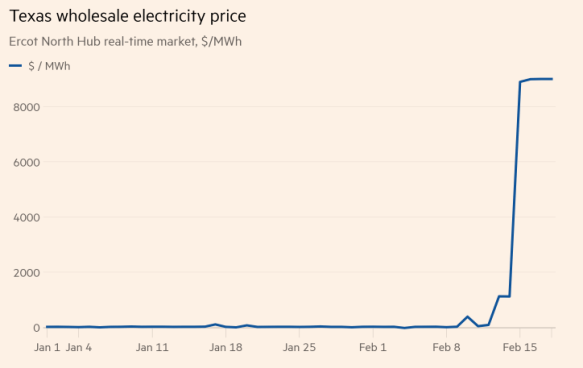
When a deep freeze shut down half the power generation capacity in Texas this week, the wholesale price of electricity exploded 10,000 per cent, with the financial consequences now being felt all the way from individual households to huge European energy companies. Astronomical bills face customers who opted for floating-rate contracts tied to wholesale prices in the state’s freewheeling electric market.

The wholesale power price was at the maximum allowable $9,000 a megawatt hour for five days from last Sunday. For a household, that translates to a $9 a kilowatt-hour electricity rate, compared with a typical cost of 12 cents.

EuqxyxkXYAA6ix6

In Burleson, a suburb of Fort Worth, Valerie Williams has been charged more than $6,000 by her electricity retailer Griddy to power her 1,400 sq ft home over the past few days. As the storm approached, Griddy told its customers to switch to more typical fixed-rate plans from other providers, but not everyone did, since there was little indication of just how extreme prices would become.

Griddy was charging her credit card multiple times a day, Williams said. She struggled to find a new provider during the crisis before finally identifying one that would switch her service on Friday. “I’m guessing it will be close to $7,000 by the time we get moved,” she said of her bill. . . .

On Friday, the city council in Denton, Texas, met to approve emergency borrowing to cover $300m the city-owned utility would pay Ercot this week — more than quadruple its purchases in full-year 2020. — “Freeze Sends Prices Soaring: Grid Operator Ercot Requires Billions in Payments”, Financial Times

The idea behind Texas energy policy was that a deregulated market didn’t require any oversight to protect the system from crisis, because profit-maximizing utilities would build in robust excess capacity to take advantage of possible price spikes. But they didn’t, even though the price spike has been incredible. — Paul Krugman

Yes, there are numerous places where Smith deplores the impact of government, and specifically the effects of intrusive regulation on trade . . . . But overall the view of Smith as anti-government seriously mistakes him. . . .He was quite clear that markets — and indeed society as a whole — are generally sustained by trust and confidence, and that for these and other things they rely on external institutions, notably of law and government, for their viability. By contrast, if merchants are left entirely to their own devices, the result is corrosive. He robustly asserts that “People of the same trade seldom meet together, even for merriment and diversion, but the conversation ends in a conspiracy against the public, or in some contrivance to raise prices”. No one who has read Smith closely can rationally believe he is an out-and-out free-marketeer. — Jesse Norman, Adam Smith: Father of Economics

The divide in our politics isn’t between proponents of big vs. small government. It’s between those trying to use government to help people and those who just want to troll the other side. When we elect responsible people, we end pandemics. When we don’t, people freeze to death. — Rep. Tom Malinowski (D-NJ)

Sacha Baron Cohen on the Greatest Propaganda Machines in History

The comedian spoke out this week. The problem he discusses may be insurmountable, given that anyone with an internet connection has the technological ability to communicate with everyone else who has one. Nevertheless, it’s encouraging that more people are demanding reasonable limits on the power of these gargantuan, unregulated companies.

The Guardian has a full transcript.


Who’s On First? Private Property or Competition?

David Brin trained as a scientist, has written science fiction and consults with the government and corporations regarding what will happen next. He’s not an economist, but he’s written an interesting little article about right-wing ideology. It’s called “Stop Using Adam Smith and Friedrich Hayek to Support Your Political Ideology: The Irony of Faith in Blind Markets”. 

Brin cites John Robb, an author, “military analyst” and entrepreneur, as a big influence on his thinking. Robb isn’t an economist either, but here are a couple of paragraphs from his blog: 

The only way to manage an economy as complex as [ours] is to allow massively parallel decision making.  A huge number of economically empowered people making small decisions, that in aggregate, are able to process more data, get better data (by being closer to the problem), and apply more brainpower to weighing alternatives than any centralized decision making group.

In other words, central planning cannot cope with the economies of developed nations in the modern world. We need the Invisible Hand of the market. Yet: 

…an extreme concentration of wealth at the center of our market economy has led to a form of central planning.   The concentration of wealth is now in so few hands and is so extreme in degree, that the combined liquid financial power of all of those not in this small group is inconsequential to determining the direction of the economy.  As a result, we now have the equivalent of centralized planning in global marketplaces.  A few thousand extremely wealthy people making decisions on the allocation of our collective wealth.  The result was inevitable:  gross misallocation [of resources] across all facets of the private economy. 

Getting back to Brin, he argues that:

….across 4,000 years we’ve seen that whenever a small group of men become powerful enough to control an economy and command-allocate its resources, they will do so according to biased perceptions, in-group delusions and fatally limited knowledge. Whether they do the normal oligarchic thing—cheating for self-interest—or else sincerely try to “allocate for the good of all,” they will generally do it badly.

So what’s the solution? Brin says it’s competition: “the most creative force in the universe”: 

By dividing and separating power and—more importantly—empowering the majority with education, health, rights and knowledge, we enabled vast numbers of people to participate in markets, democracy and science. This has had twin effects, never seen in earlier cultures.

  1. It means everybody can find out when a person stumbles onto something cool, better or right, even if that person came from a poor background.
  2. It allows us to hold each other accountable for things that are wrong, worse or uncool, even when the bad idea comes at us from someone mighty.

…cutting through countless foolish notions that held sway for millennia—like the assumption that your potential is predetermined by who your father was—while unleashing creativity, knowledge, freedom, and positive-sum wealth to a degree that surpassed all other societies, combined.

Even the most worrisome outcomes of success, like overpopulation, wealth stratification and environmental degradation, come accompanied by good news— the fact that so many of us are aware, involved, reciprocally critical, and eager to innovate better ways.

Some have argued that cooperation has contributed just as much to human progress as competition has, but putting that issue aside, Brin arrives at his major point: the people who call themselves “conservatives” and claim to revere thinkers like Adam Smith and Friedrich Hayek, both of whom extolled the benefits of a competitive market, don’t really believe in competition:

The problem is that it’s all lip service on the right! Those who most loudly proclaim Faith In Blind Markets … are generally also those proclaiming idolatry of private property as a pure, platonic essence, a tenet to be clutched with religious tenacity, as it was in feudal societies. Obdurate, they refuse to see that they are conflating two very different things.

Private property—as Adam Smith made clear—is a means for encouraging the thing he really wanted: fair and open competition….But anyone who actually reads Adam Smith also knows that he went on and on about that “fair and open” part! Especially how excessive disparities of wealth and income destroy competition…. When today’s libertarians praise the creative power of competition, then ignore the unlimited [worship of property] that poisoned it across the ages, we are witnessing historical myopia and dogmatic illogic, of staggering magnitude….

But in rejecting one set of knowledge-limited meddlers—100,000 civil servants—libertarians and conservatives seem bent on ignoring market manipulation by 5,000 or so aristocratic golf buddies, who appoint each other to company boards in order to vote each other titanic “compensation packages” while trading insider information and conspiring together to eliminate competition. Lords who are not subject to inherent limits, like each bureaucrat must face, or rules of disclosure or accountability. Lords who (whether it is legal or not) collude and share the same delusions….

Hence, at last, the supreme irony.  Those who claim most-fervent dedication to the guiding principle of our Enlightenment: competition, reciprocal accountability and enterprise—our neighbors who call themselves conservative or libertarian—have been talked into conflating that principle with something entirely different. Idolatry of private wealth, sacred and limitless. A dogmatic-religious devotion that reaches its culmination in the hypnotic cantos of Ayn Rand. Or in the Norquist pledge to cut taxes on the rich under all circumstances—during war or peace, in fat years or lean—without limit and despite the failure of any Supply Side predictions ever, ever, ever coming true.

An idolatry that leads, inevitably to the ruination of all competition and restoration of the traditional human social order that ruled our ancestors going back to cuneiform tablets — Feudalism. 

As Paul Krugman has often pointed out, it’s not the 1% that’s the problem. It’s more like the 0.001% (Brin’s “golf buddies” and their ilk around the world) whose vast wealth makes them modern-day aristocrats. It’s also those who Krugman called “enablers” in today’s column – the minions who spread the “private property is sacred” and “government destroys liberty” gospel. If these so-called “conservatives” were true to the spirit of Adam Smith, they’d celebrate “mass education, civil rights, child nutrition and national infrastructure etc.”, which Brin mentions, as well as antitrust enforcement, workers’ rights and environmental protection, all of which have “empowered greater numbers of citizens to join the fair and open process of Smithian competition”.

PS – Brin’s article is on a site called Evonomics: The Next Revolution in Economics. It’s worth visiting.