The Truth Still Matters

Will be going to North Dakota today to discuss tax reform and tax cuts. We are the highest taxed nation in the world – that will change.

— Donald J. Trump (@realDonaldTrump) September 6, 2017

But the truth still matters:
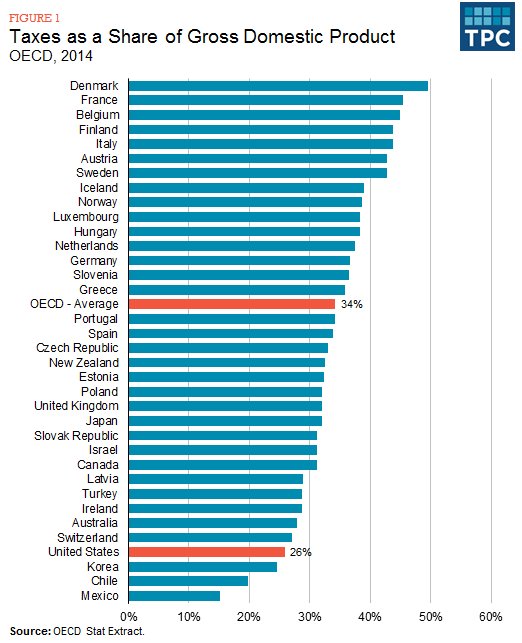
oecd tax burdens

The chart includes individual and corporate taxes, as well as local taxes, as reported by the 35-nation Organisation for Economic Co-operation and Development.

For some historical perspective, consider “When the Rich Said No to Getting Richer” by from David Leonhardt of The New York Times:

A half-century ago, a top automobile executive named George Romney — yes, Mitt’s father — turned down several big annual bonuses. He did so, he told his company’s board, because he believed that no executive should make more than $225,000 a year (which translates into almost $2 million today).

He worried that “the temptations of success” could distract people from more important matters, as he said to a biographer, T. George Harris. This belief seems to have stemmed from both Romney’s Mormon faith and a culture of financial restraint that was once commonplace in this country.

Romney didn’t try to make every dollar he could, or anywhere close to it. The same was true among many of his corporate peers. In the early 1960s, the typical chief executive at a large American company made only 20 times as much as the average worker, rather than the current 271-to-1 ratio. Today, some C.E.O.s make $2 million in a single month.

The old culture of restraint had multiple causes, but one of them was the tax code. When Romney was saying no to bonuses, the top marginal tax rate was 91 percent. Even if he had accepted the bonuses, he would have kept only a sliver of them.

The high tax rates, in other words, didn’t affect only the post-tax incomes of the wealthy. The tax code also affected pretax incomes. As the economist Gabriel Zucman says, “It’s not worth it to try to earn $50 million in income when 90 cents out of an extra dollar goes to the I.R.S.”

The tax rates helped create a culture in which Americans found gargantuan incomes to be bizarre.

A few years after Romney turned down his bonuses from the American Motors Corporation, Lyndon B. Johnson signed legislation that lowered the top marginal tax rate to 70 percent. Under Ronald Reagan, it dropped to 50 percent and kept falling. Since 1987, the top rate has hovered between 30 percent and 40 percent.

For more than 30 years now, the United States has lived with a top tax rate less than half as high as in George Romney’s day. And during those same three-plus decades, the pay of affluent Americans has soared. That’s not a coincidence. Corporate executives and others now have much more reason to fight for every last dollar.

And fight they do (it’s called “class warfare”).

Meanwhile, the president* is unnecessarily threatening hundreds of thousands of young people brought to this country by their parents and another extremely dangerous hurricane is on its way. This is further evidence that Republicans are evil and global temperatures are rising, but you already knew that.

Update:  John McCain, the Republican senator who talks a good game but can’t be relied on, has changed his mind about repealing the Affordable Care Act. He now says he’d vote Yes on what is “in may ways … the most radical” repeal bill yet. Further evidence for [see above]. 

2nd Update: McCain now says he would only vote for repeal if the legislation survived committee hearings and was subject to amendments proposed by both sides. That’s not what the 81-year old senator implied earlier today. This latest announcement is good news, because the repeal legislation is extremely unlikely to pass if it’s subject to “normal order” in the Senate instead of being rushed through. 
Fuck Him. He’s Still a Con Man.

Donald Drump gave a long speech last night that made some people think he’s not as bad as they thought. This has happened before. If you think otherwise, that he’s suddenly become “presidential” rather than “unpresidented”, read these: 

Michael Grunwald, “Salesman-in-Chief”, Politico

Brian Beutler, “The Worst Performance of [Drump’s] Presidency Now Belongs to the Press Corps”, The New Republic

Greg Sargent, “The Pundits Are Wrong. [Drump’s] Handling of the Ryan Owens Affair Was Contemptibly Cynical”, The Washington Post

Alex Pareene, “You Cretins Are Going To Get Thousands of People Killed”, The Concourse

Meanwhile, Reuters reports that there was a record high of 63.5 degrees in Antarctica last year. 

As the Climate Changes, So Will Our Understanding

William Gail is a past president of the American Meteorological Society. He calls attention to an aspect of the global warming crisis I hadn’t really considered: climate change will mean that we’ll know less about the world.

Civilization’s understanding of Earth has expanded enormously in recent decades, making humanity safer and more prosperous. As the patterns that we have come to expect are disrupted by warming temperatures, we will face huge challenges feeding a growing population and prospering within our planet’s finite resources. New developments in science offer our best hope for keeping up, but this is by no means guaranteed.

Our grandchildren could grow up knowing less about the planet than we do today. This is not a legacy we want to leave them. Yet we are on the verge of ensuring this happens.

His op-ed article is here.

Meaning Is a Many-Splendored Thing, Part 2

Roy Scranton’s “We’re Doomed. Now What?” begins with a different premise than Charlie Hueneman’s “Everything Is Meaningless – But That’s Okay” (which I went on about two weeks ago). Scranton thinks that global warming, escalating violence or a combination of the two will one day put our species out of its misery:

Today, as every hour brings new alarms of war and climate disaster, we might wish we could take Nietzsche’s place. He had to cope only with the death of God, after all, while we must come to terms with the death of our world….

We stand today on a precipice of annihilation that Nietzsche could not have even imagined. There is little reason to hope that we’ll be able to slow down global warming before we pass a tipping point….The West Antarctic ice sheet is collapsing, Greenland is melting, permafrost across the world is liquefying, and methane has been detected leaking from sea floors and Siberian craters: it’s probably already too late to stop these feedbacks, which means it’s probably already too late to stop apocalyptic planetary warming. Meanwhile the world slides into hate-filled, bloody havoc, like the last act of a particularly ugly Shakespearean tragedy.

It’s fair to say that without a major technological breakthrough on one hand or the collapse of the carbon-based global economy on the other, the amount of carbon dioxide in the atmosphere will continue to increase. That could have horrific consequences. A “runaway” greenhouse effect may have given Venus its thick atmosphere of carbon dioxide and average surface temperature of 842 degrees.

Scranton implies that we’re doomed because four common responses to the global warming crisis are seriously misguided. He says “denialists” deny the problem exists, “accelerationists” think more technology is the answer, “incrementalists” favor the kind of modest changes already being made, and “activists” argue that “we have to fight, even though we’re sure to lose”. He thinks “we respond according to our prejudices”.

He then calls attention to what could be thought of as a fifth type of response, except that it’s closer to no response at all. Scranton thinks nihilism “defines our current moment”. Too many of us believe that “if all is already lost, nothing matters anyway”. What he apparently has in mind is the point of view sometimes referred to as “existential nihilism”. That’s the idea that life, whether individual lives or human life as a whole, lacks meaning, purpose or value.

What evidence is there for this increasing nihilism? Scranton mentions four television programs (I’ve watched two of them – they’re very good). Maybe more convincingly, he says “you can see it in the rush to war, sectarianism and racial hatred”. There is also the advance of “scientific materialism”, which has been undermining religious beliefs since at least the 17th century.

But war, sectarianism and racial hatred aren’t examples of nihilism. Nobody goes to war because they think everything is meaningless. People don’t divide into sects because they lack purpose. Racists value some people more than others for no good reason. That’s stupid, but not nihilistic. Science conflicts with some religious doctrine, but people who take science seriously aren’t generally amoral. So, putting aside the issue of nihilism for the moment, what does Scranton say we should do?

Oddly, by the end of the article, Scranton has declared himself to be a kind of “activist”. He believes some of us will survive global warming. Our species isn’t due for extinction. Therefore:

…it’s up to us … to secure the future of the human species. We can’t do it by clinging to the progressivist, profit-seeking, technology-can-fix-it ideology of fossil-fueled capitalism. We can’t do it by trying to control the future. We need to learn to let our current civilization die, to accept our mortality and practice humility. We need to work together to transform a global order of meaning focused on accumulation into a new order of meaning that knows the value of limits, transience and restraint.

In other words, we need to find meaning in taking care of the planet, not in the all the stuff we can get from burning carbon. We can’t wait for the global carbon-based economy to collapse. If we want to keep the planet habitable for human beings (a few of us anyway) and other living things, we need to immediately cut back our use of fossil fuels.

I’m sure Scranton would like to explain how we can accomplish this. How will it come to pass that so many people will change their way of looking at the world, of valuing what oil and coal do for us? Global warming isn’t such an obviously imminent crisis that the powerful or the mass of humanity will quickly reorient their thinking. It’s not as if a planet-destroying asteroid is heading our way. Nor are we in danger of running out of fossil fuels in the foreseeable future. There are billions of tons of the stuff just waiting to be extracted.

But all that Scranton offers as a way forward is to cite Nietzsche. The German philosopher set forth a position known as “perspectivism”. It’s not exactly clear what he meant by that (clarity wasn’t one of his strengths), but the general idea is that we each have our own perspective on the world; none of our perspectives give us access to the world as it really is; so the best we can do is view the world from as many points of view as possible. Adopting more and more perspectives can get us closer to the truth, even though we can never attain absolute, completely objective, non-perspectival truth about anything at all.

At least that’s how Scranton interprets Nietzsche. Life may be meaningless. The planet is probably doomed. But human beings have a tremendous capacity to find meaning in all kinds of situations. We need to use that capacity to view the planet’s future from as many perspectives as possible, human and non-human:

We need to learn to see not just with Western eyes but with Islamic eyes and Inuit eyes, not just with human eyes but with golden-cheeked warbler eyes, coho salmon eyes and polar bear eyes…

If we can manage that, difficult as it may be, we may be able to stop the Earth from becoming another Venus.

Perhaps you agree about adopting new perspectives, but I think it’s highly unlikely that the world’s leaders or the mass of humanity will ever stop finding most of life’s meaning in the here and now, based on their own particular points of view. Denialists will continue denying there’s a problem. Technologists will continue looking for technological solutions. Incrementalists will advocate or settle for incremental change. Activists like Scranton will propose new ways of finding meaning, while nihilists won’t think it matters what happens.

My own view is that the human race may get lucky but probably won’t. We should, however, still make intense efforts to stop burning so much carbon, while making life as decent as possible for those of us who are already here, including the fish of the sea, the fowl of the air, and everything that travels or grows upon the earth (except maybe mosquitoes and poison ivy). We have to balance the near future in which life is hard for so many and the more distant future in which life may not be possible at all. We will probably fail, but it’s the right thing to do.

Brief Political Commentary

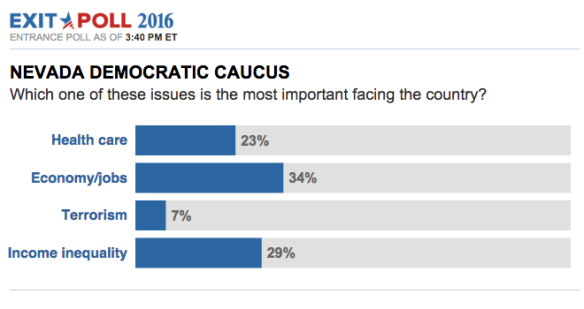
Voters who attended the Democratic caucuses in Nevada yesterday were asked to identify the most important issue facing America. 34% said the economy and jobs; 7% said terrorism.

NVDem_Issues_02202016

Voters in the Republican primary in South Carolina were asked the same question. 28% said the economy and jobs, but 32% said terrorism.

SGOP_IssuesV2_02202016I haven’t been able to determine whether the Democrats and Republicans were given the same list of issues to choose from, but it’s still remarkable that one-third of Republican voters chose terrorism as the most important issue we face. In fact, it’s remarkable that 7% of the Democrats said the same thing.

Unless these people think there is a strong chance that terrorists (of whatever political persuasion, not just Islamic fundamentalists) will attack America with nuclear or biological weapons, it’s silly to put terrorism at the top of the list. (In fact, given how silly it is, I have to wonder – mostly facetiously – whether some of those Democrats were devious Republicans attending the Democratic caucuses in order to make trouble, something the rules in Nevada allowed).

Here in New Jersey, we don’t get to participate in the nomination process until June, when it won’t matter what we think or how we vote. But if anyone asked me, I’d put global warming first, because of its possibly catastrophic consequences. After that, it would be hard to choose between the economy and jobs; money in politics; and the number of Americans who have lost their minds and vote for Republicans.