Politics and Markets One More Time

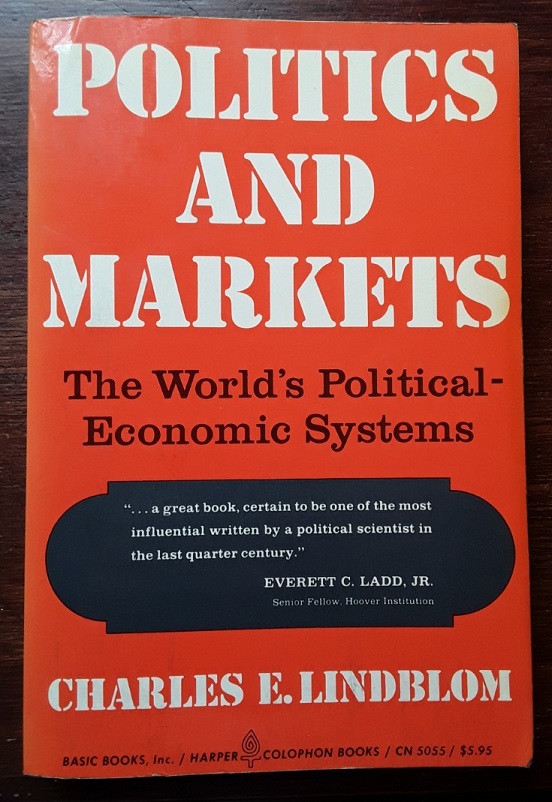
Around 40 years ago, I bought a book called Politics and Markets: The World’s Political-Economic Systems. It was written by Yale professor Charles Lindblom. I read about half of it before putting it aside. I don’t know why I stopped reading, because I thought it was excellent and intended to finish it. Instead, I treated the book like a kind of talisman. For some time, I kept it on my desk at work. It was there so long that someone asked me if I was still reading “that book”. I suppose I didn’t have the mental energy to finish it, but having it around was nice. Maybe it reminded me of my aborted attempt at an academic career.
thumbnail_20200807_142201

A few days ago, I thought I might go around the house and find books I’ve always thought about reading but never did. An obvious candidate was a biography of Ralph Waldo Emerson called Emerson: The Mind on Fire. Just like Politics and Markets, I read about half of it years ago and have often thought of finishing it. Unlike Politics and Markets, however, Emerson still had a decades-old bookmark showing where I stopped reading (it wasn’t even at the start of a chapter).

I’m now reading Politics and Markets again. I was immediately impressed.

This is how the 1977 edition above begins:

Relentlessly accumulating evidence suggests that human life on the planet is headed for a catastrophe. Indeed, several disasters are possible, and if we avert one, we will be caught by another. At present rates of population growth, another century will put 40 billion people on Earth, too many to feed. If industrial production grows at present rates during the next century, resource requirements will multiply by a thousand. And energy emission, some scientists say, will over a longer period of time raise Earths’ temperature to a level unsuitable for human habitation. All this assumes that a nuclear catastrophe does not spare us the long anguish of degeneration.

However fearful one may be that the fallible and dilatory intelligence of the human species will somehow either end human life or reduce it to unbearable squalor, the decline of the human condition is not inevitable. It is for us to decide whether we will continue to reproduce at disastrous rates, plunder the planet of resources, or burn ourselves from the face of the earth through either thermal pollution or a few quick blasts. The world is man’s doing, not something done to him.

Assuming that men and women wish to give some thought to their futures, what are the fundamental politico-economic mechanisms they can employ in order to maintain — indeed greatly enlarge — the humane qualities of life on Earth? That is the question of this book. Some will doubt that political and economic mechanisms matter. They will say that man’s future hinges on a moral regeneration. Or science and technology. Or inner awareness. Or a new form of family or other small-group association. Or organic foods — the list is open to nominations. This book is for those who believe that politics and economics will turn out to matter.

Well, some good news is that world population isn’t climbing as fast as people expected in 1977. It was 4.2 billion back then. Now it’s 7.8 billion, but the rate of increase is going down. It’s projected that there will be 10 billion of us by 2077, not 40 billion. And since the fertility rate is expected to keep dropping, world population may actually decline in the next century (even without the help of killer viruses, nuclear wars, giant meteors, etc.).

Along with population, resource requirements continue to grow, although some experts believe that we won’t run out of the things we need, since as resources become scare, they’ll become more expensive and we’ll find substitutes (I don’t know what the substitute for oxygen or water would be).

The bad news, of course, is that the “energy emission” that “some scientists” were worried about in 1977 is now out of control. If you want a scary update, see Bill McKibben’s article “130 Degrees” at the New York Review of Books site:

What [the 10 to 15% drop in emissions during the pandemic] seems to indicate is that most of the momentum destroying our Earth is hardwired into the systems that run it. Only by attacking those systems—ripping out the fossil-fueled guts and replacing them with renewable energy, even as we make them far more efficient—can we push emissions down to where we stand a chance.

As for “nuclear catastrophe”, it’s easy to think that the danger subsided with the end of the Cold War. That’s not the message from “The New Nuclear Threat”, an article by Jessica Matthews in the same issue of The New York Review of Books (I’ve subscribed for a long time — the subscription is almost worth the price):

In part because of effective deterrence, fear of their destructiveness, and a growing taboo against their use, and in part because of dumb luck, nearly a century has passed without nuclear weapons being used again in conflict. . . . But we are not safer today—quite the reverse. . . . A second nuclear arms race has begun—one that could be more dangerous than the first. . . .

The single step from which profound policy change could flow, domestically and internationally, would be formal endorsement by the five original nuclear powers—the US, Russia, the UK, France, and China—of the Reagan-Gorbachev principle, jointly articulated by the two leaders at their 1985 summit. It states simply, “a nuclear war cannot be won and must never be fought.” International adoption would simultaneously indicate the nuclear powers’ recognition of the rising dangers of nuclear conflict and the need to move toward nuclear forces around the world that are structured for deterrence, not war fighting. . . .  Eventually, these eleven words could underlie the next generation of arms control negotiations, strengthen the global nonproliferation regime, and help short-circuit a second nuclear arms race.

I don’t know if Prof. Lindblom’s old book might help with any of this. I’ll let you know if I finish it.
Ladies and Gentlemen, Our President

Quote

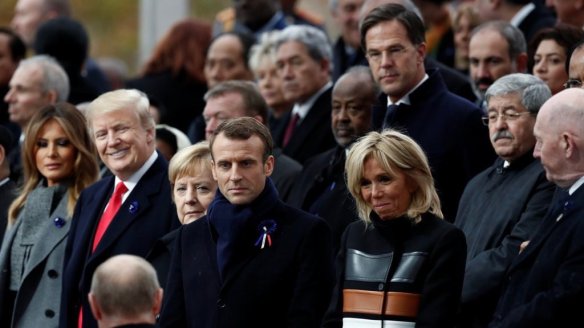
He smiles at Putin and ignores global warming. He couldn’t be bothered to honor fallen American soldiers in France because there was rain in the forecast. 

More at An Ingenious Device for Avoiding Thought.

Ladies and Gentlemen, Our President

Putin is a thug who has his opponents and critics jailed and murdered. He annexed Crimea. He interferes in elections, contributes to war crimes and has stolen millions, probably billions, from the Russian people. This is him arriving at a ceremony in France attended by our president and foreign leaders.

DruF97-X4AAJIaR

Meanwhile, the global, man-made phenomenon that our president says is a hoax gets worse every year. Among the results: California has never had such terrible fires.

DrmTyLJU0Acrw4-

The Grand Old Party Today

Once again, the bastards failed to repeal the Affordable Care Act. A few Republican senators refused to go along with the herd. No doubt they’ll keep trying to kill it, no matter how many people suffer as a result.  

Until this latest repeal effort took precedence, Sen. Alexander, a Republican, and Sen. Murray, a Democrat, were working on a bipartisan set of improvements to the ACA. They were making progress, but the Republican leadership ordered Sen. Alexander to end the discussions. When the repeal effort quickly fizzled, the Democratic leadership called for Alexander and Murray to resume their work. Here’s what the Republican leader, Senator McConnell, said:

Senate Ds have 2 thoughts on how to fix #Obamacare 1. Do nothing 2. A fully gov-run system that would take away even more of their decisions 4:45 PM – 25 Sep 2017

McConnell stopped Alexander and Murray from working together on a set of mutually agreeable fixes to the ACA. Then he claimed the Democrats weren’t willing to work with the Republicans. He knew this was totally false, but said it anyway.

Now the Republicans have pivoted to what they’re calling “tax reform”. As usual, the changes they have in mind are skewed to benefit the rich:

The tax plan that the Trump administration outlined on Wednesday is a potentially huge windfall for the wealthiest Americans. It would not directly benefit the bottom third of the population. As for the middle class, the benefits appear to be modest.

The administration and its congressional allies are proposing to sharply reduce taxation of business income, primarily benefiting the small share of the population that owns the vast majority of corporate equity….

The plan would also benefit Mr. Trump and other affluent Americans by eliminating the estate tax, which affects just a few thousand uber-wealthy families each year, and the alternative minimum tax, a safety net designed to prevent tax avoidance [by people with high incomes].

The precise impact on Mr. Trump cannot be ascertained because the president refuses to release his tax returns, but the few snippets of returns that have become public show one thing clearly: The alternative minimum tax has been unkind to Mr. Trump. In 2005, it forced him to pay $31 million in additional taxes. [The New York Times]

In addition, the Republicans want to cut taxes for “pass-through” businesses from as high as 39% down to 25%. The Trump Organization just happens to be a pass-through business.

So there are at least three big changes that would almost certainly benefit the president and his family, assuming any of them pay income tax. Yet last night he had the nerve to deny it:

President Trump unveiled his long-awaited tax plan Wednesday during a speech in Indiana. He asserted without qualification that the proposal — still only roughly outlined — would be good for middle-class Americans and not the wealthy.

“Our framework includes our explicit commitment that tax reform will protect low-income and middle-income households,” Trump said. “Not the wealthy and well-connected. They can call me all they want; I’m doing the right thing.”

He then added: “And it’s not good for me, believe me.” [The Washington Post]

Meanwhile, our fellow citizens in Puerto Rico and the U.S. Virgin Islands are in a horrible situation, having been subjected to two major hurricanes, but the Republicans who control the government aren’t responding to the crisis as urgently as they did when Texas and Florida suffered similar but less serious problems. And the Midwest and Northeast have been experiencing an unprecedented heatwave — “Late-September heat wave leaves climate experts stunned. ‘Never been a heat wave of this duration and magnitude this late in the season’ reports NOAA” [ThinkProgress] — while the Republicans deny that global warming is real and are running yet another religious fanatic (who doesn’t believe in evolution and thinks homosexuality should be a crime) for a seat in the U.S. Senate.

Years ago, Republicans weren’t as bad as they are now. Back then, I wondered whether they were mostly selfish or mostly ignorant. Those are still factors, but what’s still known as the Grand Old Party has deteriorated to the point where mere selfishness and ignorance aren’t enough to explain its awfulness. The fundamental problem is that Republicans are immoral. They don’t observe norms of human behavior that the modern world requires: caring about the lives of strangers; intellectual honesty; respect for scientific inquiry; the willingness to cooperate for the common good; long-term thinking; promoting equality of opportunity.

There is no excuse for being a Republican today. The Grand Old Party has become evil and deserves to die.

It’s Not the Reactionaries So Much as the Elites They Listen To

Twitter isn’t the best place for reasoned discussion, but depending on who you follow, it isn’t a vast, superficial wasteland either. One of the cool things it offers is the occasional tweetstorm that benefits from directness and immediacy.

Here, slightly edited, is what David Roberts, who writes about climate and energy for Vox, had to say in thirty or so tweets yesterday:

Ever since climate became a political issue in the US, one of the most ubiquitous topics of climate discussion has been “how can conservatives be persuaded to accept climate science and join in the productive search for solutions?” I have read, no joke, MILLIONS of words on that subject. Been following that conversation long enough to notice it has certain recurring features.

The weirdest aspect is that it almost always treats conservatives and their denial as a kind of feature of the landscape, like a mountain. It’s something that just IS, something other people have to maneuver around, or overcome, or otherwise deal with. It is not treated as a CHOICE, made by grown-ass adults who could choose differently, for which they are responsible.

Another (related) weird aspect is, it’s almost always treated as something that the right’s political opponents *caused*. Al Gore caused it. Strident rhetoric or “alarmism” caused it. Enviro aversion to nuclear power (or CCS [Carbon Capture and Storage], or geoengineering) caused it.

It’s always discussed as a result of something enviros or the left did–and something they could undo, if they just acted/talked right. “If environmentalists stopped doing [thing that personally annoys me], they’d be winning over the right” is a *ubiquitous* template.

But it’s bullshit. The question of what shapes conservative opinion is not some deep mystery about which your gut impulses carry any insight. It’s an intensely studied question in social science and has been, as least to a decent approximation, answered. I recommend this post, summarizing John Zaller’s book The Nature & Origins of Mass Opinion. To *very* briefly summarize: people don’t know anything; they don’t have strong opinions on political “issues”; they form opinions by following the cues of leaders in their various social tribes. We are social creatures; tribal ties (not “issues”) are primary.

So conservatives believe what conservatives believe. And they find out what conservatives believe from conservative elites.That means conservative politicians, celebs, and local leaders, but especially, in US conservatism circa 2017, *media figures*. Conservative media plays an *enormous* role in shaping conservative opinion and has dragged it steadily rightward.

So we can say with confidence that conservatives deny climate change because that’s what conservative political/media elites do. Elite cues are what matter. It follows that the *only* reliable way to get conservatives to stop denying climate change is for conservative political/media elites to stop. That’s it.

You might think that Al Gore should STFU, enviros should support nuclear, green journalists should avoid “doomism” and all the other things that VSPs [Very Serious Persons] are always scolding greens for. Fine. Think what you want. Scold away.

But there is no evidence, and no reason to think, that any of those changes would have any material effect on conservative climate denialism. Conservatives will change their tune on climate when the people they see on Fox & Breitbart change their tune. Until then, clever arguments and magic words (“national security!” “conserving God’s gift!”) are futile for everything except meeting think-piece word counts.

Conservative elites and media are to blame for conservative ignorance and obstruction on climate. Not greens, not Democrats, not Al Gore, not That Guy on Twitter. What they are doing is a monstrous crime that will directly result in enormous suffering. And they are grown-ass adults fully capable of understanding the consequences. They are responsible for their own actions and deserve to be called out for them.

Basically, conservative elites are to blame for climate paralysis and only conservative elites can change it. I don’t like it, but there it is. Step one for everyone ought to be telling the damn truth about it. Quit finding “clever,” “counterintuitive” ways to blame others, FFS. As Ornstein and Mann said (more broadly, but it applies here as well), “Republicans are the problem”.

Of course, in the case of global warming, Republicans are only part of the problem. The big problem is global warming itself, combined with how unlikely it is that we will stop it from getting worse. What scientists have predicted for decades is coming to pass. The world is getting hotter; the atmosphere has more moisture in it; the oceans are rising; the ice is receding; the permafrost is melting; storms and heat waves are intensifying. We are polluting the planet to a dangerous degree and it’s coming back to bite us, too quickly for us to stop it, yet too slowly to make everyone feel the urgency of the problem. 

Later, I saw that David Roberts presented his thoughts more formally in an article with a long title: “As Hurricanes and Wildfires Rage, US Climate Politics Enters the Realm of Farce: Climate Denial Is Less Credible, But More Powerful, Than Ever”.

But if you want to get really depressed, take a look at The Guardian‘s “This Is How Your World Could End”. If the author is correct, it’s not out of the question that the earth’s surface may become too hot for mammals. The good news is that many other living things would survive, including birds, who handle heat better than we do.