September Was Much Too Hot — As Predicted

From The Guardian:

Global temperatures soared to a new record in September by a huge margin, stunning scientists and leading one to describe it as “absolutely gobsmackingly bananas”.

The hottest September on record follows the hottest August and hottest July, with the latter being the hottest month ever recorded. The high temperatures have driven heatwaves and wildfires across the world.

September 2023 beat the previous record for that month by 0.5C, the largest jump in temperature ever seen. September was about 1.8C warmer than pre-industrial levels. Datasets from European and Japanese scientists confirm the leap.

The heat is the result of the continuing high levels of carbon dioxide emissions combined with a rapid flip of the planet’s biggest natural climate phenomenon, El Niño. The previous three years saw La Niña conditions in the Pacific Ocean, which lowers global temperature by a few tenths of a degree as more heat is stored in the ocean.

Conditions have now rebounded to an El Niño event, which releases ocean heat and drives up temperatures. It’s all but certain that 2023 will be the hottest on record and 2024 may even exceed that, as the heating impact of El Niño is felt most in the year after it begins.

“September was, in my professional opinion as a climate scientist, absolutely gobsmackingly bananas,” said Zeke Hausfather, at the Berkeley Earth climate data project.

Mika Rantanen, climate researcher at the Finnish Meteorological Institute, said: “I’m still struggling to comprehend how a single year can jump so much compared to previous years.” Prof Ed Hawkins, at the University of Reading, UK, said the heat seen this summer was “extraordinary”.

Samantha Burgess, at the EU’s Copernicus Climate Change Service, said: “The unprecedented temperatures for the time of year observed in September have broken records by an extraordinary amount. 2023 [is] on track to be the warmest year and about 1.4C above pre-industrial average temperatures. Two months out from [the UN climate conference] Cop28, the sense of urgency for ambitious climate action has never been more critical.”

The heat hit record levels within many countries too, including France, Germany, and Poland. The UK saw its joint hottest September on record, the Met Office reported, in data that goes back to 1884.

In Australia, climate scientist and author Joelle Gergis said: “Observations of Australia’s climate in September are shocking. Figures show where maximum temperatures were the highest on record, with many areas 3C to 5C above average. Rainfall deficits are primed for drought. Summer is going to be brutal.”

While human-caused global heating and El Niño are the biggest factors causing the record-breaking temperatures, other factors may be contributing small increases as well, Hausfather said. These include an uptick in the 11-year solar cycle, cuts in sun-blocking sulphur emissions from shipping and industry and a volcanic eruption in Tonga that released a large amount of water vapour, which traps heat.

In August, the Guardian asked 45 leading climate scientists from around the world about the record-breaking temperatures. They said that, despite it certainly feeling as if events had taken an alarming turn, the broad global heating trend seen to date was entirely in line with three decades of scientific predictions.

Increasingly severe weather impacts had also been long signposted by scientists, although the speed and intensity of the reality and the unexpected vulnerability of many populations scared some. The off-the-charts sea temperatures and Antarctic sea ice loss were seen as the most shocking events.

The scientists said that the exceptional events of 2023 could be a normal year in just a decade, unless there is a dramatic increase in climate action. The researchers overwhelmingly pointed to one action as critical: slashing the burning of fossil fuels down to zero.
Why the Weather Has Become So Weird

It’s the difference between a linear and a non-linear system. Andrew Dessler, Professor of Atmospheric Sciences at Texas A&M, explains:

If you’re struggling to understand why the impacts of climate change suddenly seem so awful, it’s time we discuss a key scientific term: non-linearity.

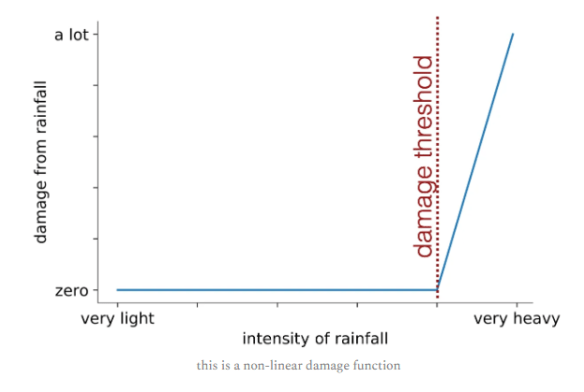
In a linear system, changes occur in a straight line. If climate impacts were linear, each 0.1°C increase in temperature would produce the same increment of damage. In this world, things slowly get worse over decades until, later this century, the accumulations of slow impacts becomes truly terrible.

But impacts of climate change are different — they are non-linear. In a rain event, for example, the first few inches of rain typically produce no damage because existing infrastructure (e.g., storm drains) were designed to handle that much rain.

As rainfall continues to intensify, however, it eventually exceeds the capacity of the storm runoff infrastructure and the neighborhood floods. You go from zero damage if the water stops half an inch below the front door of your house to tens of thousands of dollars of damage if the water rises one additional inch and flows into your house.

Untitled

Thus, the correct mental model is not one of impacts slowly getting worse over decades. Rather, the correct way to understand climate change is that things are fine until they’re not, at which point they’re really terrible. And the system can go from “fine” to “terrible” in the blink of an eye.

The key to this is recognizing the thresholds that exist in the systems around us. For example, when engineers of the 20th century designed the infrastructure that we live with today (bridges, dams, storm runoff systems), they designed it for the range of climate conditions that existed at the time, adding in a small margin for unforeseen weather extremities. But not too much of a margin — they wanted to keep costs down.

This range and margin together define the design limits of the built world. If we still had the climate of the 20th century, we’d be fine. But the relentless warming of our planet has taken us to the edge and beyond these 20th-century design limits.

The speed of us passing limits is mind bending. People who are affected are often shocked and we frequently see people bemoaning the fact that some impact never happened before — this is the calling card of non-linear effects.

So when we see all of the climate impacts of the last few years suddenly appearing, it shouldn’t surprise us. The very rapid warming we are experiencing is pushing us past many thresholds in our human and natural systems.

Note that these damages are not uniformly distributed. When the globe warms from 1.1C to 1.2C, most people are unaffected. But, for a minority of people, this will drive the climate system past important thresholds, resulting in enormous damages and suffering for them. It could be a rainfall event that, intensified by warming, crosses a threshold and floods a city. Or it could be a heatwave that, powered by increasing temperatures, becomes intense enough to wipe out entire crops. Whatever the scenario, for those people it is awful.

When the Earth warms the next 0.1C, an entirely new group of thresholds will be passed, bringing great harms to entirely different groups of people. Many of them will not expect it, having been lulled into complacency by the fact that they hadn’t been negatively impacted by warming up to then. Is that you?

Let’s hope not, but the reality is that someone, somewhere, will inevitably face climate disaster in the near future. Therefore, it’s crucial to discard the notion of climate change as a distant, linear threat and acknowledge that all of us are in the non-linear firing line.

Good News, Bad News on Climate

The New York Times has a long article about the climate crisis that can be summed up thusly: It’s going to be very bad for a lot of people but doesn’t look like the end of the world.

Here’s a link to the whole article: “Beyond Catastrophe: A New Climate Is Coming Into View” by David Foster-Wallace. Some excerpts:

With the world already 1.2 degrees hotter, scientists believe that warming this century will most likely fall between two or three degrees…. A little lower is possible, with much more concerted action; a little higher, too, with slower action and bad climate luck….Thanks to astonishing declines in the price of renewables, a truly global political mobilization, a clearer picture of the energy future and serious policy focus from world leaders, we have cut expected warming almost in half in just five years….

First, worst-case temperature scenarios that recently seemed plausible now look much less so, which is inarguably good news and, in a time of climate panic and despair, a truly underappreciated sign of genuine and world-shaping progress.

Second, and just as important, the likeliest futures still lie beyond thresholds long thought disastrous, marking a failure of global efforts to limit warming to “safe” levels. Through decades of only minimal action, we have squandered that opportunity. Perhaps even more concerning, the more we are learning about even relatively moderate levels of warming, the harsher and harder to navigate they seem. In a news release…, the United Nations predicted that a world more than two degrees warmer would lead to “endless suffering.”

Third, humanity retains an enormous amount of control — over just how hot it will get and how much we will do to protect one another through those assaults and disruptions. Acknowledging that truly apocalyptic warming now looks considerably less likely than it did just a few years ago pulls the future out of the realm of myth and returns it to the plane of history: contested, combative, combining suffering and flourishing — though not in equal measure for every group….

“The good news is we have implemented policies that are significantly bringing down the projected global average temperature change,” says the Canadian atmospheric scientist Katharine Hayhoe,…The bad news, she says, is that we have been “systematically underestimating the rate and magnitude of extremes.” Even if temperature rise is limited to two degrees, she says, “the extremes might be what you would have projected for four to five.”

“Things are coming through faster and more severely,” agrees the British economist Nicholas Stern… In green technology, he says, “we hold the growth story of the 21st century in our hands.” But he worries about the future of the Amazon, the melting of carbon-rich permafrost in the northern latitudes and the instability of the ice sheets — each a tipping point that “could start running away from us.” “Each time you get an I.P.C.C. report, it’s still worse than you thought, even though you thought it was very bad,” he says. “The human race doesn’t, as it were, collapse at two degrees, but you probably will see a lot of death, a lot of movement of people, a lot of conflict over space and water.

…. What will the world look like at two degrees? There will be extreme weather even more intense and much more frequent. Disruption and upheaval, at some scale, at nearly every level, from the microbial to the geopolitical. Suffering and injustice for hundreds of millions of people, because the benefits of industrial activity have accumulated in parts of the world that will also be spared the worst of its consequences. Innovation, too, including down paths hard to imagine today, and some new prosperity, if less than would have been expected in the absence of warming. Normalization of larger and more costly disasters, and perhaps an exhaustion of empathy in the face of devastation in the global south….”

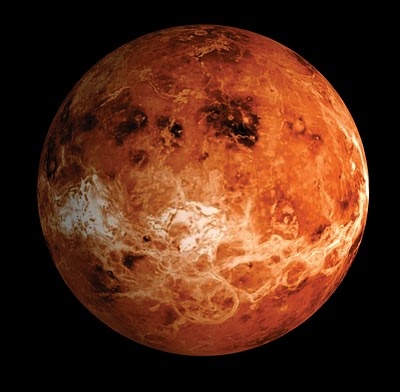
So we shouldn’t worry about the Earth turning into another Venus, a planetary greenhouse with surface temperatures of 800 degrees. That’s the good news.

71abd1cb372a70c9c80e80cfa60aaa91--space-planets-the-planets

For more on the bad news, there’s a companion article by the same author: “The New World: Envisioning Life After Climate Change”.

The moral of this story: We’ll still be around for a long time but we have plenty of work to do to make things not so bad.

And a note for the reactionaries who love oil and coal:

Since 2010, the cost of solar power and lithium-battery technology has fallen by more than 85 percent, the cost of wind power by more than 55 percent. The International Energy Agency recently predicted that solar power would become “the cheapest source of electricity in history,” and a report by Carbon Tracker found that 90 percent of the global population lives in places where new renewable power would be cheaper than new dirty power. 

Connecting Global Dots

Josh Marshall of Talking Points Memo looks at the big picture: 

It’s interesting to step back sometimes and consider … our times. Today we have our ongoing battle over democracy and authoritarianism in the U.S. The UK is in its latest stage of its ongoing national self-immolation. Italy has just elected its first far-right government since Benito Mussolini’s rise to power in the early 1920s. Russia, which has made itself into the international clarion of rightist nationalism, is stumbling through a succession of largely self-inflicted catastrophes in its war of choice in Ukraine.

Let’s go back to the Arab Spring. The Arab Spring unsettles or topples governments across the Arab Middle East. But it triggers long-running civil wars in Syria and Libya. The first especially, but also the second, are the main drivers of the European Union migrant crisis of 2015, in which some 1.3 million refugees/migrants requested asylum in the EU, the most in any single year since World War II. Given the closeness of the vote and the great focus on the migrant crisis in 2015 and 2016, it’s very hard to imagine the UK leaves the European Union without this chain of events … beginning in December 2010.

Less obvious is that you can make a looser but I think still fairly persuasive argument that these events play a key role in the rise of [MAGA-ism] in the United States….The rise of [MAGA-ism] is part of a long progression within the United States. [However, their leader’s] particular platform — to the extent you can call it that — focused on “the wall” and immigrants from Mexico and Central America….

But there’s a somewhat different commonality I am focusing on.

The [reactionary] right is, paradoxically, highly internationalized if not internationalist. There’s a deep confluence and sharing of ideas, imagery and programs between the U.S. and Europe. The narratives of “our out of control migration” and white Christian cultures under threat was a common, interwoven and reinforcing pattern on both sides of the Atlantic….

These are of course only the barest thumbnail outlines of recent history and its relationship to the present…. Why this interests me is that migration flows and their intensity are going to increase over time. The most basic reason is climate. Our potential climate futures range from really bad to truly catastrophic. But anywhere on that spectrum you have lots of people trying to move from places that are less habitable than they used to be or are in the throes of political and economic instability for those same reasons. Telecommunications and transport technology greatly accelerate that process.

A century ago a poor peasant in India or Ecuador may have known in a general way that there were vastly richer societies in Europe and North America. But they couldn’t really know the details and it was close to impossible to get there anyway. Today, almost everyone in the world can see through electronic media how people live in Europe, North America, and other parts of the affluent world and — though it’s hard and often dangerous — it is possible to get there.

What we can draw from this is that the accelerating patterns of global migration which are so central to the politics of the last decade and have helped reshape politics in Europe and North America will almost certainly continue to intensify.

While I Was Away

Here are a few things from the past week or so I wanted to share:

From Paul Krugman at the New York Times:

Wonking Out: The Tax Cut Zombie Attacks Britain

I’ve written a lot over the years about zombie economic ideas — ideas that have failed repeatedly in practice, and should be dead, but somehow are still shambling around, eating policymakers’ brains. The pre-eminent zombie in American economic discourse has long been the belief that cutting taxes on the rich will create an economic miracle.

That belief is still out there: Even as its infrastructure was collapsing to the point that its largest city no longer had running water, Mississippi tried to raise its economic fortunes with … a tax cut….

The important point to understand is that there isn’t a serious debate about the proposition that tax cuts for the rich strongly increase economic growth. The truth is that there is no evidence — none — for that proposition….

Of course, people on the right, raised on the legend of Saint Reagan, believe that his tax cuts did wonders for the U.S. economy. But the data don’t agree [he has charts, etc.]

From Jamelle Bouie, also at the New York Times:

In political writing about the federal judiciary, there is a convention to treat the partisan affiliation of a judge or justice as a mere curiosity, to pretend that it does not matter that much whether a jurist was nominated by Ronald Reagan or Bill Clinton or George W. Bush or Barack Obama so long as he or she can faithfully uphold the law.

The issue with this convention, as we’ve seen in the legal drama over the classified materials found … at Mar-a-Lago, is that it isn’t equipped to deal with the problem of hyperpartisan, ideological judges who are less committed to the rule of law than to their presidential patron….

Thankfully, there is a solution, and it takes only a simple vote of Congress: expand and reorganize the federal court system [well, actually it would only be a partial solution and important votes in Congress are rarely simple].

The practical reason to increase the number of courts and judges is that the country is much larger than it was in 1990, when Congress made its last expansion….

In the 32 years since 1990, the United States has grown from a population of roughly 250 million to a population of over 330 million….. And the federal judiciary is swamped. Last year, the Judicial Conference of the United States, a nonpartisan policymaking body for the federal courts, recommended that Congress create 79 new judgeships across existing district and appeals courts.

Congress, and here I mean Democrats, should go further with a court expansion to rival [Jimmy Carter’s in 1978]…. The goal is simple: to account for growth and to deal with the problem of a cohort of hyperpartisan and ideological judges whose loyalty to [the orange-ish ex-president] may outweigh their commitment to the law.

Would it be a partisan move? Yes. But it is a truth of American politics going back to the early days of the Republic that partisan problems — like the one engineered by Mitch McConnell … and the Federalist Society — demand partisan solutions.

From Charles Pierce for Esquire:

In the End, Climate Change Is the Only Story That Matters

To pretend otherwise is just to build the walls of your sandcastle higher.

While we watch the disembowelment of various lawyers in the employ of a former president* and wrap ourselves in the momentum of the upcoming midterm elections, the climate crisis—its time and tides—waits for no one. Every other story in our politics is a sideshow now. Every other issue, no matter how large it looms in the immediate present, is secondary to the accumulating evidence that the planet itself (or at least large parts of it) may be edging toward uninhabitability….

To stand on the bluffs above the Chukchi Sea [between Siberia and Alaska], looking down at a series of broken and ruined seawalls that have already failed to hold back the power of the ocean, and to consider that there are politicians in this country who are unwilling to do anything about the climate crisis, or who even deny it exists, is to wish they all could come and stand on these bluffs and look out at the relentless, devouring sea.

It probably doesn’t matter, but:

From Verlyn Klinkenborg for the New York Review of Books:

Endless Summer [not a great title]

Brian Wilson’s songs still have the power to astonish on their own terms, from their own time….

I have trouble accepting that Smile—the album he abandoned in 1967—was finally finished in 2004, because I question the continuity of the creative mind that “finished” it nearly forty years after it was begun. My skepticism makes me wonder whether I’m simply clinging to the memory of my own experience of the Beach Boys when I was young. But I don’t think so. They’re the same doubts that apply, say, to Wordsworth’s late revisions to The Prelude.

The joy I experience listening to those early Beach Boys records—through “Good Vibrations” and “Heroes and Villains” and slightly beyond—has nothing to do with nostalgia, with memories of where I was or who I was when I heard them. They don’t evoke for me an idealized California or even my adolescent yearnings. I don’t hear them from [Iowa] or Sacramento. I hear them from now. Wilson’s songs still have the power to astonish on their own terms, from their own time. What makes them so remarkable isn’t just the artistic fulfillment they achieve. It’s the artistic promise they embody. You can feel the explosive, disruptive, but ultimately controlled power of Wilson’s musical imagination—usually in three minutes or less….

Wilson marvels, in one of the documentaries I’ve mentioned, how quickly he wrote the melody of a song like “Caroline, No.” To me, that’s a sign that he’s allowed himself to misunderstand—in wholly conventional terms—what’s most remarkable about his work. It isn’t the melodic line or the speed with which it was written that stuns me now and stunned me then. It’s the shape of the mind in which the intricate shapes of his music entangled and resolved themselves. That mind has only ever been captured in one place: in the music as Brian Wilson recorded it long ago. 

Finally, two conclusions about France:

Louis XIV’s Versailles estate is too damn big. Did any of those 18th century aristocrats walk great distances in their 18th century shoes? The “gardens” are not somewhere to stroll around. They’re somewhere to hike or ride around.

And almost every French waiter was extremely nice, even the one who spilled the orange juice. Aren’t they supposed to be mean and snooty? Or is that only at the more exclusive establishments?