Good News, Yes, Good News

There might be good news coming from Washington. The obvious good news should be the passage of the Build Back Better Act in some form or other. Last month, Reuters used seven categories to summarize what’s in the bill (the details of which are all subject to change):

  1. Climate
  2. Education
  3. Family Benefits
  4. Healthcare
  5. Housing
  6. Immigration
  7. Taxes
  8. Other

Its passage after months of negotiation between the best and worst Democrats in Congress will be a very good thing (Republicans are opposed to progress and fairness so will all vote against it).

Meanwhile, Senate Democrats are working on changes to the filibuster. That would allow them to pass some kind of voting rights legislation over the usual Republican opposition. From Politico:

The latest attempt is taking place among a group of Senate Democrats who have gone back to the drawing board. Rather than the draconian step of tossing out the filibuster, they’re debating other possible rule changes to the chamber that could pave the way for election reform bills that are viewed by Democrats as paramount to combatting restrictive new voting laws and preserving democracy.

Sen. Tim Kaine (D-Va.), who is a member of the group drafting the reforms, said it would be “premature” to share specifics of the possible rule changes at this stage because “there’s no handshake deal yet.” But he did express a level of cautious optimism, stressing that abolishing the filibuster, which requires 60 Senate votes to advance legislation, is not under consideration this time.

“We’re not going to abolish the filibuster. Joe Manchin (D-W.Va.) has made [it] very plain we’re not abolishing the filibuster,” Kaine said in an interview. “We’re looking at a number of complaints that Democrats and Republicans have had about the way the place operates to see if we can restore it to operating better and do it in a way that would facilitate passage of voting rights.”

Kaine said the group is “analyzing potential rule reforms” by “putting the shoe on the other foot” and asking “If we’re in the minority, how would we feel about this? Can we live under this? Would this make the Senate work better for either party under a president of either party?”

The latest conversations come after four failed attempts by Democrats to pass voting or election reform bills in the Senate due to a [Republican] blockade. The hope within the party is that once President Joe Biden’s social spending plan is passed, they can prioritize voting rights and present a pathway to get it through the Senate. . . . 

The effort is expected to come to a head as early as January, according to multiple senators involved. . . . 

Ideas being floated . . . include changes to the amendment process and how the Senate debates legislation and nominations. . . . Other options raised by Democrats — and Manchin himself — include a standing filibuster which would require senators to continue debating on the floor rather than needing 60 votes to end debate on a bill. . . . 

Biden has urged Congress to pass legislation that expands ballot access, ends partisan gerrymandering and would restore the pre-clearance authority of the 1965 Voting Rights Act gutted by the Supreme Court. . . . Biden has characterized the moment as an inflection point that poses the “most significant test of our democracy since the Civil War”, as civil rights advocates press the administration to match the president’s rhetoric with urgent action . . .

For months, Democrats have repeatedly run into a brick wall as every GOP senator but one has refused to offer votes for even a restoration of key sections of the Voting Rights Act, a reform Democrats see as a modest step. Republicans have voted for such reauthorizations in the past but their opposition has led an increasing number of Democrats to either endorse a carveout to the filibuster, if not an outright elimination. . .

But Democrats will need buy-in from Manchin and Sen. Kyrsten Sinema (D-Ariz.) — who both oppose nixing the legislative filibuster — if they want to change the chambers’ rules. . . .

Tester said Tuesday that he thinks Manchin and Sinema are “absolutely” open to some of the changes being considered. . . .

Unquote.

On another front, the five most reactionary Republicans on the Supreme Court decided it’s fine to let states ignore the Supreme Court and the Constitution. This is how Chief Justice Roberts, the least reactionary Republican, described the majority’s ruling on Texas’s anti-abortion bounty hunter law:

The clear purpose and actual effect of [the Texas law] has been to nullify this Court’s rulings. It is, however, a basic principle that the Constitution is the “fundamental and paramount law of the nation,” and “[i]t is emphatically the province and duty of the judicial department to say what the law is.” Marbury v. Madison (1803). Indeed, “[i]f the legislatures of the several states may, at will, annul the judgments of the courts of the United States, and destroy the rights acquired under those judgments, the constitution itself becomes a solemn mockery.” United States v. Peters (1809). The nature of the federal right infringed does not matter; it is the role of the Supreme Court in our constitutional system that is at stake.

Justice Sonia Sotomayor wrote:

The Court should have put an end to this madness months ago, before [the law] first went into effect. It failed to do so then, and it fails again today. . . . The Court thus betrays not only the citizens of Texas, but also our constitutional system of government.

Given that a Supreme Court majority has gone renegade, reform is clearly necessary. A former federal judge and a law professor published a column in The Washington Post explaining why they now favor a major change:

We now believe that Congress must expand the size of the Supreme Court and do so as soon as possible. We did not come to this conclusion lightly. . . . We started out leaning toward term limits for Supreme Court justices but against court expansion and ended up doubtful about term limits but in favor of expanding the size of the court. . . . 

Sadly, we no longer have [confidence in the Court], given three things: first, the dubious legitimacy of the way some justices were appointed; second, what Justice Sonia Sotomayor rightly called the “stench” of politics hovering over this court’s deliberations about the most contentious issues; and third, the anti-democratic, anti-egalitarian direction of this court’s decisions about matters such as voting rights, gerrymandering and the corrupting effects of dark money.

Those judicial decisions haven’t been just wrong; they put the court — and, more important, our entire system of government — on a one-way trip from a defective but still hopeful democracy toward a system in which the few corruptly govern the many, something between autocracy and oligarchy. Instead of serving as a guardrail against going over that cliff, our Supreme Court has become an all-too-willing accomplice in that disaster . . . [We cannot look] other way when the court seeks to undo decades of precedent relied on by half the population to shape their lives just because, given the new majority, it has the votes.

Unquote.

Republicans go too far when they have power. Their overreach invites a Democratic response. Perhaps they’ve done it this time as well. I sure hope so.
Midnight Is Approaching: We Can Have Either the Filibuster or Democracy

Last month, Republican senators refused to allow a vote on the Freedom To Vote Act. Because of the Senate’s filibuster rule, the fifty Democratic senators needed ten of their Republican colleagues to join them in allowing the bill to come up for a vote. But not one Republican voted with the Democrats (the Democratic majority leader changed his vote to No so the bill can be given another chance). Here’s why Republicans oppose the bill. The Freedom To Vote Act would:

  • Expand voter registration (e.g., automatic and same-day registration) and voting access (e.g., vote-by-mail and early voting) and limit removing voters from voter rolls.
  • Establish Election Day as a federal holiday.
  • Allow ex-felons to vote. 
  • Make it illegal to interfere with another person’s ability to register and vote.
  • Require states to follow new rules for post-election audits and congressional redistricting.
  • Expand the prohibition on campaign spending by foreign nationals and require additional disclosure of campaign-related fundraising and spending.

No wonder every single Republican senator refused to allow the bill to be considered. They’re opposed to the idea of majority rule.

In support of the bill’s passage, however, more than 150 academics, experts in subjects like political science, history and public policy, have released this statement:

We, the undersigned, are scholars of democracy writing in support of the Freedom to Vote Act, the most important piece of legislation to defend and strengthen American democracy since the Voting Rights Act of 1965. This bill would protect our elections from interference, partisan gerrymandering, dark money, and voter suppression. We urge all members of Congress to pass the bill, if necessary by suspending the Senate filibuster rule and using a simple majority vote.

This is no ordinary moment in the course of our democracy. It is a moment of great peril and risk.

Though disputes over the legitimacy of America’s elections have been growing for two decades, they have taken a catastrophic turn since the 2020 election. The “Big Lie” of a stolen election is now widely accepted among Republican voters, and support for it has become a litmus test for Republicans running for public office. Republican state legislatures in Georgia, Florida, Texas, and across the country have enacted partisan laws intended to make it harder for Democrats to win elections. Most alarmingly, these laws have forged legal pathways for partisan politicians to overturn state election results if they are dissatisfied with the outcome.

The partisan politicization of what has long been trustworthy, non-partisan administration of elections represents a clear and present threat to the future of electoral democracy in the United States. The history of other crisis-ridden democracies tells us this threat cannot be wished away. It must be promptly and forthrightly confronted. Failure to pass the Freedom to Vote Act would heighten post-election disputes, weaken government legitimacy, and damage America’s international reputation as a beacon of democracy in the world.

Each branch of government has a role to play in protecting free and fair elections, but Congress’s responsibility looms largest. After the Civil War, when the path of American democracy was highly uncertain, Congress built the foundations of our modern democracy by passing two constitutional amendments and five pieces of legislation to protect the right of African Americans to vote. All were passed on party-line votes. But in 1890, the Senate failed to break a filibuster on a sixth piece of legislation: the Federal Elections Bill (also known as the Lodge Bill), which would have pushed back against voting rights violations in the South.

The upshot of that critical vote was that southern states, in the absence of any federal supervision, were allowed to pursue the wholesale disenfranchisement of African Americans for the next 75 years. By a tiny margin in one branch of Congress, American democracy took a giant leap backwards.

Protecting future elections from subversion, providing equal opportunities for all citizens to participate, drawing fair district boundaries, strengthening transparency over money in politics, and facilitating impartial electoral administration should not be partisan matters. Unfortunately, however, across state legislatures, Republicans have challenged the legitimacy of the 2020 U.S. presidential election and altered election rules on party-line votes, with a clear intent to entrench minority rule.

If Congress fails to pass the Freedom to Vote Act, American democracy will be at critical risk. Not only could this failure undermine the minimum condition for electoral democracy—free and fair elections—but it would in turn likely result in an extended period of minority rule, which a majority of the country would reject as undemocratic and illegitimate. This would have grave consequences not only for our democracy, but for political order, economic prosperity, and the national security of the United States as well.

Defenders of democracy in America still have a slim window of opportunity to act. But time is ticking away, and midnight is approaching. To lose our democracy but preserve the filibuster in its current form—in which a minority can block popular legislation without even having to hold the floor—would be a short-sighted mistake of historic proportions. The remarkable history of the American system of government is replete with critical, generational moments in which liberal democracy itself was under threat, and Congress asserted its central leadership role in proving that a system of free and fair elections can work.

We urge the Senate to suspend the filibuster rule for this measure and pass the Freedom to Vote Act. This would uphold the Senate’s noblest tradition of preserving and strengthening American democracy.

Unquote.

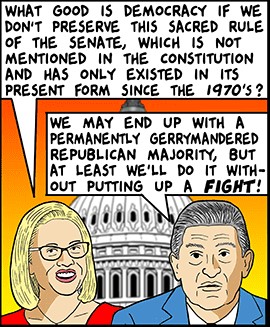
At least two Democratic senators, Sinema of Arizona and Manchin of West Virginia, have opposed reforming the filibuster in order to protect voting rights. Tom Tomorrow of This Modern World nicely captures the “logic” of their position:

TMW2021-11-24color

If you’d like to share your views on this matter (in a nice way) with Senator Sinema, you can contact her even if you don’t live in Arizona. Likewise, you can contact Senator Manchin even if you don’t live in West Virginia. Maybe they care enough about democracy to see reason.

Bad News and Possible Good News

The bad news isn’t actually news, but it’s good news that more people are finally admitting how bad it is. From Charles Pierce of Esquire:

Call me the Wet Blanket of the Gods, but I despair of ever making common cause with people who volunteer to live in Bedlam. From IPSOS:

. . . 56% of Republicans believe the election was rigged or the result of illegal voting, and 53% think [X] is the actual President, not Joe Biden.

There is no longer any reason to try to “understand” these people. Nor should there be any compunction about doing whatever we can to read them out of American politics, because they clearly have opted out on their own. They should be considered anathema, as should the entire Republican Party and the modern conservative movement that animates it.

Anything that can be done without including them should be done for the good—to say nothing of the sanity—of the country. Raw political power should be used to push through whatever of this administration’s policy priorities can be passed without any Republican help whatsoever. Majoritarianism should be invoked without mercy, and by whatever legitimate means necessary, and the window of opportunity to do that is closing fast.

It doesn’t matter if 53 percent of them say they believe the former president* is still the president* because they actually believe it, or they say it because it makes them one of The Elect. The effect on democracy is the same. They are poison in the bloodstream. And they’re proud of it.

Only 30% of Republicans feel confident that absentee or mail-in ballots were accurately counted . . . As a result, 87% of Republicans believe it is important that the government place new limits on voting to protect elections from fraud. Finally, 63% percent of Republicans think [X] should run for President again in 2024 . . . 

This is beyond the beyond. There is no compromise with this. There is no common ground. There is no deal to be struck. Millions of our fellow citizens are lost in rebellion against reality, and the only solution for the common good is to isolate them from decision-making and hope enough of them find their way back to make the country governable again. I’m not optimistic.

Unquote.

Today it was announced that the Manhattan district attorney has convened a grand jury to look at possible criminal behavior by the former president, his associates or his company. It’s unlikely the grand jury will indict anybody soon, but it’s a good development. Maybe he’ll have to run for president from jail.

And some observers think it’s becoming more likely the Senate filibuster’s stranglehold on progress will be loosened. From David Atkins of Washington Monthly:

The pressure to end the filibuster is getting strong enough you can feel all way from Arizona to West Virginia. But this time the impetus isn’t coming from outside activists or anti-gerrymandering and vote suppression reformers: it’s coming from inexorable forces within Congress itself.

A series of crucial votes looms in the near future, and it’s not clear that the internal calculus of Republican senators in the [X] era can permit a compromise with Democrats. Even less can Democrats permit an entire year and a half of legislative stalemate that not only threatens to derail democracy but would functionally disable the basic functions of government.

The immediate triggers for all this are 1) the imperiled January 6th Commission; 2) the debt ceiling fight; and 3) rising awareness that if nothing is done to curtail it, Republicans will simply rig elections in their favor and even refuse to certify their defeat even if they do lose their own rigged game. . . . 

The hostility of Senate Republicans toward accepting even the basic premises of a bipartisan commission to examine the January 6th insurrection on the Capitol has pulled a wet blanket over the hopes of optimists seeking to avoid partisan entrenchment. It is possible that Republicans are simply using hardball negotiating tactics and will eventually . . .  strike an agreement. But it’s unlikely. . . . 

Democrats, meanwhile, cannot afford not to investigate it. It was the most damaging assault on the foundations of American democracy since the Civil War, and members of Congress themselves were just minutes from potentially being murdered by the right-wing mob. Pressure will mount considerably to push the Democratic senators still defending the filibuster (most notably Arizona Senator Kyrsten Sinema and West Virginia Senator Joe Manchin) to change their stance if Republicans refuse to come to the table . . . 

But an even bigger battle looms ahead of the commission. As Dave Dayen notes at The American Prospect, Republicans in Congress are even likelier than they were in the Obama Administration to hold the government hostage over the debt limit–thereby threatening the full faith and credit of the United States Treasury. Democrats, for their part, are far less inclined to lend credibility to conservative crocodile tears about deficits or hamstring their own ability to help people or craft policy. . . . 

Ryan Grim is confident enough in this trajectory to predict that this is how the filibuster goes down. Grim believes that the debt ceiling will be the cue to enter Act II of Adam Jentleson’s speculative timeline for the end of the filibuster in his book Kill Switch: the flash point that will turn Manchin’s and Sinema’s Mom-and-apple-pie defenses of the filibuster into regretful reforms. There is good reason believe this analysis is correct. . . .

I’m Intentionally Avoiding This Topic

It’s too damn depressing. But for the record, here are two stories from the front page of The New York Times:

— With Florida Bill, Republicans Continue Unrelenting Push to Restrict Voting

Republican lawmakers are marching ahead to overhaul voting systems in states where they control the government, Next up: Texas

— G.O.P. Seeks to Empower Poll Watchers, Raising Intimidation Worries

As Republican lawmakers seek to make voting harder and more confusing, they are simultaneously making a push to grant more autonomy to partisan poll watchers. In the past, poll watchers have been used to intimidate voters and harass workers.

One from The Washington Post:

— As [ex-president] seizes on Arizona ballot audit, election officials fear partisan vote counts could be the norm in future elections

The GOP-backed recount of Maricopa County’s ballots has been criticized for abandoning state guidelines and allowing the rules to be set by a private contractor who promoted claims that the election was stolen.

And a full story from The Guardian:

— Why a filibuster showdown in the US Senate is unavoidable

During Joe Biden’s first 100 days in office, there are few issues more pressing than the escalating attack on the right to vote in America. Democrats may be running out of time to address it.

As Republicans have pushed more than 360 bills across the country to restrict access to the ballot, the president and Democrats have strongly condemned those efforts, but they’ve been unable to stop them. Even though Democrats control both chambers of Congress in Washington, they can’t pass a sweeping voting rights bill because they don’t have enough votes to get rid of the filibuster, an arcane senate rule that requires 60 votes to advance legislation. A showdown over the filibuster has loomed over the first 100 days of the Biden administration, but during the next 100 days, it’s clear that a showdown over getting rid of the procedure is unavoidable.

Amanda Litman, the executive director of the Run for Something, a group that recruits candidates for state legislative races, told me this week she thinks some Democrats still don’t fully appreciate how dangerous and consequential the GOP’s ongoing efforts are. “This is really an existential crisis. It’s a five-alarm fire. But I’m not sure it’s quite sunk in for members of the United States Senate or the Democratic party writ large,” she told me.

“If the Senate does not kill the filibuster and pass voting rights reforms 
 Democrats are going to lose control of the House and likely the Senate forever. You don’t put these worms back into a can. You can’t undo this quite easily,” she added.

Chuck Schumer, the Democratic leader in the Senate, last week set August as a deadline for Democrats to pass their sweeping voting rights bill, which would require early voting, automatic and same-day registration, among other measures. . . . 

But the window for Democrats to have the most impact with their legislation is rapidly closing. The decennial process of redrawing district lines is set to take place later this year, and a critical portion of the Democratic bill would set new limits to prevent state lawmakers, who have the power to draw the maps, from severely manipulating districts for partisan gain. While it’s probably already too late to set up independent redistricting commissions for this year, Democrats could still pass rules to prevent the most severe partisan manipulation.

“You could pass new criteria, including a ban on partisan gerrymandering…require greater transparency in the process,” Michael Li, a redistricting expert at the Brennan Center for Justice, told me. “There’s a lot that could be done.”

I also asked the Minnesota senator Amy Klobuchar, a Democrat who chairs the Senate committee currently considering the bill, what kind of message it would send if Democrats failed to take any action to protect voting rights while they held the reins of government. “Failure is not an option,” she said, adding she wasn’t going to let the filibuster stand in the way.

“This is our very democracy that’s at stake,” she said. “I’m not gonna let some old senate rule get in the way of that.”

The prime example of a purported Democrat who doesn’t recognize the crisis is Senator Joe Manchin of West Virginia. From Vox’s profile of Manchin:

Some filibuster reformers hope that, as the year goes on, the reality of Republican obstruction will become clear to Manchin and he’ll be driven to change his mind — that Senate rules will in the end be just as negotiable to him as the details of Biden’s stimulus bill. For instance, reformers hoped a GOP filibuster of Democrats’ big voting rights bill, the For the People Act, could spur holdout senators to change the rules to pass it, because it’s so important.

Manchin recoils at the very idea. “How in the world could you, with the tension we have right now, allow a voting bill to restructure the voting of America on a partisan line?” he asked. He says that 20 to 25 percent of the public already doesn’t trust the system and that a party-line overhaul would “guarantee” that number would increase, leading to more “anarchy” like that at the Capitol on January 6. He added: “I just believe with all my heart and soul that’s what would happen, and I’m not going to be part of it.”

Unquote.

What Manchin is saying is that the millions of Republicans who have bought the Big Lie — that the 2020 election was stolen from the leader of their cult — are so angry that interfering with Republican efforts to make voting as hard as possible would make the crazier ones even crazier. For that reason, he’s willing to let Republican politicians in the Senate and across the country do whatever they want to get Republicans elected, by, for instance, insuring that fewer poor people, Black people, Spanish speakers and college students vote, and when they do vote, their votes don’t matter, because Congressional districts have been gerrymandered to, yes, get Republicans elected.

It’s positions like these that get Manchin referred to as a “moderate” Democrat.

A Possible Way to Address the Filibuster Mess

After four years of political hell, Democrats have a chance to actually move this country forward. In order to do that, Senate Democrats have to either abolish the filibuster or seriously reform it.

Today, ending debate in the Senate requires a “cloture” vote. That means sixty senators have to vote Yes on cloture before the Senate can stop debating and actually vote on legislation. A filibuster is the refusal of forty-one or more senators to vote Yes on cloture. That means the debate proceeds or the Senate gives up and moves on to something else.

But as Senator Warren said last night, senators aren’t sent to Washington to conduct a debate society. If Senate Democrats can’t all agree to totally get rid of the filibuster and allow a simple majority of senators to end debate, they can seriously reform it.

E. J. Dionne shows how it might be done:

Democrats won both Georgia Senate seats in January’s runoffs, giving them control of both houses of Congress and the White House for the first time in a decade. But their ability to advance legislation — from raising the federal minimum wage to democracy reforms in the John Lewis Voting Rights Advancement Act — can be thwarted by the Senate’s 60-vote supermajority filibuster rule.

Progressives’ anger at Minority Leader Mitch McConnell (R-Ky.) and his caucus, who use the filibuster to block every initiative they can, is nearly matched by their frustration with Democratic Sens. Joe Manchin III (W. Va.) and Kyrsten Sinema (Ariz.), whose opposition to getting rid of the filibuster means Democrats are stuck with it, since they’d need all 50 votes in their caucus, plus Vice President Harris as a tiebreaker, to do it. . . .

Manchin hasn’t budged, though. Monday, when asked if he’d reconsider his stance on eliminating the filibuster, he shot back: “Jesus Christ, what don’t you understand about ‘never’?”

Democrats are right to see the urgency: Republican state lawmakers around the country are moving to enact voter suppression measures that will, if passed, put the slender Democratic majorities in the Senate and House of Representatives in jeopardy in 2022 and beyond. Without democracy reform, and with the Supreme Court’s recent assaults on the Voting Rights Act, sticking with the filibuster could make it nearly impossible for the Biden administration to pursue its agenda.

But Democrats should proceed with caution: In 2001, I warned that if Republicans harangued Sen. Jim Jeffords (Vt.) over his apostasy on their party’s policy priorities, they would regret it. He would switch parties and, in a 50-50 Senate, shift the Senate majority. The next month, it happened. The same concern now applies to Democrats with Manchin. Push too far, and the result could be Majority Leader McConnell, foreclosing Democrats’ avenue to pursue infrastructure, tax reform and health reform legislation.

So, what can Democrats do?

. . . Instead of naming and shaming them, Democrats might consider looking at what Manchin and Sinema like about the filibuster. Sinema recently said, “Retaining the legislative filibuster is not meant to impede the things we want to get done. Rather, it’s meant to protect what the Senate was designed to be. I believe the Senate has a responsibility to put politics aside and fully consider, debate, and reach compromise on legislative issues that will affect all Americans.” Last year, Manchin said, “The minority should have input — that’s the whole purpose for the Senate. If you basically do away with the filibuster altogether for legislation, you won’t have the Senate. You’re a glorified House. And I will not do that.”

If you take their views at face value, the goal is to preserve some rights for the Senate minority, with the aim of fostering compromise. The key, then, is to find ways not to eliminate the filibuster on legislation but to reform it to fit that vision. Here are some options:

MAKE THE MINORITY DO THE WORK

Currently, it takes 60 senators to reach cloture — to end debate and move to a vote on final passage of a bill. The burden is on the majority, a consequence of filibuster reform in 1975, which moved the standard from two-thirds of senators present and voting to three-fifths of the entire Senate. Before that change, if the Senate went around-the-clock, filibustering senators would have to be present in force.

If, for example, only 75 senators showed up for a cloture vote, 50 of them could invoke cloture and move to a final vote. After the reform, only a few senators in the minority needed to be present to a request for unanimous consent and to keep the majority from closing debate by forcing a quorum call. The around-the-clock approach riveted the public, putting a genuine spotlight on the issues. Without it, the minority’s delaying tactics go largely unnoticed, with little or no penalty for obstruction, and no requirement actually to debate the issue.

One way to restore the filibuster’s original intent would be requiring at least two-thirds of the full Senate, or 40 senators, to keep debating instead requiring 60 to end debate. The burden would fall to the minority, who’d have to be prepared for several votes, potentially over several days and nights, including weekends and all-night sessions, and if only once they couldn’t muster 40 — the equivalent of cloture — debate would end, making way for a vote on final passage of the bill in question.

GO BACK TO THE “PRESENT AND VOTING” STANDARD

A shift to three-fifths of the Senate “present and voting” would similarly require the minority to keep most of its members around the Senate when in session. If, for example, the issue in question were voting rights, a Senate deliberating on the floor, 24 hours a day for several days, would put a sharp spotlight on the issue, forcing Republicans to publicly justify opposition to legislation aimed at protecting the voting rights of minorities. Weekend Senate sessions would cause Republicans up for reelection in 2022 to remain in Washington instead of freeing them to go home to campaign.

In a three-fifths present and voting scenario, if only 80 senators showed up, only 48 votes would be needed to get to cloture. Add to that a requirement that at all times, a member of the minority party would have to be on the floor, actually debating, and the burden would be even greater, while delivering what Manchin and Sinema say they want — more debate. . . .

In a 50-50 Senate, and with the Republican strategy clearly being united opposition to almost all Democratic priorities, Biden and Majority Leader Charles E. Schumer (N.Y.) need the support of Manchin and Sinema on a daily basis. They won’t be persuaded by pressure campaigns from progressive groups or from members of Congress. But they might consider reforms that weaken the power of filibusters and give Democrats more leverage to enact their policies, without pursuing the dead end of abolishing the rule altogether.