The Director of the F.B.I. Adds His Two Cents

I wasn’t surprised when James Comey, head of the F.B.I., announced that Hillary Clinton would not face criminal charges as a result of her email practices. But I was relieved. There was always the possibility that Comey, a Republican, might complicate the election by calling for an indictment. So it was good news when Comey said:

….no reasonable prosecutor would bring such a case…. In looking back at our investigations into mishandling or removal of classified information, we cannot find a case that would support bringing criminal charges on these facts.

That could have been the end of the matter. The F.B.I.’s job was to determine the facts and make a recommendation to the Attorney General. In this case, the recommendation was: “No prosecution is called for”.

But Comey had much more to say that morning (actually he had 2,300 words to say in his prepared statement). In an attempt at explanation, he included this preamble:

This will be an unusual statement in at least a couple ways. First, I am going to include more detail about our process than I ordinarily would, because I think the American people deserve those details in a case of intense public interest. Second, I have not coordinated or reviewed this statement in any way with the Department of Justice or any other part of the government. They do not know what I am about to say.

As you’ve probably heard, Comey then went into some detail about what the F.B.I. found. He also strongly criticized Clinton for being careless with national security (although no actual breach of national security was detected) and offered critiques of some of Clinton’s statements.

Immediately, what seemed like a good day for Clinton seemed like a very bad day. Reporters and pundits repeated Comey’s language about carelessness and drew conclusions about the negative effects the F.B.I. director’s remarks would have. One reporter for the New York Times went so far as to write a theoretical attack ad for Trump’s campaign. It was presented on the front page of the Times as “news analysis”.

Since then, of course, the Republicans have strongly criticized Comey’s recommendation that Clinton not be prosecuted. And other facts have come out. For example, it turns out that some of the information that was labeled “classified” shouldn’t have been, according to the State Department, and that the labeling wasn’t done according to the rules in a clearly visible way.

Compared to the other issues we’re confronting, and considering who Clinton is running against, it’s possible that the email issue will fade away as the election approaches and our ballots are finally cast. (I’ve always thought this story was mainly interesting because it demonstrates how too much information is “classified” by overzealous government employees.) Nevertheless, after the initial blast of “analysis”, I saw an article and a letter to the editor that characterized Comey’s two-thousand-word statement in an interesting way.

The article in The Washington Post was written by a former director of the Justice Department’s public affairs office. It’s called “James Comey’s Abuse of Power” and is worth quoting at length:

When FBI Director James B. Comey stepped to the lectern to deliver his remarks about Hillary Clinton on Tuesday, he violated time-honored Justice Department practices for how such matters are to be handled, set a dangerous precedent for future investigations and committed a gross abuse of his own power.

…his willingness to reprimand publicly a figure against whom he believes there is no basis for criminal charges should trouble anyone who believes in the rule of law and fundamental principles of fairness.

Justice Department rules set clear guidelines for when it is appropriate for the government to comment about individuals involved in an ongoing investigation, which this matter was until prosecutors closed it Wednesday. Prosecutors and investigators can reassure the public that a matter is being taken seriously, and in some rare cases can provide additional information to protect public safety, such as when a suspect is loose and poses a danger.

And when the department closes an investigation, it typically does so quietly, at most noting that it has investigated the matter fully and decided not to bring charges.

These practices are important because of the role the Justice Department and FBI play in our system of justice. They are not the final adjudicators of the appropriateness of conduct for anyone they investigate. Instead, they build cases that they present in court, where their assertions are backed up by evidence that can be challenged by an opposing party and ultimately adjudicated by a judge or jury.

In a case where the government decides it will not submit its assertions to that sort of rigorous scrutiny by bringing charges, it has the responsibility to not besmirch someone’s reputation by lobbing accusations publicly instead. Prosecutors and agents have followed this precedent for years.

In this case, Comey ignored those rules to editorialize about what he called carelessness by Clinton and her aides in handling classified information, a statement not grounded in any position in law. He recklessly speculated that Clinton’s email system could have been hacked, even while admitting he had no evidence that it was. This conjecture, which has been the subject of much debate and heated allegations, puts Clinton in the impossible position of having to prove a negative in response….

While Clinton shouldn’t have received special treatment, she does not deserve worse treatment from her government than anyone else, either. Yet by inserting himself into the middle of a political campaign and making unprecedented public assertions, that is exactly what Comey provided.

Finally, a professor of legal ethics at the New York University school of law wrote this letter to The Times:

James B. Comey, the F.B.I. director, was out of line in holding a press briefing to deliver his verdict on Hillary Clinton’s use of a private server. The F.B.I. investigates crime and reports its findings and recommendations to federal prosecutors, who then decide whether to seek indictments.

The F.B.I. is neither judge nor jury. And it certainly has no business characterizing the noncriminal conduct of subjects of investigation, as Mr. Comey did. Cops, even top cops, should not play this role.

While it may gratify the country to hear Mr. Comey’s independent views on the server controversy, his press briefing sets a bad precedent that can harm the fair administration of justice. Few people under investigation have the resources Mrs. Clinton has to defend herself….

Once a decision is made not to indict, a prosecuting agency should say nothing more. Its job is to prosecute crime, and if there is no crime, it should remain silent.

My conclusion is that Comey’s statement was unusual in a way he didn’t think to mention, i.e., it was wrong for him to make it.
The Metaphysics and Ethics of Relativism by Carol Rovane

I would have to read this book at least one more time in order to feel confident about summarizing the conclusions the author reaches. However, here’s my impression after reading it once. As I understand her aims, Carol Rovane wants to clearly explain what relativism is with respect to science and ethics, and then determine whether we should endorse relativism with respect to either of those domains.

She begins by criticizing what she calls “the prevailing, consensus view” of relativism, which she says relies on the idea of disagreement. This is the idea that relativism arises “with a certain kind of disagreement that is said to be, first of all, ‘irresoluble’ [i.e. unsolvable], but also, second, ‘irresoluble’ for the specific reason that both parties are right” [15-16]. Rovane prefers defining relativism in terms of alternatives, which may or may not involve disagreement, and which are themselves explainable in terms of “normative insularity”.

According to Rovane, relativists believe that some alternative views in science or ethics are cut off from other scientific or ethical views. Logic neither “mandates, licenses or prohibits” inferences between them, so two people can hold alternative views about science or ethics and logic has nothing to say about the alternatives [94]. It’s as if, metaphorically speaking, people can occupy different scientific or ethical worlds. Non-relativists, on the other hand, believe that all truth bearers are logically related, either directly or indirectly. My scientific views aren’t insulated from your scientific views, and your ethical views aren’t insulated from mine. We all occupy the same scientific world and the same ethical world.

Rovane goes so far as to label the non-relativist and relativist positions in terms of how many “worlds” they mandate. What she calls “unimundialism” is the non-relativistic view that there is only one world (in which there is no “normative insularity” between propositions in science or ethics). “Multimundialism” is the relativistic view that there are many worlds (in which there is “normative insularity” between some scientific or ethical propositions). 

I think the conclusion she reaches is that scientific theories apply to a single world, so it’s best not to think of science in unimundial or non-relativistic terms. Reality is one, so alternative scientific theories can’t be equally correct. But unlike scientists, who all study the same world, people grow up and live their daily lives in various social conditions. These social conditions help determine which behavior is morally correct for them. Rovane thinks it’s fair to say, therefore, metaphorically speaking, that people inhabit different ethical worlds depending on their particular social conditions. Hence, multimundialism or relativism is an acceptable view with respect to ethics.

To help justify her relativistic conclusion regarding ethics, Rovane asks us to imagine two women. One woman was brought up in Europe or America and accepts the ethical importance of autonomy, i.e. every individual’s right to make their way in the world according to their own needs and desires while respecting the needs and desires of other people. The other woman was brought up in a village in India and sincerely believes she has an ethical obligation to obey her parents, even if it means giving up her right to pursue her own needs and desires.  Rovane argues that these two women live in very different ethical worlds. Their societies are so different when it comes to ethical issues that each woman is acting ethically, even though they are following very different paths and choosing to obey very different ethical principles.

Lies, Damn Lies and Some Statistics

I keep intending to update this blog, but end up doing other things. I can’t use those popular but lame “I’m too busy” or “There isn’t enough time” excuses. The truth is that I’m choosing to do other things. Why lie?

But last month I promised to revisit the philosopher Gerald Dworkin’s discussion of permissible lies when Professor Dworkin did. His new article, “How You Justified 10 Lies (Or Didn’t)”, was published a few days ago.

Professor Dworkin begins by listing the ten lies he discussed last time. He still thinks all ten would be permissible. Now, however, we get to see what percentage of 10,000 New York Times readers agreed with him. Even more importantly, from my perspective, we get to see how many of them agreed with me.

Surprisingly, all ten lies were deemed “permissible” by a majority of the Times readers. One lie was approved by 96% of the respondents. One was merely approved by 51%. But every single lie Dworkin listed got a positive reaction. Do the generally liberal New York Times readers who read “The Stone” philosophy blog and respond to opinion polls tend to be liars? Or maybe they were lying when they said these lies would be acceptable?

So here are the ten lies, listed according to my evaluations of them and showing how many Times readers got it right or were seriously mistaken when they responded to Professor Dworkin’s poll.

I think these five would clearly be permissible:

(1) to hold a surprise party. 96% of the Times readers agreed;
(3) to calm down a loved one who has severe dementia. 89% agreed;
(4) to protect a newly-widowed woman from unnecessary pain regarding the violent death of her husband. But only 51% agreed;
(5) to test for racial discrimination in housing. 89% agreed;
(9) to get a better price from a car salesman. 94% agreed (very few sell cars for a living).

I had some concerns about these two, but decided they would also be permissible:

(8) to tell the willing participants in a medical study that they received real knee surgery when they really didn’t. 87% agreed;
(10) to tell a young child that their drawing was great when it really wasn’t. 71%.

I had more trouble with the last three. I wasn’t completely sure about this one, but decided to reject it:

(7) to lie about one’s plans to have children in order to get a job. 62% said it would be permissible. I thought it would be better to deflect the question (being male would make it easier for me to deflect).

Finally, these two were easy to reject:

(2) to tell a young child seriously injured in a plane crash that his parents “were O.K.”, even though neither survived, so that the child might be stronger during his upcoming surgery. 63% said it would be o.k., presumably hoping that somebody else would tell the kid the truth later on: “You know that plane crash you were in, and how the doctor said your parents were o.k.? Well, they weren’t. They were dead all along.” I thought one of those vague answers doctors know how to give would be better in the long run.

(6) During the Cuban Missile Crisis, President Kennedy denied that America’s missiles in Turkey were discussed with the Russians. That was a lie. 55% said it was permissible. Again, I thought it would have been better to deflect the question or give a vague answer, while intending to eventually tell the truth.

After revealing the results of the readers’ poll, Dworkin discusses some of the more contentious lies. For example, a reader argued that it would be better for the woman in the job interview to answer truthfully regarding her plans to have a family, but “to question the heck” out of the interviewer (“How will this affect my chances?”, etc.). Other readers argued that the widow would have a right to know the truth about her husband’s painful death, although Dworkin observes that the woman might ask the question without really wanting to know if her husband suffered.

Most interesting to me is Dworkin’s discussion of the child facing surgery whose parents died in the plane crash. He and 51% of the respondents thought that saying the child’s parents were “O.K.” would be permissible. That’s hard for me to believe. Dworkin wants to protect the child in the short run, hoping that the surgery will go better if the child doesn’t know the truth. He also questions whether a young child has a right to know the truth, since young children aren’t fully autonomous yet. Fortunately, he concludes that if the child would be satisfied with a vague answer, a vague answer would be preferable to lying. I think that’s obviously true and that it’s extremely likely that a doctor could come up with a suitably vague but reassuring answer. So we aren’t as far apart on this case as it seemed.

In fact, while writing the previous paragraph, I realized that I could accept a lie in this situation too. My principal reason for disagreeing with Dworkin and the 51% is that I disagree with the particular lie they endorsed. I believe a lie like “Your parents were hurt too, so other doctors are helping them”, would be permissible, since it would allow for the possibility that the doctors weren’t able to help the parents enough to keep them alive. A lie like that could make the child’s transition to the truth less painful than hearing “your parents are O.K.”.

Dworkin concludes with some general remarks on the morality of lying. I think the most important point he makes is that there are no simple rules for deciding whether a lie is permissible. Life is complicated and so is morality. Different values come into play and need to be balanced in different situations. This is one reason the world needs blogs and other forms of communication, even though the people who communicate often end up doing things other things, some of which are easier or more fun than communicating.

Lies and Damn Lies, But No Statistics

The philosopher Gerald Dworkin got a big response when he wrote about lying earlier this week. He listed ten situations in which someone might or did tell a lie and asked his readers how they felt about each case. Dworkin himself thinks we all lie more than we realize and that lying is generally more acceptable than we think. It isn’t possible to respond to Dworkin’s list online anymore, but here’s the article. It includes some prefatory remarks. As for the lies, they’re listed below, followed by my thoughts on their acceptability.

Are the following lies permissible (yes) or not (no)?

1. A man lies to his wife about where they are going in order to get her to a place where a surprise birthday party has been organized.

2. A young child is rescued from a plane crash in a very weakened state. His parents have been killed in the crash but he is unaware of this. He asks about his parents and the attending physician says they are O.K. He intends to tell the truth once the child is stronger. 

3. Your father suffers from severe dementia and is in a nursing home. When it is time for you to leave he becomes extremely agitated and often has to be restrained. On the occasions when you have said you would be back tomorrow he was quite peaceful about your leaving. You tell him now every time you leave that you will be back tomorrow knowing that in a very short time after you leave he will have forgotten what you said.

4. A woman’s husband drowned in a car accident when the car plunged off a bridge into a body of water. It was clear from the physical evidence that he desperately tried to get out of the car and died a dreadful death. At the hospital where his body was brought his wife asked the physician in attendance what kind of death her husband suffered. He replied, “He died immediately from the impact of the crash. He did not suffer.”

5. In an effort to enforce rules against racial discrimination “testers” were sent out to rent a house. First, an African-American couple claiming to be married with two children and an income that was sufficient to pay the rent would try to rent a house. If they were told that the house was not available, a white tester couple with the same family and economic profile would be sent. If they were offered the rental there would be persuasive evidence of racial discrimination.

6. In November of 1962, during the Cuban Missile crisis, President Kennedy gave a press conference. When asked whether he had discussed any matters other than Cuban missiles with the Soviets he absolutely denied it. In fact, he had promised that the United States would remove missiles from Turkey. 

7. A woman interviewing for a job in a small philosophy department is asked if she intends to have children. Believing that if she says (politely) it’s none of their business she will not get the job, she lies and says she does not intend to have a family.

8. In order to test whether arthroscopic surgery improved the conditions of patients’ knees a study was done in which half the patients were told the procedure was being done but it was not. Little cuts were made in the knees, the doctors talked as if it were being done, sounds were produced as if the operation were being done. The patients were under light anesthesia. It turned out that the same percentage of patients reported pain relief and increased mobility in the real and sham operations. The patients were informed in advance that they either would receive a real or a sham operation. 

9. I am negotiating for a car with a salesperson. He asks me what the maximum I am prepared to pay is. I say $15,000. It is actually $20,000.

10. We heap exaggerated praise on our children all the time about their earliest attempts to sing or dance or paint or write poems. For some children this encouragement leads to future practice, which in turn promotes the development–in some — of genuine achievement.

Dworkin thinks all ten of these lies are justifiable. I think half of them clearly are. It’s acceptable to lie:

(1) to hold a surprise party;
(3) to calm down an Alzheimer’s patient;
(4) to protect a newly-widowed woman from unnecessary pain;
(5) to test for racial discrimination in housing; and
(9) to get a better price from a car salesman.

Lie (8), the one about telling people they had an operation when they really didn’t, is a bit problematic. To be acceptable, two conditions would have to be met. First, the patients would have to fully understand that some of them would be receiving, in effect, a placebo. Giving a placebo is acceptable in medical research if the experiment’s subjects understand they might receive a placebo and won’t suffer significant consequences from not getting the real thing. Dworkin mentions the first condition, but not the second.

I would add a third condition: every patient should receive the real surgery, not the fake surgery, if the study showed the surgery to be beneficial. Since these other conditions aren’t mentioned, I wouldn’t put lie (8) in the clearly acceptable category. But if forced to choose, I’d say it’s all right to “lie” in this case. Telling someone you will tell them a lie is more like playing a game than real lying.

Lie (10), the one regarding exaggerated praise for children, is also a little problematic. It’s acceptable to sometimes give children exaggerated praise, but the praise shouldn’t be extravagant. Praise should also leave room for improvement (if a drawing is perfect, there’s no reason to do a better one next time). But lie (10)  also goes in the “yes” column.

I have more trouble with lie (7). Should a prospective employee lie about their desire to have children if an interviewer inappropriately raises the subject? Instead of lying, I think a better response would be to politely ask the interviewer whether it’s appropriate to ask a prospective employee about having children. Not answering the question while mildly calling attention to its inappropriateness would be more acceptable than lying, so I give lie (7) a “no”.

The last two lies, (2) and (6), are easy to reject. In both cases, giving a vague or non-committal answer would be better than lying. Lie (2) might stop the injured little boy from worrying about his parents. But why open the door to a future revelation: “Remember when I told you that your parents were doing fine? I lied. They were already dead.” If you couldn’t think of a sufficiently vague answer, you could at least tell a lie that was closer to the truth: “Your parents were hurt, but the doctors are trying to make them better.” Then change the subject back to the child’s needs. Eventually learning the truth wouldn’t be as much of a shock.

Finally, in the case of (6), the only non-hypothetical lie in the list, it’s fair to say that all government leaders sometimes have valid reasons to keep a secret. Perhaps President Kennedy had a good, non-political reason not to tell the truth about his talks with the Russians. But he didn’t have to absolutely deny that America’s missiles in Turkey were discussed. Kennedy could just as easily have told the press that various issues of national security always come up when dealing with the Russians. This time was no different. Next question, please.

So, giving a “no” to (2) and (6) leaves me with seven acceptable and three unacceptable lies. Professor Dworkin, who said all ten were justified, promises to write about this further. I’ll do the same. But keep in mind that you can trust me, because I’m not lying. Whether this clearly untrustworthy professor returns to the subject is a whole other question.

Cutting the Cord (the Saga Continues and Continues)

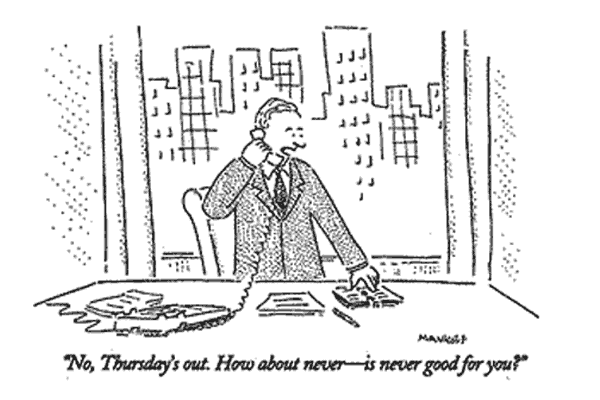
how-about-never

Verizon told us they’d be at our house between 11 am and 2 pm to install our new fiber optic connection (good-bye, Comcast!). The installation was supposed to take three hours and might require work on the outside of our house.

After a while, I checked our order status on the Verizon website. A note had been added. The technician will arrive between 1 pm and 5 pm. Ok, whatever.

The afternoon wore on. No technician. No word from Verizon. No email, no phone call.

But another visit to their website reveals an updated note: the technician will arrive between 7:45 pm and 8:45 pm. Really? To do a three-hour job that might involve working outside? In the dark?

Ok, let’s contact Verizon. First, a brief online chat. Second, a phone call to “customer service”. Third, another phone call to “customer service” after the first call disconnects.

The Verizon representative is surprised to hear that Verizon technicians do installations at night. So am I. I ask her to confirm that this is actually going to happen. Or will the technician actually show up tomorrow morning? Or never?

She contacts the dispatcher, who confirms that the technician will be arriving tonight. I’m not convinced.

Meanwhile, the website has a new note: the technician will arrive between 9 pm and 10 pm:

verizon 1

verizon 2

I find this new promise even less believable than “between 7:45 and 8:45”. Our technician will be working past midnight to finish this job? I express my skepticism and repeat my request for confirmation.

Yes, the dispatcher still says the technician will arrive between 7:45 and 8:45 pm, even though the website disagrees. I express an opinion or two to “customer service” and we say good-bye.

Comcast, I already miss you and you haven’t gone away!