Ladies and Gentlemen, Our President

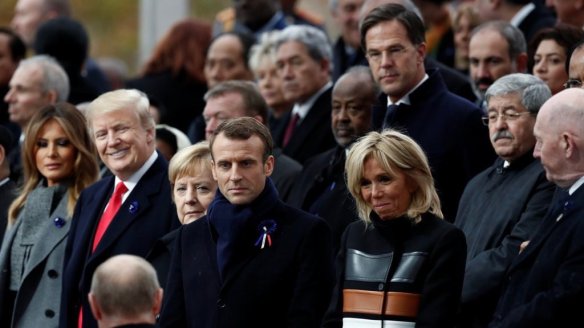
Putin is a thug who has his opponents and critics jailed and murdered. He annexed Crimea. He interferes in elections, contributes to war crimes and has stolen millions, probably billions, from the Russian people. This is him arriving at a ceremony in France attended by our president and foreign leaders.

DruF97-X4AAJIaR

Meanwhile, the global, man-made phenomenon that our president says is a hoax gets worse every year. Among the results: California has never had such terrible fires.

DrmTyLJU0Acrw4-

Avoiding Individual-1 for the Most Part

I’ve mostly blogged about politics since the beginning of the crisis (you know, the crisis known as “Individual-1”). Other topics haven’t seemed worth writing about.

But, even though Individual-1 is still happening, I haven’t posted anything lately. That’s because, two months ago, I took a break from American politics. At the end of June, I stopped reading the digital front pages of The Washington Post, The New York Times and the U.S. edition of The Guardian. I also stopped looking at New York Magazine‘s “Daily Intelligencer” and Twitter. I was sick of my mind being polluted by the latest Individual-1 “news”. 

Instead, I began looking at international or “world” news. (Even in the U.S., we’re part of the world, right?) I’m told my mood improved, which shouldn’t have been a surprise, even though some American news made it through. For instance, The Guardian puts selected American stories on their international page. And any other contact, direct or indirect, with the rest of humanity meant that I might be exposed to the latest turmoil and trouble.

Helped along by last week’s positive legal developments, I started looking at U.S. news again. I didn’t immerse myself in it as much as before, but this wasn’t a great idea. Even limited exposure has been depressing. This means I probably won’t be writing much until the November election — an event on which hope for America’s redemption rests.

Before going, however, I’ll mention a few articles I’ve come across that are worth reading.

First, philosophy professor Bryan Van Norden explains why people have a right to speak, but not necessarily to be heard. He argues that some people aren’t entitled to an audience:

Access to the general public, granted by institutions like television networks, newspapers, magazines, and university lectures, is a finite resource. Justice requires that, like any finite good, institutional access should be apportioned based on merit and on what benefits the community as a whole. There is a clear line between censoring someone and refusing to provide them with institutional resources for disseminating their ideas. 

In other words, outlawing speech is a bad idea, but that doesn’t mean all opinions are equal or deserve equal time in the “marketplace of ideas”. Otherwise, (quoting the philosopher Herbert Marcuse) “the stupid opinion is treated with the same respect as the intelligent one, the misinformed may talk as long as the informed, and propaganda rides along with education, truth with falsehood”. And it becomes far easier to produce a political crisis like Individual-1.

On a related topic, a former Prime Minister of Australia writes about “the cancer eating the heart of Australian democracy”. The cancer he’s referring to is Rupert Murdoch, whose media empire “operates as a political party, acting in pursuit of clearly defined commercial interests, in addition to his far-right ideological world view”. Murdoch and his outlets like Fox News are one big reason why politics is so screwed up in the U.S. (Individual-1), the United Kingdom (Brexit) and Australia (five prime ministers in five years). Contrast that with politics in two other English-speaking nations, Canada and New Zealand. Their politics is a much more rational affair. Is it a coincidence that Murdoch doesn’t propagandize in either of those countries?

This week, James Fallows pointed out that it would only take one or two Republican senators to “serve as a check on [Individual-1’s] excesses”. As of now, the Republicans have a mere one-vote margin in the Senate. They will be ahead 51 to 49 after the late Senator McCain is replaced. As Fallows says:

Every [Republican] swore an oath to defend the U.S. Constitution, not simply their own careerist comfort. And not a one of them, yet, has been willing to risk comfort, career, or fund-raising to defend the constitutional check-and-balance prerogatives of their legislative branch.

On a related topic, Brian Beutler explains why there is a natural alliance between Individual-1 and Vladimir Putin (who, of course, is no longer a Communist):

For the white nationalists in [the Republican] coalition [including the president himself], Putin seeks a global alliance of white nationalist parties, and is meddling in elections world wide to help those parties gain political power. But … even more garden variety conservatives see their interests and Putin’s coming into alignment. Putin is deeply hostile to LGBT people, and frames his hostility in religious terms. The Russian economy is built on a broken foundation of fossil fuel extraction. American conservatives aren’t killing journalists and … opposition leaders, but they are hostile to journalism and democracy, and increasingly comfortable with both propaganda and exercising power through minority rule…. Russia’s political identity is shaped by its aggrievement over the crumbling of its once-vast empire. The American right is similarly revanchist—not over lost territory, but lost demographic dominance and privilege.

For now, the GOP’s congressional leaders remain nominally committed to the western alliance, and to treating Russia as an adversary. But they will not check [the president] as he advances the opposite view. Elite conservative opinion is already shifting on the Russia question, and should Trump ever convince a majority of Republican voters that he’s right about Russia, the congressional leadership will follow suit. Putin seems to grasp that, too. What we’re seeing, across several different plot lines, is that in many ways Moscow understood Republicans better than Republicans understand themselves. 

But let’s conclude with some good news. In an interview with The Atlantic, Senator Elizabeth Warren discusses “two aggressive proposals for overhauling American business”, i.e. making capitalism work the way it’s supposed to:

One [of her proposals] is the Accountable Capitalism Act, which would require the largest corporations to allow workers to choose 40 percent of their board seats. [This] is meant to provide an antidote to short-term thinking in the biggest businesses—and to short-circuit the ease with which CEOs make decisions that enrich themselves at the expense of workers and the underlying health of their firm. A similar system exists in Germany, and it goes by the name “codetermination.”

A second set of proposals is what Warren calls the Anti-Corruption and Public Integrity Act. Warren has called for a frontal assault on lobbying, including a lifetime prohibition that would prevent federal officeholders (including the president, members of Congress, and Cabinet secretaries) from ever becoming paid influence peddlers. Her argument is that lobbying undermines the functioning of markets, by permitting corporations to exert outsize control over the regulatory state and use government to squash competitors.

It’s also good news that there are only sixty-nine days until the midterm election. On November 6th, we can quicken the demise of the Republican Party. We should make the most of the opportunity.
The New York Times Receives a Little Feedback

I’ve still got a digital subscription to The New York Times but am limiting myself to the International section, the Arts section and Paul Krugman’s column. Our president is in England, so the International section wasn’t safe today. 

The Times headline says: 

Trump, on His Best Behavior, Heaps Praise on May as ‘Tough’ and ‘Capable’

I was moved to submit the following comment (with inflation, it might be worth two cents to somebody):

“Trump on his best behavior” suggests the White House Press Office is writing headlines for The Times. One British paper, The Guardian, describes Trump’s presence as “the visit from hell” and refers to “Trump’s oily and obnoxious personality” and “towering lies”.

Regarding today’s press conference with Prime Minister Theresa May, a British journalist writes:

Then he went into overdrive. Sure, Boris Johnson would make a great prime minister. Why not? He was a great guy who had said some nice things about him. May looked as if she might throw up at that point. It was a while since a prime minister had been publicly insulted in her own back garden. Even when Trump went out of his way to praise her – “She’s doing a great job. The greatest job” – he somehow managed to sound patronising and condescending.

No, he wouldn’t take a question from CNN because they were more fake reporting. But, hell, he knew about nukes because his uncle had been a professor of nukes. He was now full-on delusional, repeating lies about events and meetings that had never happened. A masterclass in uncontrolled narcissism made orange flesh.

Perhaps the reference to the president’s “best behavior” was a moment of sarcasm? I doubt it, because the American establishment continues to treat this monster with undeserved respect.

Mussolini and Hitler Were Both Elected

In the Italian election of 1924, Benito Mussolini’s National List, a coalition of fascists and nationalists, won 65% of the vote. Mussolini immediately became Prime Minister. He then gradually took total control of the government. In 1926, after a 15-year old boy tried to assassinate him, Mussolini banned all non-fascist political parties. Mussolini’s National List was dissolved, since it was no longer needed. It had no competition. Italy wouldn’t hold another multi-party election until 1946.

In the German presidential election of 1932, Adolph Hitler lost to the incumbent, Paul von Hindenburg. In a parliamentary election a few months later, Hitler’s National Socialist German Workers’ Party won the most seats. With the Nazis and other far-right parties having a majority in parliament, von Hindenburg appointed Hitler as Germany’s Chancellor. Before Hitler, the Chancellor was a relatively weak position. Hitler immediately began accumulating power. The Reichstag fire in February 1933 contributed to Hitler receiving the authority to make laws on his own, without involving parliament. In 1934, Hindenburg died and Hitler assumed total control of the government.

In the American presidential election of 2016, Donald Trump received fewer votes than his opponent but became president anyway. Since then, he has attacked the press, the Department of Justice and the FBI. He has threatened to end an investigation into his campaign’s relationship with Russia. He has expressed his admiration for foreign dictators and continues to claim that millions of people voted illegally in 2016. He has not done anything to investigate or inhibit Russian interference in the next election. He has ignored the law by continuing to profit from his personal business. His latest offense was to take thousands of children from their parents and lock them up with no plan to reunite them. The Republican-controlled Congress, supposedly an equal branch of the government, has done nothing at all to stop him.

We take comfort in the fact that the president is incompetent. He doesn’t seem to have the skills necessary to obliterate a democracy and the rule of law like Mussolini and Hitler did. But what if there is a terrorist attack before November? Or an assassination attempt? Would the president declare a national emergency and delay the election? Would the Republican Congress do anything, considering that they’ve done nothing to stop him so far? Would Fox News finally draw the line?

I’ve avoided the news for the past four days. Maybe things have taken a major turn for the better. If so, nobody has told me. Assuming things have continued on their downward slide, we may have a long way to go before we hit bottom.

This Is Happening Right Now

Like other governments, the government of the United States has sometimes separated children from their parents, but our government has never done it like this until now. (There is a monster living in the White House.)

Jonathan Chait summarizes:

The Trump administration is holding the children of migrants hostage, in both the literal and the figurative sense. Literally: The children are taken from their parents in order to leverage the behavior of adult migrants. And figuratively: The administration is leveraging the suffering of these families in order to pressure Democrats into capitulating to the administration’s policy demands. President Trump, reports Axios, “views the issue as leverage, and will try to get funding for a border wall or other concessions for a rollback of the policy.”

The hostage strategy arises from a profound internal division within not only the Republican Party but the Trump administration itself. The administration originally enacted a policy of separating child migrants from their parents in order to deter those families from entering the country. Chief of Staff John Kelly defended family separation last month as “a tough deterrent.” Also last month, Secretary of Homeland Security Kirstjen Nielsen laid out the tough policy: “If you are single adult, if you are part of a family, if you are pregnant, if you have any other condition, you’re an adult and you break the law, we will refer you. Operationally what that means is we will have to separate your family.” To justify this powerful new deterrent, the White House “interpreted a 1997 legal agreement and a 2008 bipartisan human trafficking bill as requiring the separation of families,” an interpretation neither of the previous two administrations supported.

Unsurprisingly, the policy of separating children from their parents has proven unbearably cruel in practice. Not everybody within the Republican Party or even the administration itself is still willing to defend its own handiwork. And so the administration’s public explanation of this policy toggles between three mutually exclusive positions.

One, the policy exists and is good (“It was a simple decision by the administration to have a zero tolerance policy for illegal entry. Period,” says Stephen Miller.) Two, the policy does not exist. (“We do not have a policy of separating families at the border. Period,” insists Secretary of Homeland Security Kirstjen Nielsen.) And third, the policy does exist, and is bad, and the Democrats are to blame (“I hate the children being taken away. The Democrats have to change their law — that’s their law,” declared President Trump.)

A recent poll finds the public opposed to child separation by a 56/37 percent margin, but Republicans somewhat in favor (46/32 percent). Another finds even more stark differences — the public opposes family separation by a 66/27 percent margin, but Republicans favor it, 55/35 percent.

Horrible events are coming to light every day. For instance, this from a few hours ago:

ProPublica has obtained audio from inside a U.S. Customs and Border Protection facility, in which children can be heard wailing as an agent jokes, “We have an orchestra here.”

The desperate sobbing of 10 Central American children, separated from their parents one day last week by immigration authorities at the border, makes for excruciating listening. Many of them sound like they’re crying so hard, they can barely breathe. They scream “Mami” and “Papá” over and over again, as if those are the only words they know.

The baritone voice of a Border Patrol agent booms above the crying. “Well, we have an orchestra here,” he jokes. “What’s missing is a conductor.”

You can read more and hear the recording here, if you can stand it. I only listened for a few seconds. Unlike the unidentified Border Patrol agent, most of us don’t enjoy children being abused and traumatized. (Would it help if the president were forced to listen to that recording? I’m wondering how it would affect a powerful sociopath.)

There is a bill in the Senate designed to end this barbarism. Every Democratic senator has announced support for the bill. None of the Republicans have, although some have expressed concerns about the administration policy. There is no indication it will even come to a vote, given Republican control of the senate. Only the president can end this today, although he can’t erase the traumatic memories. Nor can he change the fact that thousands of children will still be separated from their parents, perhaps forever, given the circumstances of their lives and the way government agencies sometimes do their jobs. 

Some final thoughts from David Roberts, who writes for Vox.com:

Look at what US conservatives are able to justify to themselves — relative to what you thought was sane, normal politics just 2 years ago. Now ask yourself: if the permission structure were in place, do you have *any* doubt that they would support much worse?

US institutions may at some point provide a backstop, halting the slide. But do you have any remaining illusions that anyone or anything *within* the conservative coalition would stop it? That they would draw the line at, I dunno, cancelled elections or ethnic purges?

Of course, it sounds ridiculous & hysterical to talk about cancelled elections today — just as, a year ago, it would have sounded ridiculous & hysterical to talk about concentration camps for immigrant children. That’s kind of how this works.

One truth that’s held steady in US politics for my entire adult life: the US conservative movement will always get worse — more lawless, intolerant, heedless of norms or decency. Always. At every stage, there’s a temptation to think it’s as bad as it can get. It isn’t.

PS: Sure, our government has waged unjust wars, destroyed the lives of countless American Indians and supported the terrible institution of slavery, but treating people who want to come here in this way has no precedent.