Submitted For Your Approval

Many of us with gray hair find it almost impossible to encounter a bizarre situation without invoking the title of an ancient television show. It ran from 1959 to 1964 and was in black and white. The program was created and hosted by Rod Serling (1924-1975), a talented writer and Unitarian from upstate New York with a reputation in the TV industry as an “angry young man”.

Sometimes the best part of a Twilight Zone program was when Serling appeared on screen to introduce the show and then later to comment on the weird or scary stuff that just happened. And there was that great theme music!

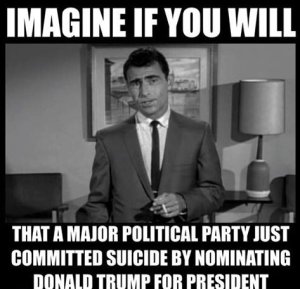
Given the recent tragedy, it’s safe to say that millions of Americans, including whoever created the image below, had the exact same thought: “It’s like we’re in The Twilight Zone“.

serling-and

To worldwide acclaim, a reporter for Scotland’s Sunday Herald newspaper named Damien Love used his “TV Highlights” column to brilliantly say the same thing (text below):

trump-tv

 “After a long absence, The Twilight Zone returns with one of the most ambitious, expensive and controversial productions in broadcast history. Sci-fi writers have dabbled often with alternative history stories – among the most common is the “What If The Nazis Had Won The Second World War” setting – but this huge interactive virtual reality project, which will unfold on TV, in the press, and on Twitter over the next four years, sets out to build an ongoing alternative present. The story begins in a nightmarish version of 2017 in which huge sections of the US electorate have somehow been duped into voting to make Donald Trump president. It sounds far-fetched, and it is, but as it goes on it becomes more and more chillingly plausible. Today’s feature-length opener concentrates on the gaudy inauguration of President Trump, and the stirrings of protest and despair surrounding the ceremony, while pundits speculate gravely on what lies ahead. It’s a flawed piece, but a disturbing glimpse of the horrors we could stumble into, if we’re not careful.”

Believe it or not, that was all preface to what I really wanted to share today. 

Some linkages between The Twilight Zone and the current crisis aren’t so successful:
1462548044177-rod_serling

We’ll have to wait and see if the Republican Party committed suicide or not, but the real problem here is that Rod Serling never opened The Twilight Zone with “Imagine if you will”. Nor did he say “Consider if you will”, although he sometimes asked us to “imagine” something.  

How do I know this? Because we have Wikiquotes and internet browsers with a “Find” feature. 

It’s amazing but true. One or more devoted souls have transcribed everything Rod Serling said during the five-year run of The Twilight Zone. You can read every word right here.  

Mr. Serling once said “Pleased to present for your consideration”, but it turns out he preferred the word “submitted” as in “Submitted for your approval”:

“Respectfully submitted for your perusal, a Kanamit. Height: a little over nine feet. Weight: in the neighborhood of 350 pounds. Origin: unknown.” (“To Serve Man”, March 2, 1962)

“Submitted for your approval: the case of one Miss Agnes Grep, put on Earth with two left feet, an overabundance of thumbs and a propensity for falling down manholes.” (“Cavender Is Coming”, May 25, 1962)

“Major Robert Gaines, a latter-day voyager just returned from an adventure. Submitted to you without any recommendation as to belief or disbelief.” (“The Parallel”, March 14, 1963)

“Submitted for your approval or at least your analysis: one Patrick Thomas McNulty, who, at age forty-one, is the biggest bore on Earth.” (“A Kind of a Stopwatch”, October 18, 1963)

He also liked “picture”:

“Picture of the spaceship E-89, cruising above the thirteenth planet of star system fifty-one, the year 1997.” (“Death Ship”, February 7, 1963)

“Picture of an aging man who leads his life, as Thoreau said, ‘in a quiet desperation.’ (“A Short Drink From a Certain Fountain” (December 13, 1963)

When we used to listen to Mr. Serling’s clipped, sonorous tones each week, we supposed the present age would feature marvels like a three-day workweek and astronauts voyaging to Jupiter and beyond. Some things have turned out better than expected, but we haven’t cured the common cold, it’s legal to parade around with a six-gun on your hip in much of the United States and a mentally-ill game show host in thrall to a foreign dictator will soon be the Commander-in-Chief. I mean, it’s like living in The Twilight Zone.

On the Bright Side, ACA-Wise

There is only one sure thing when it comes to predicting what President Donnie will do. He’ll always do what he thinks will serve his interests. It might not actually serve his interests, but he will believe it does. Otherwise he wouldn’t do it. That’s because he doesn’t have an altruistic gene or self-sacrificing neural pathway in his body. Not one. He is 100% self-centered and selfish. 

The possibly good news is that Donnie has promised not to cut Medicare and Medicaid (and Social Security):

trump-msg

Plus, there’s this:

…T***p told the Wall Street Journal he would consider keeping two of [the ACA’s] most popular provisions — one that allows adult children to stay on their parents’ health insurance plans, and another that would forbid insurance companies from refusing to cover “pre-existing conditions.”

“I like those very much,” the newspaper quoted Trump as saying [on Nov. 11th].

Furthermore, although he has parroted the standard Republican line about quickly repealing the Affordable Care Act, he’s said it should immediately be replaced with something “terrific”. In his case, of course, “terrific” usually means either expensive or fraudulent, but let’s assume he wants the ACA replacement to be popular. It’s true that he’s so mendacious, ignorant and/or stupid that he recently said it will take about a week to design and approve a terrific replacement, but put that aside too. Perhaps he sees an opportunity to feed his narcissism by doing something that will make most of America admire him (as unlikely as that will ever be). 

It shouldn’t have been a surprise, therefore, that Donnie told “The Washington Post” yesterday that he will shortly unveil a plan that offers “insurance for everybody”!

(By the way, before I forget, whoever is responsible for childishly defacing that picture up there from Donnie’s Twitter account is going to be in big, big trouble on January 20th.)

Of course, given that the President-elect’s entire career outside reality TV has been based on telling suckers what they want to hear, his promises are less than worthless. But at least we know that protecting Medicare and Medicaid; limiting the ruthlessness of insurance companies; and making sure we all have health insurance are ideas he’s heard of.

There are a few other reasons for a tiny bit of extremely cautious optimism:

(1) Most of us don’t want the ACA repealed and nobody wants to lose what they already have, so there has been a huge negative response to the Republican “plans”, with websites like Faces of the ACA , articles like “Without Obamacare, I’ll Get Sicker, Faster, Until I Die” and “Here’s What One Cancer Survivor Wants You To Know About Obamacare” and constant reminders that it’s “Time to Turn Up the Heat: Senate Staffers Are Complaining About the Avalanche of Angry Calls”. The anti-ACA repeal movement is also getting support (some of it lukewarm) from unlikely sources, including Republican governors, hospital administrators, insurance companies and the American Medical Association. 

(2) The House of Representatives almost always follows its leader, the odious Paul Ryan, but the Senate is much less predictable. Even in the House, the most reactionary Republicans sometimes vote against their leader because a proposed piece of legislation doesn’t harm enough people. In fact, recent history shows that Republicans find it much easier to agree on what they’re against than on what they’re for. On top of that, nobody knows how  Pres. Donnie will react to legislation that doesn’t obviously satisfy his greed or narcissism. For a helpful summary of the procedural hurdles Congressional Republicans are up against, see “Everything Republicans Will Have To Do To Actually Repeal and Replace Obamacare” (subtitle: “It Won’t Be Easy”). 

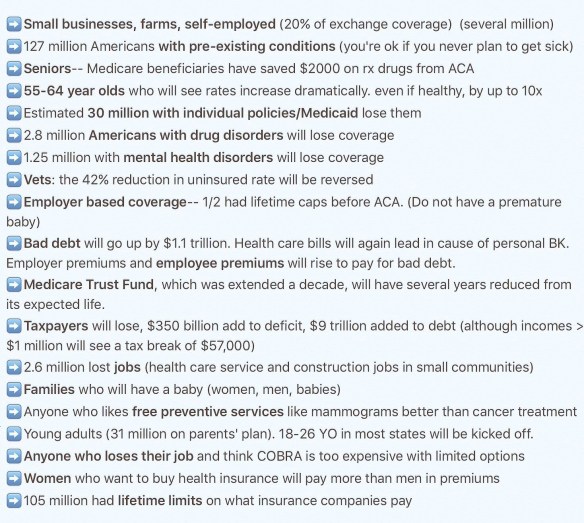
(3) It’s been reported that there is more opposition to “Obamacare” than to the Affordable Care Act. The more people learn what the ACA actually does, the more they like it. So, once President Obama becomes a fond memory, and despite well-funded Republican efforts to confuse the issue, it’s possible that support for the ACA will increase. Andy Slavitt, the acting administrator of the Centers for Medicare and Medicaid Services, prepared a list of everyone who will be negatively affected by repeal of the ACA (without, of course, a terrific replacement):

c2k_w0xwqaad8d4

And let’s not forget this bit of good news:

c2esrmzusaadfg9-1

Will spreading the good news about the ACA and bad news about its repeal have an effect on the right-wing ideologues in Congress and the orange person in the White House? We don’t know, but it’s worth a try.

One last thought for now. One of the phrases that comes up in arguments about our healthcare system is “socialized medicine”. It’s used to attack the idea that the government should control or bear responsibility for healthcare. When you think about it, however, it’s clear that healthcare does have a very strong social aspect. If we don’t want poor people dying in the streets or dread diseases spreading through the population, we need society, including the government, to make sure people get medical treatment. This is why people who arrive at emergency rooms at the edge of death get medical treatment, even if they don’t have a health insurance card or a suitcase full of cash.

The idea that healthcare is a social good fits nicely with the standard Democratic view that “we are all in this together”. Most of us don’t want to live in a dog eat dog world. 

Republicans, however, lean toward the “every man for himself” or “not my brother’s keeper” model. That’s not all bad. Almost everyone puts themselves, their family and their friends ahead of strangers. But in the Republicans’ case, that fundamental attitude easily translates into less for the poor and sick and more for the rich and healthy. That’s the underlying message behind Paul Ryan’s recent statement that he favors “high risk pools” for people with “pre-existing conditions”. He was answering a question from a cancer patient whose life was saved by the ACA:

So we, obviously, want to have a system where they can get affordable coverage without going bankrupt because they get sick. But, we can do that without destroying the rest of the healthcare system for everybody else. That’s the point I’m trying to make. What we should have done was fix what was broken in health care without breaking what was working in healthcare, and that’s what, unfortunately, Obamacare did. So, by financing state high-risk pools to guarantee people get affordable coverage when they have a pre-existing condition, like yourself, what you’re doing is, you’re dramatically lowering the price of insurance for everybody else [PoliticsUSA].

Doing this won’t work, of course, unless those unlucky sick people are wealthy enough to pay sky-high premiums, the government (meaning the rest of us) pays their bills or they simply give up, drop out of the insurance market and take their chances. That’s how “high risk pools”, also known as “insurance ghettos”, have always worked, i.e. failed, in the past.

A closing comment from the PoliticsUSA site:

… Ryan thinks cancer patients and other pre-existing conditions are ruining healthcare for everyone else…The true evil in [Ryan’s] plan is that by separating out the high-risk patients from everyone else, Ryan … can keep costs down by underfunding the pool for people who need healthcare the most…

That’s the attitude we’re up against. The news isn’t all bad, but it’s not going to be easy.

New Developments in the Mother Russia/Motherf****r Scandal

I already had a title for a post called “The Big Picture on Health Insurance”, but that topic can wait. The T__p/Putin scandal seems to be growing. The British newspaper The Independent just made the story even more interesting:

(1) The ex-spy Christopher Steele who investigated Trump’s Russian connection eventually concluded that the FBI intentionally ignored solid evidence on the matter. In fact, Mr. Steele decided that there was a cabal in the FBI willing to cover up damaging information about T__p while the Bureau pursed a vendetta against Hillary Clinton;

(2) Back in the summer, when T__p downplayed the Russian invasion of Ukraine and simultaneously called for the Russians to hack Clinton’s emails, and when the Trump campaign later removed a plank from the Republican platform condemning the invasion, it was all done in response to a recent request from Russia. 

If any of this is true, then T__p, people close to him and members of the FBI committed treason. Ideally, they would all end up in prison. There would also be a constitutional amendment allowing for a new election. 

Even if these charges are true, however, it’s unlikely we’ll get a new election. That would require amending the Constitution, which would require cooperation from too many self-serving Republican politicians. T__p’s impeachment, however, followed by a stretch in a Federal prison, could easily happen. When they can’t avoid the truth anymore, the Republican sleazes in Congress will rush to get rid of the bastard.

Who Says Republicans Don’t Have a Sense of Humor?

Example 1:

“House Republicans have found a subject for their opening review of conflicts of interest under Donald Trump: the federal official in charge of investigating conflicts of interest.”

Yes, the Republican chairman of the House Oversight Committee, Jason Chaffetz of Utah, is mad at the head of the Office of Government Ethics for pointing out (as both Democratic and Republican ethics lawyers agree) that the President-elect’s “plan” to avoid his many, many conflicts of interest is “meaningless”. There are hysterical details here. 

Last night, I found the ethics official’s explanation of his negativity at the Office of Government Ethics site. It was a four-page PDF file, but the lawyer who wrote it isn’t nearly as funny as Rep. Chaffetz. Unfortunately, the link isn’t working at the moment (because of heavy traffic or those madcap Russians). But maybe it will work for you.

In a related, even more priceless development, Rep. Chaffetz announced a few days ago that he plans to keep investigating Hillary Clinton’s emails! This lovable scamp Chaffetz is relentless!

Yet:

When asked about T__p’s potential business conflicts, [chairman Chaffetz] noted that the law‎ exempts the president of the United States, calling the push from Democrats to launch a committee investigation on T__p’s business ties “premature at best.” [CNN]

I suppose “premature at best” implies “totally ridiculous at worst”!

best-dad-jokes

giphy

tumblr_me7cg67ys31raj8mk


All right, now that I’ve recovered my composure…

Example 2:

It might seem like yesterday, but it was almost seven years ago that America’s first step toward universal healthcare became law. It was officially called the Patient Protection and Affordable Care Act, but rapidly became known as Obamacare. The law included many (in fact, mostly) conservative ideas, but in the end not one Republican Senator voted for it. In fact, Republicans immediately began calling for the law’s repeal.

Now that the Republicans control Congress and are about to occupy the White House, they’re beginning the effort to repeal the ACA, but questions are being raised, even by Republicans. Should the law be repealed in toto, which would mean taking health insurance away from millions of people, including lots of Republican voters? Or should it be left in place until the law’s terrific right-wing replacement is all ready to go? 

Since they’ve had seven years to think about it, they must have something wonderful (“My God, it’s full of stars!”) waiting in the wings. So here’s what happened last night at Speaker of the House Paul Ryan’s nationally-televised “town hall”.

From the GQ site:

The event began with a question from a polite, middle-aged gentleman named Jeff Jeans, a small-business owner:

“I was a Republican, and I worked for the Reagan and Bush campaigns. Just like you, I was opposed to the Affordable Care Act. When it was passed, I told my wife we would close our business before I complied with this law. Then, at 49, I was given six weeks to live with a very curable type of cancer. We offered three times the cost of my treatment, which was rejected. They required an insurance card. Thanks to the Affordable Care Act, I’m standing here today, alive. Being both a small businessperson [and] someone with preexisting conditions, I rely on the Affordable Care Act to be able to purchase my own insurance. Why would you repeal the Affordable Care Act without a replacement?”

Chuckling nervously like a local-news anchor who suddenly lost his teleprompter feed, Ryan began explaining to Jeans that his party in fact does have a proposal—it’s just a secret one that he still hasn’t shared with his colleagues. Jeans, however, still needed to twist the knife.

RYAN: We wouldn’t do that. We want to replace it with something better. First of all, I’m glad you’re standing here! I mean, really, seriously, I—

JEANS: Can I say one thing? I hate to interrupt you.

RYAN: Yeah, yeah, yeah.

JEANS: I want to thank President Obama from the bottom of my heart, because I would be dead if it weren’t for him.

Seeking further information, I was led to a site called “A Better Health Care Plan”. It’s run by a bunch of Republicans who call themselves the “American Action Network”. The first thing you see is a link to a YouTube video: “A New Path Forward”. Here’s the video’s entire script: 

Imagine a new path forward. Health insurance that provides more choices and better care at lower costs. A system that puts patients and doctors in charge, provides peace of mind to people with pre-existing conditions, and paves the way for new cures by eliminating senseless regulations. House Republicans have a plan to get there without disrupting existing coverage, giving your family the health care they deserve.

You’re then invited to visit the very site you’re on, “A Better Health Care Plan”, for further information. And here it is: 

House Republicans have a plan to get there

Our Congress is fighting for us: lowering costs, providing more control and more choices to pick a plan that meets our needs, not a plan that Washington mandates.

That’s all the further information provided. In toto.

Now who doesn’t think Republicans have a terrific sense of humor? 

uxwwgnz


How Shall We Describe the Orange Menace?

Language helps us cope with the world. That’s why using the right words matters. Telling your companion there’s “something” behind her would be accurate, but telling her it’s a “bear” would be better, assuming it really was a bear.

This explains the continuing effort to find the right terminology for President-elect Orange Menace. He’s been called “insane” and a “demagogue”, a “con man” and a “thug”.  He’s been described as an “arrogant orange idiot”.

In fact, those last three words, “arrogant”, “orange” and “idiot” are the three most popular responses at Trump In One Word. That’s the helpful site where you can submit a pungent word of your choice to describe him, see which words have been chosen most often, and even find out what words your (anonymous) neighbors selected (good job, neighbors!).

Which brings me to the “fascist” issue. Some observers think the next President is clearly a fascist or at least exhibits strong fascistic tendencies. Others see similarities but don’t think he satisfies enough of the criteria (yet anyway) to put him in the same category as Mussolini, Hitler or Francisco Franco. All the experts agree he’s an authoritarian, right-wing demagogue, but they don’t all agree that he’s a “fascist”. The truth is they don’t even agree on how to define the term. Hence, the “fascist” problem.

[Before we proceed, please note that I recently began using the Google Chrome extension Rename T___p. That’s why you will see “*****” where the O.M.’s name appears in the text I’ll be quoting. It’s a very nice tool. I chose “*****” for everyday use, but it was gratifying to see that “Orange Menace” is the 13th most popular T___p replacement – not as popular as “Fuckface Von Clownstick”, of course – but still doing very well. The extension is free and available here.]

One scholar, Sarah Kendzior, has argued that we should compare the O.M. to the rulers of a few countries we don’t usually hear about:

Left out – as always – have been the dictatorships of former Soviet Central Asia: Uzbekistan, Turkmenistan, Tajikistan, Kazakhstan, and (to a lesser degree) Kyrgyzstan.

The Central Asian states are dictatorships. They are also spectacular. And it is by examining this–dictatorship as spectacle–that the parallels to ***** emerge… The nation becomes a brand; the dictator, a brand ambassador; the people, a captive audience….

…Spectacle soothes the masses while distracting them from their suffering. *****, a master of the American reality TV genre which has made a spectacle of human suffering – he made “You’re fired!” a beloved tagline … – knows how to make an audience feel included through the theatrical exclusion of others. This tactic carries over into *****’s rallies, where protesters are booted — and sometimes beaten — with fanfare. It also carries over into his policies, which are structured around exclusion: a wall against Mexico, banned entry for foreign Muslims, a database for U.S. Muslims, and a media denied access unless they acquiesce to *****’s demands…

The most obvious corollary to ***** is Turkmenistan’s deceased leader Niyazov … best known for the monuments and dictates bolstering his personality cult. They included building a giant golden statue of himself which rotated to face the sun; renaming the months and common words, like “bread”, after his relatives; and the Ruhnama, a collection of autobiographical anecdotes … and parables which all citizens were required to read. (A giant electronic version of the Ruhnama blared Niyazov’s wisdom from its perch in the capital.)….

“I’m personally against seeing my pictures and statues in the streets, but it’s what the people want,” explained Niyazov when asked about his ubiquitous visage. It is easy to imagine ***** making similar claims… It is also easy to imagine [him] building a giant golden statue of himself that revolves to face the sun.

Unfortunately, there’s no word that means “the leader of a dictatorship in former Soviet Central Asia”. And the phrase “***** is another Niyzaov” probably wouldn’t catch on.

In a similar vein, however, a few writers have suggested that “caudillo” would be a good label for the Orange Menace. It’s Spanish for “leader”. Thus, Franco proclaimed himself “El Caudillo” just like Mussolini was “Il Duce” and Hitler “Der FĂĽhrer”. One might object that ***** isn’t as fascistic as those other villains, but the word has a longer and more varied history than its use in the glorification of Francisco Franco.

Paul Campos at the Lawyers, Guns & Money blog explains:

The classic Caudillo is a charismatic populist, who attacks the existing political and economic establishment with what might be called trans-ideological enthusiasm.  He claims that he and he alone has the ability to solve the nation’s problems, and to be the voice of the dispossessed.  He bullies his opponents, he persecutes any media who do not grovel before him, he boasts of his supposed sexual prowess, he has a narcissistic and therefore unquenchable thirst for public adulation, he is openly contemptuous of formal legal restraints, and he talks constantly of restoring the nation to its former grandeur.  To bolster his political base he uses the latest social media to speak as directly as possible to his followers, cutting out traditional forms of governmental and journalistic intermediation.  And he loves to make lots of absurd and expensive promises, often in the form of spectacularly ridiculous government projects, many of which are designed to keep out or expel contaminating and subversive foreign influences.

Remind you of anyone?

Mr. Campos then asks why this bizarre and dangerous person has made such an alarming dent in our politics:

I suspect the answer has much to do with the extent that the United States economy is coming to resemble many a Latin American breeding ground for narcissistic despots.  In terms of relative levels of economic inequality, the U.S. now looks much more like Latin America than Europe, and the trend is only getting stronger.  As Omar Encarnacion notes:

“… *****, like many caudillos, has capitalized upon his status as a political outsider. This status, ***** argues, best allows him to blow up the current political system and to replace it with something that would work for everyone, but especially for those feeling left behind.”

… All of which is to say that, especially now, it would benefit us all to pay much more attention to both the history and the present circumstances of our various southern neighbors.

Words matter, because they help us make our way in the world. Beginning January 20, the words we use may be more important than any we living Americans have ever used before.