In Reaction to the Reactionary-in-Chief’s Latest Offense

The Federal Bureau of Investigation has only had seven Directors (as opposed to acting Directors) in its 82-year history. From what I can gather, none of the seven have been Democrats or liberals. Even Democratic Presidents have selected conservative Republicans for the job. There have only been three Democratic Presidents who had the chance to select an FBI Director and Jimmy Carter, Bill Clinton and Barack Obama were all known for their “bipartisan” tendencies. No doubt the three of them also wanted to appear “tough on crime”.

So it’s unlikely that our Republican President will nominate a Democrat to lead the law enforcement agency that’s looking into his Russian connection. But he could pick a respected Democrat. It would make the President look less like the criminal that he is.

I can’t think of anything else to say about this crisis that’s not already being said. For instance:

John Cassidy, The New Yorker:

Ever since [DT] took office, many people have worried about his commitment to democratic norms, the Constitution, and the rule of law. From the hasty promulgation of his anti-Muslim travel ban onward, he has done little to salve these concerns. Now he has acted like one of the authoritarian leaders he so admires—a Putin, an Erdoğan, or an El-Sisi.

Congress must restrain him and reassert the principles of American democracy by appointing an independent special prosecutor to take over the Russia investigation. If the legislature won’t act unprompted—and the initial signs are that most of the G.O.P. intends to yield to the President’s abuse of his power—it will be incumbent on the American people to register their protests forcefully, and to put pressure on their elected officials. [DT] is a menace. He must be stopped.

David Cole, The New York Review of Books:

Current investigations in both the House and the Senate are controlled by Republicans, and as House Intelligence chair Devin Nunes has shown, party loyalty can all too easily compromise a meaningful inquiry. In early April, Nunes was forced to step down from his committee’s investigation… That’s why Comey was such a threat to [DT]. He was the only official independent of the administration and its party reviewing the campaign’s ties to Russia….

The vitality of the rule of law in the United States will depend on whether the American people are willing to hold the Trump administration accountable. As Archibald Cox said, shortly after Richard Nixon fired him as Watergate special prosecutor: “Whether ours shall continue to be a government of laws and not of men is now for Congress and ultimately the American people.” We remain a democracy, at least for the time being, and if we the people insist on an independent investigation, we will get one. But only if we insist—including by demanding that our elected representatives take full responsibility for addressing this crisis with every power at their disposal. As Ben Franklin reportedly warned some 240 years ago, the Framers gave us “a republic, if you can keep it.” [DT]’s latest action puts that question once again to the test.

So far, Congressional Republicans are either supporting the President’s obstruction of justice or expressing “concerns”. (If he were to murder a nun in the middle of Pennsylvania Avenue, the most thoughtful Republicans might be moved to express “deep concerns”.)

It’s not clear, therefore, that putting pressure on Republicans will make much of a difference. If you want to see what members of Congress are saying, however, The New York Times is keeping track.

As of 3:40 p.m. today

138 Democrats (or independents) have called for a special prosecutor 

84 Democrats (etc.) and 5 Republicans have called for an independent investigation.

41 Republicans and 9 Democrats have questions or concerns (the Democrats have deep concerns)

96 Republicans are neutral or support the President’s action

146 Republicans and 12 comatose Democrats haven’t said a thing 

Zero members of Congress have called for the President’s immediate impeachment (I added this category myself. It doesn’t hurt to mention it.)
If There Was Any Doubt

Polls indicate that Americans are evenly split regarding DT’s cruise missile attack on the Syrian airfield last week. A Washington Post poll found 51% in favor, which corresponds to results from Gallup (50%) and YouGov (51%). CBS found 57% in favor, but their poll didn’t mention the unpopular DT by name. We can conclude that the Washington Post poll was reasonably accurate.

Here’s the interesting thing:

In 2013, when Barack Obama was president, a Washington Post-ABC News poll found that only 22 percent of Republicans supported the U.S. launching missile strikes against Syria in response to Bashar al-Assad using chemical weapons against civilians.

[The] new Post-ABC poll finds that 86 percent of Republicans support [DT’s] decision to launch strikes on Syria for the same reason. Only 11 percent are opposed.

Republican support for attacking Syria went from 22% to 86% when a Republican replaced a Democrat in the White House!

You might say that’s how people are. The Democrats probably switched sides just like the Republicans.

You would be wrong:

For context, 37 percent of Democrats back Trump’s missile strikes. In 2013, 38 percent of Democrats supported Obama’s plan.

In other words, changing Presidents didn’t matter to the Democrats at all (a 1% difference is well within the margin of error).

Do you get the feeling that our Republican friends belong to a tribe in which group loyalty is a paramount virtue? And that other values play a secondary role? For that matter, that facts aren’t as important to them as group loyalty?

Some of the explanation for their astounding fickleness is, no doubt, that the right-wing propaganda they swallowed in 2013 was anti-missile attack, while the right-wing propaganda only four years later was pro-missile-attack. But being this easy to manipulate is just as bad as putting tribal loyalty above everything else. It’s all part of the same sad and dangerous phenomenon. Millions of right-wing Americans care more about group loyalty than reality or morality. If there was any doubt.

America Isn’t a Democracy? Not Really, But It’s Suffering

Having finally finished the previous post, I was deleting bookmarks when I came upon an article I’d forgotten to read: “America’s Not a Democracy, and That’s Bad News for Democrats”. It’s by Ed Kilgore of New York Magazine. He’s a professional writer who makes some of the points I made, but in a more professional manner.

The least significant part of his article is captured by that eye-catching phrase “America’s Not a Democracy”. The distinction he’s drawing is that between a democracy and a republic. But what’s a republic? Here’s a standard definition from The American Heritage New Dictionary of Cultural Literacy (3rd edition). A “republic” is: 

A form of government in which power is explicitly vested in the people, who in turn exercise their power through elected representatives.

But the dictionary goes on to explain that:

Today, the terms “republic” and “democracy” are virtually interchangeable, but historically the two differed. Democracy implied direct rule by the people, all of whom were equal, whereas republic implied a system of government in which the will of the people was mediated by representatives, who might be wiser and better educated than the average person. In the early American republic, for example, the requirement that voters own property and the establishment of institutions such as the Electoral College were intended to cushion the government from the direct expression of the popular will.

Well, we can certainly agree that the Electoral College is on its way to cushioning the government from the popular will this year, since it appears that Hillary Clinton (now leading the monster by almost 2.5 million votes) will be spending January 20th at home in Chappaqua – or maybe somewhere nice and warm where English is a foreign language.

Anyway, we now use the phrase “representative democracy” to say what America is. It means that we average citizens have a big role in choosing other citizens to run big parts of the government. 

The more significant part of the article is a recitation of the various ways in which “the … imbalance between the party that keeps winning the presidential popular vote and the party that keeps winning everything else is entirely the product of a system that systematically violates the supposedly sacrosanct principle of voter equality”. In other words, One Person, One Vote is a nice sentiment but that’s about it. Mr. Kilgore concludes, therefore:

For all of these interlocking reasons, the half-or-so of the American citizenry that is prone to support the Democratic Party and its more-or-less progressive agenda and ideology is and may continue to be underrepresented at the federal level to the point of powerlessness, and confined at the state and even local levels to enclaves that contain an awful lot of people but exert limited clout. And all this is totally aside from the extrinsic factors that place a thumb on the scale for Republicans, such as their support from business and financial interests and our currently uncontrolled system of campaign financing.

He then lists some ways Democrats might improve the situation. My favorite is “to win majorities in more states”. Unfortunately for our representative democracy, he doesn’t explain how that can be done. 

An Open Letter to the Leading Democrat in the House

As foreign diplomats and business people begin funneling cash to the President-Elect by taking rooms and scheduling events at T—p’s new Washington hotel (see “kleptocracy”), someone shared the following letter with me. It’s addressed to Nancy Pelosi, the current leader of the Democrats in the House of Representatives.

I am writing to you on the assumption that you will continue to be leader of the Democratic members of the House of Representatives, and am urging you and the Democratic Caucus to immediately start drafting Articles of Impeachment for our presumptive President, Vice President, and other executive positions subject to impeachment.

Like many Americans, I am deeply troubled by the results of the November election. Assuming the lobbying of the Electoral College comes to naught and we do end up with this amazingly unqualified individual as President, my feeling is that everyone should do whatever they can to minimize damage to the country during his tenure.

Impeachment of executive branch officials, both elected and appointed, is the domain of the House of Representatives. There is surely zero chance that Articles of Impeachment drafted by the Democratic Caucus would pass the Judiciary Committee. But I do believe a steady stream of draft impeachment documents presented to the committee would help keep the incompetence of the Executive Branch and its appointments in the public eye. Even if the majority party does not allow draft Articles of Impeachment to come under committee consideration, their existence and content can still be publicized.

When considering the President and Vice President, and the people who are being named for other positions subject to impeachment, there is no doubt in my mind that it would be no trouble to create a steadily growing list of impeachable offenses for several years to come.

Thank you for your kind attention.

Meanwhile, a few Republicans in the Electoral College can still interfere with the monster’s journey to the White House. 

We’re at the Brink, So We Need to Get Serious

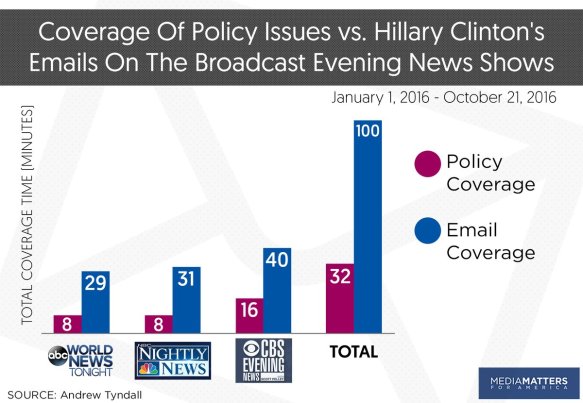
If you’re familiar with American politics and mass media, you probably won’t be surprised to hear that, between January 1st and October 24th of this year, the nightly news programs on ABC, CBS and NBC devoted three times as much coverage to Hillary Clinton’s emails than to all issues of government policy combined (from the Tyndall Report):

cwrzmtrweaacwe5

It’s safe to say this imbalance has grown even larger since October 28th. That’s when the Republican FBI Director Robert Comey sent Congress his cryptic letter regarding Anthony Weiner’s laptop. As Comey should have realized (and no doubt did), releasing that letter eleven days before the election led to an explosion of speculation and related discussion, none of which has revealed relevant facts about anything at all except that Trump and his supporters will use any excuse to paint Clinton as corrupt.

The incessant email stories on the broadcast networks and cable news and in leading newspapers has had a bizarre result. From the Gallup polling company:

We found that “email” was by far the most frequently used word when we asked Americans what they had read or heard about Clinton back in August 2015.…As [we] put it then: “When Gallup recently asked Americans to say what they recall reading or hearing about her, one word — ’email’ — drowned out everything else.”

Now we are asking Americans every day the same basic question — what they have read, seen or heard about Clinton — and once again, “email” dominates. For interviews conducted Oct. 28-31, “email” drowns out everything else, particularly anything relating to policy or substance. Indeed, the second-, third- and fourth-most-frequently used words associated with Clinton also relate to emails: “FBI,” “investigation” and “scandal.”

Believe it or not, 46% of voters in a recent poll said that Trump, the most obvious con man ever to run for the Presidency, is more trustworthy than Clinton (only 38% gave her higher marks). When people are asked to explain why they don’t trust Clinton, the most frequent response is, of course, “emails”.

As a minuscule corrective to the mountain of email nonsense that the media, Wikileaks (assisted by Russia, of course) and the FBI (officially and via politically-motivated leaks) have disseminated, here are an article and a video worth considering. You might also share them with friends, acquaintances, antagonists and random citizens before the voting ends on Tuesday.

First, Matthew Yglesias of Vox analyzes the Clinton email story with the aptly titled: “The Real Clinton Email Scandal Is That a Bullshit Story Has Dominated the Campaign”. He explains what Clinton did and shows why we shouldn’t care. An excerpt:

Clinton broke no laws according to the FBI itself. Her setup gave her no power to evade federal transparency laws beyond what anyone who has a personal email account of any kind has. Her stated explanation for her conduct is entirely believable, fits the facts perfectly, and is entirely plausible to anyone who doesn’t simply start with the assumption that she’s guilty of something.

Given [Secretary Colin] Powell’s conduct, Clinton wasn’t even breaking with an informal precedent. The very worst you can say is that, faced with an annoying government IT policy, she used her stature to find a personal workaround rather than a systemic fix that would work for everyone. To spend so much time on such a trivial matter would be absurd in a city council race, much less a presidential election. To do so in circumstances when it advances the electoral prospects of a rival who has shattered all precedents in terms of lacking transparency or basic honesty is infinitely more scandalous than anything related to the server itself.

And here is an eight-minute video uploaded today by Humanity for Hillary. It features Daveed Diggs and is called “Clinton vs. Trump on the Issues”:

Finally, a few words from Jonathan Chait of New York Magazine: 

However low my opinion of the Republican Party, it was not low enough….This is not a joke. This is one of the moments in history when the republic is at the brink.

Republican voters chose Trump. Republican donors have supported Trump. Republican politicians, even those who condemned him as a charlatan totally unfit to be President, have endorsed Trump. Others have remained silent. There are no excuses for what they’ve done. But now we have the chance to teach them a lesson. We need to vote for Democrats up and down the ballot. Only an historic, stinging defeat for the Republican Party will protect America and the world from getting this close to the brink the next time someone as dangerously abnormal as Trump wants the ability to launch nuclear missiles.