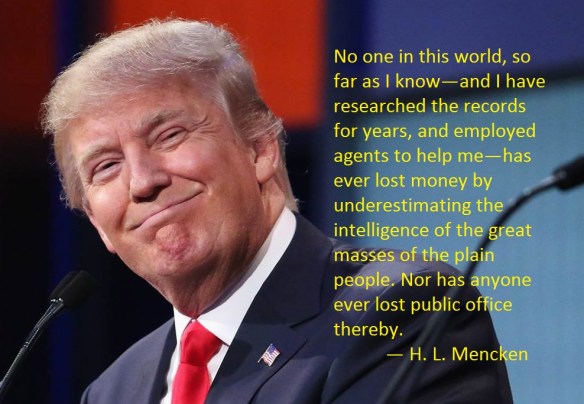
Actually, I think the masses of plain people will do okay this time.
Actually, I think the masses of plain people will do okay this time.
Some phenomena cry out for explanations. I bet you can think of one such phenomenon right now. Here are a few attempts to explain it.
Chris Hedges is one of those overwrought leftists who see no significant difference between most Democratic and Republican politicians. That’s why he names Bill and Hillary Clinton and Barack Obama as prime villains in “The Revenge of the Lower Classes and the Rise of American Fascism” (where “fascism” refers to what You Know Who is selling):
College-educated elites, on behalf of corporations, carried out the savage neoliberal assault on the working poor. Now they are being made to pay. Their duplicity—embodied in politicians such as Bill and Hillary Clinton and Barack Obama—succeeded for decades. These elites, many from East Coast Ivy League schools, spoke the language of values—civility, inclusivity, a condemnation of overt racism and bigotry, a concern for the middle class—while thrusting a knife into the back of the underclass for their corporate masters. This game has ended.
There are tens of millions of Americans, especially lower-class whites, rightfully enraged at what has been done to them, their families and their communities. They have risen up to reject the neoliberal policies and political correctness imposed on them by college-educated elites from both political parties: Lower-class whites are embracing an American fascism.
Hedges is hoping for the day when the “underclass” unites and takes its revenge, but notice how his language changes by the end of his second paragraph. First, it’s “especially lower-class whites” who have risen up. Then it’s simply “lower-class whites” who are embracing you know who.
For a moment, however, consider whether non-white members of the lower class would identify the Clintons or Obama as their principal opponents among the ruling class. Has it been the Democratic Party that’s stood in the way of universal healthcare, a higher minimum wage, immigration reform and more government spending on infrastructure and education?
Hedges moves on to considering the roots of fascism in general:
In fascism the politically disempowered and disengaged, ignored and reviled by the establishment, discover a voice and a sense of empowerment.
Yet we’re unlikely to see masses of disempowered and disengaged non-white Americans supporting right-wing politicians like you know who. Some registered Democrats do, however. In “Some of < … >’s Strongest Supporters Are Registered Democrats. Here’s Why“, Sean McElwee and Jason McDaniel cite various surveys, concluding that there’s a simple explanation for < … >’s success: economic insecurity tends to increase racial resentment among white voters, even relatively moderate white voters.
In previous articles, McElwee and McDaniel offered data to show that racial resentment, not economic insecurity, is strongly correlated with support for the Tea Party and opposition to governmental programs (like the Affordable Care Act) that aim to reduce economic inequality. They conclude that:
… progressives should be wary of arguments that recessions or financial crises lead to opportunities for progressive policymaking. Rather, they foster exactly the sort of divisiveness that strengthens right-wing movements, at least for whites. For all the talk of “the working class” supporting [< …>], few pundits have noted that the working class is increasingly diverse. The idea that economic peril alone creates [-< … >’s] support is belied by the fact that working-class people of color aren’t flocking to [< …>]. The reason so many liberal and moderate whites are flocking toward [< …>] is simple: racism.
Finally, “The Rise of American Authoritarianism“, by Amanda Taub, is a long but helpful article that explains the popularity of He-Who-Must-Not-Be-Named in terms of his appeal to the authoritarians among us. Her article summarizes the work of political scientists who have identified an “authoritarian personality”:
Authoritarians are thought to express much deeper fears than the rest of the electorate, to seek the imposition of order where they perceive dangerous change, and to desire a strong leader who will defeat those fears with force. They would thus seek a candidate who promised these things. And the extreme nature of authoritarians’ fears, and of their desire to challenge threats with force, would lead them toward a candidate whose temperament was totally unlike anything we usually see in American politics — and whose policies went far beyond the acceptable norms….
Authoritarians prioritize social order and hierarchies, which bring a sense of control to a chaotic world. Challenges to that order — diversity, influx of outsiders, breakdown of the old order — are experienced as personally threatening because they risk upending the status quo order they equate with basic security.
… Those changes have been happening for a long time, but in recent years they have become more visible and harder to ignore. And they are coinciding with economic trends that have squeezed working-class white people.
Hence, it shouldn’t be a great surprise that so many white Americans with authoritarian leanings have responded to a pseudo-politician who promises to make America “great” (for them) again. What’s most surprising is that they’re responding so positively to such a ridiculous figure. It’s hard to believe that so many people think this character could deliver on his promises. If nothing else, recent history shows how difficult it is for our government to accomplish anything, let alone the deportation of millions of citizens or the construction of another Great Wall of China by the Mexican government. But if you’re longing for a dictator, a blowhard who plays a dictator on TV may be good enough for the time being.
Taub’s article concludes with some thoughts on the future of American politics. She believes we may already have a three-party system: Democrats on the left, the Republican establishment on the right and authoritarian Republicans on the far right. In the long run, however, she thinks the Republican establishment may move even further to the right, leading to a party “that is even more hard-line on immigration and on policing, that is more outspoken about fearing Muslims and other minority groups, but also takes a softer line on traditional party economic issues like tax cuts”.
Of course, some observers, as noted above, think there is no difference worth mentioning between the Democratic and Republican establishments today. I disagree, but it’s certainly possible that a Republican Party that moves further right will mean that more moderate Republicans (like the ones threatening to support Clinton if what’s his name is nominated) will move to the Democratic Party, bringing their money with them. That could lead to the creation of a different three-party system, featuring fed-up progressives or democratic socialists on the left, a centrist Democratic Republican party in the middle and angry Tea Party authoritarians on the right. It could even lead to a more representative four-party system. Or a people’s party vs. a capitalist’s party.
Fantasizing about the future of American politics can be a lot of fun, since the present state of our politics is so damn depressing.
Last week, Republican Senator Lindsey Graham, while admitting that his own political party has gone “batshit crazy”, referred to Hillary Clinton as “the most dishonest woman in America”. He was joking – kind of (video here).
This week, former Republican Presidential candidate Mitt Romney, while attacking one of this year’s candidates, said “a person as dishonest and untrustworthy as Hillary Clinton must not become President” (transcript here).
Obviously, characterizing Clinton as dishonest and untrustworthy is standard song and dance for Republican politicians. What’s been surprising lately is how many Democrats are making similar statements. The Democrats in question are generally the ones who support Clinton’s opponent for the Democratic Presidential nomination, Senator Bernie Sanders.
I bring this up because “73angelD” posted this comment on New York Magazine‘s site yesterday:
73angelD: “There are many middle-aged female Sanders supporters like myself who do not trust Clinton.”
That type of thing from a liberal or progressive voter who should and almost certainly will vote for Clinton in November raises an interesting question. So I asked it:
PersonaObscura [that’s me!]: “I’m honestly confused. What is it that you don’t trust Clinton to do? Do you think she’ll be remarkably less liberal in office than she says she’ll be? Or her voting record in the Senate indicates? She’s always seemed to be more liberal than her husband, but less slippery.”
Which someone else tried to answer:
Madapalooza: “We don’t trust her irresponsiblity due to the email scandal, her being a Goldwater Girl, her taking hundreds of thousands from the institutions she “claims” she’s going to regulate, withholding the wall street transcripts, the fact that she not once but twice dismissed black protesters who simply asked her to explain her racial remarks on television, her husband sabotaging the voting polls in Massachusetts on super Tuesday, ect, ect…”
Resisting the urge to comment on those particular “offenses” (and the more powerful urge to correct the “ect, ect”), I replied:
PersonaObscura: “You listed things you don’t like about her or her husband, but trust has to do with what you expect her to do as President. Based on everything she’s said and done in her life, and what we’ve gone through as a nation in recent years, it’s reasonable to expect her policies will be to the left of Bill Clinton’s and to the right of what Bernie’s would have been. This will be our choice in November: a relatively liberal Democrat vs. some right-wing goon.”
The discussion probably went on from there (my policy in these matters is to say one or two things and then exit, often pursued by an angry elephant or donkey).
As we traverse the next eight months, we should all keep in mind that casting a ballot in a Presidential election amounts to making a prediction. Who do we predict will have the most success carrying out policies we endorse? We can’t be certain, so we need to make an educated guess.
In Hillary Clinton’s case, it should be obvious to everyone that she will tend to do her job like President Obama has done his. She won’t govern like a democratic socialist or a reactionary Republican. There is no reason to think she has been hiding her real intentions for the past 50 years. Therefore, we can trust her to govern like Jimmy Carter, Bill Clinton and Barack Obama, not like Ronald Reagan, George H. W. Bush or his feckless son.
She will try to reduce income inequality, create middle class jobs, move us closer to universal healthcare, reform our immigration policies and protect the environment. She will pay attention to science. She will take a particular interest in issues facing women and children. She will be pro-market but not necessarily pro-big business. She will nominate reasonable people to be judges.
Likewise, she will allow the CIA and NSA to stay in business, authorize drone strikes and allow Israel to get away with very bad behavior toward the Palestinians. We can trust her to do these kinds of things, the good and the bad. That’s the kind of trust that’s relevant.
Saying you don’t trust Hillary Clinton is an easy way to criticize her without bothering to explain what you don’t trust her to do. As President, she will often disappoint us, but who knows? She could turn out to be almost as progressive as the Republicans fear. It’s about time they got something right.
The article referred to above is here. The author’s thesis is that some conservatives are voting for Sanders because they don’t like uppity women. I don’t recommend the comments!
PS: A few words about Hillary Rodham back when she would have been Feeling the Bern:
In her junior year, Rodham became a supporter of the antiwar presidential nomination campaign of Democrat Eugene McCarthy. In early 1968, she was elected president of the Wellesley College Government Association and served through early 1969. Following the assassination of MartinLuther King, Jr., Rodham organized a two-day student strike and worked with Wellesley’s black students to recruit more black students and faculty. In her student government role, she played a role in keeping Wellesley from being embroiled in the student disruptions common to other colleges. A number of her fellow students thought she might some day become the first female President of the United States….
That summer, [after graduation] she worked her way across Alaska, washing dishes in Mount McKinley National Park and sliming salmon in a fish processing cannery in Valdez (which fired her and shut down overnight when she complained about unhealthful conditions). [Wikipedia]
“Donald Trump, Crony Capitalist” is a nice little article by Luigi Zingales, a professor at the University of Chicago’s business school. He analyzes one aspect of Trump’s surprising presidential campaign: the fact that Trump presents himself as a critic of big business, even though he’s a long-standing member of “the pro-business establishment”.
One of the best parts of Zingales’s article is his explanation of the difference between big business and the free market. He says the Republican establishment has spent years obscuring that difference, claiming to be champions of the free market while serving as “big business’s mouthpiece”.
Supporting the market means being in favor of competition and against concentrated economic power. Zingales cites Theodore Roosevelt, a Republican President from a century ago. From Wikipedia:
One of Roosevelt’s first notable acts as president was to deliver a 20,000-word address to Congress asking it to curb the power of large corporations (called “trusts”). He also spoke in support of organized labor to further chagrin big business … For his aggressive use of United States antitrust law, he became known as the “trust-buster”. He brought 40 antitrust suits, and broke up major companies, such as the largest railroad and Standard Oil, the largest oil company.
Being pro-market means you’re against monopolies (in which one company controls a market) and oligopolies (in which a few companies do). It also means you’re in favor of government regulations and policies that help make markets competitive. A fair, properly functioning market requires that the playing field be level, not slanted to the advantage of insiders or the powerful.
Big business, however, is totally in favor of special advantages when it increases profits. As Zingales says, “business executives are only pro-market when they want to enter a new sector”. But:
[Once] they become established in a sector, they favor entry restrictions, excessive licensing, distortive regulation and corporate subsidies. Those policies are pro-business (in the sense that they favor existing businesses), but they are harmful and distort a competitive market economy.
Zingales points out, for example, how rare it is for Republican politicians to call for antitrust enforcement, the prosecution of white-collar criminals and pro-market policies like fostering competition in the market for prescription drugs. That’s because the men who run the Republican Party are in the business of protecting big business, not the market.
Many of his supporters think Trump is fervently pro-market, but:
As a businessman Mr. Trump has a longstanding habit of using his money and power aggressively to obtain special deals from the government… He is, in short, the essence of that commingling of big business and government that goes under the name of crony capitalism.
Anyway, it’s a good little article that’s worth reading even if you’re sick of hearing about the Republican freak show currently touring the country.
Parting thought:
The Bill of Rights would have been better if the Second Amendment, including its call for a properly-regulated militia, had never been written. In its place, we could have had an amendment like this:
A well-regulated Market, being necessary to the prosperity of a free State, the right of the people to enjoy the benefits of fair competition shall not be infringed except to benefit the Nation as a whole.
Voters who attended the Democratic caucuses in Nevada yesterday were asked to identify the most important issue facing America. 34% said the economy and jobs; 7% said terrorism.
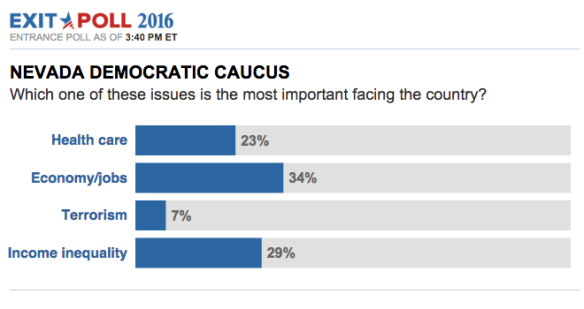
Voters in the Republican primary in South Carolina were asked the same question. 28% said the economy and jobs, but 32% said terrorism.
 I haven’t been able to determine whether the Democrats and Republicans were given the same list of issues to choose from, but it’s still remarkable that one-third of Republican voters chose terrorism as the most important issue we face. In fact, it’s remarkable that 7% of the Democrats said the same thing.
Unless these people think there is a strong chance that terrorists (of whatever political persuasion, not just Islamic fundamentalists) will attack America with nuclear or biological weapons, it’s silly to put terrorism at the top of the list. (In fact, given how silly it is, I have to wonder – mostly facetiously – whether some of those Democrats were devious Republicans attending the Democratic caucuses in order to make trouble, something the rules in Nevada allowed).
Here in New Jersey, we don’t get to participate in the nomination process until June, when it won’t matter what we think or how we vote. But if anyone asked me, I’d put global warming first, because of its possibly catastrophic consequences. After that, it would be hard to choose between the economy and jobs; money in politics; and the number of Americans who have lost their minds and vote for Republicans.
 Whereof One Can Speak 🇺🇦
You must be logged in to post a comment.