It’s Been With Us For Years, But Gotten Worse

The historian Richard Hofstadter (1916-1970) is known outside academic circles for having written a particular book and a particular essay. The book was Anti-intellectualism in American Life from 1963. The essay was “The Paranoid Style in American Politics” from 1964. I read the essay a few days ago in a collection of Hofstadter’s work. Anyone who wants to understand how we got to this point in American history will benefit from reading Richard Hofstadter.

He explains, for example, the basis for “economic individualism”, the idea that it’s not only more efficient but more ethical that everyone should sink or swim on their own. Thus, poor or working-class conservatives are often against anyone receiving help from the government, even though they could use that help themselves:

On many occasions they approach economic issues as matters of faith and morals rather than matters of fact. For example, people often oppose certain economic policies not because they have been or would be economically hurt by such policies, or even because they have carefully calculated views about their economical efficacy, but because they disapprove on moral grounds of the assumptions on which they think the policies rest….Deficit spending might work to their advantage; but the moral  and psychological effect, which is what they can really understand and feel, is quite otherwise: when society adopts a policy of deficit spending, thrifty [conservatives] feel that their way of life has been officially and insultingly repudiated [“Pseudo-Conservatism Revisited – 1965”].

Hofstadter borrowed the term “pseudo-conservative” from the German thinker Theodore Adorno. He explained why in an earlier essay written in response to McCarthyism:

There is a dynamic of dissent in America today…The new dissent is based upon a relentless demand for conformity… Its exponents, although they believe themselves to be conservatives and usually employ the rhetoric of conservatism, show signs of a serious and restless dissatisfaction with American life, traditions and institutions. They have little in common with the temperate and compromising spirit of true conservatism in the classical sense of the word…Their political reactions express rather a profound … hatred of our society and its ways – a hatred which one would hesitate to impute to them if one did not have suggestive evidence from clinical techniques and from their own modes of expression [From “The Pseudo-Conservative Revolt”, 1954].

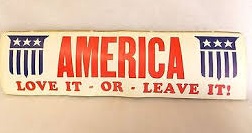
Remind you of anyone you know? I mean, who in public life expresses more contempt for America in the 21st century than the next President and his fans, the vocal minority that wants to make this country “great” (i.e. “white”) again? Maybe the Democrats should have revived those popular bumper stickers from the 1960s, the ones aimed at Volkswagen-driving hippies and protesters.  
download-4

Finally, here’s what Hofstadter said about the Republicans’ first pseudo-conservative Presidential nominee, Senator Barry Goldwater:

Unquestionably, Goldwater’s ideas do retain some shreds and scraps of genuine conservatism, but the main course of his career puts him closer to the right-wing ideologues who were essential to his success, who shaped his tactics, who responded to his line of argument… How are we to explain the character of a “conservative” whose whole political life has been spent urging a sharp break with the past, whose great moment as a party leader was marked by a repudiation of our traditional political ways, whose followers were so notable for their destructive and divisive energies, and whose public reputation was marked not with standpattism or excessive caution but with wayward impulse and recklessness? [“Goldwater and Pseudo-Conservative Politics”, 1964].

Again, remind you of anyone you know?

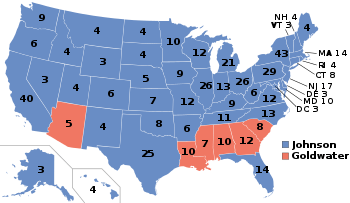
Fortunately, Lyndon Johnson beat Goldwater by 26 million votes (rather than 3 million) and by 61% to 27% (rather than 48% to 46%). Goldwater only won six states in the 1964 election: the five former slave states of the Deep South and his home state of Arizona. That gave him 52 electoral votes compared to Johnson’s 486. 
electoralcollege1964-svg

In addition to being a pseudo-conservative, Goldwater had no particular qualifications to be President. Before being elected to the Senate, he managed the family department store. In the Senate, he played no significant role. In Hofstadter’s words, “his main business there was simply to vote No”. He was still an “outsider” even after 12 years in Washington.

Goldwater’s extreme positions and lackluster qualifications contributed to his historic defeat. Fifty-two years later, due to a variety of circumstances, another pseudo-conservative, this time with no government experience at all, won narrow victories in enough states to win the White House. Given their appeal to the same sorts of voters, and given the fact that our next President is obviously suffering from a personality disorder (whereas Goldwater was relatively normal in that regard), it’s fair to say our democracy is showing signs of wear and tear that are beyond serious.

Addendum:

The journalist James Fallows recently reported the following conversation with a U.S. Senator:

Q:  How many of your colleagues know that there is something wrong with T***p?
A:  All of them, obviously.
Q:  Which Republican will be the first to say so?
A:  Ummmm….

Stating the Obvious – It Should Be Stated Again and Again

Although this may be the last time I state it. The election was five weeks ago. Its otherworldly result is likely to be set in stone by 300 members of the Electoral College next week (despite their duty to do otherwise). In the weeks ahead, therefore, I hope to turn my attention to the election’s aftermath, and possibly even other topics of interest, like Brian Wilson’s very good memoir, what to look for in a snow shovel and how to leave the U.S. without a passport. Or maybe where to acquire body armor and the safest way to throw a Molotov cocktail.

Nevertheless, Amanda Marcotte has a very good summary at Salon of how the Russians got away with hacking the election. The long headline is:  

The big problem isn’t that Russian hackers tried to influence our election — it’s more that we let them – Media lameness, a gullible public, useful idiots on the left and the GOP all helped enable Russian propaganda

She makes an excellent point. It’s not a new point, but it bears repeating over and over again (by someone else, not me). Assuming we escape the clutches of the Orange Menace one day, how do we avoid going through something like this again if we don’t understand how it happened? 

She begins:

(The Russian’s apparent) strategy worked because too many power players in the American political ecosystem were too shortsighted, lazy and selfish to look past their own immediate self-interest and consider the big picture. What the purported Russian email hack ended up doing was illustrating the various weaknesses in our political systems and culture — weaknesses that Trump, likely with Vladimir Putin’s assistance, was able to exploit to claw his way into the White House.

First, “mainstream media outlets are more interested in appearing fair than actually being fair”. Fox News, of course, being a propaganda machine, doesn’t care about being balanced. They simply claim to be. Reputable news sources like CNN and the New York Times, however, want to provide “balanced” coverage. They want to acquire and retain customers all along the political spectrum. But, in 2016, their lame attempts to be balanced led to disaster: 

Trump is so corrupt that he coughs up more genuine scandals before breakfast than most dirty politicians can come up with in a lifetime. Hillary Clinton, in contrast, is a clean politician, which we know because she’s been under some kind of dogged investigation for the better part of three decades, without a speck of real dirt coming up on her.

But to report this basic truth — that one candidate was irredeemably corrupt and the other was not — would have drawn accusations from the right that the media was in the tank for Clinton. So, in order to appear fair, mainstream media outlets embraced a policy of being incredibly unfair to Clinton, blowing every non-scandal out of proportion.

Marcotte then points her finger at the average American voter:Most people don’t really read the news, but just glean general themes from headlines and cable TV”. One of the example she cites from Vanity Fair magazine:

juicy

But in the actual text, writer T.A. Frank admitted that “you’ll find nothing close to a scandal in itself” and “Clinton’s campaign is, mostly, reassuringly plodding and rules-bound.”

An honest headline written by someone whose goal was to inform the public would have looked something like this: 

PODESTA EMAILS SHOW PLODDING, SCANDAL-FREE CAMPAIGN

Sensationalism like Vanity Fair‘s is one reason most voters thought Clinton was more corrupt than T—p:

All these stories about “leaked” emails left the indelible impression with voters that there must have been something in them that was worth leaking, even if they had no idea what it was. 

Marcotte then points out that people on the left are open to conspiracy theories, too. Emails stolen from the Democratic National Committee convinced some Sanders supporters that the primary elections were rigged:

The email hack did not actually reveal any evidence that the Democratic National Committee had treated Sanders unfairly during the primary. It did find that some DNC employees expressed negative thoughts about him after his campaign repeatedly accused party officials of dirty pool, but there was no dirt beyond private grousing.

Nevertheless, the impression grew that somehow Sanders had been cheated. That led some who would ordinarily vote Democratic to stay home or vote for a third party. Consider, for example, that in Michigan, Pennsylvania and Wisconsin, the Green Party candidate got more than 133,000 votes. Clinton lost those three states and, as a result, the Electoral College by 78,000. 

Lastly, of course, most Republican politicians put party over country. In particular, Senator McConnell’s refusal to condemn or even acknowledge the Russian hacking was, in Marcotte’s words:

… a neat distillation of Republicans’ attitude toward any Trump-based corruption: They’re happy to look the other way as Trump and his supporters plunder the country, spread racism and bigotry and undermine our democracy, so long as they get a crack at destroying Social Security and Medicare.

So, putting the election aside and looking to the future, Kurt Eichenwald of Newsweek has a long article that shows how T—p’s business would (or will) lead to major conflicts of interest. They even have a 3-minute video that summarizes the sad story.

For All the Special Snowflakes Out There

Who couldn’t bring themselves to vote for a “flawed” candidate.

czlrgidxeaepghr

(Thanks to whoever made this. Assuming it isn’t real. Yet.)

How We Got Here & What To Do

It’s so strange, but I haven’t woken from this nightmare yet. And it’s so realistic, in one sense of that word.

But seriously, Charles Pierce of Esquire has written the best explanation I’ve seen of how we got to this bizarre, dangerous point in our history. It’s called “Russia’s Interference in This Election Should Not Be a Surprise: This kind of thing has been a long time coming”. 

I wish every adult would read it, because it was written for adults, the millions of Americans who are grown up enough and rational enough to perceive reality and then take responsibility for their own and other people’s lives.

If, for example, the 306 Republicans in the Electoral College read it, at least 37 of them might do their duty next Tuesday. They would vote for someone else and let the House of Representatives make the final decision. Otherwise, December 19, 2016 (it’s only one week away) will join the other dates in American history that live in infamy.

So please read Mr. Pierce’s article now. Here it is. It won’t take more than a few minutes.

As Mr. Pierce says, this is the starkest challenge to a free people that has arisen in our lifetimes. So what shall we do?

The first thing you might do is remind the Republican electors of their responsibility to defend the Constitution and protect the United States of America. One patriotic American has created a website with instructions on how to do exactly that. It’s called Direct Election. The site has lots of tools, including letters already addressed to 273 of the 306 Republican electors (the others were hard to locate).

I’m going to start mailing a letter myself, maybe something like this:

Dear …

If you are planning to vote for Mr. Trump on December 19th, or feel obligated to do so, please don’t.

Mr. Trump isn’t a real Republican. He’s not even a real Democrat. He is a dangerous, psychologically-damaged con man who must never become President of our great nation. 

I won’t ask you to vote for a specific person. But I do respectfully ask that you vote for someone other than Mr. Trump. By doing so, you will perform your solemn duty to protect the Constitution and the United States of America.

After all, the Electoral College was designed to forestall the election of a person unfit to be President. That includes anyone who puts his own financial interests or the interests of a foreign power ahead of ours. We need someone who loves America and is both willing and able to fulfill the responsibilities of the job. 

I respectfully submit that Mr. Trump is not such a man. The evidence, including his behavior since winning the election, is clear. You are now our only hope. Thirty-seven of you can let the House of Representatives choose a qualified person. More of you working together can determine who is President. Please vote for anyone else on December 19th.

Please note that any state laws that say an elector must vote a certain way are most likely unconstitutional. Furthermore, thousands of concerned citizens stand ready to pay for any legal fees or fines you might incur, and there are lawyers who have pledged to provide free legal services to any electors who face legal consequences for voting their conscience.

Thank you for reading this letter.

Sincerely yours, and God bless America, …

Assuming the Electoral College fails to do its duty next week, there are other things to do.

First, Timothy Snyder, the Housum Professor of History at Yale University and the author of Bloodlands: Europe Between Hitler and Stalin, offers a “Twenty-Point Guide to Defending Democracy Under a T—p Presidency”. The first item on his list is:

1. Do not obey in advance.

Much of the power of authoritarianism is freely given. In times like these, individuals think ahead about what a more repressive government will want, and then start to do it without being asked. You’ve already done this, haven’t you? Stop. Anticipatory obedience teaches authorities what is possible and accelerates unfreedom.

Second, Thomas Geoghagan, a Chicago labor lawyer and author, describes “Four Things We the People Can Do About Our Unjust Voting System and a President Trump”. Three of his four suggestions require legislative action. One would involve states with Democratic majorities agreeing to an interstate compact: 

This interstate compact … would be a quasi-constitution—a model for what the whole country should have. 

Such a compact might include, for example:

  • A ban on partisan redistricting of U.S. House and state legislature positions.
  • A right to healthcare.
  • A commitment to carry out their share of what the U.S. committed to in the Paris global warming accords.
  • A bill of rights for employees, including a right not to be terminated except for just cause.
  • A formula for a just level of funding for public education.
  • A comprehensive system of background checks for gun purchases.

Mr. Geoghagan concludes:

Since each of the above is an act that the state itself would be free to take, an interstate compact would not infringe on federal sovereignty —or require approval of Congress under Article I, section 10. 

Let one part of America, at least, be a city on a hill.

In Case You Missed It, Let’s Review the Crime That’s Still in Progress

Republican Senator Mitch McConnell and Republican FBI Director James Comey, with help from Vladimir Putin and Julian Assange, are in the process of stealing our election. They’ll do it unless the Electoral College does its constitutional, patriotic duty nine days from now and elects Hillary Clinton or some other qualified person.

The indictment:

According to the CIA, and probably the NSA too, neither of which are generally considered left-wing organizations, Russia hacked both Democrats and Republicans this year, but the Russians only gave the Democrats’ stolen information to Wikileaks. Wikileaks then gave the information, some of which was embarrassing to the Democrats and the Clinton campaign, to the world.

In September, President Obama informed Congressional leaders that the Russians had done this in order to elect the Orange Menace. Obama also requested a bipartisan declaration opposing the Russian interference in our election. But Senator McConnell, the Republican Majority Leader, wouldn’t make a joint statement, arguing that it would interfere with the election.

Instead, on October 7th, the Department Of Homeland Security and the Office of the Director of National Intelligence issued their own watered-down joint statement on Russia’s hacking activity, not pointing out that only information damaging to the Democrats was being revealed:

The U.S. Intelligence Community [which includes the CIA, FBI, NSA and thirteen other agencies] is confident that the Russian Government directed the recent compromises of e-mails from US persons and institutions, including from US political organizations…. These thefts and disclosures are intended to interfere with the US election process….We believe, based on the scope and sensitivity of these efforts, that only Russia’s senior-most officials could have authorized these activities.

Furthermore, on October 31st, the Financial Times reported that the Republican Director of the FBI was against making even that announcement:

FBI chief opposed US statement blaming Russia for hacks

Government official says James Comey had election timing concerns

Of course, only three days before, and only eleven days before the election, Director Comey ignored the Department of Justice policy against making such announcements near an election and sent a letter to Congressional leaders announcing a new investigation into emails possibly involving Hillary Clinton.

That letter was immediately leaked to the press and led to a blizzard of news coverage. The Orange Menace immediately declared that “this changes everything”. Although nothing at all came of the investigation, the Clinton and T—p campaigns agree that the FBI’s new suggestion of scandal was the crucial last-minute event that swayed enough voters to change the election. From Politico:

Top officials for both campaigns said the revelation—which turned out to be an inconsequential cache of previously parsed emails kept on the laptop of Clinton aide Huma Abedin’s estranged husband, Anthony Weiner—was a game-changer in a race in which Clinton had little margin for error. Elan Kreigel’s team saw her numbers collapse in the most volatile swing demographic: educated whites who had been repulsed by Trump’s sexual misdeeds.

To sum up: Vladimir Putin releases hacked emails in order to defeat Clinton. Julian Assange makes the emails public. Mitch McConnell and James Comey interfere with voters being told about Russia’s plan on the grounds that it will affect the election, i.e. hurt the Republican candidate. Meanwhile, Comey ignores Department of Justice policy and tells the world that there is more to the supposed Clinton email scandal, not caring that his last-minute “revelation” will affect the election, i.e. hurt the Democratic candidate.

Despite everything, Clinton gets almost 3 million more votes than T—p nationwide. But in three “swing” states that Clinton expected to win, T—p gets 77,000 more votes than Clinton, giving him the Electoral College majority necessary to become President.

As the saying goes, can you spell “coup d’Ă©tat”? How about “treason”? If you think that’s too harsh, how about “putting party ahead of country”?

The solution:

At this late date, the only ones who can prevent this crime from succeeding are the Republican members of the Electoral College. Thirty-seven of them can deny an unqualified, dangerous person the presidency and let the House of Representatives choose someone else. Forty-eight of them can switch to Hillary Clinton and elect the qualified person who got more votes. It’s that simple. 

And yet it’s that unlikely. What are the odds that there are more than a handful of Republicans among the 306 who will vote on December 19th who are sufficiently patriotic and sufficiently respectful of the Constitution to do what Alexander Hamilton said was necessary? Regarding the Electoral College, from The Federalist Papers, number 68:

Nothing was more to be desired than that every practicable obstacle should be opposed to cabal, intrigue, and corruption. These most deadly adversaries of republican government might naturally have been expected to make their approaches from more than one quarter, but chiefly from the desire in foreign powers to gain an improper ascendant in our councils. How could they better gratify this, than by raising a creature of their own to the chief magistracy of the Union?…

But the convention have guarded against all danger of this sort, with the most provident and judicious attention. They have not made the appointment of the President to depend on any preexisting bodies of men, who might be tampered with beforehand to prostitute their votes; but they have referred it in the first instance to an immediate act of the people of America, to be exerted in the choice of persons for the temporary and sole purpose of making the appointment….

All these advantages will happily combine in the plan devised by the convention; which is, that the people of each State shall choose a number of persons as electors, equal to the number of senators and representatives of such State in the national government, who shall assemble within the State, and vote for some fit person as President. Their votes, thus given, are to be transmitted to the seat of the national government, and the person who may happen to have a majority of the whole number of votes will be the President….

The process of election affords a moral certainty, that the office of President will never fall to the lot of any man who is not in an eminent degree endowed with the requisite qualifications. Talents for low intrigue, and the little arts of popularity, may alone suffice to elevate a man to the first honors in a single State; but it will require other talents, and a different kind of merit, to establish him in the esteem and confidence of the whole Union, or of so considerable a portion of it as would be necessary to make him a successful candidate for the distinguished office of President of the United States.

I mean, how amazing would it be, if a band of brave citizens, now being referred to as “Hamilton Electors”, rose to the occasion, saved the world and got complimentary tickets to the Broadway smash “Hamilton” too?

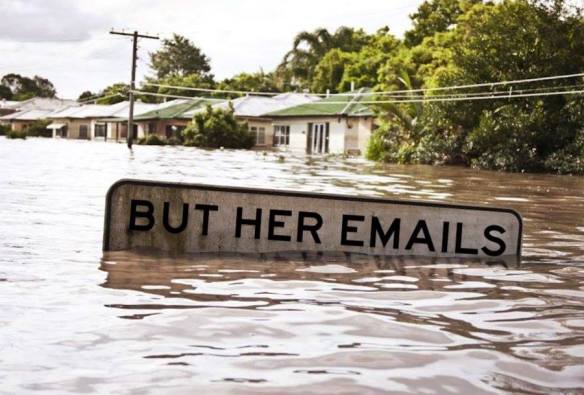
PS – Forgot to mention that T—p is going to appoint Senator McConnell’s wife to a cabinet position. Others in T—p’s cabinet, like the head of Exxon who will be Secretary of State, are very pro-Russian. But emails!

PPS – Nate Silver, respected political analyst and statistician, on Twitter: “Clinton lost 4 states (FL, MI, WI, PA) by ~1 point. If not for Comey/Russia, she probably wins them all by ~2 points & strategy looks great.”