It Used To Be the Blue and the Gray; Now It’s Blue and Red

One of the most moronic members of Congress was in the news recently when she proposed a “national divorce”. Red and blue states would go their separate ways. She’d have us remain one country, but the national government would have much less authority than it does now.

American politics being what it is these days, many of us, probably most of us, have thought it would be a good idea if those other states — the crazy ones — went off and formed their own damn country. Unfortunately, this would be a very difficult thing to do.

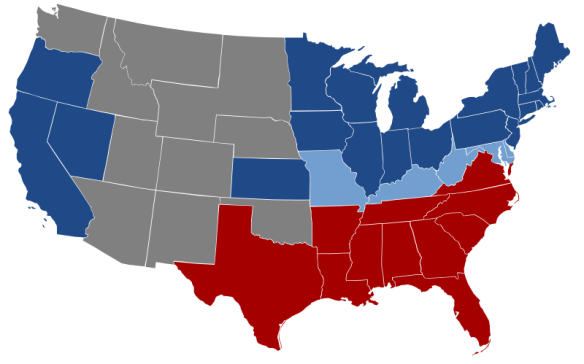
Back in 1861, the country was geographically divided between the North and South. The South  had slavery, its “peculiar institution”, and the North didn’t. But the division wasn’t that clearcut. There were five “border states” (Missouri, Kentucky, West Virginia, Maryland and Delaware, moving from west to east) that permitted slavery but didn’t secede from the Union. They’re the light blue ones below (the gray areas were relatively unsettled “territories” that hadn’t yet become states).
US_map_1864_Civil_War_divisions.svg

President Lincoln’s Emancipation Proclamation was only intended to end slavery in the eleven states that had seceded. It wasn’t until the 13th Amendment to the Constitution was ratified in 1865 that slavery was abolished everywhere. But geography made it relatively easy for the southern states to try to leave.

Dividing America by red and blue states is more complicated today. This map shows the results of the 2020 presidential election. The blue states voted for the Democratic winner; the red ones for the Republican loser. The red states are connected; the blue ones aren’t. And look at Georgia all by itself. (That’s where the Republican moron who proposes a national divorce was voted into Congress. Based on this election, she’d want to relocate.)
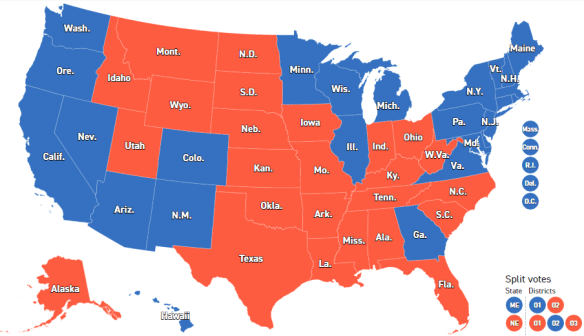
Untitled This way of portraying an election makes sense in terms of our obsolete Electoral College, since it requires each state to hold its own separate presidential election. In almost every state, a candidate gets all of that states “electoral votes” if they beat their opponent by one vote in that state’s election.

But a state-level map hides something important about American politics. After the 2004 election, the editors of a Seattle alternative paper called “The Stranger” wrote about our Urban Archipelago:

Look at our famously blue West Coast. But for the cities—Seattle, Portland, San Francisco, Los Angeles, and San Diego—the West Coast would be a deep, dark red. The same is true for other nominally blue states. Illinois is almost entirely red—Chicago turns the state blue. Michigan is almost entirely red—Detroit, Lansing, Kalamazoo turn it blue. And on and on. What tips these states into the blue column? Their urban areas do, their big, populous counties….

Liberals, progressives, and Democrats do not live in a country that stretches from the Atlantic to the Pacific, from Canada to Mexico. We live on a chain of islands. We are citizens of the Urban Archipelago, the United Cities of America. We live on islands of sanity, liberalism, and compassion—New York City, Chicago, Philadelphia, Seattle, St. Louis, Minneapolis, San Francisco, and on and on.

And we live on islands in red states too—a fact obscured by that state-by-state map. Denver and Boulder are our islands in Colorado; Austin is our island in Texas; Las Vegas is our island in Nevada; Miami and Fort Lauderdale are our islands in Florida. Citizens of the Urban Archipelago reject heartland “values” like xenophobia, sexism, racism, and homophobia, as well as the more intolerant strains of Christianity that have taken root in this country….

For Democrats, it’s the cities, stupid—not the rural areas, not the prickly, hateful “heartland,” but the sane, sensible cities—including the cities trapped in the heartland.

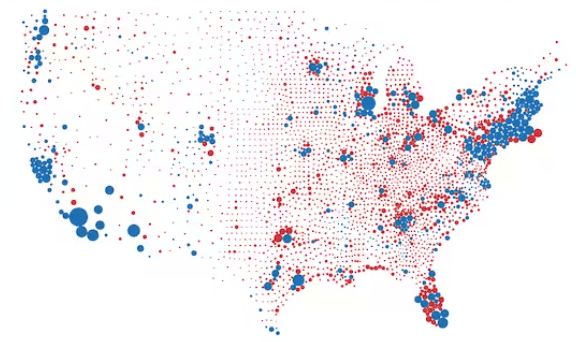
This map shows the 2020 election by county instead of state. The blue dots are the Urban Archipelago, the United Cities of America. (The map also shows how Biden managed to win by 7.5 million votes, unlike state-level maps that ignore how many people are in those states.)
Untitled

Of course, not everybody in Los Angeles County or Miami-Dade voted for Democrats. But on top of all its other problems, a “national divorce” by state would strand millions of Democratic city dwellers in red Republican states free to become even more reactionary and dangerous to live in.

Even though un-uniting the United States is unlikely, thinking about the possibility helps us understand our country’s political geography. According to a 2019 paper by Will Wilkinson of the Niskanen Center, it’s all about cities and population density. The title of the paper is “The Density Divide: Urbanization, Polarization and the Populist Backlash”. Here’s his summary of his findings:

We’ve failed to fully grasp that urbanization is a relentless, glacial social force that transforms entire societies and, in the process, generates cultural and political polarization by segregating populations along the lines of the traits that make individuals more or less responsive to the incentives that draw people to the city. I explore three such traits — ethnicity, ideology-correlated aspects of personality, and level of educational achievement — and their intricate web of relationships. The upshot is that, over the course of millions of moves over many decades, high density areas have become economically thriving, multicultural havens while whiter, lower density places are facing stagnation and decline as their populations have become increasingly uniform in terms of socially conservative personality, aversion to diversity, and lower levels of education. This self-segregation of the population, I argue, created the polarized economic and cultural conditions that led to populist backlash [note: and the election of You Know Who in 2016].

Because the story of urbanization just is the story of a strengthening relationship between density, human capital and economic productivity, it’s also the story of relative small town and rural decline. The same process that has filtered better-educated, more temperamentally liberal whites out of lower density places has left those places with less vibrant economies, but also with more place-bound, ethnocentric populations.

It’s no shock that leavers leave and stayers stay. What’s surprising is that, if you’re white…,  the personality traits that make you more or less inclined to leave or stay — that make you more or less magnetized to the rising attractive force of the city — also predict how socially conservative or liberal you’ll tend to be, and which political party you’ll tend to support.

So the pull of urbanization has segregated us geographically on those traits, and it has done it so thoroughly that Democratic vote share now rises, and Republican vote share drops, in a remarkably linear fashion as population density rises. The relationship between density and party affiliation is, with few exceptions, similar everywhere — in “red states” and “blue states,” in sprawling metro regions and bucolic small towns — and majorities tend to flip at the density typical of a big city’s outer suburbs. I call this partisan polarization on population density the “density divide.”

When populations segregate geographically on traits relevant to ideology and party affiliation, political polarization is sure to follow. The increasing concentration of the economy in big cities, which is both a cause and effect of urbanization, amplifies this polarization. Rising prosperity reliably produces a liberalizing, tolerant, positive-sum mood. Material insecurity, in contrast, tends to elicit a grim, zero-sum, us-or-them mindset. Because the sunshine of prosperity has become increasingly focused on urban populations, lower density white populations — which, thanks to the sorting logic of urbanization, are already more conservative and ethnocentric — have been left with objectively darkening prospects and a mounting sense of anxiety that is, at once, economic and ethno-cultural.

This combination of conditions created a political opportunity [a certain orange demagogue]  managed to exploit. Because urbanization is reshaping societies everywhere around the world, it has created similar conditions, and similarly illiberal strongman leaders, in other countries as well. If we’re going to be able to do anything about the acrimony of polarization and the peril of ethno-nationalist populism, we’re going to have to get the story straight. This cross-disciplinary account of the social and psychological forces behind the density divide is my preliminary attempt to put us, finally, on the right track.
People in Congress Vote, But They Don’t All Believe in Democracy

Yesterday, I posted part of a pro-democracy, pro-majority rule speech given this week by a Democratic congressman, Sean Casten of Illinois. He argues that Congress doesn’t do what most voters want it to do because our government has a built-in bias toward minority-rule. Given how we elect presidents and members of Congress and how the Supreme Court functions, a minority of voters and a minority in Congress can make it difficult, sometimes impossible, for the government to do things most of us want it to do. He therefore recommends changes to the House of Representatives, Senate, Supreme Court and Electoral College that would make each of those institutions more democratic, i.e. more responsive to the will of the majority.

At the beginning of his speech, however, he said something about his colleagues in the House that just isn’t true:

Now everybody in this body has different policy views, different ideas of what a better position in that relay might look like. But I submit that we do have some universal goals that we all agree on or else we wouldn’t be in this line of work.

We all want a government that delivers the greatest good for the greatest number. We all want a government that upholds our founding promise of freedom and equality.

We all, I think, believe Abraham Lincoln’s admonition to us that a government of, by, and for the people should not perish from this Earth. And we all, also, I think agree that on those really hard questions, … the single best way to resolve those disputes is through a democratic process.

A few bedrock principles of democracy are that the vast majority of adult citizens get to vote, each of their votes counts the same, the person or proposal getting the most votes wins and people should be encouraged to vote (otherwise we won’t know what the majority wants).

It’s hard to know what Rep. Casten was thinking when he suggested that everybody in Congress believes in democracy. Maybe he was being collegial or sarcastic. But it simply isn’t true that his Republican colleagues accept the democratic principles he thinks are universal.

I just finished a book by two sociologists called The Flag and the Cross. It’s a great book if you want to understand American politics, since it deals with the rise of White Christian nationalism, the ideology that’s become dominant in the Republican Party. In a nutshell, White Christian nationalists think America should be a Christian country and White people who profess to support Christianity (mainly White men) should be in charge. You can immediately see there’s a conflict here with democracy and majority rule. Republicans don’t always admit they oppose majority rule, but sometimes they do. This is from The Flag and the Cross (pp. 96-98):

White Christian nationalism designates who is “worthy” of the freedom it cherishes, namely, “people like us.” But for the “others” outside that group, white Christian nationalism grants whites in authority the “freedom” to control such populations, to maintain a certain kind of social order that privileges “good people like us”….

Both legal and illegal voter suppression have long been a tactic of white conservatives to tilt elections in their favor. Yet political scientists and sociologists often forget the ideological support for such efforts since the civil rights movement has come from white Christian nationalism. Just months before the 1980 election, Paul Weyrich, cofounder of the American Legislative Exchange Council and the Moral Majority, spoke at a Dallas conference to an audience that included evangelical leaders … as well as GOP presidential candidate Ronald Reagan.

Weyrich told his audience, “Now many of our Christians have what I call the ‘goo-goo syndrome.’ Good government. They want everybody to vote. I don’t want everybody to vote. Elections are not won by a majority of people. They never have been from the beginning of our country, and they are not now.” He went on, explaining: “As a matter of fact, our leverage in the elections quite candidly goes up as the voting populace goes down.”

Here before his Christian Right audience, Weyrich explained the strategy: our group stays in power if fewer people—especially our opponents—are able to vote. The policy implication is clear: make it harder for “problem” populations to vote, or at least don’t make it easier.

Weyrich’s antidemocratic sentiment has been repeated on the Christian Right for decades since. Also among those in attendance at that 1980 meeting was longtime conservative activist Phyllis Schlafly. Leading up to the 2012 presidential election, Schlafly underscored why limiting early voting was so critical. “The reduction in the number of days allowed for early voting is particularly important because early voting plays a major role in Obama’s ground game. The Democrats carried most states that allow many days of early voting.”

Several years later, former Baptist pastor, governor of Arkansas, and GOP presidential candidate Mike Huckabee echoed Weyrich’s words: “I know that most politicians say we want everyone to vote, I’m gonna be honest with you, I don’t want everyone to vote. If they’re so stupid—that’s right, if they’re gonna vote for me they need to vote, if they’re not gonna vote for me they need to stay home. I mean, it’s that simple . . . But in the big picture, there are people who vote and they have no idea what our Constitution says.” This last part of Huckabee’s quote is instructive in that he ties citizens’ worthiness to vote not only to their support for him, but to their knowledge of the Constitution.

Undergirding these views is an understanding of democratic participation that has deep historical roots, namely, that only certain groups (i.e., people like us) are “worthy” to have a say in government and it is perfectly acceptable to make it more difficult to vote, and particularly for those who might be “undeserving” (i.e., people like them). Indeed, we find the connection between white Christian nationalism and these attitudes is exceptionally strong.

In October 2020, just before the election, we asked Americans a series of questions about voter access…. Christian nationalism is the strongest predictor that white Americans believe we already make it too easy to vote in this country and that they would support hypothetical laws restricting the vote….By contrast, as white Americans’ affirmation of our Christian nationalism indicators increases, their likelihood of believing voter suppression in presidential elections is a real problem plummets.

Why would we see these patterns even after we account for relevant political characteristics? Because White Christian nationalism is fundamentally antidemocratic for “others,” that is, those who are “unworthy” of participation. This is how order is maintained: freedom for us, restraint for them.

If you’d like to see more recent examples, this (gift) Washington Post article from two years ago quotes several Republican politicians who admit their party “needs voting restrictions to win”. It concludes:

In this age, in which one party in particular has embraced an all’s-fair-in-politics approach, they’re bothering less with arguing that this is the right policy for government, and more that it’s the right policy for Republicans being able to control government.

The End of Democracy: A Reading List

Articles calling attention to the perilous state of America’s politics have proliferated this week in light of Tuesday’s election. The New York Times has a list of books to read in order to understand the disheartening big picture. The article contains brief summaries and links to review of the books. This is its beginning and end, along with the list:

Autocratic demagogues. The erosion of the rule of law. Growing inequality. The upending of elections. Normalization of violence. These are all symptoms of what the scholar Larry Diamond has called “democratic recession” — and we are seeing them not just in America, but around the world. Over the last 16 years, according to Freedom House, a nonprofit that researches and promotes global democracy, more nations have moved away from democratic principles than strengthened their embrace of them. The list includes the United States. What’s new is that this trend is happening in modern, prosperous, liberal democracies.

At the same time — and, of course, because of it — there has been a miniboom in books about the decline of democracy. These range from works that diagnose the causes of democratic unraveling or seek to put it in historical context to those that forecast the grim consequences. Despite different points of view, these books all have a few core ideas in common: that democracies are fragile; that democratic norms are necessary but crumbling; that authoritarianism is seductive; that while America is one of the world’s oldest surviving democracies, it is not immune to the forces that have abraded our form of government elsewhere….

It has become clichĂ© in publishing that no matter how pessimistic your book title, you have to add a clause to the subtitle along the lines of: “and what we can do about it.” The problem in this case is that what we can do about democratic decline is not very clear; the diagnosis has been much more extensively analyzed than the potential cures. All the books on this list call for less inequality, more fairness, less social media, more facts. Easier said than done.

But the potential end of our democracy is an urgent matter. Remember, modern democracies vote themselves out of existence, and the midterms are around the corner. Though the authors of these books have different views of our current political situation, they would probably agree on this: If you have one party in a two-party democracy that does not accept election results, you don’t really have a democracy anymore. The question is no longer: Can it happen here? (The answer to that is yes.) The question is now: Will it happen here?

I’ll add a highly relevant book the Times didn’t mention:

Democracy for Realists: Why Elections Do Not Produce Responsive Government, Christopher H. Achen and Larry M. Bartels (2017)

From the publisher:

Christopher Achen and Larry Bartels deploy a wealth of social-scientific evidence … to show that the familiar ideal of thoughtful citizens steering the ship of state from the voting booth is fundamentally misguided. They demonstrate that voters—even those who are well informed and politically engaged—mostly choose parties and candidates on the basis of social identities and partisan loyalties, not political issues. They also show that voters adjust their policy views and even their perceptions of basic matters of fact to match those loyalties. When parties are roughly evenly matched, elections often turn on irrelevant or misleading considerations such as economic spurts or downturns beyond the incumbents’ control; the outcomes are essentially random….

Achen and Bartels argue that democratic theory needs to be founded on identity groups and political parties, not on the preferences of individual voters…. Democracy for Realists provides a powerful challenge to conventional thinking, pointing the way toward a fundamentally different understanding of the realities and potential of democratic government.

Let’s wish ourselves and the American experiment luck this Tuesday and the days thereafter.

Columnists Are Deeply Concerned About the Election

I’m still avoiding “news” about Tuesday’s election, but many people who write for a living are expressing these two points:

  • Republican politicians no longer even pretend to care about morality.
  • The election will be a choice between democracy and autocracy.

They don’t need to mention that democracy may lose.

From “The New Nihilists” by Sarah Longwell for Persuasion:

These midterms are proving how deep the GOP rot runs.

The crop of Republican candidates running in the midterms has taken immorality to a whole new level. [She then cites scandalous behavior by three of their Senate candidates, Lake, Oz and Walker.]

What was the response from GOP leaders and media figures? In essence: “LOL, nothing matters”. 

It’s a baffling turn for those of us who grew up in an era where the Republican Party built its public brand around morality and character….Until a few years ago, the GOP still defended virtue rhetorically, even when it fell short and engaged in double standards….

In 2022, by contrast, the GOP ignores or perverts virtue altogether. [Their leader] has spawned hundreds of GOP candidates who ape his lies about the 2020 election, his corruption, and his combative style. Candidates of low character—like Lake, Oz, and Walker—are the rule in the GOP, rather than the exception. According to the old saying, hypocrisy is the tribute that vice pays to virtue—and Republicans have resolved their hypocrisy in favor of vice.   

From “Well, America, You Were a Good Idea While You Lasted” by Charles Pierce for Esquire:

The GOP have finally abandoned the last shreds of common decency, the rule of law and other American ideals.

It was this weekend that I finally gave up. I have watched the steady descent of American conservatism—and its primary public vehicle, the Republican Party—into the terminal depths of the prion disease it acquired when Ronald Reagan, Richard Viguerie and Jerry Falwell first fed it the monkey-brains back in the late 1970s….

I mocked it and inveighed against it. Better people than I … have spent four decades warning us what was coming unless the prion disease was kept in check….

The public episodes are now too numerous to mention…. They are beyond anyone’s reach. They are beyond logic and reason. They left democratic norms and customs far behind decades ago. They are beyond political compromise. They are beyond checks and balances, and they have drifted off into the void of a space far beyond the Constitution.

From “We Need to Be Clear About Who Pushed Us to the Breaking Point” by Jamelle Bouie for The New York Times:

The Democratic Party is, at this moment, the only viable political party with a serious commitment to free and fair elections. And in a country where power alternates between two major parties, this means American democracy is in real trouble….

It is simply the truth of the matter. If you oppose the effort to nullify Democratic election victories and create systems of minority rule (the Republican running for governor of Wisconsin said, for example, that “Republicans will never lose another election in Wisconsin after I’m elected governor”), then there’s only one real choice on the ballot….

Democrats did not make democracy a partisan issue. Republicans did. They did when they stood with Donald Trump in the wake of Jan. 6; they did when they embraced “Stop the steal” and election-denying candidates; they did when they made light of the threats against Nancy Pelosi and the assault on her husband.

There is nothing stopping Republican candidates and Republican voters and Republican leaders from pursuing their partisan and ideological goals while keeping their commitment to free and fair elections. There is nothing stopping them from rejecting antidemocracy extremists in their midst and affirming the vital principles of popular sovereignty, rule of law and political equality. There is nothing stopping them, in other words, from making a different set of choices about the kind of political party they wish to be part of.

It’s not Democrats who left the voting public with only one choice if they want to protect democracy as they know it….

Bouie adds that this kind of politics appeals to some:

When politicians and other political leaders 
 drop the pretense of virtue and embrace a politics of cruelty and malice, in which nothing matters but the will to power — voters act accordingly. Some may recoil, but just as many will embrace the chance to live vicariously through leaders who celebrate vice and hold virtue in contempt.

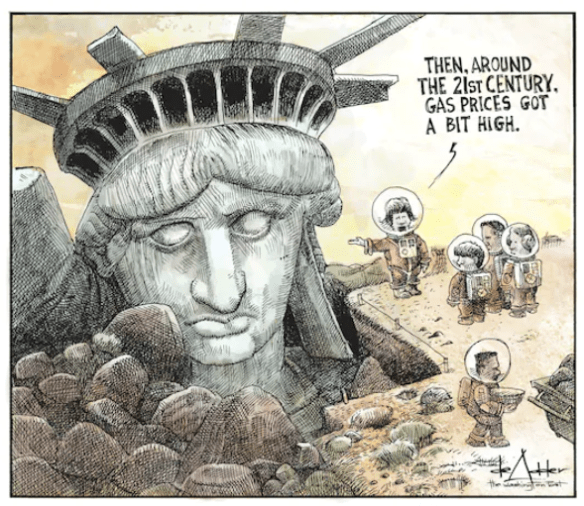
Others have other things on their mind (by Michael de Adder for The Washington Post):

Untitled

President Biden Speaks to the Nation Again, but Ignores a Big Part of the Story

Last night, President Biden gave a televised speech about the right-wing attack on democracy. But he didn’t express the obvious truth that most Republican politicians are in on it. Maybe he actually believes it’s just those extreme MAGA Republicans we have to worry about, not the average ones who are lukewarm on democracy and the rule of law. Anyway, here’s most of what he said:

Just a few days ago, a little before 2:30 a.m. in the morning, a man smashed the back windows and broke into the home of the Speaker of the House of Representatives, the third-highest-ranking official in America. He carried in his backpack zip ties, duct tape, rope and a hammer.

As he told the police, he had come looking for Nancy Pelosi to take her hostage, to interrogate her, to threaten to break her kneecaps. But she wasn’t there. Her husband … was home alone. The assailant tried to take Paul hostage….

The assailant entered the home asking: “Where’s Nancy? Where’s Nancy?” Those are the very same words used by the mob when they stormed the United States Capitol on January 6th, when they broke windows, kicked in the doors, brutally attacked law enforcement, roamed the corridors hunting for officials and erected gallows….

It was an enraged mob that had been whipped up into a frenzy by a president repeating over and over again the Big Lie, that the election of 2020 had been stolen. It’s a lie that’s fueled the dangerous rise in political violence and voter intimidation over the past two years.

Even before January 6th, we saw election officials and election workers in a number of states subjected to menacing calls, physical threats, even threats to their lives…. 

This intimidation, this violence against Democrats, Republicans and nonpartisan officials just doing their jobs, are the consequence of lies told for power and profit, lies of conspiracy and malice, lies repeated over and over to generate a cycle of anger, hate, vitriol and even violence.

In this moment, we have to confront those lies with the truth. The very future of our nation depends on it. My fellow Americans, we’re facing a defining moment, an inflection point. We must with one overwhelming unified voice speak as a country and say there’s no place, no place for voter intimidation or political violence in America. Whether it’s directed at Democrats or Republicans. No place, period. No place ever.

I speak today near Capitol Hill, near the U.S. Capitol, the citadel of our democracy. I know there’s a lot at stake in these midterm elections, from our economy, to the safety of our streets, to our personal freedoms, to the future of health care and Social Security, Medicare. It’s all important. But we’ll have our differences, we’ll have our difference of opinion. And that’s what it’s supposed to be.

But there’s something else at stake, democracy itself. I’m not the only one who sees it. Recent polls have shown an overwhelming majority of Americans believe our democracy is at risk, that our democracy is under threat. They too see that democracy is on the ballot this year, and they’re deeply concerned about it. [Note: The president failed to point out that Democrats are worried about a real threat to democracy, while Republicans are worried about an imaginary one premised on the Big Lie. Voting by mail? Truckloads of counterfeit ballots?]

So today, I appeal to all Americans, regardless of party, to meet this moment of national and generational importance. We must vote knowing what’s at stake and not just the policy of the moment. Institutions that have held us together as we’ve sought a more perfect union are also at stake. We must vote knowing who we have been, what we’re at risk of becoming.

Look, my fellow Americans, the old expression, “Freedom is not free,” it requires constant vigilance. From the very beginning, nothing has been guaranteed about democracy in America. Every generation has had to defend it, protect it, preserve it, choose it. For that’s what democracy is. It’s a choice, a decision of the people, by the people and for the people. The issue couldn’t be clearer, in my view.

We the people must decide whether we will have fair and free elections, and every vote counts. We the people must decide whether we’re going to sustain a republic, where reality’s accepted, the law is obeyed and your vote is truly sacred.

We the people must decide whether the rule of law will prevail or whether we will allow the dark forces and thirst for power put ahead of the principles that have long guided us.

You know, American democracy is under attack because the defeated former president of the United States refused to accept the results of the 2020 election. If he refuses to accept the will of the people, if he refuses to accept the fact that he lost, he’s abused his power and put the loyalty to himself before loyalty to the Constitution. And he’s made a big lie an article of faith in the MAGA Republican Party, the minority of that party [Unfortunately, recent polls say up to 60% of Republicans accept the lie.]

The great irony about the 2020 election is that it’s the most attacked election in our history. And, yet, there’s no election in our history that we can be more certain of its results. Every legal challenge that could have been brought was brought. Every recount that could have been undertaken was undertaken. Every recount confirmed the results. Wherever fact or evidence had been demanded, the Big Lie has been proven to be just that, a big lie. Every single time.

Yet now extreme MAGA Republicans aim to question not only the legitimacy of past elections, but elections being held now and into the future. The extreme MAGA element of the Republican Party [is] its driving force. It’s trying to succeed where they failed in 2020, to suppress the right of voters and subvert the electoral system itself. That means denying your right to vote and deciding whether your vote even counts.

Instead of waiting until an election is over, they’re starting well before it. They’re starting now. They’ve emboldened violence and intimidation of voters and election officials. It’s estimated that there are more than 300 election deniers on the ballot all across America this year. We can’t ignore the impact this is having on our country. It’s damaging, it’s corrosive and it’s destructive.

And I want to be very clear, this is not about me, it’s about all of us…. It’s about the durability of our democracy. For democracies are more than a form of government. They’re a way of being, a way of seeing the world, a way that defines who we are, what we believe, why we do what we do. Democracy is simply that fundamental.

We must, in this moment, dig deep within ourselves and recognize that we can’t take democracy for granted any longer. With democracy on the ballot, we have to remember these first principles. Democracy means the rule of the people, not the rule of monarchs or the moneyed, but the rule of the people.

Autocracy is the opposite of democracy. It means the rule of one, one person, one interest, one ideology, one party. To state the obvious, the lives of billions of people, from antiquity till now, have been shaped by the battle between these competing forces, between the aspirations of the many and the greed and power of the few, between the people’s right for self-determination, and the self-seeking autocrat, between the dreams of a democracy and the appetites of an autocracy.

What we’re doing now is going to determine whether democracy will long endure and, in my view, it is the biggest of questions, whether the American system that prizes the individual bends toward justice and depends on the rule of law, whether that system will prevail. This is the struggle we’re now in….

There’s been anger before in America. There’s been division before in America. But we’ve never given up on the American experiment. And we can’t do that now.… We have to face this problem. We can’t turn away from it. We can’t pretend it’s just going to solve itself.

There’s an alarming rise in the number of our people in this country condoning political violence, or simply remaining silent, because silence is complicity. To the disturbing rise of voter intimidation, the pernicious tendency to excuse political violence or at least, at least trying to explain it away. We can’t allow this sentiment to grow. We must confront it head on now. It has to stop now….

Look, even as I speak here tonight, 27 million people have already cast their ballot in the midterm elections. Millions more will cast their ballots in the final days leading up to November the 9th — 8th, excuse me…. Once again we’re seeing record turnout all over the country. And that’s good. We want Americans to vote. We want every American’s voice to be heard. Now we have to move the process forward. We know that more and more ballots are cast in early voting or by mail in America. We know that many states don’t start counting those ballots till after the polls close on Nov. 8.

That means in some cases we won’t know the winner of the election for a few days — until a few days after the election. It takes time to count all legitimate ballots in a legal and orderly manner. It’s always been important for citizens in the democracy to be informed and engaged. Now it’s important for a citizen to be patient as well. That’s how this is supposed to work.

This is the first election since the events of January 6th, 2021….I wish I could say the assault on our democracy ended that day, but I cannot.

As I stand here today, there are candidates running for every level of office in America — for governor, Congress, attorney general, secretary of state — who won’t commit, that will not commit to accepting the results of the election that they’re running in. This is a path to chaos in America. It’s unprecedented. It’s unlawful, and it’s un-American.

… So I ask you to think long and hard about the moment we’re in. In a typical year, we’re not faced with questions of whether the vote we cast will preserve democracy or put us at risk. But this year we are. This year I hope you’ll make the future of our democracy an important part of your decision to vote and how you vote….You have the power, it’s your choice, it’s your decision, the fate of the nation, the fate of the soul of America lies where it always does, with the people, in your hands, in your heart, in your ballot….