I’m Intentionally Avoiding This Topic

It’s too damn depressing. But for the record, here are two stories from the front page of The New York Times:

— With Florida Bill, Republicans Continue Unrelenting Push to Restrict Voting

Republican lawmakers are marching ahead to overhaul voting systems in states where they control the government, Next up: Texas

— G.O.P. Seeks to Empower Poll Watchers, Raising Intimidation Worries

As Republican lawmakers seek to make voting harder and more confusing, they are simultaneously making a push to grant more autonomy to partisan poll watchers. In the past, poll watchers have been used to intimidate voters and harass workers.

One from The Washington Post:

— As [ex-president] seizes on Arizona ballot audit, election officials fear partisan vote counts could be the norm in future elections

The GOP-backed recount of Maricopa County’s ballots has been criticized for abandoning state guidelines and allowing the rules to be set by a private contractor who promoted claims that the election was stolen.

And a full story from The Guardian:

— Why a filibuster showdown in the US Senate is unavoidable

During Joe Biden’s first 100 days in office, there are few issues more pressing than the escalating attack on the right to vote in America. Democrats may be running out of time to address it.

As Republicans have pushed more than 360 bills across the country to restrict access to the ballot, the president and Democrats have strongly condemned those efforts, but they’ve been unable to stop them. Even though Democrats control both chambers of Congress in Washington, they can’t pass a sweeping voting rights bill because they don’t have enough votes to get rid of the filibuster, an arcane senate rule that requires 60 votes to advance legislation. A showdown over the filibuster has loomed over the first 100 days of the Biden administration, but during the next 100 days, it’s clear that a showdown over getting rid of the procedure is unavoidable.

Amanda Litman, the executive director of the Run for Something, a group that recruits candidates for state legislative races, told me this week she thinks some Democrats still don’t fully appreciate how dangerous and consequential the GOP’s ongoing efforts are. “This is really an existential crisis. It’s a five-alarm fire. But I’m not sure it’s quite sunk in for members of the United States Senate or the Democratic party writ large,” she told me.

“If the Senate does not kill the filibuster and pass voting rights reforms … Democrats are going to lose control of the House and likely the Senate forever. You don’t put these worms back into a can. You can’t undo this quite easily,” she added.

Chuck Schumer, the Democratic leader in the Senate, last week set August as a deadline for Democrats to pass their sweeping voting rights bill, which would require early voting, automatic and same-day registration, among other measures. . . . 

But the window for Democrats to have the most impact with their legislation is rapidly closing. The decennial process of redrawing district lines is set to take place later this year, and a critical portion of the Democratic bill would set new limits to prevent state lawmakers, who have the power to draw the maps, from severely manipulating districts for partisan gain. While it’s probably already too late to set up independent redistricting commissions for this year, Democrats could still pass rules to prevent the most severe partisan manipulation.

“You could pass new criteria, including a ban on partisan gerrymandering…require greater transparency in the process,” Michael Li, a redistricting expert at the Brennan Center for Justice, told me. “There’s a lot that could be done.”

I also asked the Minnesota senator Amy Klobuchar, a Democrat who chairs the Senate committee currently considering the bill, what kind of message it would send if Democrats failed to take any action to protect voting rights while they held the reins of government. “Failure is not an option,” she said, adding she wasn’t going to let the filibuster stand in the way.

“This is our very democracy that’s at stake,” she said. “I’m not gonna let some old senate rule get in the way of that.”

The prime example of a purported Democrat who doesn’t recognize the crisis is Senator Joe Manchin of West Virginia. From Vox’s profile of Manchin:

Some filibuster reformers hope that, as the year goes on, the reality of Republican obstruction will become clear to Manchin and he’ll be driven to change his mind — that Senate rules will in the end be just as negotiable to him as the details of Biden’s stimulus bill. For instance, reformers hoped a GOP filibuster of Democrats’ big voting rights bill, the For the People Act, could spur holdout senators to change the rules to pass it, because it’s so important.

Manchin recoils at the very idea. “How in the world could you, with the tension we have right now, allow a voting bill to restructure the voting of America on a partisan line?” he asked. He says that 20 to 25 percent of the public already doesn’t trust the system and that a party-line overhaul would “guarantee” that number would increase, leading to more “anarchy” like that at the Capitol on January 6. He added: “I just believe with all my heart and soul that’s what would happen, and I’m not going to be part of it.”

Unquote.

What Manchin is saying is that the millions of Republicans who have bought the Big Lie — that the 2020 election was stolen from the leader of their cult — are so angry that interfering with Republican efforts to make voting as hard as possible would make the crazier ones even crazier. For that reason, he’s willing to let Republican politicians in the Senate and across the country do whatever they want to get Republicans elected, by, for instance, insuring that fewer poor people, Black people, Spanish speakers and college students vote, and when they do vote, their votes don’t matter, because Congressional districts have been gerrymandered to, yes, get Republicans elected.

It’s positions like these that get Manchin referred to as a “moderate” Democrat.
They’ve Got a Great Name for Voter Suppression and One Party Rule

From Fox News last month:

The Republican National Committee is launching a new panel on election integrity that it says is dedicated to restoring transparency and confidence to future elections.

The RNC announced their new Committee on Election Integrity on Wednesday, sharing the news first with Fox News.

Because everybody is in favor of election integrity.

From Greg Sargent of The Washington Post:

The New York Times has a remarkable new report that exposes the breadth of Republican voter suppression efforts. Party leaders and their conservative allies are seeking to coordinate the passage of bills — in multiple states — designed to make it harder to vote, justified by mythic voter fraud.

For instance, the Times reports, those efforts played a role in a radical package of bills moving forward in Georgia, which includes ending vote-by-mail for most voters and limiting Sunday voting drives, which are heavily utilized by African Americans.

Republican leaders and their allies plan to export statutory language restricting voting to other states, and in many of them, extensive such efforts are already underway.

“The widespread coordination underscores the extent to which the dogma of voter fraud is embedded in the Republican Party,” the Times reports, bluntly noting that the Republican “views its path to regaining a foothold in Washington” through “an intense focus on re-engineering the voting system in states where it holds control.”

The focus-grouped phrase justifying all this is “election integrity.” That’s the name of the new group, run by the Republican National Committee, that is developing more such proposals for export to states.

But [the former president] has already told us what standing for “election integrity” really means: making it harder to vote for the express purpose of making it easier for Republicans to win future elections.

[He] made this explicit during his Conservative Political Action Conference speech. He declared that the Republican must be the party of “election integrity” and that this means reversing efforts to make it easier to vote wherever possible and that this is an “urgent” matter facing the Republican. . . .

Importantly, this is not [their leader] projecting his own corrupt motives on to what Republicans are doing. Rather, it’s that Republicans are acting on precisely that very same [rationale]:

[According to the Times:]

To head its election integrity committee, the Republican National Committee tapped Joe Gruters, the Florida Republican Party chairman who in January used a #stopthesteal hashtag and advertised ways for Republicans to attend the Jan. 6 rally that ended with a riot at the Capitol. . . .

Like nearly all of the Republicans involved in the party’s voter integrity efforts, Mr. Gruters declined to characterize Mr. Biden’s victory as legitimate, despite there being no evidence of widespread fraud and multiple state audits reaffirming the results. “There are a lot of people who have a lot of questions about the 2020 race.”

The call for “election integrity” is now inseparable from the claim that the election was stolen from Trump. That’s a lie, but the fact that so many Republican base voters believe it — which Trump and Republican officials [got them to believe] — is itself the stated justification to continue.

But we are not obliged to pretend that these Republican officials actually believe their lies about the election. Once we liberate ourselves of that notion, the plain truth comes into view: The same justification used to incite an effort to violently subvert the 2020 election’s conclusion is now being used to manipulate future elections, by preventing as many Democratic-aligned voters, untold numbers of them African American, from voting as possible. . . .

Unquote.

Choosing a positive phrase to describe a blatant power grab is a great bit of marketing. Journalists will tend to adopt the Republican terminology, just like the authors of the Times article when they refer to the “election integrity committee” and “the party’s voter integrity efforts” in the quote above. We need to keep in mind that, in this case, “election integrity” means stuff like making it a crime in Georgia to give food or water to voters standing in line for hours to vote because there are so few polling places in their neighborhoods.

The Senate Moves Slowly. You Can See What They’re Doing.

Now that Democrats hold the White House and the House of Representatives, the locus of legislative action is the Senate. Democrats were able to pass the massive American Rescue Plan because a Senate rule allowed them to do so without Republican support. But so much more could be done without the filibuster rule that usually requires 60 out of 100 senators to vote Yes.

So I’ve been paying some attention to the Senate’s proceedings. The Senate has a leisurely schedule with sessions that start late in the day, long weekends and frequent vacations. I assume senators are doing something away from the Senate chamber, because it’s frequently empty. In fact, the Senate chamber is usually lightly populated even when business is being done (that’s apparently why they don’t allow the whole chamber to be shown on TV).

Like the House, the Senate has a website. You can click on Floor Proceedings to see what they did on previous days and then click on Live Proceedings to see if they’re doing anything at the moment.

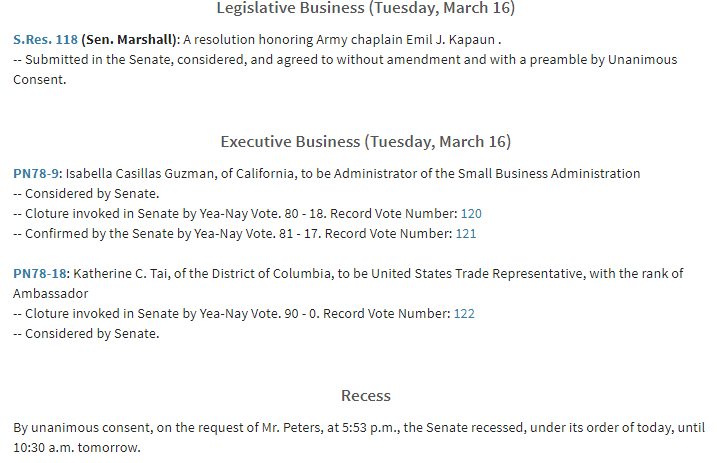
This is what the Senate accomplished on Tuesday: they honored an Army chaplain and advanced two of the president’s nominees.

Untitled

On Wednesday, they took action on two nominations again (one was from the previous day), honored the 100th anniversary of the birth of a baseball player, and approved a bill to allow the Department of Veterans Affairs to give Covid vaccines to some people not usually eligible for treatment.

On the video feed, you’ll sometimes see the Senate majority leader standing at a podium, reading from a stack of paper, uttering the same words over and over again, in order to get a few things done. The majority leader makes a motion and then the Senate’s president pro tem, who on most days is a random senator from the majority party, has a clerk read something about the motion. The president pro tem then asks for a roll call vote. The majority leader, apparently the only other senator in the room, says “aye”, the president pro tem says it appears the ayes have it, and announces that the motion is agreed to. Then they repeat the same song and dance on another motion. The Senate’s rules aren’t designed for efficiency. 

Of course, sometimes a motion is something important, so the whole Senate has to vote.  The senators come back to the chamber to tell the clerk how they’re voting. This takes quite a while, and unlike the House, the Senate doesn’t show a running total of the Yes and No votes.

In addition, senators sometimes make speeches, either regarding the motion under consideration or something else they want to talk about. You’re not allowed to see if there are any other senators present. Some of these speeches are very good. I happened to catch two excellent ones this week.

Senator Menendez, Democrat of New Jersey, made a speech condemning the stupid racist remarks of a Republican senator from Wisconsin, and Senator Warnock, Democrat of Georgia, called on the Senate to pass two bills that would reform our elections and protect voting rights (the For the People Act and the John Lewis Voting Rights Advancement Act). Both of these speeches were met with applause, but it was hard to see how many people were clapping or who they were.

I turned on the video when Menendez and Warnock were already talking, so would have missed their opening remarks, except that Vimeo has the official Senate video with the added benefit that you can scroll back to what happened earlier. Once the Senate is done for the day, both Vimeo and the Senate site make the whole day’s proceedings available. 

The Menendez and Warnock speeches are both on YouTube. Senator Menendez started by saying he took no pleasure in coming to the Senate floor to make these particular remarks, which suggested he was going to let loose on his Senate colleague. That’s what he did. Senator Warnock’s speech was his first as a senator. He pointed out that the entire Senate should support improving our democracy and helping people vote, the same way Republicans often did in the past. It’s not clear if there were any Republicans in the room when he spoke.

The President and Congress Can Protect the Right to Vote

Now that the American Rescue Plan is on the brink of becoming law, the Biden administration and Congressional Democrats are giving more attention to voting rights and the restoration of majority rule. In response, Republican politicians are producing attacks like this from Sen. Cassidy of Louisiana:

Democrats are selling out their own voters in a brazen attempt to permanently solidify their majority. States make their own voting laws, not the federal government. This power grab is shameful.

Maybe Cassidy isn’t familiar with the Constitution:

Article 1, Section 4: The Times, Places and Manner of holding Elections for Senators and Representatives, shall be prescribed in each State by the Legislature thereof; but the Congress may at any time by Law make or alter such Regulations, except as to the Places of chusing Senators.

Amendment XVII: The Senate of the United States shall be composed of two Senators from each State, elected by the people thereof, for six years . . . 

From CNBC:

President Joe Biden on Sunday signed an executive order aimed at helping to ensure all Americans have the right to vote by increasing access to voter registration services and information.

Biden’s executive order aims to take initial steps toward making the polls more accessible to Black and other minority voters, including Native Americans and people with disabilities.

It also calls for initiatives to improve access to voting for federal employees, active duty military and other voters overseas, and Americans in federal prison.

The executive order directs federal agencies to increase voters’ access to registration and information on elections online, as well as through more regular distribution of vote by mail and voter registration applications.

The executive order also calls for federal agencies to better coordinate with state governments on voter registration, as well as for updating the website Vote.gov.

Biden also called for Congress to restore the Voting Rights Act, which was signed into law in 1965 following a violent protest in Selma, Alabama, that left some participants injured.

The late Rep. John Lewis, D-Ga., who was one of the activists leading the march, suffered a fractured skull. Lewis passed away last year.

Biden’s executive order coincides with the 56th anniversary of that protest, known as Bloody Sunday.

“Today, on the anniversary of Bloody Sunday, I am signing an executive order to make it easier for eligible voters to register to vote and improve access to voting,” Biden said in prepared remarks.

“Every eligible voter should be able to vote and have that vote counted. If you have the best ideas, you have nothing to hide. Let the people vote.”

Biden’s executive order is an “initial step,” according to the White House. The president plans to work with Congress to restore the Voting Rights Act, which eliminated discriminatory practices such as requiring literacy tests in order to vote.

“I also urge Congress to fully restore the Voting Rights Act, named in John Lewis’ honor,” Biden said.

In 2013, the Supreme Court invalidated a central plank of the act which required nine states with a history of discrimination, mostly in the south, to receive federal approval to change their election laws.

Biden also plans to work with lawmakers to pass the For the People Act that was passed by the House last week, which includes additional reforms to make voting “equitable and accessible.”

“This is a landmark piece of legislation that is urgently needed to protect the right to vote, the integrity of our elections, and to repair and strengthen our democracy,” Biden said.

It Would Be So Un-American If It Wasn’t So Historically Popular

The article’s subtitle is “Republican lies about voter fraud are giving way to naked grasping for power”. From Joyce Vance for MSNBC (links in the original):

We’re living in a time where one political party openly believes it’s more important to win elections than it is to let Americans choose their own representatives in free and fair elections. And whether they’re going to get away with it is shaping up to be one of the most important issues the country faces.

The Supreme Court isn’t a venue where you typically expect to hear the quiet part said out loud. But that was what happened Tuesday, when an attorney for the Arizona Republican Party, Michael Carvin, advised the court that provisions that made it easier for eligible Americans to vote put “us at a competitive disadvantage relative to Democrats.” He was implicitly characterizing laws that make voting more difficult for likely Democratic voters, often people of color, as the difference between winning and losing elections.

Carvin was, of course, not the first person to say out loud what has become increasingly obvious to anyone paying attention: Republicans’ support for laws that make it more difficult to vote has little to do with their boogeyman — voter fraud — and everything to do with winning elections despite the will of the voters.

The former president did the same when he told “Fox & Friends” last March that Covid-19 mitigation proposals that included provisions that made it easier for more people to vote safely would mean “you’d never have a Republican elected in this country again.”

Historically, restrictive voting measures have been justified as necessary to keep a shadowy group of people who are allegedly intent on casting fraudulent ballots from stealing elections. But those people never seem to materialize, and we’ve watched that narrative implode over the past few months as claims of fraud in the election were definitively rejected in over 60 lawsuits.

Similarly, after the 2016 election, [the winner of the Electoral College] established a so-called Election Integrity Commission to prove the existence of “widespread voter fraud.” It was forced to shut down just months into its work when it was unable to find evidence to substantiate that claim. Still, the fraud lie is routinely used to burden minority voting rights.

This happens despite the conclusion by the Brennan Center for Justice, based on the data, in December that “voter fraud is extraordinarily rare and our system has strong checks in place to protect the integrity of our voting process. These are the facts.”

It was in this landscape that the Supreme Court heard oral arguments Tuesday in Brnovich v. Democratic National Committee, in which Democrats sued Arizona under Section 2 of the Voting Rights Act. The plaintiffs argued that a policy that kept otherwise lawful ballots that had been cast in the wrong precincts from being counted, as well as a law that broadly restricted people from having other people turn in early ballots for them, amounted to unlawful voter suppression. The court seemed inclined to approve both of the Arizona provisions; the Court of Appeals had ruled that they unfairly burdened Black, Latino and Native American voters.

When the Supreme Court issues its ruling, what’s really at stake is whether its holding will affect more than just the Arizona provisions. Brnovich gives an increasingly conservative court the opportunity to adopt a standard of proof in Section 2 cases that would make it easier for Republican legislatures to enact policies that make it more difficult for people of color to vote, simply by claiming they are guarding against voter fraud. Brnovich might result in a strict test that would apply to future cases — like those that may need to be brought if some of the more than 250 bills Republicans have offered to restrict voting pass in their legislatures.

It’s clear that Republican operatives and legislatures have adopted voter suppression through restrictive legislation as a political strategy. Now that a lawyer has confirmed before the Supreme Court that it’s really just about winning elections, what’s a constitutional republic to do?

It’s probably too much to hope that the court will have a moment of righteous indignation. This is an even more conservative court than the one that gutted the Voting Rights Act in Shelby County v. Holder in 2013, when Justice Ruth Bader Ginsburg accused the majority of taking away the umbrella that protected us in the middle of the rainstorm because we were still dry while using it.

It seems like it would be easier to go out and compete for votes with attractive policies and ideas than to engage in complicated legislative shenanigans and expensive litigation, but some Republicans seem to be as afraid of voters as a kid headed home to his parents with a bad report card.

So the only real solution to protect the right to vote is for the Senate to pass the For the People Act, which the House cleared Wednesday night, and for both chambers to pass the John Lewis Voting Rights Act. Those laws would restore the protections of the Voting Rights Act and remove barriers that make it difficult for eligible people to register and vote. If passed, they would restore the mechanism to challenge unduly restrictive state practices.

Unless the Supreme Court does something unexpected, this is the only path forward.
Otherwise, next year and beyond, a party that controls its state’s legislature can impose rules that make it confusing and difficult for some people to vote. It can create an array of last-minute changes and restrictions that defeat your right to vote, for instance by changing your polling place and rejecting your ballot if, unaware, you go to the previous one.

While your choice of whom to vote for may be political, the right to vote itself isn’t. Instead, it’s a fundamental right that defines who we are as Americans. In part, the story of America has been about expanding groups of people who can exercise the franchise. We celebrated the 100th anniversary of women’s gaining the right to vote last year. Important parts of our history are about people who persisted in demanding the right to vote and the dignity that comes with it for Black people, including the Selma march and the use of dogs and fire hoses against protesting schoolchildren in Birmingham. If we become a country where the right to vote can be restricted through political machinations, then who are we?

People who are afraid of the results of elections in which everyone who is eligible to vote can vote are people who don’t believe they have a good case to make to the voters — people who think they’re going to lose because they haven’t governed well. In the words of the lawyer in the Brnovich case, “Politics is a zero-sum game, and every extra vote they get … hurts us.” But voting is about our rights, not about gamesmanship. Elections should be decided by the people, not by slick efforts to make it harder for some people to register or vote.