Voting Is War, Part 2

In their latest ruling, the Supreme Court’s six reactionaries ignored the law in order to help their party’s candidates get elected. Paul Waldman of The Washington Post discusses the latest case in which the Court’s liberals are reduced to writing a “blistering” dissent:

To no one’s surprise, the Supreme Court’s six conservatives [No, radical reactionaries] on Thursday ruled for Republicans in a pair of key voting rights matters, upholding two Arizona voter suppression laws. It’s part of the long-running partnership between Republicans in the states, Republicans in Congress and Republicans on the Supreme Court to make sure that the rules of American elections are twisted and contorted to give the GOP every possible advantage.

At issue was a section of the Voting Rights Act (VRA), which was once the crown jewel of U.S. voting law and a foundation of political equality, that has been gutted by a Supreme Court unremittingly hostile to voting rights.

And the justices aren’t done, not by a long shot.

One of Arizona’s laws makes it a crime for most people to deliver someone else’s absentee ballot, a heretofore common practice of particular importance to Native Americans in the state, who find it challenging to vote given their wide geographic dispersion and slow mail service (but also used regularly by organizers in Black and Latino communities). The other law says that if you vote in the wrong precinct, the state will throw out your entire ballot, even the votes for races where the precinct is irrelevant (e.g., president).

The laws were challenged as violating the VRA because they disproportionately affect minority voters. As the plaintiffs pointed out, minority voters in Arizona are about twice as likely to mistakenly vote in the wrong precinct for a variety of reasons.

Did the Republicans who put that law in place understand that? Oh, you bet they did.

Section 2 of the VRA says statutes are invalid if they have the effect of harming people’s ability to vote on the basis of their race, even if you can’t prove that the party that passed it was doing so with racist intent. Whether that section of the VRA has any meaning in the wake of this decision is an open question.

The decision, written by Justice Samuel A. Alito Jr., argued that the system in Arizona offers ample opportunity for everyone to vote, even if it seems to fall heavier on some people, and concluded that the state’s interest in preventing voter fraud outweighs whatever overall disparate impact the law has.

The fact that voter fraud is almost entirely fictional did not disturb the justice.

In a blistering dissent [starting on page 45 of this PDF], Justice Elena Kagan wrote that the majority had essentially invented its own reading of the VRA, and accused the majority of pretending not to know that such state laws are occurring in a context where efforts to suppress minority voters continue.

“No one would know this from reading the majority opinion,” Kagan remarked.

Kagan’s disgust is appropriate. This case is part of a long and ignominious campaign by the court’s conservatives to hollow out American democracy in any way they can, so long as doing so helps the Republican Party. For this court, no voting rights provision is too sacrosanct to strike down and no voter suppression law is too discriminatory to uphold. If next week Republican-controlled states brought back poll taxes and literacy tests, the court would probably find a reason to validate them.

In the past few years, this court has again and again taken a hammer to the rules meant to ensure free elections in which all Americans can participate on an equal footing. Let’s remind ourselves:

  • In 2010, the justices said corporations have the right to use their billions to influence elections.
  • In 2011, they struck down a public financing law meant to allow candidates relying on small donations to compete with self-financed millionaires and billionaires.
  • In 2013, they struck down the heart of the Voting Rights Act, claiming it was no longer necessary because racism is pretty much over.
  • In 2018, they upheld ruthless voter purges that disenfranchise thousands of voters.
  • In 2019, they ruled that partisan gerrymandering, no matter how clearly it disenfranchises people, is beyond the ability of the courts to do anything about.

The partisan commitment of this court is so clear that in oral arguments, the lawyer for the Arizona GOP comfortably declared that the party has standing to support the law throwing out ballots cast at the wrong precinct because counting such votes “puts us at a competitive disadvantage relative to Democrats.” He knew who he was talking to.

The big picture here is that the court’s conservatives operate according to the “heads we win, tails you lose” approach to voting rights, in which with only the occasional exception, the best predictor of how a voting rights case will turn out is which side the Republican Party is taking.

Pretty much the entire GOP is now committed to the idea that if elections were fair, they’d lose — so elections must not be allowed to be fair. That’s why they’ve been on a tear at the state level, passing dozens of laws making voting more cumbersome, inconvenient and difficult, all aimed directly at populations they believe are more likely to vote for Democrats.

Wherever those laws pass, they’re being challenged in court. But what’s going to happen when those challenges make their way to the Supreme Court, with its 6-to-3 conservative supermajority? The answer is all too clear.
Thinking More Realistically About Voting

Charles Blow of The New York Times makes an excellent point about voting. It’s a war:

It has long been clear to me that we are teaching the concept of voting wrong, that we are buying into an idea of false hope and optimism that is easily exploited by those who want fewer people to vote and fewer votes to be counted.

The propaganda around voting is that of “one man (or woman), one vote,” “every vote counts,” and “free and fair elections.” That is simply not the case. I understand and appreciate the ideals, but reality is simply not aligned with this.

From the time I was a child and joined teams and clubs, we seemed to be voting on things. From the time we began to elect class officers, politics were part of our education. . . .

But that was direct democracy. Most of the time it was a show of hands in a room. Everyone present could count the votes. It was the ultimate in transparency and accountability and it laid the groundwork for how I would think about voting.

But as I got older and the elections got bigger, ballots began to be necessary. Also, the election of other people who would then vote for things in my stead. Direct democracy gave way to representative democracy and my perspective broadened.

Still, I went to a tiny school (there were 33 people in my graduating class) in the rural South. I could have learned more, been taught more about the long legacy of vote tampering and manipulation, voter intimidation and suppression, but that didn’t happen.

Neither did I learn enough about it in college. . . . I emerged into full adulthood as a political naĂŻf.

Then began my education, my quest to unlearn what little I had been taught and to learn for the first time all the things I hadn’t been taught.

First, I guess, were the widespread and never-ending attempts, with some devastating successes, to disenfranchise people, often Black people. And there was nothing like the sting of reading the words of some of the men who were engaged in this suppression. Nowadays, those who suppress votes disguise their motives, but years ago the motives were well articulated and abundantly clear: to establish white supremacy and disenfranchise the Negro.

Now, only the articulation is absent; the results are the same.

And even beyond voter suppression, there are errors and incompetence.

One thing I will never forget about the . . .  2000 election was something that should have been obvious, but hadn’t been for me: that voting machine errors are well known and some degree of error, if small enough, was considered acceptable.

The idea of an acceptable error rate for voting has stuck with me ever since.

For instance, an NPR analysis last summer found that 550,000 primary absentee ballots were rejected, up from about 319,000 in 2016.

Then there is incompetence, like what we are seeing now in the mayoral primary election in New York City. The result of the tally may well be fine, but the haphazard handling of the vote counting undermines faith in the system.

And that’s the problem with all of this: maintaining that faith. It seems to me that setting expectations too high actually works against that faith, helps to undermine it, because those expectations will collapse under the weight of reality.

It also seems to me that it is much better to think of voting as a nest of ants, a swarm of bees, a brigade of soldiers attacking an enemy: Not everyone will survive, but the point is to achieve victory by overwhelming the enemy. Everyone one that falls in the attempt assists the others in prevailing.

Not everyone who should be able to cast a ballot will be able to. And, not every ballot cast will be properly counted. That is the sad reality of the American electoral system, and conservatives in this country have done their best to maintain or exacerbate it at all costs.

You can bristle at it. You should. I do. And liberal groups can fight back through organizing, legislation and the courts. But at the same time, you also have to realize that even if you win that battle, it won’t stay won. You have to have a new vision of voting, one that factors in the oppression and imposes itself in spite of it.

Voters must be taught that swarming the polls, overwhelming them, may well be the only real shot at winning: a single movement, an irresistible deluge of votes.

“Purity” and “Quality”: A Crisis in the Making

More than 100 experts on democracy, from John Aldrich to Daniel Ziblatt, have issued a “statement of concern” regarding the imminent crisis in American politics:

We, the undersigned, are scholars of democracy who have watched the recent deterioration of U.S. elections and liberal democracy with growing alarm. Specifically, we have watched with deep concern as Republican-led state legislatures across the country have in recent months proposed or implemented what we consider radical changes to core electoral procedures in response to unproven and intentionally destructive allegations of a stolen election. Collectively, these initiatives are transforming several states into political systems that no longer meet the minimum conditions for free and fair elections. Hence, our entire democracy is now at risk.

When democracy breaks down, it typically takes many years, often decades, to reverse the downward spiral. In the process, violence and corruption typically flourish, and talent and wealth flee to more stable countries, undermining national prosperity. It is not just our venerated institutions and norms that are at risk—it is our future national standing, strength, and ability to compete globally.

Statutory changes in large key electoral battleground states are dangerously politicizing the process of electoral administration, with Republican-controlled legislatures giving themselves the power to override electoral outcomes on unproven allegations should Democrats win more votes. They are seeking to restrict access to the ballot, the most basic principle underlying the right of all adult American citizens to participate in our democracy. They are also putting in place criminal sentences and fines meant to intimidate and scare away poll workers and nonpartisan administrators. State legislatures have advanced initiatives that curtail voting methods now preferred by Democratic-leaning constituencies, such as early voting and mail voting. Republican lawmakers have openly talked about ensuring the “purity” and “quality” of the vote, echoing arguments widely used across the Jim Crow South as reasons for restricting the Black vote.

State legislators supporting these changes have cited the urgency of “electoral integrity” and the need to ensure that elections are secure and free of fraud. But by multiple expert judgments, the 2020 election was extremely secure and free of fraud. The reason that Republican voters have concerns is because many Republican officials, led by former President Donald Trump, have manufactured false claims of fraud, claims that have been repeatedly rejected by courts of law, and which Trump’s own lawyers have acknowledged were mere speculation when they testified about them before judges.

In future elections, these laws politicizing the administration and certification of elections could enable some state legislatures or partisan election officials to do what they failed to do in 2020: reverse the outcome of a free and fair election. Further, these laws could entrench extended minority rule, violating the basic and longstanding democratic principle that parties that get the most votes should win elections.

Democracy rests on certain elemental institutional and normative conditions. Elections must be neutrally and fairly administered. They must be free of manipulation. Every citizen who is qualified must have an equal right to vote, unhindered by obstruction. And when they lose elections, political parties and their candidates and supporters must be willing to accept defeat and acknowledge the legitimacy of the outcome. The refusal of prominent Republicans to accept the outcome of the 2020 election, and the anti-democratic laws adopted (or approaching adoption) in Arizona, Arkansas, Florida, Georgia, Iowa, Montana and Texas—and under serious consideration in other Republican-controlled states—violate these principles. More profoundly, these actions call into question whether the United States will remain a democracy. As scholars of democracy, we condemn these actions in the strongest possible terms as a betrayal of our precious democratic heritage.

The most effective remedy for these anti-democratic laws at the state level is federal action to protect equal access of all citizens to the ballot and to guarantee free and fair elections. Just as it ultimately took federal voting rights law to put an end to state-led voter suppression laws throughout the South, so federal law must once again ensure that American citizens’ voting rights do not depend on which party or faction happens to be dominant in their state legislature, and that votes are cast and counted equally, regardless of the state or jurisdiction in which a citizen happens to live. This is widely recognized as a fundamental principle of electoral integrity in democracies around the world.

A new voting rights law (such as that proposed in the John Lewis Voting Rights Act) is essential but alone is not enough. True electoral integrity demands a comprehensive set of national standards that ensure the sanctity and independence of election administration, guarantee that all voters can freely exercise their right to vote, prevent partisan gerrymandering from giving dominant parties in the states an unfair advantage in the process of drawing congressional districts, and regulate ethics and money in politics.

It is always far better for major democracy reforms to be bipartisan, to give change the broadest possible legitimacy. However, in the current hyper-polarized political context such broad bipartisan support is sadly lacking. Elected Republican leaders have had numerous opportunities to repudiate Trump and his “Stop the Steal” crusade, which led to the violent attack on the U.S. Capitol on January 6. Each time, they have sidestepped the truth and enabled the lie to spread.

We urge members of Congress to do whatever is necessary—including suspending the filibuster—in order to pass national voting and election administration standards that both guarantee the vote to all Americans equally, and prevent state legislatures from manipulating the rules in order to manufacture the result they want. Our democracy is fundamentally at stake. History will judge what we do at this moment.

Unquote.

The two Democratic senators who seem most reluctant to suspend the filibuster in order to protect democracy should read this statement.

Senator Joseph Manchin
306 Hart Senate Office Building
Washington D.C. 20510

Senator Kyrsten Sinema
317 Hart Senate Office Building
Washington D.C. 20510

It Can Happen Here

Earlier today, I quoted part of an interview with political scientist David Faris regarding Republican efforts to do make America safe for minority rule. The Washington Monthly’s blog also has a brief article by him. It’s called “The Republican Assault on Democracy Is Worse Than You Think” (note: besides changing the name of the orange-skinned creature to “X”, I’m changing all references to the “GOP” to “GQP” to reflect the party’s mass descent into the conspiratorial abyss):

Despite the palpable relief of Joe Biden’s election, American democracy is experiencing an ongoing crisis. With Republicans likely to end the Democratic hold on the House next year with an aggressive gerrymander, GQP-led states enacting voter suppression laws and Republicans laying the groundwork for a more successful version of [President X’s] post-hoc effort to steal the 2020 election, the threat to democracy is clear and present.

That widely felt, crisis-like sense of urgency is why the Democratic House passed the For the People Act, which among many other things would end gerrymandering and make it easier for adults to vote, and then made history by forwarding a D.C. statehood bill to the Senate, which would rectify a longstanding injustice and help keep Mitch McConnell, a Republican from Kentucky, the leader of the minority rather than the majority.

Unfortunately, a handful of Democratic senators led by and possibly limited to Joe Manchin, of West Virginia, and Kyrsten Sinema, of Arizona, may unwittingly usher in a long era of de facto authoritarianism by blocking the reforms needed to preserve democracy. Both insist that they won’t abolish the filibuster, which is the gateway drug to doing anything at all.

Consequently, Democrats must avert both the looming carnage in the midterm elections as well as a post-election putsch in 2024. There’s really only three things they can do, and none of them will be easy, but it’s worth considering because the alternatives are worse.

First, Biden and Harris could win re-election by a margin beyond dispute. The 2020 election was extremely close. A small shift in votes across three battleground states could have thrown the election to [X] despite Biden’s significant margin in the national popular vote. A more substantial Biden win in the critical states might ensure that [GQP] coup plotters won’t be able to pull off an electoral vote heist.

Barring that, it is critical that Democrats cling to one branch of Congress in both 2022 and 2024. The [GQP] gambit to object to electoral votes and throw the election into the House failed in large part because they needed a majority in both chambers to toss out the electoral votes from a particular state. While a majority of Republican senators never signed on to this malevolent project, the guess here is that this can mostly be attributed to the futility of the effort. If Republicans had the votes, many of the senators who refused to object would almost certainly have come around if they believed that the maneuver could have secured another term for [X].

Democrats must also win gubernatorial (and secretary of state) races in Pennsylvania, Michigan, Wisconsin, Georgia, Arizona, and others. Another factor in the coup is that Democrats controlled the election machinery in the Midwest battlegrounds, and Republican officials in Arizona and Georgia, to their credit, refused to play their part in [X’s] plot. We may not be so lucky in 2024.

It is hard to overstate how unlikely it is that even one of these three things might happen if Democrats can’t muster the votes to pass democracy reform.

They don’t call them midterm losses for nothing. The president’s party has taken a beating in nearly every post-WWII midterm election, losing an average of 26 seats in the House and four in the Senate. The out-party’s voters are extra motivated to deliver a rebuke to the president’s party, while the president’s party gets complacent. To make matters worse, in the absence of mandatory non-partisan redistricting, Republicans are going to add a significant number of safe or Republican-leaning seats to the House, making their path to a majority even easier.

In the Senate, Majority Leader Chuck Schumer, of New York, must hold onto precious seats in what will be tough races in Georgia (Raphael Warnock), Arizona (Mark Kelly), Nevada (Catherine Cortez-Masto), and New Hampshire (Maggie Hassan). Democrats have only three realistic pickup opportunities in Wisconsin, Pennsylvania and North Carolina, maybe Florida. That math is not great.

As for those governor races, Democrats again begin the cycle struggling against history’s headwinds. The president’s party has lost governorships in 16 of the last 19 midterms. In just one midterm since WWII (1986) has the party in power increased its gubernatorial numbers. . . . 

If Democrats lose both chambers of Congress, cough up multiple governorships, and the 2024 election is another squeaker, we know the playbook. [GQP] governors will certify Republican electors no matter what the voters want, and Republican congressional majorities will try to deliver the presidency to their party’s candidate. State legislatures, which used to pick senators, will supplant secretaries of state where Republicans detect any wobbling. Wherever it goes from there is anyone’s guess, but democracy as we know it will be gone. . . . 

That means figuring out how to get Manchin and Sinema to nuke, or at the very least curtail, the filibuster should consume every waking minute of Chuck Schumer’s life. The alternative is to either hope for a series of electoral miracles or watch helplessly as an authoritarian mob ushers in the catastrophe. We may never get another chance to fix this peacefully.

More Good News, Bad News

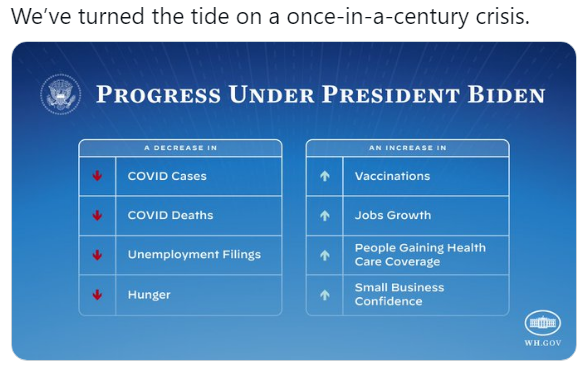
There’s good news about the economy, which means good news about people’s lives. From Paul Krugman:

At the beginning of this year, the United States was still very much in the depths of the pandemic. Daily deaths were higher than ever, with Covid-19 taking more than 3,500 lives in the country every day. Parts of the economy that depend on close physical contact were largely frozen. . . .

Then came an extraordinarily successful vaccination campaign. Deaths have plunged more than 85 percent and are still dropping. As fear recedes, the economy is surging, in what may end up being the fastest recovery ever. . . . 

Why would anyone imagine us able to achieve that kind of sudden acceleration without leaving a few skid marks, and maybe even burning some rubber?

So yes, sawmill operators, who expected a longer slump, got caught short, leading to sky-high lumber prices. Rental car companies, which sold off a large part of their fleets last year, are now scrambling to buy vehicles again, helping to send used-car prices soaring. And so on.

What about those reports of labor shortages? Some of this is what always happens after a period of high unemployment: Businesses grow accustomed to having job applicants lined up at their doors, and get cranky when the buyers’ market ends. . . .

Mainly, however, we’re just seeing the problems you’d expect when the economy tries to roar ahead from a standing start, which means that we’re calling on suppliers to ramp up production incredibly fast and expecting employers to quickly attract a large number of new workers. These problems are real, but they’ll mostly resolve themselves in a few months.

So what do these probably temporary problems say about the longer term, and in particular about President Biden’s economic plans? That’s easy: nothing. Politicians gonna politician, and Biden’s opponents are seizing on every negative bit of news as proof that his entire agenda is doomed. But none of it should be taken seriously. . . . None of this tells you anything at all about how much we should worry about overheating, let alone how much more we should be spending on infrastructure and family support (answer: a lot) or how we should pay for these initiatives (answer: tax corporations and the rich).

. . . There is some bad news out there, but most of it is a temporary byproduct of extraordinary good news: The virus is losing, and the economy is winning.

Or more succinctly, from the White House:

Untitled

On the other hand — and it’s a giant hand with about twelve dangerous fingers — one side is trying to rig the game even more than it already is. This is part of an interview from Vox:

Sean Illing

You were urging Democrats in 2018 to pass the sorts of reforms that are still on the table today, like packing the courts or granting statehood to DC and Puerto Rico. Are we beyond that now?

David Faris (political scientist and author of It’s Time to Fight Dirty)

What needs to be done has gotten more complex. The structural problems are even worse than I anticipated. I also didn’t fully anticipate the unapologetically authoritarian turn in Republican politics. But the fixes are still there. You have to abolish the filibuster in the Senate, you have to mandate national nonpartisan redistricting, you have to make voting easier, and you have to outlaw some of these Republican voter suppression tactics.

Sean Illing

I’ve had conversations with some Democrats and when these ideas about nuking the filibuster or court-packing or granting statehood to DC and Puerto Rico come up, the argument is often that it’s a nonstarter because [senators] Joe Manchin or Kyrsten Sinema simply won’t do it. What’s wrong with that thinking?

David Faris

Certainly the laws that you can pass are contingent on getting the most moderate member of your caucus on board. . . .

Where Manchin seems to be very far away from what House Democrats want to do is on the democracy reform stuff. It’s maddening because nothing that Manchin wants to do policy-wise can get done without abolishing the filibuster. Democrats are not going to have a majority after next year if they don’t do some of these things now. So it’s a mistake to assume Manchin can’t be moved. That’s the job of leadership. That’s Joe Biden’s job. That’s Chuck Schumer’s job.

Sean Illing

Let’s just say that Manchin and Kyrsten Sinema, for whatever reason, refuse to respond to the realities of the moment — then what?

David Faris

It’s bleak. I don’t know what else to say.

Democrats have to get extremely lucky next year. They either need to luck into the most favorable environment for the president’s party that we haven’t ever had for a midterm election or … I don’t know. There’s not much else they can do. None of these democracy reforms can get through on a reconciliation bill. If Democrats don’t pass nonpartisan redistricting, they’re going to be fighting at a huge disadvantage in the House. That’s the ballgame.

Progressive activists are going to pour a billion dollars into the Florida Senate race and then [Marco] Rubio is going to win by 10 points. So if they don’t act, it’s very simple. The Democrats will have to fight on this extremely unfair playing field against a newly radicalized Republican Party that is going to pull out all the stops in terms of voter suppression to win these elections, on top of the situation where they’re making other changes to state laws that could allow them to mess around with results in other ways, like what we’re seeing in Georgia now.

There’s a very circular structure to this kind of proto-authoritarianism. You have anti-democratic practices at the state level that produce minority Republican governments that pass anti-democratic laws that end up in front of courts that are appointed by a minoritarian president and approved by a minoritarian Senate that will then rule to uphold these anti-democratic practices at the state level.

And so there is no path to beating some of these laws through the courts. The Supreme Court has already said it’s not going to touch gerrymandering. And so there’s nothing left except Congress using its constitutional authority under the elections clause to do some regulation to the elections. I just don’t see another way.

Sean Illing

It feels like we’re sleepwalking into a real crisis here, but it’s hard to convey the urgency because it’s not dramatic and it’s happening in slow motion and so much of life feels so normal. And yet our democratic system is losing any semblance of legitimacy and down that road is a range of possibilities no one wants to seriously consider. …

David Faris

When people think of democracy dying, they think of some very dramatic event like Trump riding down Pennsylvania Avenue in a tank or something. That’s not the reality here.

Take the scenario where Republicans don’t have to steal the 2024 election. They just use their built-in advantages in which Biden wins the popular vote by three points but still loses the Electoral College. Democrats win the House vote but lose the House. Democrats win the Senate vote, but they lose the Senate.

That’s a situation where the citizens of the country fundamentally don’t have control of the agenda and they don’t have the ability to change the leadership. Those are two core features of democracy, and without them, you’re living in competitive authoritarianism. People are going to wake up the next day and go to work, and take care of their kids, and live their lives, and democracy will be gone. . . .