Whereof One Can Speak 🇺🇦

Nothing special, one post at a time since 2012

An Enduring Question: What Do They See In Him?

There are answers, of course. He gives them license to be their worst selves. They actually believe he can turn back the clock to an era they’d find more comfortable. He attacks and angers their perceived enemies. He promises tax cuts (for people who don’t need them) and less government regulation (for businesses that do). Against all evidence, they think he’d do a better job on the economy than a Democrat and make other countries respect us more.

One answer that doesn’t get enough attention, perhaps because it’s especially hard to believe, is offered by New York Times columnist David French:

The more I consider the challenge posed by Christian nationalism, the more I think most observers and critics are paying too much attention to the wrong group of Christian nationalists. We mainly think of Christian nationalism as a theology or at least as a philosophy. In reality, the Christian nationalist movement that actually matters is rooted in emotion and ostensibly divine revelation, and it’s that emotional and spiritual movement that so stubbornly clings to [T]…

We should not forget the astounding finding of a HarrisX poll for The Deseret News, showing that more Republicans see [T] as a “person of faith” than see openly religious figures like Mitt Romney, Tim Scott and Mike Pence, [his] own (very evangelical) vice president, that way. It’s an utterly inexplicable result, until you understand the nature of the connection between so many Christian voters and [him]….

Arguments … are helpless in the face of prophecies, like the declarations from Christian “apostles” that [T] is God’s appointed leader, destined to save the nation from destruction. Sometimes there’s no need for a prophet to deliver the message. Instead, Christians will claim that the Holy Spirit spoke to them directly. As one longtime friend told me, “David, I was with you on opposing [T] until the Holy Spirit told me that God had appointed him to lead.”

Several weeks ago, I wrote about the “rage and joy” of MAGA America. Outsiders see the rage and hatred directed at them and miss that a key part of [T’s] appeal is the joy and fellowship that [his] supporters feel with each other. But there’s one last element that cements that bond with [T]: faith, including a burning sense of certainty that by supporting him, they are instruments of God’s divine plan.

For this reason, I’ve started answering questions about Christian nationalism by saying it’s not serious, but it’s very dangerous. It’s not a serious position to argue that this diverse, secularizing country will shed liberal democracy for Catholic or Protestant religious rule. But it’s exceedingly dangerous and destabilizing when millions of citizens believe that the fate of the church is bound up in the person they believe is the once and future president of the United States.

That’s why the … fever won’t break. That’s why even the most biblically based arguments against [him] fall on deaf ears. That’s why the very act of Christian opposition to [T] is often seen as a grave betrayal of Christ himself. In 2024, this nation will wrestle with Christian nationalism once again, but it won’t be the nationalism of ideas. It will be a nationalism rooted more in emotion and mysticism than theology. The fever may not break until the “prophecies” change, and that is a factor that is entirely out of our control.

On a brighter note, there is a certain factor that is under our control. Kate Cohen, a columnist for The Washington Post, explains. I recommend the whole article, “America Doesn’t Need More God. It Needs More Atheists”. Here are excerpts:

Studies have shown that many, many Americans don’t trust atheists. They don’t want to vote for atheists, and they don’t want their children to marry atheists. Researchers have found that even atheists presume serial killers are more likely to be atheist than not.

Given all this, it’s not hard to see why atheists often prefer to keep quiet about it. Why I kept quiet. I wanted to be liked!

But when I had children — when it hit me that I was responsible for teaching my children everything — I wanted, above all, to tell them the truth….

We need Americans who demand — as atheists do — that truth claims be tethered to fact. We need Americans who understand — as atheists do — that the future of the world is in our hands. And in this particular political moment, we need Americans to stand up to Christian nationalists who are using their growing political and judicial power to take away our rights. Atheists can do that.

Fortunately, there are a lot of atheists in the United States — probably far more than you think….

Do you know what some of those atheists call themselves? Catholics. And Protestants, Jews, Muslims and Buddhists. General Social Survey data back this up: Among religious Americans, only 64 percent are certain about the existence of God. Hidden atheists can be found not just among the “nones,” as they’re called — the religiously unaffiliated — but also in America’s churches, mosques and synagogues.

“If you added up all the nominal Christians, Jews, Muslims, Hindus, Buddhists, etc. — those who are religious in name only,” Harvard humanist chaplain Greg M. Epstein writes in “Good Without God,”“you really might get the largest denomination in the world”….

Atheists can do one thing about the country’s drift into theocracy that our religious neighbors won’t: We can tell people we don’t believe in God. The more people who do that, the more we normalize atheism in America, the easier it will be — for both politicians and the general public — to usher religion back out of our laws.

Okay, but should you say you’re an atheist even if you believe in “God” as the power of nature or something like that?

Yes. It does no one any favors — not the country, not your neighbors — to say you believe in God metaphorically when there are plenty of people out there who literally believe that God is looking down from heaven deciding which of us to cast into hell.

In fact, when certain believers wield enough political power to turn their God’s presumed preferences into law, I would say it’s dangerous to claim you believe in “God” when what you actually believe in is awe or wonder. (Your “God is love” only lends validity and power to their “God hates gays.”)

So ask yourself: Do I think a supernatural being is in charge of the universe?

If you answer “no,” you’re an atheist….

Consider that your honesty will allow others to be honest, and that your reticence encourages others to keep quiet. Consider that the longer everyone keeps quiet, the longer religion has political and cultural license to hurt people. Consider that the United States — to survive as a secular democracy — needs you now more than ever.

Sure, I can say I’m technically an agnostic since nobody can really know if a god or gods exist. Isn’t an atheist someone who explicitly believes there is no god? Merriam-Webster disagrees. According to the experts, an atheist is “a person who does not believe in the existence of a god or any gods”. Not believing makes me a non-believer. If “atheist” is good enough for Merriam-Webster, it’s good enough for me.
The Tyranny of the Minority

The authors of How Democracies Die have a new book coming out called Tyranny of the Minority. Zack Beauchamp of Vox has a review that’s worth reading in full. These are selections:

In The Odyssey, Odysseus and his crew are forced to navigate a strait bounded by two equally dangerous obstacles: Scylla, a six-headed sea serpent, and Charybdis, an underwater horror that sucks down ships through a massive whirlpool. Judging Charybdis to be a greater danger to the crew as a whole, Odysseus orders his crew to try and pass through on Scylla’s side. They make it, but six sailors are eaten in the crossing.

In their new book Tyranny of the Minority, Harvard political scientists Steven Levitsky and Daniel Ziblatt — the authors of How Democracies Die â€” argue America’s founders faced an analogous problem: navigating between two types of dictatorship that threatened to devour the new country.

The founders, per Levitsky and Ziblatt, were myopically focused on one of them: the fear of a majority-backed demagogue seizing power. As a result, they made it exceptionally difficult to pass new laws and amend the constitution. But the founders, the pair argues, lost sight of a potentially more dangerous monster on the other side of the strait: a determined minority abusing this system to impose its will on the democratic majority.

“By steering the republic so sharply away from the Scylla of majority tyranny, America’s founders left it vulnerable to the Charybdis of minority rule,” they write.

This is not a hypothetical fear. According to Levitsky and Ziblatt, today’s America is currently being sucked down the anti-democratic whirlpool.

The Republican Party, they argue, has become an anti-democratic institution, its traditional leadership cowed by Trump and a racially reactionary base. As such, it is increasingly willing to twist legal tools designed to check oppressive majorities into tools for imposing its policy preferences on an unwilling majority. The best way out of this dilemma, in their view, is radical legal constitutional reform that brings the American system more in line with other advanced democracies.

Tyranny of the Minority is an exceptionally persuasive book. I think it is almost inarguably correct about both the nature of the modern Republican Party and the ways in which it exploits America’s rickety Constitution to subvert its democracy.  I come to some similar conclusions in my own forthcoming book on democracy, The Reactionary Spirit ….

In the US, Levitsky and Ziblatt see a democracy made vulnerable by its own Constitution.

The Constitution’s framers were the first to take Enlightenment ideas about freedom and translate them to an actual political system. The only historical democratic experiences they looked at were from antiquity, in places like Athens and Rome. Classical sources repeatedly chronicled threats to democracy, even outright collapse, emanating from mob rule.

Though the founders knew that democracy was at heart about majority rule, they took the Greco-Roman experience seriously and designed a system where majorities were severely constrained. The tripartite separation of powers, bicameral legislature, indirect election of the president and senators, lifetime Supreme Court tenure, the laborious process for amending the Constitution: all of these were built, in whole or in part, as limitations on the ability of majorities to impose their will on minorities.

Some American counter-majoritarian institutions emerged not from well-intentioned design but political necessity. Leading founders like James Madison bitterly resented the basic structure of the Senate, where each state gets two seats regardless of size; Alexander Hamilton called it “preposterous” during a constitutional convention debate. It was included purely to mollify small states like Delaware and Rhode Island, who were refusing to join the Union absent sufficient protections for their interests.

Over time, the US shed some of these minoritarian trappings — senators are now directly elected, thanks to the 17th Amendment — but deepened others. In 1803’s Marbury v. Madison, the Supreme Court gave itself expansive power to strike down legislation that was not explicitly granted in the Constitution. More recently, the filibuster emerged as a de facto 60-vote requirement for passing legislation in the Senate — a practice similar to the supermajority vote that the founders explicitly rejected early on.

Levitsky and Ziblatt show that almost every other peer democracy went in the opposite direction.

The United States is “the only presidential democracy in the world in which the president is elected via an Electoral College,” “one of the few remaining democracies that retains a bicameral legislature with a powerful upper chamber,” and “the only democracy in the world with lifetime tenure for Supreme Court justices.” Moreover, they note, “the U.S. Constitution is the hardest in the world to change” — making it extremely difficult for reformers to do anything about America’s minority-empowering institutions.

These institutions allow the Republican Party to rule despite being a distinctly minority faction — one that holds extreme positions on issues like taxes and abortion, and has lost the popular vote in seven out of the last eight presidential elections.

So long as the party retains appeal among a hard core of racially resentful supporters, efficiently distributed around the country to take advantage of the Senate and Electoral College’s biases, it can remain nationally competitive. The right’s control over the Supreme Court will likely last decades, thanks to lifetime tenure, allowing it to remake American policy and institutions with impunity. The GOP’s disproportionate national power enables its cadres at the state and local level to pursue explicitly undemocratic policies for holding power, like felon disenfranchisement and extreme gerrymandering, without fear of federal intervention.

Hence the titular “tyranny of the minority”: The Republican Party, having broken with its core commitment to democracy, has now embraced a peculiarly American strategy for taking and wielding power undemocratically.

“America’s countermajoritarian institutions can manufacture authoritarian minorities into governing majorities,” they write. “Far from checking authoritarian power, our institutions have begun to augment it.”

Levitsky and Ziblatt are absolutely right that its outdated constitution makes it easier for the GOP to travel down an authoritarian path.

But “easier” doesn’t mean “necessary.” While Levitsky and Ziblatt ultimately take an institutions-first approach, seeing their reform as our way out of America’s crisis, I take a more society-first view: that America’s problems are primarily the result of deep social fissures exacerbated by outdated and poorly designed institutions. Even if the United States had a more authentically democratic institution, we’d still be riven by divides over race and identity that have unerringly produced the worst political conflicts in the country’s history.

It follows from this that institutional reforms are not enough: In addition to policies for political reform, we also need to think about ways to reduce the social demand for extreme politics. More bluntly: If widespread hostility to social change enables the Republicans’ far-right authoritarian lurch, we need to figure out ways to shift Americans’ beliefs in a more egalitarian direction.

But such a proposal should be considered in addition to Levitsky and Ziblatt’s proposals, not in replacement of them …

Unquote.

Fundamental changes to the Constitution are unlikely, but the success of Democrats in recent special elections justifies some optimism regarding 2024. The Republican tendency to overreach (e.g. by trying to legislate forced birth) is also a positive factor.

Today’s oldest voters are more conservative than the Baby Boomers who will soon replace them. Young voters are more motivated than they’ve been in years. There may come a time when there are enough sensible Democratic senators to change the Senate’s various anti-democratic procedures. Two more Democrats on the Supreme Court would make it a very different institution (the two oldest Supreme Court justices, Thomas and Alito, are especially evil Republicans).

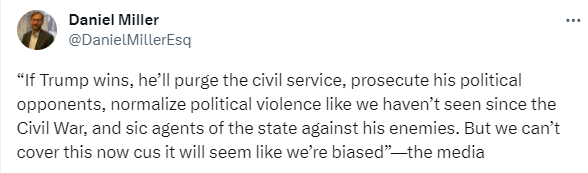
But our antiquated Constituion is a major stumbling block. So is the corporate news media:

Untitled

“A Mystery for the Ages”

In under 3 minutes, Tennessee comedian Trae Crowder explains the overriding reality confronting the Republican Party and the party’s response.

Two Very Different Presidents, Two Very Different Paths

Like so many others, the historian Kruse Kruse now has a Substack newsletter. In this edition, he sheds light on a famous speech from 43 years ago that attempted to make America better but failed.

Today [July 15th] marks the anniversary of [President] Jimmy Carter’s deeply unpopular “Malaise speech,” which actually was not deeply unpopular and actually never used the word “malaise.”

In the late 1970s, the United States was reeling from crises on several fronts, ranging from economic “stagflation” (a new term coined to describe the previously unimaginable mix of high inflation and high unemployment) to an energy crisis sparked by the one-two punch of Middle Eastern oil embargoes and OPEC’s price hikes.

In early July, President Carter scrapped plans for an address on the energy crisis, deciding that he needed to dig deeper to diagnose what was ailing America. The president assembled a cast of political figures and public intellectuals for ten days of free-ranging discussion and frank deliberation at Camp David. The conversations covered a great deal of ground, but the president focused in on what became the actual title of his misremembered speech: the country’s “Crisis of Confidence.”

On July 15, 1979, Carter delivered the speech in a nationally televised address.

Pairing the Camp David conversations with feedback he’d gotten from “other Americans, men and women like you,” Carter rattled off a series of seemingly disconnected comments that, taken together, spoke to the dissatisfaction, distrust and discontent of the American people. “The erosion of our confidence in the future,” he warned, “is threatening to destroy the social and the political fabric of America.”

Carter offered a clear-eyed vision of how, and why, Americans had come to doubt their government and, as a result, to doubt themselves too:

We were sure that ours was a nation of the ballot, not the bullet, until the murders of John Kennedy and Robert Kennedy and Martin Luther King, Jr. We were taught that our armies were always invincible and our causes were always just, only to suffer the agony of Vietnam. We respected the Presidency as a place of honor until the shock of Watergate.

We remember when the phrase “sound as a dollar” was an expression of absolute dependability, until ten years of inflation began to shrink our dollar and our savings. We believed that our nation’s resources were limitless until 1973 when we had to face a growing dependence on foreign oil.

As he well understood, the general dissatisfaction and distrust in government had been a main reason for Carter’s own election. While presidential candidates had long campaigned on a résumé thick with political roles and posts in Washington D.C., Carter leveraged his identity as “an outsider” — in a move others would quickly copy — who bore no responsibility for creating these crises and who could therefore have a better shot at fixing them.

But two and a half years into his presidency, Carter was “Washington” and these problems were now his own. Still, he tried to ally himself with unhappy Americans: “You don’t like it, and neither do I. What can we do?”

The president offered a blunt assessment:

We are at a turning point in our history. There are two paths to choose. One is a path I’ve warned about tonight, the path that leads to fragmentation and self-interest. Down that road lies a mistaken idea of freedom, the right to grasp for ourselves some advantage over others. That path would be one of constant conflict between narrow interests ending in chaos and immobility. It is a certain route to failure.

All the traditions of our past, all the lessons of our heritage, all the promises of our future point to another path — the path of common purpose and the restoration of American values. That path leads to true freedom for our nation and ourselves. We can take the first steps down that path as we begin to solve our energy problem.

Energy will be the immediate test of our ability to unite this nation, and it can also be the standard around which we rally. On the battlefield of energy we can win for our nation a new confidence, and we can seize control again of our common destiny.

Carter then laid out a detailed plan for common action on the energy crisis, one that called for reducing oil imports, diverting resources to alternative fuels, imposing stark conservation efforts and rationing gasoline.

There were, as one might expect, calls for government programs — a version of the War Production Board of World War II that would focus on energy, a plan for greater investments in public transportation, a tax on windfall profits to fund it all, etc. — but the emphasis was on the private, voluntary action of the American people. President Carter was confident they would rise to the challenge. “With God’s help and for the sake of our nation, it is time for us to join hands in America,” he urged in closing. “Let us commit ourselves together to a rebirth of the American spirit. Working together with our common faith we cannot fail.”

Despite later memories of the speech as a disaster, it was actually a tremendous success. News coverage was generally positive, with political leaders heaping praise on the president for his mixture of blunt talk and bold faith.

Most notably, President Carter’s approval rating, which had been an abysmal 26% before the speech, shot up to 37% after the speech, an impressive 11-point bump that seemed to many to signal a turnaround in his political fortunes.

But that good luck was short-lived. As he moved from words to deeds, Carter made some serious missteps, most significantly securing formal offers of resignation from his entire Cabinet and several senior White House aides…. Carter meant this to be a sign of how serious his administration was taking the crisis, but most Americans saw it [as] a sign of chaos and confusion. The good will of the speech was quickly wiped away, and as additional problems arrived, like the Iran hostage crisis, Carter only found himself discredited again.

Meanwhile, an alternative vision — the first path of “self-interest” that the pious Carter had dismissed — was advanced by former California Governor Ronald Reagan as he secured the Republican nomination and challenged the incumbent president. Like Carter’s critics on both the left and right, Reagan ignored much of what Carter had actually said and instead latched onto a word the longtime Democratic operative Clark Clifford had casually tossed out to reporters in describing the speech: America’s sense of “malaise.”

“That is really the question before us tonight,” Reagan said the evening before the 1980 election. “For the first time in our memory many Americans are asking: does history still have a place for America, for her people, for her great ideals? There are some who answer no; that our energy is spent, our days of greatness at an end, that a great national malaise is upon us.”

Carter had offered a blunt assessment of the country’s problems but expressed a sharp faith in Americans’ ability to come together and conquer them, but in Reagan’s hands the underlying optimism of that message was spun into nihilistic pessimism. “I find no national malaise,” Reagan said. “I find nothing wrong with the American people.”

Carter called on the American people to join together in common cause and to make personal sacrifices for the sake of the nation. Reagan dismissed all that as needless pessimism and confirmed their complacency….

Seeking to echo FDR’s famous first inaugural address, Carter had bluntly addressed the nation’s “crisis of confidence” but expressed his faith that, with a little hard work and personal sacrifice, Americans could pull themselves out of their problem. There was, in effect, nothing to fear but fear itself.

In sharp contrast, Reagan simply insisted there was nothing to fear, nothing to sacrifice, nothing to work together to do — except show Jimmy Carter the door.

It’s not surprising which message ultimately resonated with voters, between the challenge of self-sacrifice and the comfort of self-interest.

And it’s not surprising that political leaders, from both parties, took notice.

Israel’s Basic Conflict

Marbury vs. Madison is probably the most important ruling the Supreme Court ever made. It was the first time the court exercised “judicial review”, the ability of a federal court to declare a law unconstitutional. It’s odd in a way, since the court’s 1802 decision amounted to one branch of government unilaterally deciding it had control over the actions of another branch, i.e. Congress, even though there’s nothing in the Constitution that gives the judiciary that power.

Israel’s Supreme Court decided its own version of Marbury vs. Madison in 1995. The country has never had a written constitution, but it does have what are called “Basic Laws”. One of these laws declares that every Israeli citizen (whether Jewish or Arab) has certain fundamental rights. After the passage of the Basic Laws, the Supreme Court ruled that it could annul laws or parts of laws that violated those rights. In other words, the court gave itself the power of judicial review. Not everybody in Israel agrees with that decision.

Earlier this year, Prime Minister Netanyahu proposed legislation that would give Israel’s parliament, the Knesset, control over the appointment of judges, limit the Supreme Court’s ability to void legislation through judicial review, and override the court’s decisions. Opposition to this legislation led to massive protests all around the country.

This is from an interesting article in The New York Review of Books by Joshua Leifer:

Together, the … Basic Laws defined Israel as a “Jewish and democratic state.” This phrase appears nowhere in Israel’s 1948 Declaration of Independence…. The adoption of the “Jewish and democratic” formulation was part of an effort by Israeli leaders to shore up the ethnically exclusive character of the state as Israel entered the negotiation process that would culminate in the signing of the Oslo Accords. But for [the president of the Supreme Court], these Basic Laws also inaugurated the process of trying to harmonize Israel’s Jewish character and its putatively liberal-democratic commitments…. 

The 1995 Supreme Court decision in United Mizrahi Bank v. Migdal Cooperative Village …  created a legal means by which human rights could trump prerogatives of Jewish supremacy and state security. While this decision did not spark widespread outrage right away, with each ruling that struck down government policies in the name of democracy or human rights, right-wing hostility to the court increased….

For instance, the court provoked objections from the right when it ruled that Israel’s security services could not use physical torture—a decision that was substantively reversed in two cases in 2017 and 2018—or when it required that the Israeli military governor in the occupied territories change the location of the West Bank separation barrier to protect Palestinian private property rights. For Palestinian and human rights advocates, such interventions by the court have themselves been inadequate, because they left the infrastructure of the occupation intact and preserved laws that privileged Jews over non-Jews. In the right-wing imagination, however, the court … now appeared as a threat both to Israel’s security and to its Jewish character.

… The right insists that [the court’s] actions were their own judicial “coup”—a usurpation of the sovereign will of the people as expressed in legislation passed by the Knesset—and rejects the notion that the values of human dignity and democracy should ever win out over Jewish supremacy and state security. In fact, for much of the Israeli right, it has become anathema to suggest that the power and position of the Jewish majority have any limits at all….

Yair Lapid [a more centrist Israeli leader] has declared that it would not be sufficient simply to stop the right-wing coalition’s judicial takeover. “We don’t need to put a bandage on the wounds but rather properly treat them,” he said in an address after Netanyahu announced that he would pause the judicial overhaul legislation to allow for negotiations. “We must sit together and write a constitution based on the values of the Declaration of Independence.”

In the days since the legislative pause went into effect, a large segment of protesters has continued to return to the streets weekly, many chanting, “No constitution, no compromise.” Their argument is that without a constitution that formally establishes the relationship between the judicial and legislative branches and explicitly guarantees the civil liberties they fear the right aims to extinguish, Israel will remain vulnerable to future efforts to consolidate power over the political system and transform it into something like Viktor Orbán’s “illiberal democracy” in Hungary.

But because the renewed calls for a constitution contain no reference to the occupation and barely acknowledge discrimination against Israel’s Palestinian citizens, they have taken on an absurd cast. Lapid himself has insisted that he rejects a “state of all its citizens”—in other words, one that would guarantee equality to its inhabitants. He [and others] have consistently refused to treat Palestinian citizens as political partners…

Were a constitution along Lapidian lines to be written, it would need to be explicitly undemocratic and inegalitarian; it would enshrine as a constitutional value the discrimination against non-Jews that, according to the NGO Adalah, already appears in more than sixty-five Israeli laws—as well as in the now-infamous Nation-State Law, which was passed with the status of a Basic Law in 2018. The potential constitution might well begin [with the preamble to a proposed constitution in 1948] “WE, THE JEWISH PEOPLE.”

Writing any kind of constitution will, in other words, be no easier now than it was in 1948. The divisions between secular liberals and Orthodox traditionalists on matters of synagogue and state are perhaps felt even more intensely today than during the early years of Israel’s history. Then, secular Jews constituted an overwhelming majority, but rapidly shifting demographics mean that traditionalist and Orthodox Jews are now set to supplant them.

The protests draw some of their sense of desperation from the fear that the secular Israel of old is disappearing. More significantly, though, writing a constitution that does more than simply consecrate the current situation will still mean making the choice that confronted the state’s founding generation: between a genuinely democratic state and one that constitutionally upholds Jewish supremacy.

To start, any serious constitution must ask what the borders of the State of Israel are. Defining its territorial boundaries would require either formally annexing the West Bank or officially designating the settlements as outside Israeli sovereignty. A constitution would also need to define the status of all the Palestinians living under Israeli control. Either the constitution would grant them full equality—and therefore set in motion the dismantling of a vast apparatus of discrimination and unequal land distribution laws—or it would make Israel a de jure apartheid state, not just a de facto one.

Today no centrist or center-left Israeli Jewish leader is prepared to entertain such choices. Yet the right has its own vision for making them. After dismantling the judiciary and eliminating any checks on Jewish majority rule, it aims to annex the West Bank, legally formalize the apartheid regime over the Palestinians living there, and expel those who resist their permanent subjugation.

Some American observers have compared the situation in Israel to the ongoing debate among left-liberal legal scholars in the United States about the drawbacks of judicial politics, especially after the Dobbs decision: Has relying on the Supreme Court instead of the democratic process hampered the implementation of progressive policies? But if there is any parallel it is not to contemporary America but to the US in the years preceding the Civil War. Then in the United States as in Israel now, the country was divided over who was entitled to fundamental rights and what its founding documents meant—or in Israel’s case, what it means to lack them.

There the parallel stops. While the settler right seeks (as the proslavery camp sought) to solidify a constitutional order premised on the supremacy of the ethno-racial majority, the prodemocracy camp has embraced no call for equality comparable to that made by the American abolitionists. The protesters are largely content with Jewish supremacy as long as it protects liberal freedoms for Jews. What they seem to want is to maintain both the material benefits of that inequality and the self-comforting illusion of democracy.