He’s Going To Be Indicted

It was clear for four long years that the former president treated the US government as if he owned it. The government was just another part of his cheesy business “empire”. When it came to following rules, he saw no significant difference between being president of the United States and president of a waste management company in Queens.  

So it shouldn’t be a surprise that when the former president [hereafter “FPOTUS] was forced to vacate the premises on January 20, 2017, he took with him whatever he wanted. The latest inventory of items taken by the FBI from Mar-a-Lago shows that he stole an amazing amount of stuff [i.e. stuff that didn’t belong to him] The way the government documents were “stored” in boxes with magazine and newspaper articles and other memorabilia indicates that his staff simply collected what their boss wanted to keep while paying no attention at all to the laws regarding presidential records and national security. Maybe FPOTUS always had a box next to his desk in which he could toss anything that piqued his interest. I hope the FBI eventually interviews the people on his staff who helped him break the law. More from the New York Times:

The F.B.I.’s search of [Mar-a-Lago] last month recovered 48 empty folders marked as containing classified information, a newly disclosed court filing shows, raising the question of whether the government had fully recovered the documents or any remain missing….

Untitled

Along with the empty folders with classified markings, the F.B.I. recovered 40 more empty folders that said they contained sensitive documents the user should “return to staff secretary/military aide,” the inventory said. It also said that agents found seven documents marked as “top secret” in [FPOTUS’s] office and 11 more in a storage room.

The list and an accompanying court filing from the Justice Department did not say whether all the contents of the folders had been recovered. But the filing noted that the inquiry into Mr. Trump’s handling of the documents remained “an active criminal investigation”. The inventory also sheds further light on how documents marked as classified were stored haphazardly, mixed with everyday items.

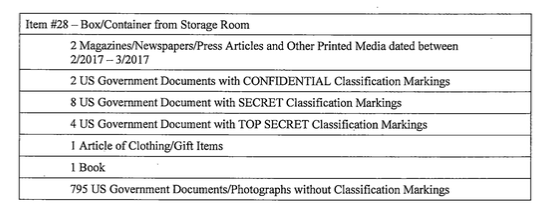
Among the items found in one box: 30 news clippings dated from 2008 to 2019, three articles of clothing or “gift items,” one book, 11 government documents marked as confidential, 21 marked as secret and 255 government documents or photographs with no classification markings.

The list suggests the files [FPOTUS] took to his Florida home were stored in a slapdash manner and appeared to underline concerns that [he] had not followed rules for protecting national security secrets.

The inventory listed seven batches of materials taken by the F.B.I. from [his] personal office at Mar-a-Lago that contained government-owned documents and photographs, some marked with classification levels up to “top secret” and some that were not marked as classified. The list also included batches of government documents that had been in 26 boxes or containers in a storage room at the compound.

In all, the list said, the F.B.I. retrieved 18 documents marked as top secret, 54 marked as secret, 31 marked as confidential, and 11,179 government documents or photographs without classification markings….

In obtaining a search warrant, the bureau described the possibility of three crimes as the basis of its investigation: the unauthorized retention of national security secrets, obstruction and concealing or destroying government documents. None require a document to have been deemed to be classified, despite repeated and unproven claims that he had declassified everything he took from the Oval Office.

At the hearing on Thursday, the Justice Department said that it had performed its own review and set aside more than 500 pages of records that could be protected by attorney-client privilege.

But lawyers for the department fiercely contested Mr. Trump’s request for a review of the materials based on executive privilege, which protects confidential executive branch communications from disclosure.

The lawyers argued that executive privilege could not be used by a former president to keep part of the executive branch, like the department itself, from reviewing government files as part of its official responsibilities.

[The judge, a Republican nominated for the federal bench by FPOTUS himself] was not entirely persuaded by that argument and left open the possibility that she would grant [her political patron] a special master to conduct a wide-ranging review, encompassing both attorney-client and executive privilege [even though even Bill Barr, FPOTUS’s former attorney general and lackey, said that makes no sense since executive privilege no longer applies to a private citizen, whether or not the Electoral College once made him president].

Unquote.

He is going to be indicted and found guilty unless he runs away. It’s unclear whether he’ll ever spend a night in jail, since he didn’t steal a six-pack from a liquor store and the law is often an ass.
Untitled

But Could He Be Elected from a Jail Cell?

On a very hot summer afternoon, what better to consider than what to do about “a pathetic, degenerate huckster capable of great violence and evil” who is going to run for president again? Followed by some encouraging words from Merrick Garland. First, from Charles Blow of The New York Times:

His entire foray into politics has been one of testing the fences for weaknesses. Every time a fence has failed, he has been encouraged. He has become a better political predator.

With the conclusion of this series of hearings about the Jan. 6 insurrection, it has become ever clearer to me that T____ should be charged with multiple crimes. But I’m not a prosecutor. I’m not part of the Department of Justice. That agency will make the final decision on federal charges.

The questions before the Justice Department are not only whether there is convincing evidence that T____ committed the crimes he is accused of but also whether the country could sustain the stain of a criminal prosecution of a former president.

I would turn the latter question around completely: Can the country afford not to prosecute Trump? I believe the answer is no.

He has learned from his failures and is now more dangerous than ever.

He has learned that the political system is incapable of holding him accountable. He can try to extort a foreign nation for political gain and not be removed from office. He can attempt a coup and not be removed from office.

He has learned that many of his supporters have almost complete contempt for women. It doesn’t matter how many women accuse you of sexual misconduct; your base, including some of your female supporters, will brush it away. You can even be caught on tape boasting about sexually assaulting women, and your followers will discount it.

He has learned that the presidency is the greatest grift of his life. For decades, he has sold gilded glamour to suckers — hawking hotels and golf courses, steaks and vodka — but with the presidency, he needed to sell them only lies that affirmed their white nationalism and justified their white fragility, and they would happily give him millions of dollars. Why erect a building when you could simply erect a myth? T____ will never willingly walk away from this.

Now with the investigation into his involvement in the insurrection and his attempts to steal the election, he is learning once again from his failures. He is learning that his loyalty tests have to be even more severe. He is learning that his attempts to grab power must come at the beginning of his presidency, not the end. He is learning that it is possible to break the political system.

Not only does T____ apparently want to run again for president; The New York Times reported that he might announce as soon as this month, partly to shield himself “from a stream of damaging revelations emerging from investigations into his attempts to cling to power after losing the 2020 election.”

T____ isn’t articulating any fully fleshed-out policy objectives he hopes to accomplish for the country, but that should come as no surprise. His desire to regain power has nothing to do with the well-being of the country. His quest is brazenly self-interested. He wants to retake the presidency because its power is a shield against accountability and a mechanism through which to funnel money.

Should his re-election bid prove successful, T____’s second term will likely be far worse than the first.

He would tighten his grip on all those near him. Mike Pence was a loyalist but in the end wouldn’t fully kowtow to him. The same can be said of Bill Barr. T____ will not again make the mistake of surrounding himself with people who would question his authority.

Some of the people who demonstrated more loyalty to the country than they did to T____ during these investigations were lower-level staff members. For the former president, they, too, present an obstacle. But he might have a fix for that as well.

Axios reported on Friday that “T____’s top allies are preparing to radically reshape the federal government if he is re-elected, purging potentially thousands of civil servants and filling career posts with loyalists to him and his ‘America First’ ideology”.

According to Axios, this strategy appears to revolve around his reimposing an executive order that would reassign tens of thousands of federal employees with “some influence over policy” to Schedule F, which would strip them of their employee protections so that T____ could fire them without recourse to appeal. [Note: T____ created Schedule F by executive order a few weeks before the 2020 election. It gave him unprecedented power to ignore civil service rules. President Biden repealed the executive order on his second day in office.]

Perhaps most dangerous, though, is that T____ will have learned that while presidents aren’t too big to fail, they are too big to jail. If a president can operate with impunity, the presidency invites corruption, and it defies the ideals of this democracy.

A T____ free of prosecution is a T____ free to rampage.

Some could argue that prosecuting a former president would forever alter presidential politics. But I would counter that not prosecuting him threatens the collapse of the entire political ecosystem and therefore the country.

Unquote.

We don’t know what it will mean, but Attorney General Merrick Garland repeated his intention to hold everybody responsible for January 6th (and possibly the entire attempted coup):

They Wanted To Assassinate a Troublesome Reporter

President Richard Nixon avoided impeachment or a jail cell by resigning. This strange story from 50 years ago made me wonder what plots were discussed in the White House more recently and whether that president will ever be punished. From The Washington Post:

Nixon’s hatred for the news media long predated his election as president. Where other politicians shrugged off public criticism, Nixon believed he was uniquely the target of journalistic vilification. When he entered the White House in 1969, he vowed revenge.

As president, Nixon ordered illegal wiretaps on newsmen who criticized his administration and instructed FBI director J. Edgar Hoover to compile a dossier on “homosexuals known and suspected in the Washington press corps.” Nixon’s Justice Department filed antitrust charges against television networks that criticized him and went to court in an unprecedented attempt to legalize government censorship. Nixon’s aides even put together a list of “enemies,” including journalists, to be secretly targeted for government retaliation.

The journalist Nixon despised most was crusading columnist Jack Anderson, then the most famous and feared investigative reporter in the country. Anderson had a hand in exposing virtually every Nixon scandal since he first entered politics, and he escalated his attacks once Nixon was president, uncovering Nixon’s deceit in foreign policy, and his political and personal corruption.

Nixon railed that “we’ve got to do something with this son of a bitch,” but nothing seemed to stop Anderson. The president’s reelection campaign planted a mole in the newsman’s office, but Anderson’s secretary discovered the snooping and ejected the infiltrator. A top White House adviser tried to discredit Anderson by leaking him forged documents, but he figured out they were bogus and didn’t fall for the ruse. The CIA illegally wiretapped and surveilled Anderson, but his nine children chased the spies away and Anderson mocked their incompetence in his column. The president even ordered his staff to smear Anderson as gay, but the allegation was as false as it was ridiculous and went nowhere.

Finally, in March 1972, the Nixon White House turned to the one method guaranteed to silence Anderson permanently: assassination. After meeting with the president in his hideaway office in the Old Executive Office Building, White House special counsel Charles Colson contacted his top White House operative, E. Howard Hunt. The “son of a bitch” Anderson “had become a great thorn in the side of the president,” Colson told Hunt, according to Hunt’s later Senate testimony, and the White House had to “stop Anderson at all costs.” (Hunt also corroborated this story in a 2003 interview.)

According to Hunt, Colson proposed assassinating Anderson by using an untraceable poison, perhaps a high dose of a hallucinogen like LSD. Colson instructed Hunt to “explore the matter with the CIA,” where Hunt had previously worked as a spy. Although he never explicitly stated that Nixon gave the order, Colson told Hunt that he was “authorized to do whatever was necessary” to eliminate the reporter.

Hunt brought in his White House sidekick, G. Gordon Liddy, who was “forever volunteering to rub people out,” as Hunt put it. Liddy was enthusiastic: It would be a “justifiable homicide,” he later said in media interviews, because Anderson was a “mutant” journalist who had “gone too far” and “had to be stopped.”

On March 24, 1972, Hunt and Liddy met with a veteran CIA poison expert, Edward T. Gunn, in the basement of the Hay-Adams Hotel, a block from the White House. Gunn and Liddy, who didn’t know each other, used aliases.

Gunn later told Watergate prosecutors that Hunt said someone “was giving them trouble” and wanted an untraceable poison “that would get him out of the way.” Gunn replied that no poison was completely undetectable. But he said the CIA had success painting LSD on a car’s steering wheel; the drug was then absorbed while driving and could cause a fatal car crash. However, there was also the risk that others — such as Anderson’s wife or children — would be poisoned if they drove the car instead.

Of course, there’s always the old simple method of simply dropping a pill in a guy’s cocktail,” Gunn suggested. But Hunt pointed out that as a Mormon, Anderson was a teetotaler.

Aspirin roulette” was another option, Liddy said: slipping a “poisoned replica” of his headache tablet into his medicine bottle. Liddy and Hunt had already cased Anderson’s house for a possible break-in. But it would be “highly impractical,” Hunt argued, to “go clandestinely into a medicine cabinet with a household full of people and pore over all of the drugs … until you found the one that Jack Anderson normally administered to himself.”

Besides, Liddy realized, it would take too long: “Months could go by before [Anderson] swallowed it.” Not to mention the “danger than an innocent member of his family might take the pill” instead.

It might be simpler, Gunn suggested, to make Anderson’s car crash by ramming into it. Hunt and Liddy had already tailed Anderson as he drove between his home and office, and Gunn suggested a specific location along the route that was “ideal” because it was already “notorious as the scene of fatal auto accidents” in Washington.

But Liddy thought this method was “too chancy” and argued for simplicity: Anderson “should just become a fatal victim of the notorious Washington street-crime rate.” Liddy offered to stab Anderson to death and make it look like a routine robbery by stealing Anderson’s watch and wallet. “I know it violates the sensibilities of the innocent and tender-minded,” Liddy later told Playboy, “but in the real world, you sometimes have to employ extreme and extralegal methods to preserve the very system whose laws you’re violating.”

Hunt briefed Colson about these various assassination options. But a few days later, the hit was canceled. The White House had a more urgent assignment: bugging the Democratic Party’s headquarters in the Watergate office building.

A few weeks later, Hunt and Liddy were arrested for their role in the Watergate burglary. The scandal that toppled Nixon’s presidency began unraveling.

In the aftermath, a Senate committee investigated and confirmed the plot to poison Anderson. Liddy and Hunt eventually acknowledged their participation in the conspiracyColson never did. All three went to prison for Watergate-related crimes.

But not Nixon, whose role in the Anderson plot has never been definitively established. Hunt believed that Colson didn’t have the “balls” to order the assassination on his own and had acted at Nixon’s behest. Colson denied that. But it is hard to imagine Nixon’s closest advisers plotting to execute America’s leading investigative reporter without the tacit — if not explicit — authorization of the president.

PS: The Rittenhouse Case

Another observer, Kurt Eichenwald, makes a good point:

. . . the biggest villains here are the Kenosha police, who refused to protect protesters by treating right-wing, gun-toting civilians as adjuncts to law enforcement. THAT is where politics & white supremacy should be most condemned – it’s institutional and allowed the streets to be filled with thugs like Rittenhouse, whose mere presence created the potential for this. But the presence of these dangerous people was not a crime.

These Brief Words About the Rittenhouse Case Sound Right to Me

Seventeen-year-old Kyle Rittenhouse traveled to Kenosha, Wisconsin, last year with an AR-15 semi-automatic rifle, saying he wanted to protect private property. This was during unrest following an earlier incident in which a policeman repeatedly shot an unarmed black man. Confronted and pursued by demonstrators, Rittenhouse killed two and wounded another. He claimed his actions were self-defense.

Josh Marshall of Talking Points Memo responded to Rittenhouse being found not guilty:

A few thoughts on this verdict. It’s probably obvious I think it was a bad verdict. But I think we have to look more broadly at the result. People disagree. Juries make bad decisions. There’s nothing new about that. But what we have in the country right now are three factors.

One is highly permissive self-defense laws. In some cases, the statutes are okay but they’re interpreted too heavily or entirely in the defendant’s subjective perception of danger. In other “stand your ground”-type cases, they’re just bad laws. But the upshot is similar.

You also have a situation where any yahoo is now allowed to bring a high capacity firearm into an already tense or potentially violent situation. Usually they come with a chip on their shoulder or a political agenda. Then if they get scared they can start shooting.

It didn’t get a lot of attention but the judge essentially threw out the law that bars minors from open carrying in Wisconsin. So literally a kid can now show up with an AR to “help” and that’s okay.

Finally we live today in a very polarized, very divided society in which some people’s lives and inner experiences count a lot more than other people’s. You can say that that really means white people’s count more. And that’s generally right. But it’s not only that.

As long as murder is okay as long as you were feeling the right thing at the moment you killed the other person, that makes something as foundational as killing wildly subjective and makes the decisions jurors make too dependent on their own private definitions of good guys and bad guys.

None of these factors are new exactly. But together they create something genuinely new in this political moment. Add in the increasingly public acceptability of political violence on the American Right and you’ve got a powder keg confluence of factors that will make resorts to violence and general murder safaris not only more common, but also acceptable under the law.

Unquote.

I’ll add two things. The first is that the extreme polarization in our society is the result of the right-wing’s descent into fantasy and authoritarianism. Countries with conservative political parties that are actually conservative, not insanely radical and not gun-crazy like the Republican Party, aren’t as polarized.

The second is that the judge dismissed the gun charge because the weapon Rittenhouse had wasn’t illegal, according to Wisconsin’s law. For whatever reason, “the law allows minors to possess shotguns and rifles as long as they’re not short-barreled. . . When [the prosecutor] acknowledged that Rittenhouse’s rifle’s barrel was longer than 16 inches, the minimum barrel length allowed under state law, [the judge] dismissed the charge (Associated Press). In other words, according to the letter of the law, it’s fine in Wisconsin for a minor to parade around with a dangerous weapon if its barrel is longer than 16 inches. The prosecutor could have appealed the judge’s decision, since it contradicted the spirit of the law, but didn’t bother. It wasn’t the prosecutor’s only mistake.