Whereof One Can Speak 🇺🇦

Nothing special, one post at a time since 2012

Please Ignore The Nonsense

The usual suspects claim the Orange Menace (hereafter OM) shouldn’t be prosecuted for what he did to stay in office. They offer three main reasons, all of them bullshit:

  1. He’s being prosecuted for lying about the election.
  2. He actually believed he won the election.
  3. He relied on the advice of his lawyers

Unfortunately, these excuses are being treated with a degree of respect by people who should know better.

First, he’s not being prosecuted for telling lies.

As the indictment states, [OM] “had a right, like every American, to speak publicly about the election and even to claim, falsely, that there had been … fraud during the election and that he had won”. He is being prosecuted for the illegal actions he took to change the result.

There are legal ways to challenge an election, both of which OM took advantage of. He demanded recounts. They didn’t change the result. He went to court. All of his lawsuits were rejected, even by judges he nominated.

But OM went much further than that. From Ruth Marcus of The Washington Post:

“The heart of our jurisprudence with respect to the First Amendment is the difference between regulating speech and regulating conduct,” Rep. Jamie B. Raskin (D-Md.), once a constitutional law professor, [explained]. “Everything charged in the indictment involves criminal conduct by [OM] and not the mere expression of political views….

Thus, the indictment doesn’t accuse [OM] of breaking the law by claiming the election was stolen. It asserts, instead, that … [he] pushed state officials to ignore the popular vote; that he organized “fraudulent slates of electors,” including some who were “tricked into participating,” and that he and his co-conspirators [pressured] the vice president to refuse to certify the election results.

Those actions were illegal and have nothing to do with the First Amendment right to free speech.

But what if [OM] truly believed he won the election? From Judd Legum of Popular Information:

[The Washington Post, Axios, CNN and The New York Times] are all “reporting” that, to convict [OM], Jack Smith has to prove [he] knew he was lying about the 2020 election. [His] lawyer is saying the same thing. And so is Fox.

The problem with this analysis is it’s completely wrong.

A successful prosecution does not hinge on what [he] BELIEVED about the 2020 election. If [he] is convicted, it will be based on his ACTIONS….

Creating a fake set of electors and then pressuring your VP to declare them valid is not one of your legal options. [Attorney Marc Elias] explained it this way: “I walk into a bank, and I think they are wrongfully holding my money. I think my balance is $5,000, and they think my balance is zero… That doesn’t excuse me from robbing the bank. I can’t pull out a gun and take the money”.

Smith spends time on evidence establishing [OM] knew he was lying to show [his] motivation. He is not required to prove motive under the law, but juries generally are looking for a motive. In this case, Smith is showing [OM] was trying to remain in power. But the media coverage is confusing a trial tactic with a legal requirement. Proving [OM] knew he was lying will be helpful to Smith, but it’s not central to his legal case. The coverage suggesting otherwise is wrong.

Finally, was the defendant simply relying on the advice of his lawyers?

One of the ways OM has successfully avoided prosecution in the past is that he’s insulated himself behind teams of lawyers and accountants. There is always somebody else to blame for whatever he did. Returning to that earlier example, your lawyer telling you it’s okay to rob a bank doesn’t make it so. You need to use your common sense. What happened in this case is that OM was desperate to overturn the election, so he looked for lawyers who’d help him, ignoring all the ones who wouldn’t. From Greg Sargent of The Washington Post:

The indictment contains lots of ammunition against this defense. For instance, it shows Pence repeatedly told [OM] he had no such authority. On one occasion, [OM] blithely suggested he would “prefer” to believe otherwise. On another, [OM] rebuked Pence for refusing to abuse his authority: “You’re too honest.”

It wasn’t just the Vice President who told OM the truth. His Attorney General and others in his administration told him the same thing. On top of that, judges, lawyers and law professors all over the country were saying there was no way to stop or pause the counting of the electoral votes on January 6, 2021. For example, from NBC News at the time:

A federal district court in Washington recently ruled against a last-ditch effort suit by [OM] supporters against Pence, Congress and the Electoral College that sought to stop the certification of Biden’s win.

The plaintiffs’ theory “lies somewhere between a willful misreading of the Constitution and fantasy,” a judge ruled Monday, denying the motion.

From Salon in December 2020:

“Pence’s constitutional role is to ‘open’ the certificates. That’s it,” said Harry Litman, a former Justice Department official and constitutional law expert at UCLA. “Not to certify. Not even technically to count. He has no way even to purport to change the count. It’d be like saying the Oscar presenters get to decide who wins best picture.”

“The idea that Pence is going to overturn the election in January is pure fantasy-land nonsense,” Justin Levitt, an election law expert at Loyola Marymount University, told Vice News.

From the right-wing National Review on January 5, 2021:

I’m starting to wonder if this is a gag: Like, in order to amuse himself, President [OM] is trying to see how far erstwhile “constitutional conservative” Republicans are willing to beclown themselves … Whatever it may be, it’s time to stop. It was actually time to stop a few weeks ago, but this has gotten so irrational it no longer rises even to the level of farce.

The president now says Vice President Pence has the unilateral authority to invalidate state electoral votes that he decides are fraudulent. That is a ridiculous claim. 

OM preferred to ignore a national chorus of legal experts and people with common sense who said he lost and there was nothing he could do about it. He preferred to work with a tiny minority willing to tell him what he wanted to hear. It’s no surprise that the leading members of that tiny minority are now known as his co-conspirators, numbers 1 through 6.
Let Justice Be Done

Our former president has finally been charged with committing four felonies in order to remain in office after losing the 2020 election. The government has identified six co-conspirators who will presumably be charged at a later date. Charging the former president alone will allow the proceedings against him to go more quickly. He wasn’t charged with a crime like seditious conspiracy, no doubt because the other charges are easier to prove (and he didn’t personally break into the Capitol building). The case has been  assigned to Judge Tanya Chutkan, who was nominated by President Obama. The defendant is schedule to appear in court on August 3.

Special Counsel Jack Smith recommended that we read the 45-page indictment, which is available here.

What follows is the indictment’s introduction. It describes the three counts involving conspiracy (the other count is non-conspiratorial Obstruction of, and Attempt to Obstruct, an Official Proceeding—18 U.S.C. §§ 1512(c)(2), 2, which is based on the same evidence).

1. The Defendant, DONALD J. TRUMP, was the forty-fifth President of the United States and a candidate for re-election in 2020. The Defendant lost the 2020 presidential election.

2. Despite having lost, the Defendant was determined to remain in power. So for more than two months following election day on November 3, 2020, the Defendant spread lies that there had been outcome-determinative fraud in the election and that he had actually won. These claims were false, and the Defendant knew that they were false. But the Defendant repeated and widely disseminated them anyway—to make his knowingly false claims appear legitimate, create an intense national atmosphere of mistrust and anger, and erode public faith in the administration of the election.

3. The Defendant had a right, like every American, to speak publicly about the election and even to claim, falsely, that there had been outcome-determinative fraud during the
election and that he had won. He was also entitled to formally challenge the results of the election through lawful and appropriate means, such as by seeking recounts or audits of the popular vote in states or filing lawsuits challenging ballots and procedures. Indeed, in many cases, the Defendant did pursue these methods of contesting the election results. His efforts to change the outcome in any state through recounts, audits, or legal challenges were uniformly unsuccessful.

4. Shortly after election day, the Defendant also pursued unlawful means of discounting legitimate votes and subverting the election results. In so doing, the Defendant
perpetrated three criminal conspiracies:

a. A conspiracy to defraud the United States by using dishonesty, fraud, and deceit to impair, obstruct, and defeat the lawful federal government function by which the results of the presidential election are collected, counted, and certified by the federal government, in violation of 18 U.S.C. § 371;

b. A conspiracy to corruptly obstruct and impede the January 6 congressional proceeding at which the collected results of the presidential election are counted and certified (“the certification proceeding”), in violation of 18 U.S.C. § 1512(k); and

c. A conspiracy against the right to vote and to have one’s vote counted, in violation of 18 U.S.C. § 241. Each of these conspiracies—which built on the widespread mistrust the Defendant was creating through pervasive and destabilizing lies about election fraud—targeted a bedrock function of the United States federal government: the nation’s process of collecting, counting, and certifying the results of the presidential election (“the federal government function’).

I Find the Former President’s Criminal Case Very Interesting, Maybe Too Interesting

Our former president (hereafter “the defendant”) will be in court tomorrow afternoon to formally be told what crimes he’s accused of. He may be ready to enter a plea of guilty or not guilty as well. It turns out that the proceedings won’t be conducted by the biased and incompetent Judge Aileen “Loose” Cannon, even though she’s been assigned to handle his trial (for now). A magistrate judge, one step below a full-fledged, lifetime-appointment federal judge like Cannon, will be in charge tomorrow. That’s the normal procedure. It’s possible the magistrate judge will set some conditions for the defendant’s release, like telling him not to leave the country. I rather doubt the judge will lock him up.

There’s talk that he’s having trouble finding a lawyer willing to represent him. Would you want to be his lawyer, given how challenging it is to represent him? But he’s already got Florida lawyers who can go with him to court tomorrow, whether or not they represent him in further proceedings.

Judge Cannon being selected to handle this case raises two interesting questions. Why was she selected? Will she step aside or be forced to?

[A personal note/warning: I worked in the Los Angeles County Superior Court system for five years, so may find the following much more interesting than you do.]

Cannon’s assignment was random but not as random as it could have been. The New York Times described the process:

Under the district court’s procedures, new cases are randomly delegated to a judge who sits in the division where the matter arose or a neighboring one, even if it relates to a previous case. That Judge Cannon is handling [the defendant’s] criminal indictment elicited the question of how that had come to be.

Asked over email whether normal procedures were followed and Judge Cannon’s assignment was random, Ms. Noble [the chief clerk of the court] wrote: “Normal procedures were followed.”

Mar-a-Lago is in the West Palm Beach division, between the Fort Lauderdale division and the Fort Pierce division, where Judge Cannon sits. The district court’s website shows that seven active judges have chambers in those three divisions, as do three judges on senior status who still hear cases‌.

Ms. Noble wrote that certain factors increased the chances that the case would land before Judge Cannon.

For one, she said, senior judges are removed from the case assignment system, or wheel, once they fulfill their target caseload for the year. At least one of the senior judges is done, she wrote, adding that she was highly confident that the other two “are very likely at their target,” too.

In addition, she wrote, one of the seven active judges with chambers in Fort Lauderdale is now a Miami judge for the purpose of assignments. Another is not currently receiving cases.

A third active judge … draws 50 percent of his criminal cases from the Miami division, she wrote, decreasing his odds…. Judge Cannon, Ms. Noble wrote, “draws 50 percent of her cases from West Palm Beach, increasing her odds.”

Given the clerk’s explanation, my rough estimate is that there was a 1-in-4 chance that Cannon would receive the case, assuming the district’s normal process was followed. There could have been as many as 10 judges available, but it turns out there were only 5. In addition, one of those 5 had less of a chance and Cannon had more of a chance, so it was around 1-in-4.

Presumably, Special Counsel Jack Smith was aware of the likelihood that Cannon would get the case, but chose to file the case in Florida anyway, given that the alleged crimes took place in West Palm Beach. I’m pretty sure Smith wouldn’t choose Judge Cannon, given what happened last time she got involved. This is from the same Times article:

The news of Judge Cannon’s assignment raised eyebrows because of her role in an earlier lawsuit filed by [the defendant] challenging the F.B.I.’s search of his Florida club and estate, Mar-a-Lago. In issuing a series of rulings favorable to him, Judge Cannon, [whom the defendant chose to be a federal judge], effectively disrupted the investigation until a conservative appeals court ruled she never had legitimate legal authority to intervene.

One of the mistakes she made was to say the defendant deserved special consideration, since he is an ex-president. That’s not how the law is supposed to work.

The second question is whether Cannon will preside over the pre-trial proceedings and an eventual trial, all of which will go on for months (unless the defendant pleads guilty, is incapacitated, etc.). The New Yorker has an interview with Stephen Gillers, a professor emeritus at N.Y.U. Law and an expert on judicial matters. He says the answer to that question should be “No”, according to the law that covers judicial assignments.

Going forward, what can the government do if it feels like a judge will not give it a fair shake?

It raises the question of recusal. There’s a statute dealing with federal judge recusal—it’s 28 U.S.C. § 455…. The very first sentence … says that a judge should recuse if the judge’s impartiality “might reasonably be questioned.”

Now, the fact that a judge’s impartiality might reasonably be questioned doesn’t mean that the judge is partial. The public may simply not trust the impartiality of the judge. Because public trust in the work of the court is a value as important as the work itself, the rule says that the judge should not sit when we can’t fairly ask the public to trust what the judge does. That rule is especially important in this case. One thing the prosecution can do is move to recuse Judge Cannon on the ground that, in light of her experience in the search-warrant case last year, her impartiality might reasonably be questioned.

And who would make that judgment if the government does push for this recusal?

The judge herself gets to make that decision in our system. If she denies the recusal, the government could go to the Eleventh Circuit and ask it to order her to recuse herself, and that’s a process called mandamus….In effect, you’re suing the judge to force the judge to recuse….

There’s one other thing the government can do, aside from doing nothing, and that is to write a letter to the judge suggesting the reasons she should consider recusing herself without being formally asked to do so. That’s done also, so as not to create a formal motion….

One factor to consider in deciding whether recusal is necessary is how important the case is to the public and to the need for public trust. If the [Court of Appeals] were to reverse Cannon’s recusal decision, one thing they might say is “We are not questioning the probity or the fairness or the competence of the judge, but we don’t think we can ask the public to accept her rulings.”

So, if the government decides that it’s not going to get a fair shake from Cannon based on its previous experience with her, we will end up with this three-judge panel.

Here, the questions are: Will they initially just write a letter suggesting that she recuse? If she does, that’s the end of it. If she doesn’t, will they make a formal motion to recuse? If she grants it, that’s the end of it. If she doesn’t, then they have to decide whether to seek mandamus. If they do, then the three judges, who are randomly chosen and who hear that mandamus petition, will have to decide whether she should be removed. If they decide that she should not, that’s the end of it. If they decide that she should, then there’ll be a reassignment….

Is there some advantage for the government to wait and see how the trial is going before it pushes for a recusal? Would it have a stronger case for recusal that way?

If there is a basis to move to recuse, you can’t wait around. You have to do it quickly. You can’t wait around to see whether the judge rules on motions in your favor.

Are there downsides to going for recusal right away?

The problem with going for recusal right off the bat is that you may lose in the circuit, and now you’re trying a case before a judge you’ve accused of being unable to appear impartial—and that’s not pleasant. So the government may decide that it’s just better to make the strongest case they can and hope that she behaves like a judge.

Given what we saw regarding Cannon’s behavior during the previous case, do you think that the government will or should go for a recusal?

Given the importance of this case, perhaps the most important criminal trial in the history of the United States—certainly the most watched—and in light of what Judge Cannon did in the search-and-seizure case last year, I think she must step aside. I think she must grant a motion to recuse herself, unless she does it before a motion is even made.

And the reason I say that is that she treated [the defendant] as special, or, to put it another way, she was partial to [him] as a former President, which should not have any influence on the way this trial is conducted…. The partiality she expressed in her decisions last year creates a reasonable perception in the mind of a fair-minded person that she is not impartial—which is the test. Her behavior when she was ruling on the search-and-seizure case creates a reason to doubt her impartiality.

But when you say “must,” you mean from an ethical sense.

No, “must” in a rule sense. There’s a rule.

O.K., but there’s also no way to enforce the rule, right?

Except through mandamus.

That suggests to me that [unless Cannon recuses herself] you think the government should or will go to mandamus.

… If the government does so, she must grant the recusal, and if she doesn’t the Eleventh Circuit must order it.

That’s “must” according to the law. Other legal experts have said the same thing. But it’s judges who decide what the laws mean.

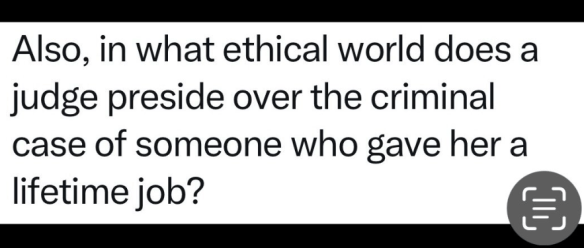
As far as I can tell, the experts aren’t too concerned that the defendant chose Cannon to become a federal judge. Maybe they don’t want to imply that judges tend to favor the politicians who got them their jobs. For us mortals, however, we might ask, as someone did:

Untitled

A Few Thoughts on the Indictment, and a Disturbing List

The Mueller investigation implied that our former president was guilty of obstruction of justice. Mueller’s final reported listed 10 times he may have committed that crime. But the Department of Justice doesn’t like to prosecute presidents. Nothing happened. For reasons unknown, in 2021, the new attorney general let the matter drop, even though the former president was now a private citizen.

Now, more than two years later, the Department of Justice has convinced a grand jury that private citizen Donald J. Trump has committed a new set of crimes. The grand jury’s indictment is entitled “United States of America v. Donald J. Trump and Waltine Nauta, Defendants” (Nauta is one of Trump’s employees).

An important thing to note is that this ex-official isn’t accused of doing anything when he was in office. He could have removed all kinds of sensitive material from the White House when he was still president (like others have done before him) and nothing would have happened except justifiable criticism for being loose with government secrets. But when he was no longer president, he was required to give it all back, like others have done. His crimes boil down to lying to the FBI about which documents he had, hiding them and refusing to give them back.

These are the specific felonies he’s charged with:

  1. Willful Retention of National Defense Information (a section of the Espionage Act)
  2. Conspiracy to Obstruct Justice
  3. Withholding a Document or Record
  4. Corruptly Concealing a Document or Record
  5. Concealing a Document in a Federal Investigation
  6. Scheme to Conceal
  7. False Statements and Representations

They probably could have added another crime to the list, since he shared what he had with other people.

Note: There is absolutely no evidence that Hillary Clinton, Joe Biden or Mike Pence ever committed any of these crimes even though sensitive material was found in their possession at some point. (A major difference being that none of them refused to return anything or lied to the cops.)

Assuming the defendant pleads Not Guilty on Tuesday, it will be months before there’s a trial (assuming he doesn’t drop dead, lose his mind, change his plea, flee the country, etc. etc. in the meantime). In our judicial system, a “speedy trial” is hardly ever a quick one.

Although a biased, incompetent right-wing judge (Aileen “Loose” Cannon) will accept the defendant’s plea next week, it seems impossible that she will handle the rest of the case. Has a judge ever presided over a federal criminal case in which the defendant chose her to be a judge? No. It would be like a kennel club official deciding who’ll be the judge at a dog show and then entering her own dog in the contest.

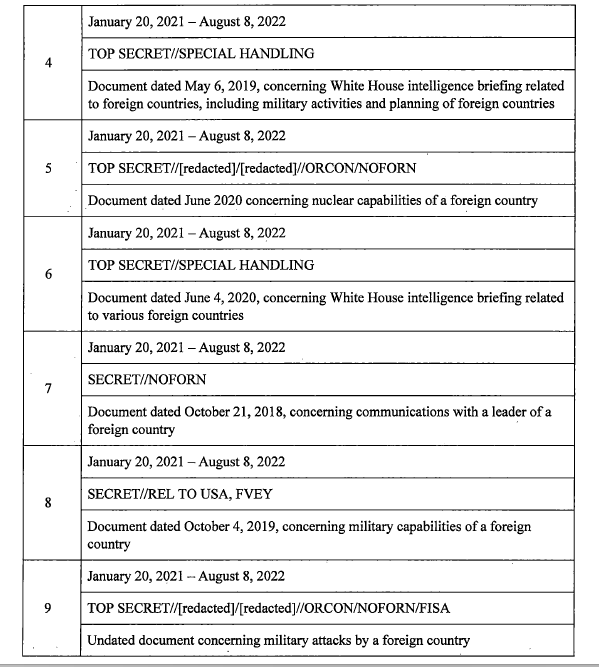
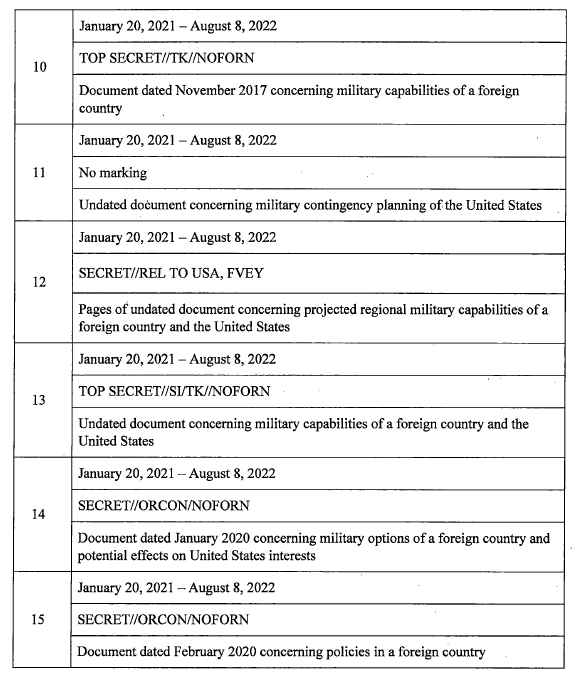
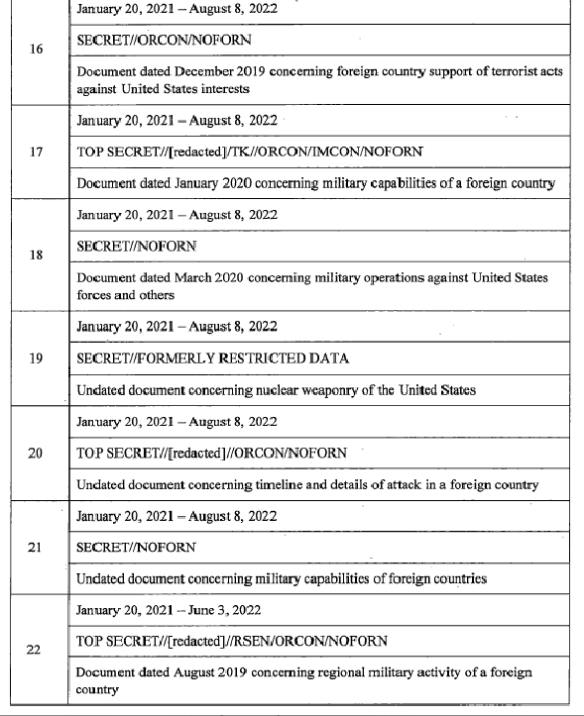
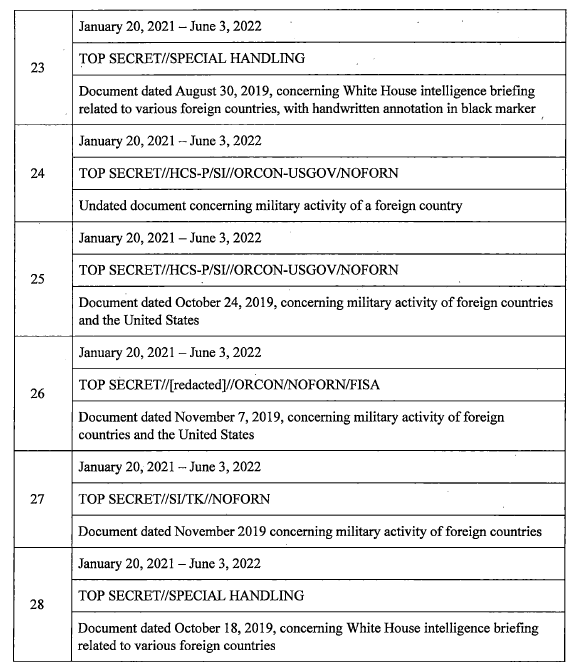
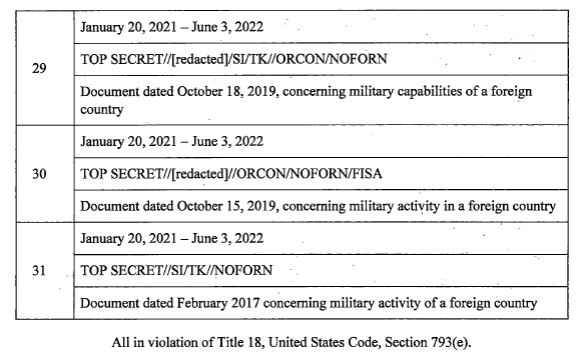
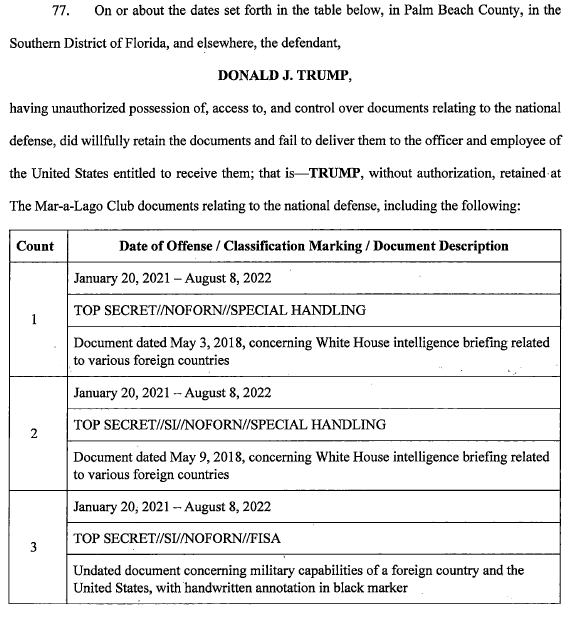
Finally, the part of the indictment that mainly describes the movement and concealment  of boxes, which goes from page 17 to page 26, is kind of boring, but one of the things after that is very interesting. I don’t think anybody in the government knows if the defendant is still holding on to stuff he shouldn’t have. It’s also possible the prosecutors didn’t list the most sensitive documents he took (it would make the U.S. government’s ability to keep secrets look even worse). But take a look at the documents listed:

Untitled1Untitled2

Untitled3Untitled4Untitled5Untitled6

I Intend To Never Mention This Again

Whitewater. Her emails. Our latest fake scandal can’t possibly generate as much bullshit as those two. Nevertheless, it’s worth being reminded of a few simple facts. Jonathan Chait of New York Magazine does the reminding with “Biden’s Document Blunder Is Nothing Like Trump’s Crime”:

The sweet spot for D____ T____’s allies has always been when they can justify his abuses and crimes through misdirected comparisons rather than direct defense. Did T____ extort Ukraine into smearing his opponent? Well, Ted Kennedy once did something kind of like this. Did T____ try to stay in office after losing the election? Maybe so, but let us tell you about the time a Democrat registered an objection to the Electoral College count in Congress.

The key aspect of these arguments is exaggeration, not fabrication. They seize on real events, often genuinely bad things done by other politicians, then use them as pretext to dismiss actions by Trump of a vastly greater order of magnitude.

As many people have very neutrally pointed out, the news that President Biden held on to classified documents is pure manna for T____’s defenders. It gives them a set of facts to work with that, if examined without any of the important context, can be spun to the willfully credulous as evidence that these men have committed similar crimes.

“There’s no good case for putting a President in prison — much less making two Presidents into cellmates — for improperly retaining materials from recent public office,” intones The Wall Street Journal. “When Mr. T____ was out on a limb by himself, this point was less obvious to some of our media competitors. Now that Mr. Biden faces a similar inquiry, perhaps they see how ridiculous it is.”

But T____ is not potentially facing charges because he improperly took classified documents. It’s because when the government found out about the documents, he refused to give them back and — allegedly — took steps to hide them from the FBI. This is not a small twist on the same crime. It is the crime.

You might say, in T____s defense, that he had no underlying motive to hold on to the documents — that is, they didn’t contain any national-security secrets he planned to sell or incriminating information he wished to hoard. That is probably true. The motive instead seems to be that T____ does not believe the law applies to him.

This is how he has operated for his entire career. He cheats, lies, and steals in the expectation that he can brazen out any consequences. He can simply refuse to let Black people rent an apartment or pay contractors what he promised them or lie to his lenders about his worth, and whatever cost he faces will be worth it. The reason his document theft rose to the level of a federal crime was that he applied this method to behavior that is covered by the federal criminal code and handled by prosecutors he can’t necessarily bully or bribe into submission.

When T____’s allies moan about his supposedly unfair treatment, the distinction is hiding in plain sight of their complaints. “Where’s the raid? Where’s the pictures of the classified documents? Where’s the special counsel?” demands Jim Jordan.

“Why hasn’t the FBI raided Joe Biden’s home?” asks Dan Crenshaw.

The obvious answer is that Biden didn’t refuse to give back the documents. Indeed, his lawyers volunteered that they had the documents and turned them over immediately. There was nothing to raid.

If T____’s lawyers had informed the National Archives that he’d mistakenly taken classified documents, or even if they had responded to requests from the archives by turning them over, the FBI never would have been involved. The documents themselves would never have become a criminal matter if T____ had complied with the law. It became one because he flagrantly refused to follow the law, which happened because T____ is a criminal.

The whole thrust of T____ist propaganda has been to act as though normal politicians making normal blunders are criminals in order to justify handing the presidency to a lifelong crook. T____ is not a smart man but shrewd enough to comprehend that his party is fully invested in a narrative of Democratic evil that compels them to deem anything he’s done, however wrong or illegal, as no different than the actions of any other powerful man. If T____ shot somebody on Fifth Avenue, Republicans would start talking about [anything else].

Meanwhile, the deputy opinion editor of the Washington Post argued today that — although Biden’s situation is clearly different — the Department of Justice shouldn’t prosecute the former president/unindicted co-conspirator/lifelong con man and scofflaw, since the Department’s “credibility rests on being perceived to play fair” and millions of Republicans won’t think it’s fair that only their guy is prosecuted. The Post’s deputy opinion editor isn’t equally concerned about the credibility of a Department of Justice that doesn’t prosecute somebody for serious crimes because his supporters will be angry.