No More Bad Bailouts

An opinion piece from The Boston Globe describes a policy a sensible government would adopt:

Twice in a dozen years, Congress has undertaken enormous bailouts to rescue companies and individuals in the economy. In 2008, the federal government drafted legislation on the fly that bailed out the big financial institutions, but left many homeowners drowning with underwater mortgages. Amid popular outcry, Congress then promised to end bailouts forever with the passage of the Dodd-Frank Wall Street Reform Act in 2010.

Less than a decade later, Congress has authorized an even more enormous bailout. This time, the legislative process has been even more complicated. Congress once again scrambled, drafting legislation to address both the public health and economic emergencies stemming from COVID-19. So far it has rushed through five separate relief bills in a matter of months because each successive bill was insufficient to address not only the public health crisis but also the economic crisis. Congress will now likely take up a sixth bill in late July [assuming Sen. Turtle Face, the Kentucky Republican, agrees], in part to deal with the imminent expiration of expanded unemployment insurance benefits.

Once again, the rescue legislation has been a bonanza for lobbyists, financial institutions, and big businesses, which have been able to get access to financing relatively swiftly and with few conditions. Once again, the public is left wondering where all the money went. And once again, workers and Main Street businesses have been relegated to second-class status. Small businesses have struggled to get limited rescue funds under the Paycheck Protection Act. Even with trillions of dollars going out the door, 40 million Americans remain out of work. The public health crisis continues, as testing remains woefully limited and incidence of the virus is growing in many parts of the country. Communities of color have been hit especially hard, setting back efforts to expand equality and opportunity.

This ad hoc approach to responding to economic crises is inefficient at best and malpractice at worst. Emergency response and disaster management professionals do not “wing it” every time there is a forest fire or a hurricane. They prepare in advance, developing policies and procedures so they can react swiftly and effectively. When Congress starts thinking about a response only after an economic crisis starts, it’s no surprise that the response isn’t very effective.

Policymakers should take a page from the disaster response playbook. Economic crises are emergencies, and just like with a fire or a hurricane, many aspects of a response can be anticipated — unemployment, income shocks, and liquidity constraints. What we need, therefore, is a standing set of procedures and policies — an emergency economic resilience and stabilization law that can be activated when a crisis hits.

The benefits of this approach are significant. Congress could respond to economic emergencies more quickly because it wouldn’t need to reinvent the wheel every time there is a crisis. Executive branch agencies would also be able to anticipate the administrative capacities needed to implement the program. And individuals and businesses would have a good sense of what happens during a crisis, reducing fear and uncertainty.

Because the standing law would address the major foreseeable problems, Congress could focus its attention on the unique causes of the specific downturn. In the case of COVID-19, for example, Congress would have been able to spend much of the spring focused on the public health aspect of the crisis, such as facilitating production of tests and establishing a contact tracing system.

A standing program would also reshape the political dynamics around rescue legislation. In the fog of an economic crisis, lobbyists see a bonanza: a chance to stuff goodies for their clients into must-pass legislation. Members of Congress who simply want good governance can end up using their limited political capital fighting off such bad policies or ensuring that uncontroversial provisions make it into the final bill rather than advancing the best policies.

While Congress would be free to change the economic resilience program even in the midst of a crisis, the fact that a program already exists would require members to explain any divergences. There would likely be fewer concerns about lobbying, favoritism, and corruption because the rules would be written without anyone knowing which particular companies need help—or which lobbied hardest. So what might such a program look like? We think it should have four parts.

First, it would end no-strings-attached bailouts by providing a restructuring process for large or publicly traded companies. The companies would have the option to get funding from the US government, but their shareholders would be wiped out. Their debt would be converted into equity — meaning the company would now be owned by its lenders and by the federal government, which would get a preferred equity stake. Alternatively, companies would still have the option to pursue a traditional restructuring in bankruptcy, but without federal aid.

Second, there would be a program for smaller businesses to cover payroll and operating expenses to prevent mass layoffs and closures on Main Street. The small business program would be akin to what Congress attempted with the Paycheck Protection Program, but with direct payroll subsidies for employers to maintain payroll and cover operating expenses, rather than operating through banks as third-party intermediaries.

Third, there would be reforms to the financial system infrastructure so that every person or business could get an account to which emergency government payments could immediately be credited. That would make it possible for people and businesses to get direct payments, like checks, much more quickly than they have in this crisis.

Finally, the program would include “automatic stabilizers,” a wonky term for policies that are automatically triggered based on data, rather than relying on repeated and recurrent congressional action. In the event of an economic crisis like the crash in 2008 or COVID-19 this past spring, funding for state and local governments, for example, would automatically kick in and would continue until the economy has bounced back.

A standing economic resilience program like this one is possible for a simple reason. We can predict many of the policy responses that are needed in a crisis. While every crisis undoubtedly has its own unique trigger and features, the next time won’t be very different. Rather than live through another round of ad hoc bailouts for the wealthy and powerful and suffering for everyone else, Congress should get prepared, so our country’s response to the next crisis can be quicker, fairer, and more effective.

Unquote.

This week the government was forced to identify some of the “small businesses” that received stimulus money. They included top law firms, the Secretary of the Treasury’s family business, several chains with wealthy private-equity investors, twenty-two tenants of an office building owned by the president, Kanye West’s company, the Ayn Rand Institute and the Archdiocese of New York. 

It would be cynical to say a sensible policy like this would never, ever happen in a country like ours.

(It would probably never happen in a country like ours.)
“Mild” Is Sometimes Damn Bad

Mildness is relative. From The Guardian:

Conventional wisdom suggests that when a sickness is mild, it’s not too much to worry about. But if you’re taking comfort in World Health Organization reports that over 80% of global Covid-19 cases are mild or asymptomatic, think again. As virologists race to understand the biomechanics of Sars-CoV-2, one thing is becoming increasingly clear: even “mild” cases can be more complicated, dangerous and harder to shake than many first thought.

Throughout the pandemic, a notion has persevered that people who have “mild” cases of Covid-19 and do not require an ICU stay or the use of a ventilator are spared from serious health repercussions. Just last week, . . . the US vice-president claimed it’s “a good thing” that nearly half of the new Covid-19 cases surging in 16 states are young Americans, who are at less risk of becoming severely ill than their older counterparts. This kind of rhetoric would lead you to believe that the ordeal of “mildly infected” patients ends within two weeks of becoming ill, at which point they recover and everything goes back to normal.

While that may be the case for some people who get Covid-19, emerging medical research as well as anecdotal evidence from recovery support groups suggest that many survivors of “mild” Covid-19 are not so lucky. They experience lasting side-effects, and doctors are still trying to understand the ramifications.

Some of these side effects can be fatal. Otherwise healthy people who thought they had recovered from coronavirus are reporting persistent and strange symptoms – including strokes.

According to Dr Christopher Kellner, a professor of neurosurgery at Mount Sinai hospital in New York, “mild” cases of Covid-19 in which the patient was not hospitalized for the virus have been linked to blood clotting and severe strokes in people as young as 30. In May, Kellner told Healthline that Mount Sinai had implemented a plan to give anticoagulant drugs to people with Covid-19 to prevent the strokes they were seeing in “younger patients with no or mild symptoms”.

Doctors now know that Covid-19 not only affects the lungs and blood, but kidneys, liver and brain – the last potentially resulting in chronic fatigue and depression, among other symptoms. Although the virus is not yet old enough for long-term effects on those organs to be well understood, they may manifest regardless of whether a patient ever required hospitalization, hindering their recovery process.

Another troubling phenomenon now coming into focus is that of “long-haul” Covid-19 sufferers – people whose experience of the illness has lasted months. For a Dutch report published earlier this month (an excerpt is translated here) researchers surveyed 1,622 Covid-19 patients with an average age of 53, who reported a number of enduring symptoms, including intense fatigue (88%) persistent shortness of breath (75%) and chest pressure (45%). Ninety-one per cent of the patients weren’t hospitalized, suggesting they suffered these side-effects despite their cases of Covid-19 qualifying as “mild”. While 85% of the surveyed patients considered themselves generally healthy before having Covid-19, only 6% still did so one month or more after getting the virus. . . .

“To me, and I think most people, the definition of ‘mild’, passed down from the WHO and other authorities, meant any case that didn’t require hospitalization at all, that anyone who wasn’t hospitalized was just going to have a small cold and could take care of it at home,” [said ] Hannah Davis, the author of a patient-led survey. “From my point of view, this has been a really harmful narrative and absolutely has misinformed the public. . . .

At this stage, when medical professionals and the public alike are learning about Covid-19 as the pandemic unfolds, it’s important to keep in mind how little we truly know about this vastly complicated [and highly contagious] disease . . . .

Unquote.

Broadway actor Nick Cordero, 41, died yesterday after 90 days in the hospital. According to The Guardian, “Cordero entered the emergency room on 30 March and had a succession of health setbacks including mini-strokes, blood clots, sepsis infections, a tracheostomy and a temporary pacemaker implant. He had been on a ventilator and unconscious and had his right leg amputated. A double lung transplant was being explored”.

But remember, he said we’re getting it under control.

“To reduce the incidence or severity of, especially to innocuous levels”

“We have it totally under control,” President Txxxx said in late January. A month later: “The coronavirus is very much under control in the USA”. . . .

The virus is “getting under control,” he said Wednesday.

As reported tonight by The Washington Post, The New York Times and The Los Angeles Times:

The seven-day average for daily new cases in the United States reached a record high — 49,600 — for the 27th straight day.

Thirteen states reported new highs in their seven-day averages. South Carolina, Texas, Arizona, Nevada and California reported record numbers of current Covid-19 hospitalizations.

After Texas reported another single-day record for new cases over the weekend, Austin Mayor Steve Adler said there won’t be enough medical personnel to keep up with the spike in cases if the rate of increase continued unabated in his city. Intensive care units in the city could be overflowing within 10 days. He currently lacks the authority to impose a shelter-in-place order for the city.

Houston Mayor Sylvester Turner said hospitals in his city face staffing shortages as demand for ICU beds is increasing exponentially. Demand for testing has also outstripped the city’s capacity, he said, and the positivity rate has soared from 10 percent a month ago to 25 percent recently.

Mayor Kate Gallego of Phoenix said that with cases and death counts soaring in Arizona, testing sites in her city and surrounding Maricopa County are overwhelmed, but the Federal Emergency Management Agency has rebuffed her pleas for help. More than 20 percent of tests in Arizona are coming back positive now, Gallego said. “Public health officials tell me that when you’re doing the appropriate amount of testing, it should be around 2 percent,” she said.

Gallego said federal officials had dismissed her requests to conduct community-based testing in the area after people reported waiting in line for six hours at some testing sites. “We were told they’re moving away from that,” she said, “which feels like they are declaring victory while we’re still in crisis mode”. An aide to the mayor said that FEMA had responded to the city’s most recent request by saying the agency was “getting out of the testing business”.

In Florida, new cases exceeded 10,000 in a day on Sunday for the third time in the past week, after the state posted a record high of 11,400 the previous day. The new infections pushed the state’s total caseload past 200,000, a mark passed by just two other states, New York and California.

Miami Mayor Francis X. Suarez said it was “clear that the growth is exponential at this point. . . It’s extremely worrisome”, noting that positivity rates in Miami-Dade County — the share of tests that come back positive — were also now above 20 percent.

Los Angeles County officials reported more than 3,000 cases for Friday — the highest daily total since the pandemic began. The number of hospital patients with confirmed coronavirus infections jumped 41% in the last three weeks. As of Saturday, there were 1,900 people hospitalized in L.A. County with confirmed cases; 28% of those people were in the ICU and 18% were on ventilators. Officials warned last week about “alarming increases in positivity rates and hospitalizations” and projected the possibility of running out of hospital beds in two to three weeks.

The country’s seven-day average of new deaths did fall, but health experts cautioned that the count of infections would soon drive the number back up.

In addition, the death rate does not capture all of the harm caused by the disease. As many as 15 to 20 percent of known Covid-19 patients may require hospitalization, and of the group admitted, 15 to 20 percent are transferred into intensive care, according to some estimates. Many who have recovered are still struggling to regain their pre-disease lives, and may face long-term health issues.

“The virus is getting under control”, he said.

On Not Having a Good Time

A philosophical anecdote from Witcraft, a book by Jonathan Rée:

Kierkegaards’s works were not available in English when Wittgenstein started teaching at Cambridge, but he encouraged his students to read him if they could, especially on questions of ethics. Kierkegaard, according to Wittgenstein, reminded us that we must choose between alternative ways of living, some based on sensual pleasure, others on ethical renunciation, still other on religious rejoicing; but these “categories of life-style”, as Wittgenstein called them, were so different as to be “incommensurable” [they have no common standard of measurement], and if we took our choice seriously we would realize that it must issue from unfathomable anguish rather than dispassionate observation or calm reason. “Mind you I don’t believe what Kierkegaard believed, ” he said, “but of this I am certain, that we are not here in order to have a good time” [607].

Speaking of which, The Guardian reports that “doctors are seeing more and more young patients”:

Until recently, the majority of coronavirus cases that Dr Quinn Snyder, an emergency doctor at one of Arizona’s largest emergency departments, saw were older people. But since mid-May, when the state’s stay-at-home order was lifted, and particularly after the Memorial Day holiday, the demographic has shifted. Snyder says he has seen an “explosion” in cases among 20-44-year-olds.

Some of those, he said, are coming in severely ill – requiring oxygen, intubation and ventilators. “We even had people in that age group die, unfortunately. So it’s very troubling and it’s very difficult to watch young people die from this disease. It’s horrible.”

As cases continue to soar at record levels across the US, which now has over 2.6m cases, there is growing alarm about a surge in younger people getting the virus. On Friday, [the vice president] said half of new cases in the US in recent weeks were adults under 35.

Speaking ahead of the Fourth of July holiday weekend, health experts in hotspot states – which include Arizona, Texas and Florida – warned numbers will continue to rise and that if young people do not take better precautions, hospitals will reach capacity and states could be left with no choice but to completely shut down.

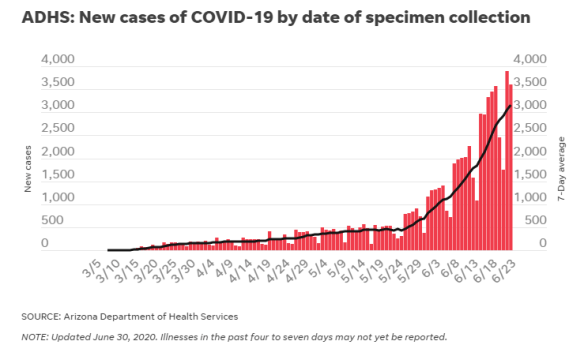
Untitled

ADHS is the Arizona Department of Health Services.


America the Extraordinary

“Reddit shut down its popular but controversial forum devoted to supporting President Txxxx on Monday, following years in which the social media company tried but often failed to control the racism, misogyny, anti-Semitism, glorification of violence and conspiracy theories that flourished there” (The Washington Post).

“The US is ‘unlikely’ to achieve herd immunity to the coronavirus even with a vaccine, according to the country’s leading public health expert, who warned that a ‘general anti-science, anti-authority, anti-vaccine feeling’ is likely to thwart vaccination efforts. In an interview with CNN, Dr Anthony Fauci also said people not wearing masks was ‘a recipe for disaster’”… (The Guardian).

“The videos are now showing up in your social media feed every hour or two, each one more over-the-top than the one before — viral missives from a world that seems to have gone mad and yet somehow exists right in our backyard. These ‘forgotten Americans’ are at the lectern at your county commission meeting if they’re not yelling at you in the produce aisle — screaming that the elected officials and their so-called scientific experts demanding they wear a mask to prevent the spread of coronavirus are really part of a vast conspiracy to take away their freedoms” (Will Bunch for The Philadelphia Inquirer).

Mr. Bunch continues:

It was another great day for liberty — and yet a horrible one for tens of thousands of Americans who now may die needlessly because so many cling to a warped idea of freedom that apparently means not caring whether others in your community get sick.

The reality is that those devil-worshiping elected officials and their mad scientists are trying to mandate masks in public for the same reasons they don’t let 12-year-olds drive and they close bars at 2 a.m.: They actually want to keep their constituents alive.

There’s a plethora of reasons why countries across Europe — even Boris Johnson’s United Kingdom, for God’s sake — crushed their coronavirus curve while the United States didn’t. Their shutdowns were somewhat longer, their reopenings came with better testing and contact tracing, their leaders set good examples, and their people showed common sense about social distancing and masks. But especially masks.

The most comprehensive study published in the journal Lancet found mask-wearing could reduce the risk of coronavirus transmission from 17% to 3%. No wonder the University of Washington says universal mask-wearing in the United States would reduce the coronavirus death toll between now and October by a whopping 33,000 human beings.

Just think of all the restrictions on freedom and liberty — from the government seeing what you checked out at the library to invasive searches at the airport — to prevent another attack like 9/11 that killed 3,000 people, or less than one-tenth the toll from not wearing masks. But for millions of Americans — not a majority, mind you, but enough to cause a public-health hazard in a pandemic — the idea of masks has been launched into a different orbit where freedom talk is injected with the uniquely American viruses of free-market capitalism and media manipulation, maybe with a dollop of white supremacy….

But … too much of the warped notion of freedom promoted by the aggressively not-mask-wearing President Txxxx and his No. 2, Mike Pence, and their prophets like Rush Limbaugh and Sean Hannity won’t just get you high — to continue with the Sweet analogy — but could also kill you by an overdose. What the radio hucksters, and the wannabe dictators they installed, won’t tell you is that freedom without any social responsibility or empathy for others is ultimately hollow.

But let’s remember that American people — even the damaged souls that you’re laughing at on Twitter today — didn’t pervert the meaning of freedom on their own. The warped modern version of liberty was sold to them, first by right-wing public intellectuals like Ayn Rand, who killed thousands of trees to wrap unbridled selfishness in her endless tomes about freedom, and later by the salesmen of Big Capitalism.

Protecting your freedom became the ideal branding for what these pitchmen really wanted, which was political cover to dramatically lower taxes on millionaires (who, thanks to that, would become billionaires) and to crush unions and their demands for higher pay, freeing up profits to now pay CEOs 350 times what the average worker makes. Talk about finding the cost of freedom! With the help of academics like the Nobel economist James McGill Buchanan, backed by billionaires like the Koch brothers, warped freedom capitalism got a fancy name — free-market libertarianism…..

Confronted with scientific realities like man-made climate change, the forces of conservative libertarianism turned their guns toward expertise, with the goals of thwarting environmentalism and keeping corporate profits high. The bills for global warming are starting to come due, but that has been superseded for the time being by the COVID-19 crisis; the lack of trust for medical expertise from Main Street all the way to an ignorant president whom 62 million Main Streeters installed at 1600 Pennsylvania Avenue has proved lethal.

No other nation has botched its coronavirus response so badly because no other nation holds science in such low esteem. “Who made you perpetrators over my life?” the self-proclaimed Txxxx Girl demanded of the experts at the Palm Beach County meeting. In a recent Washington Post op-ed, Stanford psychiatry prof Keith Humphreys noted that the United States simply can’t impose a coronavirus testing regimen like South Korea or Singapore because we don’t trust the government on public health. “Clusters of gun-toting protesters opposing public health measures are a real — and uniquely American — problem,” he wrote, “but it’s the much more prevalent distrust in government’s role in public health that would curtail the success of any test, trace and isolate program.”

In a functioning society, freedom can flourish when it’s part of a broader social compact, when liberty is not abused because its practitioners also see themselves as part of a community, where they care about others — even, or especially, when it comes to wearing a mask and not spreading germs to your neighbor. But has there ever been a branding campaign as successful as America repackaging selfishness, self-interest, and extreme inequality as personal freedom?

That’s even true of the freedom that’s so central to my work life: the free press that exists under the First Amendment. I’ve seen how that only works well when publishers fuel their press freedom with common sense and an understanding of responsibility to the readers. In the internet age, the promise of an even greater media freedom has been polluted by billionaires from Fox’s Rupert Murdoch to Facebook’s Mark Zuckerberg, who made bigger profits off lies and unchecked conspiracy theories than off fact-checking in the public interest. The filth of Zuckerberg’s Facebook is what’s spewing, unmasked, from the self-styled “patriots” of Palm Beach County….

As the global pandemic advanced and as evidence mounted that COVID-19 is most lethal not just for the elderly but also for Black and brown Americans, it seems clear that for some white people, not wearing a mask isn’t just a freedom song but a defiant proclamation of their superiority. That’s validated every day by America’s white-supremacist-in-chief, whose refusal to wear a mask in public is in fact a different kind of mask, one of his deep insecurity. This toxic blend of narcissism and white privilege is Dxxxx Txxxx’s idea of leadership — even as he leads some of his voters to an early grave.

The flip side is that the millions who’ve marched in America’s streets after George Floyd’s murder — many, although not all, from the under-35 generation — are making the case that a better world, built around empathy and compassion for people who don’t look like ourselves, is coming. They are using their freedom of speech and assembly to forge a more perfect union, and I fervently wish that the 33,000 Americans who may be doomed by a lethal injection of phony liberty can somehow live to see it.