Small States and Minority Rule

Every four years we elect a president. Almost every four years, we discuss the Electoral College. From Jesse Wegman of The New York Times:

As the 538 members of the Electoral College gather on Monday to carry out their constitutional duty and officially elect Joe Biden as the nation’s 46th president and Kamala Harris as his vice president, we are confronted again with the jarring reminder that it could easily have gone the other way. We came within a hairbreadth of re-electing a man who finished more than seven million votes behind his opponent — and we nearly repeated the shock of 2016, when Dxxxx Txxxx took office after coming in a distant second in the balloting.

No other election in the country is run like this. But why not? That question has been nagging at me for the past few years, particularly in the weeks since Election Day, as I’ve watched with morbid fascination the ludicrous effort by Mr. Txxxx and his allies to use the Electoral College to subvert the will of the majority of American voters and overturn an election that he lost.

The obvious answer is that, for the most part, we abide by the principle of majority rule. . . . 

In the last 20 years, Republicans have been gifted the White House while losing the popular vote twice, and it came distressingly close to happening for a third time this year. 

Since 2000, we’ve had six presidential elections. The candidate who got the most votes only won four of them. This year, shifting 44,000 votes to the loser in Arizona, Georgia and Wisconsin would have resulted in a 269-269 tie in the Electoral College. That would have moved the election to the House of Representatives, where each state’s delegation gets one vote, regardless of population. Since most states have Republican-majority representation in the House — even though the House has more Democrats — DDT would have presumably been re-elected, hard as that is to imagine. 

Among the comments the Times article received, one person said the Electoral College is fine, since we’re a collection of states, the United States of America, not a collection of citizens. He said it’s only fair that we pick a president based on which states the candidates win, not how many votes they get. Besides, he added, votes in the Electoral College are “roughly” assigned by population.

I don’t agree that because we’re called the United States, we should ignore majority rule when it coms to picking a president. After all, the states we live in are supposed to be “united”. But his statement about the Electoral College being “roughly” based on population made me wonder.

How would the 2020 election have turned out if votes in the Electoral College were “precisely” assigned by population, instead of “roughly”? Today, the largest state, California, gets 55 electoral votes and the smallest state, Wyoming, gets 3. But California’s population is 68 times Wyoming’s. So if the Electoral College were precisely allocated by population, California would get 204 electoral votes, not 55. Quite a difference. The next largest state, Texas, would get 150 instead of 38.

Would that have made the result in the Electoral College much different? It was surprising to see that it wouldn’t. If you do the same precise arithmetic for all 50 states and the District of Columbia, Joe Biden receives 974 electoral votes instead of 306 and DDT gets 730 instead of 232. That looks like a big difference, but the percentages are about the same. Biden would get 57.2% of the electoral votes with the precise arithmetic and 56.9% with the rough arithmetic. It works out that way because some big states, like California and New York, went for Biden and some, like Texas and Florida, went for DDT. When you average it all out, the Electoral College result would be about the same either way.

There would be a big difference, however. Big states would be much more important in the Electoral College than small states. If California got 204 electoral votes instead of 55, it would make even less difference who won a bunch of little states like Wyoming, Vermont and Alaska. In fact, assuming precise arithmetic, the 25 largest states would get 1,423 electoral votes vs. 288 for the 25 smallest. 

What this shows is that the current Electoral College is significantly skewed to benefit smaller states. Voters in those states play a bigger role than they should, based on how few of them there are. Being precise about population wouldn’t necessarily change the winner every time, but a more accurate Electoral College would reflect where people actually live in these “united” states. It would also reflect the cultural divisions in this country, since smaller states tend to be more rural.

Unfortunately, it’s not just the Electoral College that is skewed toward smaller states. According to the Constitution, each state gets as many votes in the Electoral College as it has members of Congress. Wyoming gets three electoral votes because it has two people in the Senate and one in the House of Representatives. California gets 55 electoral votes because it has two senators and 53 representatives in the House. If seats in Congress were precisely allocated by population, California would still have two senators, but it would elect almost four times as many members of the House of Representatives as Wyoming. The ratio in the House would be California’s 202 to Wyoming’s one, not 53 to one.

If the makeup of the House of Representatives isn’t unfair enough, consider the US Senate. Each state, regardless of population, gets two senators. It was designed to give small states the same representation as big states, so each state, regardless of population, gets to elect two. Maybe that made sense when there were only 13 states and they were relatively close in population. Now we have 50 states with a very wide range of populations.

In 1790, for example, the largest state, Virginia, had 13 times as many people as the smallest, Delaware. Today, as noted above, California has 68 times more people than Wyoming. Furthermore, the 50 members of the Senate from the largest 25 states represent almost 275 million people. The 50 senators from the smallest 25 states represent 49 million.

The imbalance is made even worse by the fact that the Senate is responsible for approving nominations to the Executive Branch (including all the officials in the president’s cabinet) and the federal judiciary (including the Supreme Court), as well as approving treaties. Because of the way senators were to be chosen, the authors of the Constitution assumed that members of the Senate would be more responsible than the unruly members of the House of Representatives. That’s hardly the case today.

In addition, smaller states, which tend to more rural, tend to vote for Republicans. Of the 25 largest states, 15 voted for Biden and 10 for his opponent. Of the 25 smallest, 10 voted for Biden and 15 for the other guy. That’s why the Senate is where progressive legislation goes to die and liberal nominees fall into comas waiting to be approved.

Add this all up and it’s easy to see that a Constitution written in 1789 doesn’t work very well for a large, complicated country in 2020. The Senate is skewed to benefit smaller, more Republican states, while the House of Representatives and the Electoral College, which chooses the president, are skewed the same way, although less so. This unfairness explains why Hillary Clinton could beat her opponent by 3 million votes and lose, why Joe Biden could beat the same opponent by 7 million votes but not necessarily win, and why forward-looking legislation that would make the United States a much better place to live has so little chance of success. Maybe shifting demographics will eventually help, but in the short run, we have to assume the United States will be subject to minority rule from Washington in important ways and much too often. 
Let This Sink In

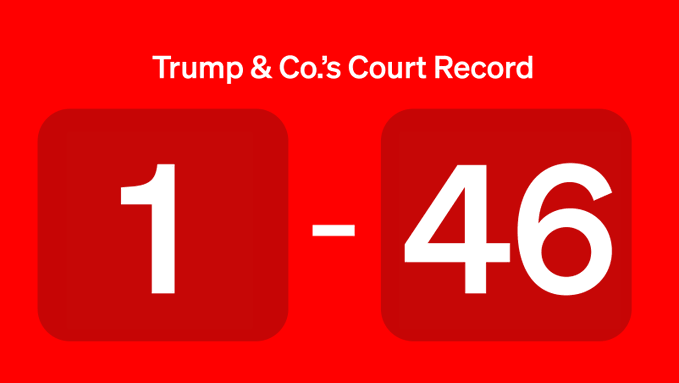
The president and members of his political party continue to file frivolous lawsuits attacking the results of the election, despite an overwhelming series of losses.

EobohfBU0AAAytD

From The New York Times:

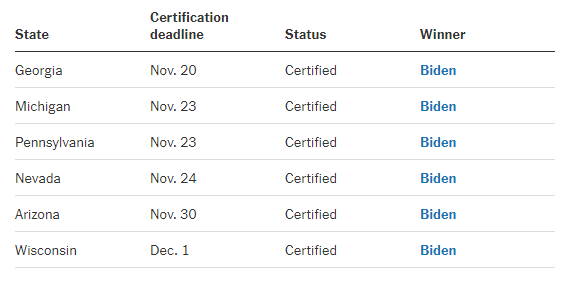
The . . . campaign’s unsuccessful strategy was to try to delay the certification processes in the key battleground states that President-elect Joseph R. Biden Jr. won. As of Monday, Nov. 30, all of those states had certified their results.

Untitled

From Wired:

On December 14, Electoral College members will formally cast their votes based on their states’ certified results, resolving any possible ambiguity that Biden is the president-elect.

“It’s [officially] over on December 14,” says Elaine Kamarck, director of the Brookings Institute’s Center for Effective Public Management . . . . “We forget that the electors are actual people, but they go to their state capitals and sign their ballots. Then the US Senate opens them, reads them out, and does the count on January 6, but there’s nothing else the Senate can do. Once they’re signed on the 14th and are on their way to Washington, that’s the end of the game.”

From The Washington Post:

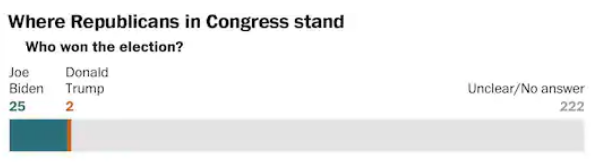
Just 25 [out of 249] congressional Republicans acknowledge Joe Biden’s win over President Txxxx a month after the former vice president’s clear victory of more than 7 million votes nationally and a convincing electoral-vote margin that exactly matched Txxxx’s 2016 tally.

Two Republicans consider Txxxx the winner despite all evidence showing otherwise. And another 222 GOP members of the House and Senate — nearly 90 percent of all Republicans serving in Congress — will simply not say who won the election.

Those are the findings of a Washington Post survey of all 249 Republicans in the House and Senate . . . 

The results demonstrate the fear that most Republicans have of the outgoing president and his grip on the party, despite his new status as just the third incumbent to lose reelection in the last 80 years. More than 70 percent of Republican lawmakers did not acknowledge The Post’s questions as of Friday evening. . . .

Of the 14 House Republicans who recognize the true winner, six are retiring from politics at the end of this month . . . 

Untitled

When Joe Biden is inaugurated as our 47th president on January 20th, the Orange Menace will still have ten tiny fingers and a Twitter account.

Making the Supreme Court More (Small “d”) Democratic

The fundamental objection to the Supreme Court’s powers . . . is that no one concerned to establish a democratic state would bestow on nine judges, appointed for life at the whim of the pre­sident, powers to determine society’s governing norms.

That’s from an Oxford fellow’s London Review of Books article about America’s Supreme Court, which now includes six Republicans (five of whom are Catholics) and three Democrats (one of whom is). The article continues:

Some progressives have begun to argue that the court’s problems can be fixed only if its powers are reduced. One possibility would be to introduce term limits for judges. This, though, wouldn’t limit their powers.

But the Constitution says federal judges “shall hold their offices during good behaviour”. That seems to mean term limits would require a constitutional amendment, which would be unlikely to pass when the Court is so unbalanced. Republicans wouldn’t agree to give up their big advantage.

Another suggestion is to change the voting rules on the court. Continental legal systems often require unanimity among the judges in all decisions. In the US, if the justices were unable to reach unanimous agreement, the lower court’s decision would be upheld. This already happens when an equal number of justices are in favour of and opposed to a ruling: the court can divide equally when . . . there are only eight members on the court, or when a justice recuses him or herself. A unanimity rule would not deprive the court of all its powers: between 1946 and 2009, 41 per cent of decisions were unanimous.

There is nothing in the Constitution that says how many votes are required for the Supreme Court to make a decision, so requiring a unanimous vote would merely require a new law, not a constitutional amendment. A Democratic president and Democratic Congress could easily make that happen, assuming a Democratic Senate got rid of the filibuster.

But it would mean that a single ideologue could exercise an outsized effect on individual decisions.

Some scholars propose a super-majority requirement, permitting one or two dissenters. That deprives the lone ideologue of ransom power, but it is also a conservative measure, entrenching the court’s existing decisions; the more controversial may never be overturned.

The proposal often mentioned is to enlarge the Court (so-called “court packing”). Congress and the President could add three Democrats, for example, creating a 12-member Court split evenly between the parties.

. . . When Franklin Roosevelt sought to pass progressive legislation during the Great Depression, the Supreme Court stymied his efforts by striking down key parts of the New Deal. In response, he resolved to appoint as many as six new justices. Roosevelt, for all his skills, was unable to get the measure through the Senate (though the court was chastened by his efforts). Pete Buttigieg revived the idea in his run for president, proposing an expansion from nine to 15 judges. There is no principled reason to settle on nine as the appropriate number of justices; the court initially had six, once had ten, and other Supreme Courts around the world often have more.

The author of the Guardian article thinks adding justices would be inadequate:

But ‘packing’ the court, even if it were politically feasible, still doesn’t address the problem of how to limit its powers. That said, the political confrontation it would generate might cause the justices to reconsider their attitudes to those powers. That would be no bad thing.

Chief Justice Roberts is apparently concerned that the Court’s right-wing activism may sometimes go too far. But depending on him or other justices to refrain from using all their power to carry out the Republican agenda is wishful thinking. Rather than waiting for the Republican majority to restrain itself, Congress should limit the Court’s powers. A University of Chicago law professor explained how last month in The Washington Post:

A new Democratic Congress could, for example, impose by ordinary statute a limit on the Supreme Court’s authority to declare federal legislation unconstitutional, permitting it to do so only by supermajority (say, 7-2) rather than the usual 5-4. In so doing, Congress would be using the same power it does to dictate how many justices constitute a quorum. This reform would implement, via voting rule, the sort of “clear error” approach to judicial review imagined by Harvard professor James Bradley Thayer in the late 1800s. Such a rule would permit a judicial veto in cases of uncontroversial constitutional violation (for example, an effort to reintroduce de jure segregation of schools or criminalizing the speech of political opponents) but otherwise require the court to stay its hand.

Alternatively, Congress and the president might (again by ordinary statute) “strip” the court of jurisdiction over constitutional challenges to specific legislation — the Green New Deal, for example, or HR1, the sweeping set of reforms first approved by the Democratic House in 2019 that includes establishing automatic voter registration, making Election Day a national holiday and ending partisan gerrymandering. (It could also strip its jurisdiction over whole areas of law, such as climate legislation). Here, Congress would be making use of its Article III power to decide what kinds of cases the Supreme Court may hear on appeal — the court has constitutionally mandated jurisdiction only over disputes between states and the like — as well as its authority to decide whether lower federal courts exist at all, and so what cases they are permitted to hear.

. . . The exact scope of Congress’s ability to strip jurisdiction remains controversial, and a recalcitrant court might resist. This is a situation in which additional sympathetic justices recently added to the court might be helpful; court packing, in other words, might pave the way for additional reforms. Whatever stance the court takes, the limits Congress may impose is a question that careful attention to the Constitution is unlikely to answer; rather, as with most of these disputes, the resolution would ultimately be political, as opposed to legal, with the political and judicial branches left to hash out a new status quo. As former dean of Stanford Law School Larry Kramer has observed: “The Constitution leaves room for countless political responses to an overreaching court” — including judicial impeachment, slashing the court’s budget, giving the justices onerous responsibilities or simply ignoring the court, as did Lincoln, after the Dred Scott case.

Conservatives made similar efforts at limiting the court’s authority in the 1970s and 1980s (backed by legal arguments from a young [John] Roberts, working as an attorney at the Department of Justice) — repeatedly introducing legislation to limit federal courts’ ability to adjudicate contentious cultural issues such as abortion and school prayer — and have made similar efforts since. Those efforts failed, in part because of a lack of support in the Senate, but one can imagine that a Democratic-controlled Senate might be exceptionally motivated to protect its potential legislative accomplishments from a hostile judiciary.

Given Republican rhetoric about unduly powerful courts, there’s a chance that at least some conservatives may embrace the cause of judicial disarmament (especially if liberal court-packing is the alternative). For both parties, of course, going down such a path would increase the stakes for who controls the political branches. Both sides would have to ratchet down the expectation that the Supreme Court would annul popular laws that they find distasteful — whether that means (on the right) a statute phasing out fossil fuel production or (on the left) a federal ban on affirmative action in higher education. In a democracy, however, that is exactly how things should be.

Unquote.

Seven days.

Attacking the Post Office Means It’s Time To Impeach the Bastard Again

Title 39 of the U.S. Code says:

The United States Postal Service shall be operated as a basic and fundamental service provided to the people by the Government of the United States, authorized by the Constitution, created by Act of Congress, and supported by the people. The Postal Service shall have as its basic function the obligation to provide postal services to bind the Nation together through the personal, educational, literary, and business correspondence of the people. It shall provide prompt, reliable, and efficient services to patrons in all areas and shall render postal services to all communities. The costs of establishing and maintaining the Postal Service shall not be apportioned to impair the overall value of such service to the people.

Title 18: says:

“Whoever knowingly and willfully obstructs or retards the passage of the mail, or any carrier or conveyance carrying the mail, shall be fined under this title or imprisoned not more than six months, or both.

The Washington Post reports:

President Txxxx says the U.S. Postal Service is incapable of facilitating mail-in voting because it cannot access the emergency funding he is blocking, and made clear that requests for additional aid were nonstarters in coronavirus relief negotiations.

Txxxx, who has been railing against mail-in balloting for months, said the cash-strapped agency’s enlarged role in the November election would perpetuate “one of the greatest frauds in history.” Speaking Wednesday at his daily pandemic news briefing, Txxxx said he would not approve $25 billion in emergency funding for the Postal Service, or $3.5 billion in supplemental funding for election resources, citing prohibitively high costs.

“They don’t have the money to do the universal mail-in voting. So therefore, they can’t do it, I guess,” Txxxx said. “Are they going to do it even if they don’t have the money?”

Quoting Paul Waldman of the Post:

The White House made sure that grants for the Postal Service would not be included in previous coronavirus pandemic rescue packages (“We told them very clearly that the president was not going to sign the bill if [money for the Postal Service] was in it,” an administration official told The Post in April), and as the problems at the Postal Service worsen seemingly by the day, Txxxx is sending the same message about any new rescue bill Congress might pass.

. . . Txxxx’s partner in the project to destroy the Postal Service is Postmaster General Louis DeJoy, the GOP megadonor who has given millions of dollars to the Txxxx campaign and the Republican Party, and has been on the job for just two months.

Soon after taking office, DeJoy ordered a series of changes in policy that shocked postal employees. He banned overtime and told carriers to leave mail behind at distribution centers, causing it to pile up day after day. Employees also report that sorting machines that help speed mail processing have been removed from postal facilities. The inevitable result has been slower delivery, with letters and packages arriving late and many Americans simply not getting their mail every day. You’ve probably noticed it yourself.

The implications for the election, with unprecedented numbers of Americans wary of going to polls in the midst of a pandemic, quickly became clear. As The Post reported last month, “Postal employees and union officials say the changes implemented by [DeJoy] are contributing to a growing perception that mail delays are the result of a political effort to undermine absentee voting” . .

I34 states, including the swing states of Arizona, Georgia, Maine, Michigan, Minnesota, New Hampshire, Pennsylvania and Wisconsin, ballots can’t just be postmarked by Election Day to count. It has to be received by Election Day. If you mail it three days before, thinking you did everything right, but it doesn’t arrive at the board of elections until the day after the election, it’s tossed in the trash.

This has all the makings of an election nightmare purposefully engineered by Txxxx and DeJoy. As they know full well, due to Txxxx’s relentless campaign to convince people that mail voting is inherently fraudulent (unless Republicans are doing it), Democrats are now far more likely to say they’re going to vote by mail.

This is election theft in progress. And as awful as that is, it’s made even more despicable by the fact that to rig the election, Txxxx is trying to murder a national treasure.

Unquote.

Txxxx swore an oath to faithfully execute his duties as president. If Congress can’t agree to do anything else, the House needs to impeach him again and the Senate needs to hold another trial. That will give this issue the publicity it deserves.

But since the federal government is now partly run as a criminal enterprise, if you can’t put your ballot in the mail weeks before the election, hand-deliver it to county officials or vote in person, like Sylvia Smiles, a 77-year-old retired teacher from Charleston, S.C., is going to do. I hope she also contacts her representatives in Congress!

Noam Chomsky called the Republican Party “the most dangerous organization in human history”, given it’s denial of climate change. We have an opportunity to damage it for years to come. Maybe we can even put it out of its misery. Together, let’s get it done this November.

There Is No “Congress”

It is true that the Constitution of the United States of America created a legislature. Its principal function is to make laws. It comprises the legislative branch of the federal government, the other two branches being the executive and the judicial.

The authors of the Constitution called this legislative branch “Congress”. They also divided this “Congress” into two parts.

Article I, Section 1:

All legislative Powers herein granted shall be vested in a Congress of the United States, which shall consist of a Senate and House of Representatives.

When a law or a change to a law is proposed, the Senate and the House of Representatives must both endorse the proposal in order for it to become official, i.e. “the law of the land”. (The Executive branch, embodied by a “President”, also gets to participate in the process. Sometimes the Judicial branch does too.)

So far, so good.

The Constitution nowhere mentions political parties, but it only took a few years for a “two-party system” to develop.

The Founding Fathers did not originally intend for American politics to be partisan. . . .  Alexander Hamilton and James Madison . . . wrote specifically about the dangers of domestic political factions. In addition, the first president, George Washington, was not a member of any political party . . . Furthermore, he hoped that political parties would not be formed, fearing conflict and stagnation . . .

Nevertheless, the beginnings of the American two-party system merged from his immediate circle of advisers. Hamilton and Madison . . .  ended up being the core leaders in this emerging party system. It was the split camps of Federalists, given rise with Hamilton as a leader, and Democratic-Republicans, with Madison and Thomas Jefferson at the helm . . . that created the environment in which partisanship, once distasteful, came to being [Wikipedia].

How does the two-party system affect Congress? If the majority in both the Senate and the House belong to the same party, it doesn’t make that much difference. If, say, the Racoon Party has the majority in both houses, there is general agreement on which laws to adopt (since senators serve for six years and representatives only serve for two, the members of the two houses sometimes have different priorities even when they belong to the same party).

But what if the Racoons are the majority in the Senate and the Otters are the majority in the House? Or the other way around? It is more difficult for the two majorities to agree on what the country’s laws should be. Sometimes it’s almost impossible.

Since 1857, when the Republicans joined the Democrats as one of America’s two major parties, there have been eighty-two sessions of Congress. By my count, the same party has controlled both houses of Congress sixty-six times, leaving sixteen sessions in which Congress has been divided. We are living through one of those sixteen sessions now, since the Democrats control the House and the Republicans control the Senate.

As we would expect, with two different parties in charge, things are not going well.

For example, the Democrat-led House agreed on legislation in May, almost three months ago, in order to deal with the suffering and disruption caused by Covid-19. Among other things, House Bill 6800 (unfortunately called “The Heroes Act”) would extend the $600 weekly increase in unemployment insurance, make another round of direct payments (up to $6,000 for a family), provide $25 billion to the U.S. Postal Service and increase aid to state and local governments.

The Republican-led Senate has not taken a vote on the House’s bill. Nor has the Senate proposed its own version of legislation to address the same issues (which would then be subject to negotiation with the House). The result is that the $600 increase in unemployment insurance agreed to earlier this year has lapsed. A moratorium on housing evictions is also ending.

So the country is in quite a pickle.

Now here’s what motivated me to express myself today. It’s a headline in The Washington Post.

Congress deeply unpopular again as gridlock on coronavirus relief has real-life consequences

Here’s one from USA Today.

Congress leaves town without a coronavirus stimulus deal, allowing $600 unemployment benefit to end

Here’s a classic example of the problem from an experienced New York Times reporter:

A conservative Republican House member profanely accosts a Democratic congresswoman as she strides up the Capitol steps to do her job during multiple national calamities.

With expanded jobless benefits supporting tens of millions of fearful Americans about to expire and a pandemic raging, Senate Republicans and the [Republican] White House cannot agree among themselves about how to respond, let alone begin to bargain with Democrats.

In a private party session, arch-conservative Republicans ambush their top female leader and demand her ouster over political and policy differences.

And that’s just the past few days.

By nearly any measure, Congress is a toxic mess . . .

Jonathan Chait is a columnist for New York Magazine. He referred to the problem twice in the past month:

If I could change one thing about political coverage, it would be the practice of attributing actions by one party to “Congress” [June 27].

The single worst practice in political journalism is attributing decisions by one party to “Congress” [July 26].

I’d make it “actions or inaction by one party”, but he made a very good point.

My suggestion is that when two different parties are in charge of Congress, people who write about politics for a living should make an effort to specify which party in which house is doing (or not doing) something. That would help readers understand where the dysfunction usually lies (hint: it’s not the Democratic side).

Since my suggesting this will have no effect, I’ll alternatively suggest that when we readers see references to Congress in times like this, we keep in mind that Congress has two parts and that one of those parts (same hint) is totally screwed up.

In fact, in times like this, “Congress” doesn’t really exist.