It’s Getting Worse, But A Few Republicans Could Make a Big Difference

The Washington Post reported last night that the President and his henchmen have been discussing his authority to grant pardons for members of his administration, his associates, his family members and even for himself, should any of them be at risk of criminal prosecution for a Federal crime. They are also discussing ways to interfere with special counsel Robert Mueller’s criminal investigation into the President’s Russian connection. The President is especially concerned that Mueller is reportedly examining DT’s tangled finances.

In a bizarre interview with The New York Times, the President left open the possibility that he might fire the special counsel if Mueller’s investigation goes too far, even though Mueller is authorized to investigate “any links and/or coordination between the Russian government and individuals associated with the campaign of President Donald Trump”, as well as other matters that “may arise directly from the investigation” (remember how an investigation into an Arkansas land deal led to questions about sex in the Oval Office?). 

Two observers drew the same scary conclusion from these reports. Brian Beutler of The New Republic writes:

The loud hum of chaos and spectacle engulfing the Trump administration is drowning out a creeping reality: We are on the brink of an authoritarian crisis that will make the firing of FBI Director James Comey seem quaint in hindsight.

In a more rule-bound environment, Mueller’s interest in opening Trump’s books would probably be checkmate for the president. Quite apart from the question of whether his campaign conspired with Russian intelligence to sabotage Hillary Clinton’s campaign, it is widely suspected that a peek under the hood of the Trump organization will reveal serious financial crimes. Assuming that informed speculation is correct, and assuming our system of checks hasn’t broken down, Mueller would uncover the wrongdoing and bring down a president, or Trump would fire Mueller and Congress would step in to edge Trump out.

But at the moment there are no reliable sources of accountability. None.

Republicans have given every indication over the course of the past several months that no malfeasance, no matter how naked and severe, will impel them to rein in Trump or impeach him….

Should Trump fire Mueller, with the tacit assent of Republicans in Congress and the [Department of Justice] leadership, there will be little recourse. It is feasible (though difficult) to imagine a [Republican] House and Senate passing an independent counsel statute to restore Mueller to his job; it is nearly impossible to imagine them doing so by veto-proof margins. And should Trump pardon himself and his inner circle, it is dispiritingly easy to imagine Republicans reprising their familiar refrain: The president’s power to pardon is beyond question.

If this crisis unfolds as depicted here, the country’s final hope for avoiding a terminal slide into authoritarianism would be the midterm election, contesting control of a historically gerrymandered House of Representatives. That election is 16 months away. Between now and then, Trump’s DOJ and his sham election-integrity commission will seek to disenfranchise as many Democratic voters as possible, while the president himself beseeches further foreign interference aimed at Democratic candidates. Absent the necessary sweep, everything Trump will have done to degrade our system for his own enrichment and protection will have been ratified, and a point of no return will have been crossed.

Prof. Ruth Ben-Ghiat of New York University writes for CNN that:

Just before Donald Trump took office, I argued that our new President would likely follow the “authoritarian playbook,” an approach toward governance that privileges executive power and makes the leader’s personal goals and needs the focus of his public office. Now, six months later, those predictions have come true….

I warned that President Trump would escalate his attacks on the media, disregard political customs and democratic norms, and single out judges or other government employees who might challenge the legality or ethics of his actions.

He is on his way to accomplishing the most important things an authoritarian leader must do to survive over the long term. The strategies that he’s already used effectively will also guide his next phase of rule….

The most important item of the authoritarian’s playbook is this: He is in office not to serve the nation but to protect his own position of power, often enriching himself along the way….

Studies show that once political elites [such as Congressional Republicans] have concluded their deals with authoritarians and signed on publicly, they usually stick with those leaders to the bitter end.

The inauguration was six months ago today. Since then, the issue of creeping authoritarianism hasn’t been talked about much – there have been other, more immediate problems to worry about. In addition, seeing the President in action for six months has confirmed that he’s too stupid, ignorant and lazy to “seize power” in a truly authoritarian way. It seems more likely that the Trump administration will keep reversing progress and generating pain for the next 3 1/2 years, without achieving iron rule. 

But the failure of Congressional Republicans to hold the President accountable in any way is still shocking. There’s polling evidence that the Democrats could take back the House of Representatives in next year’s election, and maybe the Senate, but after reading these articles last night, I began to wonder if there could be a quicker solution. 

In fact, there is. If three Republican senators were to switch parties or declare themselves independents and vote with the Democrats, they could replace the odious Senator Turtle Face (aka Mitchell McConnell), who rules the Senate with a semi-iron hand, with a sensible Democrat. Likewise, although less likely, if 24 Republican members of the House (one-tenth of their total of 240) were to do the same, they could replace the dead-eyed granny-starver, Speaker of the House Paul Ryan, with a Democratic colleague.

In fact, the Speaker of the House doesn’t even have to be a member of Congress. They could elect Joe Biden! Or The Rock! Or you! Or me! There’s no need to wait for another national election, since the Senate Majority Leader and the Speaker of the House can be replaced at any time by a simple majority vote in their respective houses of Congress.

Just to show I’m not completely off the wall, respected journalist James Fallows posted “Everything Now Hinges on Three Republicans in the Senate” this morning:

By midnight on July 20, 2017, it seemed increasingly likely that Donald Trump will fire the special counsel, Robert Mueller.

Mueller embodies what is admirable in U.S. public service … Donald Trump embodies the reverse.

Yet for now Trump has the legal power, directly or indirectly, to dismiss Mueller, if the investigation gets too close to Trump’s obviously sensitive financial concerns. And Trump himself, unaware of history and oblivious to rules, norms, and constraints, has given every indication that this will be his next step.

What happens then? [Fallows then refers to Brian Beutler’s scary article above.]

There are 52 Americans who have it within their power to prove that dark assessment wrong. Really, it would take a subset of just three of those 52. With the 52-48 current party lineup in the U.S. Senate, a switch of three votes of conscience is all it would take to have this branch of government fulfill its checks-and-balances function.

With three votes, a Senate majority could issue subpoenas and compel sworn testimony from Administration officials. It could empower its own thorough investigation, even re-hiring Robert Mueller to lead it. It could compel Donald Trump to release the tax returns about which he is so evidently nervous. It could act as if America in fact possessed a system of rule-of-law, rather than whim-of-one-man.

[Fallows then lists several Republican senators who might do the right thing, since, for example, some of them won’t run for reelection again.]

It would take only three. Some—Grassley? Heller? McCain if he is able to vote?—might think: What do they have to lose? They might as well wind up with dignity. Others … are so far away from re-election that a lot will happen in the meantime. And all of them are senators, part of a body self-consciously proud of its independence, its individual judgment, its role in defending the long-term principles of governance.

A country of 300-plus million people, with the world’s largest economy and most powerful military, should not rely for its orderly stability on the decisions-of-conscience of just three people. But the United States may soon be in that situation. These names will go down in history, depending on the choices they make.  
No Smooth Sailing Ahead for the Bad Guys in Washington

There are lots of reasons why the Republicans haven’t passed any significant legislation this year (during what is supposed to be the new president’s “honeymoon” phase). The one I keep coming back to is DT’s ignorance and incompetence. He doesn’t understand the legislation he’s supposed to be in favor of, which is one reason he hasn’t been able to make any “deals”, even though making deals was supposed to be his great strength. All he can do is to say the kind of things presidents often say (“It’s the other side’s fault for not cooperating”) regardless of the situation at hand. He might as well be one of those dolls with a string out the back or a button to push, programmed to repeat random presidential phrases (“We’re working hard to help middle class families!”) and vacuous campaign promises (“Our healthcare bill is going to be wonderful!”).

But some of the things he says are so stupid, they bear repeating. The Republicans have 52 seats in the Senate vs. 48 for the Democrats. They needed 50 of those Republican senators to repeal the ACA, something they’ve been talking about doing for more than seven years. Today, DT “lamented the inability of Senate Republicans to pass their healthcare bill, but said that coming up short was still ‘pretty impressive'”:

“You had 52 people, you had 4 no’s,” [he] said during a meeting at the White House. “Now, we might have had another one, someone in there. But the vote would have been if you look at it, 48-4. That’s a pretty impressive vote by any standard.

So getting at most 48 Republicans to vote Yes, while 48 Democrats and at least four Republicans were going to vote No, was pretty impressive by any standard? How about the standard called “having enough votes to get something done”?

Now that the Republicans have failed to repeal the Affordable Care Act (for the time being), journalist Paul Waldman points out that they have other problems to deal with:

One way to interpret this failure is that Republicans were undone by an ignorant, erratic, feckless president who couldn’t be bothered to help them pass the bill. There’s some truth in that story — President Trump’s indifference and buffoonery certainly didn’t do them any favors. But the real failure belongs to Republicans in Congress, both the leadership and the rank and file. And now, as they try to salvage their agenda in what will be an unusually challenging few months, they could be undone by the same weaknesses that rendered them unable to pass their health-care bill….

The debt ceiling: 

Before Barack Obama became president, the debt ceiling was little more than a periodic opportunity for some consequence-free posturing….Members of the opposition party would give a few speeches railing against the administration’s free-spending ways, then Congress would vote to raise the ceiling, with a few of the opposition members casting protest votes against the increase. No one even considered not raising the ceiling as a serious possibility, as that would be cataclysmic — if the United States were no longer paying its debts, it could set off a worldwide financial crisis.

That is, until the tea party came to town, with a “tear it all down” philosophy and a hatred of Obama that burned with the fire of a thousand suns. So we had debt ceiling crises in 2011 and 2013 in which there was a serious possibility that the [Republicans] would refuse to increase the ceiling and the government would go into default.

Which brings us today. The debt-ceiling increase must be passed by October, but the administration can’t even decide itself whether to have a “clean” vote without strings attached…. Congress may end up fighting with itself as well, as the leadership tries to just increase the debt ceiling and avoid a catastrophe while conservative members try to use that specter as a way to extract policy concessions. What should be easy, because Republicans have total control of government, becomes excruciatingly hard.

(A side note: The fact that we have a debt ceiling at all is insane. The only other democratic country that has one is Denmark, and they set theirs so high that it’s never a problem. We should just get rid of it entirely.)

The budget: 

Today the House Budget Committee released a blueprint of the House budget, and in many ways it’s analogous to what gave them such difficulty on health care: It includes savage cuts to domestic programs that are politically perilous and will cause reservations among House moderates and threaten the bill’s chances in the Senate, yet are nonetheless decried by House conservatives as not cruel enough, all justified using unrealistic predictions about the future….

There are big cuts to programs such as Medicaid and food stamps, and this bill would even move forward on House Speaker Paul D. Ryan’s fantasy of turning Medicare into a voucher program. In other words, it provides ample targets for Democrats to charge that it’s another attack on the safety net while it helps out Wall Street (there are provisions unwinding the Dodd-Frank law in there, too) and paves the way for a tax cut for the wealthy. Which brings us to …

Tax reform: 

Because of procedural rules, Republicans need to pass the budget in order to use reconciliation for tax reform, which would enable them to pass a tax bill with only 50 votes in the Senate. But even if they pass the budget, tax reform is going to be extraordinarily difficult, because it will pit various Republican constituencies against each other, all wanting to preserve the tax breaks and loopholes their lobbyists have so painstakingly written over the years. Many Republicans say that passing tax reform will be even more difficult than passing health-care reform was. While in the past tax reform has proven so complicated that it has taken years of work and negotiations to accomplish, the Keystone Kops of this Congress want to get it done in the next few months, and they’ve barely begun working on it….

That’s not to mention that alleged priorities such as infrastructure have just disappeared in the dust cloud kicked up by Republican pratfalls. This is all a reminder that even when a party controls both Congress and the White House, success in passing meaningful legislation is anything but guaranteed. It also serves to highlight what an extraordinary job {Democrats] did in the first two years of Obama’s first term, when they passed a set of hugely consequential bills including a stimulus package, Wall Street reform, health-care reform, the auto bailout, FDA oversight of tobacco, an expansion of CHIP and many other things that most of us have forgotten.

It turns out that legislating is hard — who knew! — and in order to be successful at it, you need a number of things: an understanding of the process, skill at wrangling your members, a relatively unified caucus in both houses, a president who can intervene successfully at key moments and the support of the public for the substance of what you’re trying to do. Republicans’ failure so far to pass any major legislation is a result of their lack of some or all of those requirements. And there’s little reason to think they’re going to have an easier time from this point on.

Something Encouraging For a Change

In today’s news, Senator Turtle Face (formally known as Addison Mitchell McConnell, Jr., Republican of Kentucky) delayed the vote on the “Less Money for Health Insurance Equals More Money for Rich People” bill. Presumably, he didn’t have enough Yes votes to pass legislation that nobody (except him and a few rich people?) likes.

This will either give the Republicans a few days to find the necessary Yes votes, or it will give opponents of the bill (of which there are many) the chance to create more No votes. Since the Senate Majority Leader had planned a quick vote on a bill he tried to keep as secret as possible, the postponement appears on balance to be a welcome development.

Proving again that he is indeed the Master Negotiator, the President put on a show at the White House today with Republican Senators, at which he announced:

This will be great if we get it done. And if we don’t get it done, it’s just going to be something that we’re not going to like, and that’s OK, and I understand that very well.

As far as we know, the President has not yet demonstrated in a single case whatsoever that he has any understanding at all of the the American healthcare system, the Affordable Care Act, or the Republican effort to repeal or replace it. Clearly, he is a Big Picture guy.

Consistent with the possibility that this is not Hell, some observers think the Republicans’ struggles are a sign of better things to come. Paul Waldman of The Washington Post writes:

The Republican health-care bill is not dead yet, but it’s in rough shape. Whether it passes or not, it has been an utter debacle for the GOP, making the Affordable Care Act they’re trying to undo more popular than ever, energizing the Democratic base, complicating the relationship between President [DT] and Congress and sowing justified distrust of Republican motives among the broader public.

It has also done something else: moved the debate on health care in America to the left and made single payer much more likely.

Even if the Senate bill fails, Republicans give up and move on to tax reform, and the status quo remains in place, this debate will have had profound effects on our politics. While the Democratic Party may have been moving to the left on health care anyway, its momentum in that direction may now be unstoppable. And the entire country will be more receptive than ever to the arguments Democrats will make. This, by the way, will also be the case if the GOP repeal effort succeeds, because it will make so much that people hate about our health-care system a lot worse.

Let me point to one politician as an illustration. For years, Sen. Elizabeth Warren’s position on single payer has essentially been “Maybe someday” — not opposed to it, but focused in the short term on the more urgent priority of defending and enhancing the ACA. But in an article in today’s Wall Street Journal, we learn that she is now ready to take that plunge:

“President Obama tried to move us forward with health-care coverage by using a conservative model that came from one of the conservative think tanks that had been advanced by a Republican governor in Massachusetts,” she said during an interview in her Senate office last week. “Now it’s time for the next step. And the next step is single payer.”

Warren is not going to be the last Democrat to take this step. In fact, any Democrat who runs for president in 2020 — and there will be a lot of them — will have a hard time explaining to the primary electorate why they don’t want single payer, and most or all of them will probably say they do.

We can make an analogy with what happened in the GOP after the failure of comprehensive immigration reform [in 2013]…. The situations aren’t exactly the same, but … a dramatic political failure — whether it’s yours or the other party’s — can have profound effects on the choices politicians make about how to approach the electorate. And it’s important to understand that while there are some Democratic politicians who emphatically favor single payer and would be unsatisfied with anything less, most of them would be willing to advocate for a range of policy options, depending on what looks politically achievable and what their base demands at a particular moment.

All the ups and downs of the past eight years, from the beginning of the debate on the ACA to the end of the debate on Republican repeal plans, hold many lessons for Democrats who are still eager to address the problems in the American health-care system. Among other things, we know that voters are risk-averse, that they’re extremely sensitive to out-of-pocket costs, that they want security and that arguments about the glories of the free market aren’t going to be persuasive to them. After seeing how desperately unpopular this Republican plan is, Democrats are going to be much less afraid to defend government health care and advocate its expansion.

And they know that whatever they propose next has to be simple and understandable. We can debate whether the ACA had to be as complex as it was, but next time around, no Democrat is going to believe that you can take on President Trump with a technocratic approach to health care. Saying “Here are the 10 tweaks I’d make to the ACA” isn’t going to cut it.

That isn’t to say that whatever plans they propose won’t be fully fleshed out under the hood, but they’ll have to be presented in a way that is easy for voters to understand. And, yes, Republicans will cry about “Washington bureaucrats making decisions for you,” but Democrats are less likely to be intimidated. Ask your parents or grandparents on Medicare how they feel about their coverage — Medicare is the most popular health insurance program we have, and it’s run by Washington bureaucrats.

It’s important to keep in mind that “single payer” isn’t one thing — if you look around the world at highly developed countries, there is a spectrum of health systems with various levels of public and private involvement. But what they have in common is that they achieve universal coverage while working better and costing less than ours. We could well have 15 Democratic presidential candidates proposing 15 different kinds of single payer. Some may be highly socialized systems — what Bernie Sanders would likely advocate if he runs again — but the ones that are most appealing could be hybrid systems of the kind that have been successful in countries such as France. The way it works is that there’s a government plan that covers everyone’s basic needs, but you can also buy supplemental private insurance to get as many more benefits as you want.

Among the advantages of a hybrid system is that one can actually see a path from where we are now to there. That path runs through Medicaid, which now covers nearly 75 million Americans. What if we auto-enrolled everyone under 65 in Medicaid — it’s there if you need it, but if you have different insurance you’d prefer, go ahead and use that instead. No one would be without coverage. Private insurance would evolve into something you buy to fill in the gaps and get perks that Medicaid wouldn’t provide. Instead of covering all your health care, employers could provide the supplemental private insurance.

As a political matter, you could sell this as something that we could transition to over an extended period, and as a system that satisfies the goals of both liberals and conservatives. Liberals get the universal coverage and security they want, and conservatives get the freedom they want — if you’re rich enough to buy a supplemental plan that includes deliveries of Dom Perignon during any hospitalization, go right ahead.

That isn’t to say that Republicans wouldn’t resist and there won’t be more intense arguments about health care, because they would and there will be. But by handling this debate so terribly and proposing something so monstrous, Republicans have opened up the space for Democrats to go much further than they’ve been willing to before. It’s not impossible to foresee Democrats winning the House in 2018, then taking the presidency and the Senate in 2020 — and then taking the first steps toward making single-payer health care in America a reality. 

End quote.

What a Concerned Person Might Do

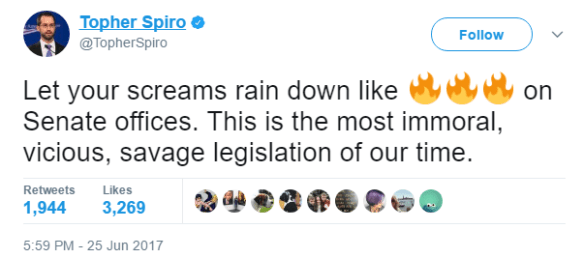
It’s Monday afternoon and the resistance is heating up. There’s going to be a big demonstration in Washington on Wednesday. A human chain around the Capitol Building has been mentioned.

Meanwhile:

legumspiro

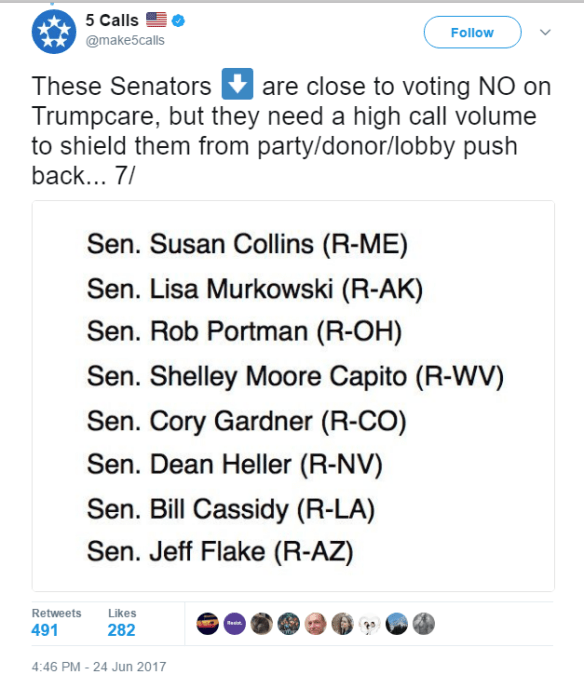
calls

Senators love hearing from people who live in their states. They also love hearing from nice people who claim to live in their states. Such people could try calling Senators through the main Senate switchboard at (202) 224-2131. But it’s often easier to get through to a Senator’s local office, in states like, for instance, Maine, Arkansas and Ohio (see list above).

Emails don’t have as much impact, but Senators also love getting them, especially from people who live in their states (or claim to). You can tell because their contact pages usually refer to the Senators by their first names. So it’s “Contact Jeff” or “Contact Susan”.

If a person wanted to send a nice but not quite accurate email to a Senator, despite not living in the Senator’s state, a person could:

Find a city in that state.

Bring up the map for that city.

Look for a part of town where affluent people probably live (usually somewhere on the outskirts where the streets are curvy or there are lakes or a country club nearby).

Identify a pleasant street name.

Use Zillow to find a nice house on that street. (Zillow will provide the Zip Code too!)

Look for a local business, school or church and save the phone number.

Find the Senator’s contact page. (They all look like Jeff’s.)

Then a person could enter some personal data, specifying a name of their choice, an address on that nice street with a street number of their choice, the Zip Code that Zillow provided, and maybe a phone number with the relevant area code and prefix.

Unfortunately, a person would also have to enter an email address, possibly twice, so it’s good if a person has  an innocuous email address that can be used to receive garbage emails. (I have one; maybe a person should have one too.)

After that, all a person would have to do is maybe select a topic (something like “Health”), possibly type in a subject (like “Senate Health Care Bill”) and then enter a polite plea to vote No on an upcoming piece of abominable legislation that relates to health insurance.

Perhaps something like this, but using a person’s own words: 

Dear Sen. XXX: Please vote No on the Senate Health Care Bill. You know in your heart that it’s a bad bill. It will harm the people of <XXX’s state>. Reporters say that moderate Republicans always give in to the GOP leadership at the last moment. Don’t let that happen, no matter what they promise. We are counting on you. Sincerely yours, <the name that a person chose to use>

I’m not recommending this, of course, because, as President Nixon famously pointed out, “it would be wrong”. But given the stakes (many people will unnecessarily suffer and die if this legislation passes), a concerned person might do it anyway.


What People Need to Know About Medicaid

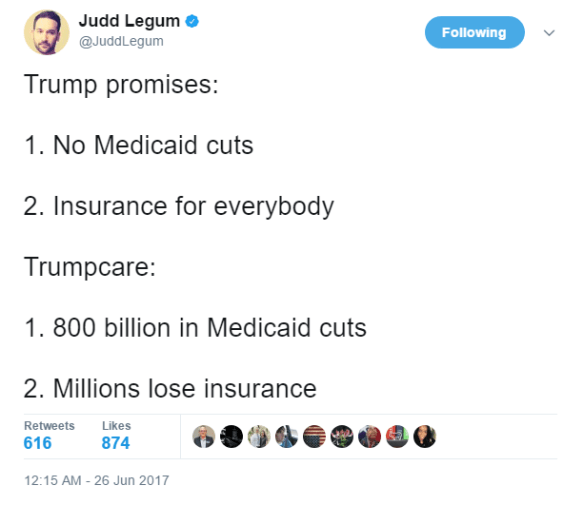
Please share this 20-minute video, even with Americans who hate politics. It might reach people in Alaska, Arizona, Colorado, Louisiana, Maine, Nevada, Ohio or West Virginia who will call their relatively sane Republican Senators and demand that they vote No on the Better Healthcare Reconciliation Act, also known as the Senate healthcare bill or Trumpcare. We need to stop this abomination now.