September Was Much Too Hot — As Predicted

From The Guardian:

Global temperatures soared to a new record in September by a huge margin, stunning scientists and leading one to describe it as “absolutely gobsmackingly bananas”.

The hottest September on record follows the hottest August and hottest July, with the latter being the hottest month ever recorded. The high temperatures have driven heatwaves and wildfires across the world.

September 2023 beat the previous record for that month by 0.5C, the largest jump in temperature ever seen. September was about 1.8C warmer than pre-industrial levels. Datasets from European and Japanese scientists confirm the leap.

The heat is the result of the continuing high levels of carbon dioxide emissions combined with a rapid flip of the planet’s biggest natural climate phenomenon, El Niño. The previous three years saw La Niña conditions in the Pacific Ocean, which lowers global temperature by a few tenths of a degree as more heat is stored in the ocean.

Conditions have now rebounded to an El Niño event, which releases ocean heat and drives up temperatures. It’s all but certain that 2023 will be the hottest on record and 2024 may even exceed that, as the heating impact of El Niño is felt most in the year after it begins.

“September was, in my professional opinion as a climate scientist, absolutely gobsmackingly bananas,” said Zeke Hausfather, at the Berkeley Earth climate data project.

Mika Rantanen, climate researcher at the Finnish Meteorological Institute, said: “I’m still struggling to comprehend how a single year can jump so much compared to previous years.” Prof Ed Hawkins, at the University of Reading, UK, said the heat seen this summer was “extraordinary”.

Samantha Burgess, at the EU’s Copernicus Climate Change Service, said: “The unprecedented temperatures for the time of year observed in September have broken records by an extraordinary amount. 2023 [is] on track to be the warmest year and about 1.4C above pre-industrial average temperatures. Two months out from [the UN climate conference] Cop28, the sense of urgency for ambitious climate action has never been more critical.”

The heat hit record levels within many countries too, including France, Germany, and Poland. The UK saw its joint hottest September on record, the Met Office reported, in data that goes back to 1884.

In Australia, climate scientist and author Joelle Gergis said: “Observations of Australia’s climate in September are shocking. Figures show where maximum temperatures were the highest on record, with many areas 3C to 5C above average. Rainfall deficits are primed for drought. Summer is going to be brutal.”

While human-caused global heating and El Niño are the biggest factors causing the record-breaking temperatures, other factors may be contributing small increases as well, Hausfather said. These include an uptick in the 11-year solar cycle, cuts in sun-blocking sulphur emissions from shipping and industry and a volcanic eruption in Tonga that released a large amount of water vapour, which traps heat.

In August, the Guardian asked 45 leading climate scientists from around the world about the record-breaking temperatures. They said that, despite it certainly feeling as if events had taken an alarming turn, the broad global heating trend seen to date was entirely in line with three decades of scientific predictions.

Increasingly severe weather impacts had also been long signposted by scientists, although the speed and intensity of the reality and the unexpected vulnerability of many populations scared some. The off-the-charts sea temperatures and Antarctic sea ice loss were seen as the most shocking events.

The scientists said that the exceptional events of 2023 could be a normal year in just a decade, unless there is a dramatic increase in climate action. The researchers overwhelmingly pointed to one action as critical: slashing the burning of fossil fuels down to zero.

It All Hangs Together

Yesterday, the leader of the Republican Party claimed that the January 6th riot was “staged by the government”. He didn’t explain why he, as head of the government, did nothing to stop the riot as the afternoon wore on or why juries have since convicted hundreds of the riot’s participants, including, given his assessment, many government agents.

That he is still the leader of the party tells us a lot about Republican voters and politicians. It also provides context for Tom Tomorrow’s latest bulletin from This Modern World.

06556a5b-f184-76cb-de64-c6c3fbfc8c81

Two Very Different Presidents, Two Very Different Paths

Like so many others, the historian Kruse Kruse now has a Substack newsletter. In this edition, he sheds light on a famous speech from 43 years ago that attempted to make America better but failed.

Today [July 15th] marks the anniversary of [President] Jimmy Carter’s deeply unpopular “Malaise speech,” which actually was not deeply unpopular and actually never used the word “malaise.”

In the late 1970s, the United States was reeling from crises on several fronts, ranging from economic “stagflation” (a new term coined to describe the previously unimaginable mix of high inflation and high unemployment) to an energy crisis sparked by the one-two punch of Middle Eastern oil embargoes and OPEC’s price hikes.

In early July, President Carter scrapped plans for an address on the energy crisis, deciding that he needed to dig deeper to diagnose what was ailing America. The president assembled a cast of political figures and public intellectuals for ten days of free-ranging discussion and frank deliberation at Camp David. The conversations covered a great deal of ground, but the president focused in on what became the actual title of his misremembered speech: the country’s “Crisis of Confidence.”

On July 15, 1979, Carter delivered the speech in a nationally televised address.

Pairing the Camp David conversations with feedback he’d gotten from “other Americans, men and women like you,” Carter rattled off a series of seemingly disconnected comments that, taken together, spoke to the dissatisfaction, distrust and discontent of the American people. “The erosion of our confidence in the future,” he warned, “is threatening to destroy the social and the political fabric of America.”

Carter offered a clear-eyed vision of how, and why, Americans had come to doubt their government and, as a result, to doubt themselves too:

We were sure that ours was a nation of the ballot, not the bullet, until the murders of John Kennedy and Robert Kennedy and Martin Luther King, Jr. We were taught that our armies were always invincible and our causes were always just, only to suffer the agony of Vietnam. We respected the Presidency as a place of honor until the shock of Watergate.

We remember when the phrase “sound as a dollar” was an expression of absolute dependability, until ten years of inflation began to shrink our dollar and our savings. We believed that our nation’s resources were limitless until 1973 when we had to face a growing dependence on foreign oil.

As he well understood, the general dissatisfaction and distrust in government had been a main reason for Carter’s own election. While presidential candidates had long campaigned on a résumé thick with political roles and posts in Washington D.C., Carter leveraged his identity as “an outsider” — in a move others would quickly copy — who bore no responsibility for creating these crises and who could therefore have a better shot at fixing them.

But two and a half years into his presidency, Carter was “Washington” and these problems were now his own. Still, he tried to ally himself with unhappy Americans: “You don’t like it, and neither do I. What can we do?”

The president offered a blunt assessment:

We are at a turning point in our history. There are two paths to choose. One is a path I’ve warned about tonight, the path that leads to fragmentation and self-interest. Down that road lies a mistaken idea of freedom, the right to grasp for ourselves some advantage over others. That path would be one of constant conflict between narrow interests ending in chaos and immobility. It is a certain route to failure.

All the traditions of our past, all the lessons of our heritage, all the promises of our future point to another path — the path of common purpose and the restoration of American values. That path leads to true freedom for our nation and ourselves. We can take the first steps down that path as we begin to solve our energy problem.

Energy will be the immediate test of our ability to unite this nation, and it can also be the standard around which we rally. On the battlefield of energy we can win for our nation a new confidence, and we can seize control again of our common destiny.

Carter then laid out a detailed plan for common action on the energy crisis, one that called for reducing oil imports, diverting resources to alternative fuels, imposing stark conservation efforts and rationing gasoline.

There were, as one might expect, calls for government programs — a version of the War Production Board of World War II that would focus on energy, a plan for greater investments in public transportation, a tax on windfall profits to fund it all, etc. — but the emphasis was on the private, voluntary action of the American people. President Carter was confident they would rise to the challenge. “With God’s help and for the sake of our nation, it is time for us to join hands in America,” he urged in closing. “Let us commit ourselves together to a rebirth of the American spirit. Working together with our common faith we cannot fail.”

Despite later memories of the speech as a disaster, it was actually a tremendous success. News coverage was generally positive, with political leaders heaping praise on the president for his mixture of blunt talk and bold faith.

Most notably, President Carter’s approval rating, which had been an abysmal 26% before the speech, shot up to 37% after the speech, an impressive 11-point bump that seemed to many to signal a turnaround in his political fortunes.

But that good luck was short-lived. As he moved from words to deeds, Carter made some serious missteps, most significantly securing formal offers of resignation from his entire Cabinet and several senior White House aides…. Carter meant this to be a sign of how serious his administration was taking the crisis, but most Americans saw it [as] a sign of chaos and confusion. The good will of the speech was quickly wiped away, and as additional problems arrived, like the Iran hostage crisis, Carter only found himself discredited again.

Meanwhile, an alternative vision — the first path of “self-interest” that the pious Carter had dismissed — was advanced by former California Governor Ronald Reagan as he secured the Republican nomination and challenged the incumbent president. Like Carter’s critics on both the left and right, Reagan ignored much of what Carter had actually said and instead latched onto a word the longtime Democratic operative Clark Clifford had casually tossed out to reporters in describing the speech: America’s sense of “malaise.”

“That is really the question before us tonight,” Reagan said the evening before the 1980 election. “For the first time in our memory many Americans are asking: does history still have a place for America, for her people, for her great ideals? There are some who answer no; that our energy is spent, our days of greatness at an end, that a great national malaise is upon us.”

Carter had offered a blunt assessment of the country’s problems but expressed a sharp faith in Americans’ ability to come together and conquer them, but in Reagan’s hands the underlying optimism of that message was spun into nihilistic pessimism. “I find no national malaise,” Reagan said. “I find nothing wrong with the American people.”

Carter called on the American people to join together in common cause and to make personal sacrifices for the sake of the nation. Reagan dismissed all that as needless pessimism and confirmed their complacency….

Seeking to echo FDR’s famous first inaugural address, Carter had bluntly addressed the nation’s “crisis of confidence” but expressed his faith that, with a little hard work and personal sacrifice, Americans could pull themselves out of their problem. There was, in effect, nothing to fear but fear itself.

In sharp contrast, Reagan simply insisted there was nothing to fear, nothing to sacrifice, nothing to work together to do — except show Jimmy Carter the door.

It’s not surprising which message ultimately resonated with voters, between the challenge of self-sacrifice and the comfort of self-interest.

And it’s not surprising that political leaders, from both parties, took notice.
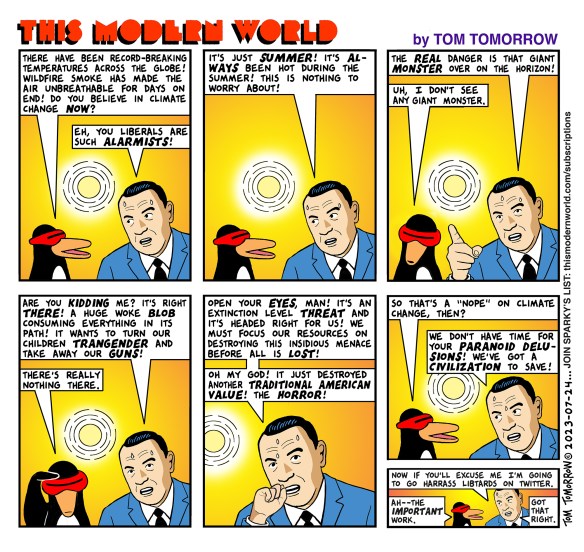
They’re Not Going To Help Deal With the Climate Crisis

Our local air quality has improved to “Poor” now that some of the Canadian smoke has drifted elsewhere. The climate crisis is manifesting itself in ever more disheartening ways. Wildfires are becoming more frequent and severe. Ninety percent of Antarctic ice is gone. Mosquitoes that spread malaria are moving north.

At the same time, people who call themselves “conservative” are opposed to conserving a climate we humans have evolved to live in. The environmentalist David Roberts has an explanation for their opposition:

I have a fairly unpopular opinion that has grown stronger throughout my career, to wit: Conservative opposition to acknowledging and acting on climate change is not a contingent accident of history. The two — climate change and modern conservatism — are intrinsically at odds. 

In other words, the situation wouldn’t have been substantially changed by Al Gore not making his movie, or John McCain winning, or environmentalists talking more about national security and less about polar bears, or any of the other glib explanations that have been offered over the years. 

[There are] two basic reasons. First, at a more abstract level, solving (or just dealing with) climate requires a) concern for people distant in space and/or time, b) global cooperation across lines of race/nationality/etc., c) short-term sacrifice for future benefits, and d) planning. It requires that we think and plan as a species. It requires solidarity and cooperation. That’s just not compatible with nationalism amd other forms of in-group/out-group tribalism. It’s not compatible with extreme “there is no such thing as society” individualism. 

Slightly more concretely, clean energy is, relative to fossil fuels, more networked and infrastructure-based, more distributed, more about sharing, more reliant on long-term contracts, more reliant on solidarity and social trust. 

Basically, the structure of the climate problem and its solutions require more cooperation and solidarity and planning, less competition and nationalism and trust in markets. There’s no clever rhetorical way around that. And yes, I realize that conservatives can acknowledge climate change and still double down on reactionary shit like hoarding and wall-building — that is, in effect, what they’re currently doing — but that’s not a solution. Conservatism has no solution. 

“The two tasks – preventing Earth systems collapse and preventing the rise of the far right – are not divisible. We have no choice but to fight both forces at once.”  It’s a little crazy that George Monbiot is the only one saying this clearly.

Georoge Monbiot writes for The Guardian. Here are the first and last paragraphs of the column Roberts quoted from:

Round the cycle turns. As millions are driven from their homes by climate disasters, the extreme right exploits their misery to extend its reach. As the extreme right gains power, climate programmes are shut down, heating accelerates and more people are driven from their homes. If we don’t break this cycle soon, it will become the dominant story of our times….

It is easy to whip up fascism. It’s the default result of political ignorance and its exploitation. Containing it is much harder, and never-ending. The two tasks – preventing Earth systems collapse and preventing the rise of the far right – are not divisible. We have no choice but to fight both forces at once.

The Shape of Things to Come

H. G. Wells published a book in 1933 with that title. It was made into a movie a few years later. In the story, humanity has some big ups and downs:

A long economic slump causes a major war that leaves Europe devastated and threatened by the plague. In decades of chaos with much of the world reverting to medieval conditions, pilots and technicians formerly serving in various nations’ air forces maintain a network of functioning air fields. Around this nucleus, technological civilization is rebuilt, with the pilots and other skilled technicians eventually seizing worldwide power and sweeping away the remnants of the old nation states.

A benevolent dictatorship is set up, paving the way for world peace by abolishing national divisions, enforcing the English language, promoting scientific learning and outlawing religion. The enlightened world-citizens are able to depose the dictators peacefully, and go on to breed a new race of super-talents, able to maintain a permanent utopia [Wikipedia].

Recent events indicate future ups and downs of a similar nature.

From The Guardian’s environment editor:

After a 10,000-year journey, human civilisation has reached a climate crossroads: what we do in the next few years will determine our fate for millennia.

That choice is laid bare in the landmark report published on Monday by the Intergovernmental Panel on Climate Change (IPCC), assembled by the world’s foremost climate experts and approved by all the world’s governments. The next update will be around 2030 – by that time the most critical choices will have been made.

The report is clear what is at stake – everything: “There is a rapidly closing window of opportunity to secure a liveable and sustainable future for all.”

“The choices and actions implemented in this decade [ie by 2030] will have impacts now and for thousands of years,” it says. The climate crisis is already taking away lives and livelihoods across the world, and the report says the future effects will be even worse than was thought: “For any given future warming level, many climate-related risks are higher than [previously] assessed.”

“Continued emissions will further affect all major climate system components, and many changes will be irreversible on centennial to millennial time scales,” it says. To follow the path of least suffering – limiting global temperature rise to 1.5C – greenhouse gas emissions must peak “at the latest before 2025”, the report says, followed by “deep global reductions”. Yet in 2022, global emissions rose again to set a new record.

The 1.5C goal appears virtually out of reach, the IPCC says: “In the near-term, global warming is more likely than not to reach 1.5C even under a very low emission scenario.” A huge ramping up of work to protect people will therefore be needed….

However, the faster emissions are cut, the better it will be for billions of people: “Adverse impacts and related losses and damages from climate change will escalate with every increment of global warming.” Every tonne of CO2 emissions prevented also reduces the risk of true catastrophe: “Abrupt and/or irreversible changes in the climate system, including changes triggered when tipping points are reached.”

The report presents the choice humanity faces in stark terms, made all the more chilling by the fact this is the compromise language agreed by all the world nations – many would go further if speaking alone. But it also presents the signposts to the path the world should and could take to secure that liveable future….

“Without a strengthening of policies, global warming of 3.2C is projected by 2100.” That is the “highway to hell”.

The article indicates how we might avoid hell on Earth, but doesn’t suggest we will.

From three contributors to the New York Times:

Imagine that as you are boarding an airplane, half the engineers who built it tell you there is a 10 percent chance the plane will crash, killing you and everyone else on it. Would you still board?

In 2022, over 700 top academics and researchers behind the leading artificial intelligence companies were asked in a survey about future A.I. risk. Half of those surveyed stated that there was a 10 percent or greater chance of human extinction (or similarly permanent and severe disempowerment) from future A.I. systems. Technology companies building today’s large language models are caught in a race to put all of humanity on that plane.

… A.I. systems with the power of GPT-4 and beyond should not be entangled with the lives of billions of people at a pace faster than cultures can safely absorb them. A race to dominate the market should not set the speed of deploying humanity’s most consequential technology. We should move at whatever speed enables us to get this right.

…  It is difficult for our human minds to grasp the new capabilities of GPT-4 and similar tools, and it is even harder to grasp the exponential speed at which these tools are developing more advanced and powerful capabilities. But most of the key skills boil down to one thing: the ability to manipulate and generate language, whether with wordssounds or images.

… Language is the operating system of human culture. From language emerges myth and law, gods and money, art and science, friendships and nations and computer code. A.I.’s new mastery of language means it can now hack and manipulate the operating system of civilization. By gaining mastery of language, A.I. is seizing the master key to civilization, from bank vaults to holy sepulchers.

What would it mean for humans to live in a world where a large percentage of stories, melodies, images, laws, policies and tools are shaped by nonhuman intelligence, which knows how to exploit with superhuman efficiency the weaknesses, biases and addictions of the human mind — while knowing how to form intimate relationships with human beings? In games like chess, no human can hope to beat a computer. What happens when the same thing occurs in art, politics or religion?

A.I. could rapidly eat the whole of human culture — everything we have produced over thousands of years — digest it and begin to gush out a flood of new cultural artifacts. Not just school essays but also political speeches, ideological manifestos, holy books for new cults.

… Simply by gaining mastery of language, A.I. would have all it needs to contain us in a Matrix-like world of illusions, without shooting anyone or implanting any chips in our brains. If any shooting is necessary, A.I. could make humans pull the trigger, just by telling us the right story.

The specter of being trapped in a world of illusions has haunted humankind much longer than the specter of A.I. Soon we will finally come face to face with Descartes’s demon, with Plato’s cave, with the Buddhist Maya. A curtain of illusions could descend over the whole of humanity, and we might never again be able to tear that curtain away — or even realize it is there.

What will be the shape of things to come? We are headed for interesting times.