It’s the Civil War Minus the Armed Rebellion Part

Michael Lind grew up in Texas, which apparently gives him an advantage in understanding Tea Party-ish people.

Lind argues that there are a number of common misconceptions about Tea Party supporters. First, they aren’t merely a group of ideological extremists. Second, they aren’t populists – the average Tea Party supporter is more affluent than the national average. Third, despite their silly costumes and bizarre beliefs, they aren’t stupid or uneducated – they’re actually better educated than the average voter.

If the Tea Party isn’t best understood as a case of “abstract ideological extremism”, “working-class populism” or “ignorance and stupidity”, how should it be understood?

According to Lind, the Tea Party is simply the latest example of white right-wingers, mostly Southern, doing whatever they can to maintain their privileged position. He prefers referring to this movement as the “Newest Right”. They are merely the traditional right wing “adopting new strategies in response to changed circumstances”. The social base of the Newest Right consists of “local notables”, i.e.: “provincial elites whose power and privileges are threatened from above by a stronger central government they do not control and from below by the local poor and the local working class”.

Basically, it’s a continuation of the Civil War carried on by mostly Southern county supervisors and car dealers, “second-tier people on a national level but first-tier people in their states and counties and cities”, without the armed rebellion part.

Before describing their current strategies, Lind outlines some history:

For nearly a century, from the end of Reconstruction, when white Southern terrorism drove federal troops out of the conquered South, until the Civil Rights Revolution, the South’s local notables maintained their control over a region of the U.S. larger than Western Europe by means of segregation, disenfranchisement, and bloc voting and the filibuster at the federal level. Segregation created a powerless black workforce and helped the South’s notables pit poor whites against poor blacks. The local notables also used literacy tests and other tricks to disenfranchise lower-income whites as well as blacks in the South, creating a distinctly upscale electorate. Finally, by voting as a unit in Congress and presidential elections, the “Solid South” sought to thwart any federal reforms that could undermine the power of Southern notables at the state, county and city level. When the Solid South failed, Southern senators made a specialty of the filibuster, the last defense of the embattled former Confederacy.

It shouldn’t be surprising, therefore, to see Republicans using similar methods now in order to maintain their economic position and insure a supply of cheap, compliant labor. Lind highlights these four strategies (although there are others, such as providing limited funding for public education):

Use partisan and racial gerrymandering to maintain a Solid South;
Employ the filibuster and the “Hastert” rule to sabotage Congress;
Disenfranchise politically unreliable voters; and
Localize and privatize federal programs.

It’s an excellent article if you want to understand today’s political environment:

http://www.salon.com/2013/10/06/tea_party_radicalism_is_misunderstood_meet_the_newest_right/

At the Globalist, Stephan Richter places the government shutdown and debt ceiling mess in the same historical context:

One of the biggest hoaxes of American history is that the Civil War ended back in 1865. Unfortunately, it has not ended yet. What was achieved back then was an armistice, similar to the situation between the two Koreas.

As the current logjam in the U.S. Congress makes plain, the Civil War is still very present in today’s America – and with virulence that most other civilized nations find as breathtaking as it is irresponsible.

The reason why the Civil War was declared finished, according to the history books, is the military defeat of the South and its secessionist forces. But can anyone seriously doubt that the same anti-Union spirit is still to be heard loud and clear in the halls of the U.S. Congress today?

http://www.theglobalist.com/u-s-civil-war-continues/

The Fire This Time

la-na-tt-republicans-blame-obama-20131006-001

More from political cartoonist David Horsey of the Los Angeles Times here:

http://www.latimes.com/opinion/topoftheticket/la-na-tt-republicans-blame-obama-20131006,0,2739790.story

Jonathan Chait’s conclusion to a thoughtful article in New York magazine:

In our Founders’ defense, it’s hard to design any political system strong enough to withstand a party as ideologically radical and epistemically closed as the contemporary GOP. (Its proximate casus belli—forestalling the onset of universal health insurance—is alien to every other major conservative party in the industrialized world.) The tea-party insurgents turn out to be right that the Obama era has seen a fundamental challenge to the constitutional order of American government. They were wrong about who was waging it.

http://nymag.com/news/politics/nationalinterest/government-shutdown-2013-10/

Class Warfare Is a Fact – Part 3

After some discussion in the comments on Part 2 of what has turned into a brief series, I thought it would be a good idea to post the concluding paragraphs of the underlying paper by Emmanuel Saez (winner of the John Bates Clark Medal, periodically awarded to an outstanding young economist).

Here are his conclusions (my emphasis added):

“Interestingly, the income composition pattern at the very top has
changed considerably over the century. The share of wage and salary income
has increased sharply from the 1920s to the present, and especially since the
1970s. Therefore, a significant fraction of the surge in top incomes since 1970
is due to an explosion of top wages and salaries. Indeed, estimates based
purely on wages and salaries show that the share of total wages and salaries
earned by the top 1 percent wage income earners has jumped from 5.1
percent in 1970 to 12.4 percent in 2007.

(Footnote:  this dramatic increase in top wage incomes has not been mitigated by an increase in mobility at the top of the wage distribution.As Wojciech Kopczuk, myself, and JaeSong have shown in a separate paper,the probability of staying in the top 1 percent wage income group from one year to the next has remained remarkably stable since the 1970s.)

Evidence based on the wealth distribution is consistent with those
facts. Estimates of wealth concentration, measured by the share of total
wealth accruing to top 1 percent wealth holders, constructed by Wojciech
Kopczuk and myself from estate tax returns for the 1916-2000 period in the
United States show a precipitous decline in the first part of the century with
only fairly modest increases in recent decades. The evidence suggests that
top incomes earners today are not “rentiers” deriving their incomes from past
wealth but rather are “working rich,” highly paid employees or new
entrepreneurs who have not yet accumulated fortunes comparable to those
accumulated during the Gilded Age. Such a pattern might not last for very
long. The drastic cuts of the federal tax on large estates could certainly
accelerate the path toward the reconstitution of the great wealth concentration
that existed in the U.S. economy before the Great Depression.
The labor market has been creating much more inequality over the
last thirty years, with the very top earners capturing a large fraction of
macroeconomic productivity gains.

A number of factors may help explain this increase in inequality, not only underlying technological changes but also the retreat of institutions developed during the New Deal and World War II – such as progressive tax policies, powerful unions, corporate provision of health and retirement benefits, and changing social norms regarding pay inequality. We need to decide as a society whether this increase in income inequality is efficient and acceptable and, if not, what mix of institutional and tax reforms should be developed to counter it.

End quote.

By the way, the latest column by Paul Krugman (winner of the Nobel Prize in economics and one of the most astute op-ed columnists writing today) is called “Rich Man’s Recovery”:

“Whatever is causing the growing concentration of income at the top, the effect of that concentration is to undermine all the values that define America. Year by year, we’re diverging from our ideals. Inherited privilege is crowding out equality of opportunity; the power of money is crowding out effective democracy.

So what can be done? For the moment, the kind of transformation that took place under the New Deal — a transformation that created a middle-class society, not just through government programs, but by greatly increasing workers’ bargaining power — seems politically out of reach. But that doesn’t mean we should give up on smaller steps, initiatives that do at least a bit to level the playing field.”

End quote.

This isn’t a war in the usual sense, but the fact remains that the people in this country who have the most money are using their high incomes and wealth to manipulate the political system and other levers of power in order to increase their advantages still more. It’s not a shooting war, but it’s an assault on America as a prosperous and democratic nation.

——————————————————————————————————————-

Professor Saez’s relatively short paper:

http://elsa.berkeley.edu/~saez/saez-UStopincomes-2012.pdf

Professor Krugman’s most recent column:

http://www.nytimes.com/2013/09/13/opinion/krugman-rich-mans-recovery.html?hp

Class Warfare Is a Fact – Part 2

Paul Krugman makes the important point that the substantial gains in income for the richest Americans has been concentrated in a very small group. It’s not the top 10% or the top 5% or even the top 1% that has prospered the most — it’s the top tenth of 1% and the top hundredth of 1% who have substantially increased their share of the national income:

Of the gains made by the top 10 percent [since 1979], almost none went to the 90-95 group; in fact, the great bulk went to the top 1 percent. The bulk of the gains of the top 1, in turn, went to the top 0.1; and the bulk of those gains went to the top 0.01. We really are talking about the flourishing of a tiny elite.

In other words, income has only increased for the top 5.0% since 1979, and more than half of that increase went to the top 0.1%. It’s as if the bottom 95.0% of Americans haven’t received a raise in 30 years.

http://krugman.blogs.nytimes.com/2013/09/12/good-times-at-the-top/

Class Warfare Is a Fact

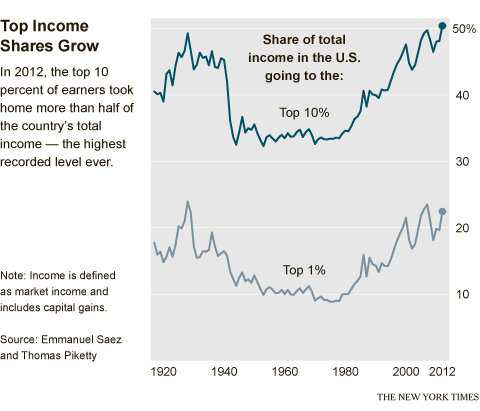
An updated study by economist Emanuel Saez of U.C. Berkeley shows that the the top 1% of earners in the United States received more than 20% of the country’s total income in 2012, while the top 10% of earners received more than half of the country’s income. The share of income going to the wealthiest Americans is now at or near the highest levels on record since the government began keeping the relevant statistics and the federal income tax was created in 1913.

What’s even more remarkable, perhaps, is that the income of the top 1% went up nearly 20% in 2012, while the income of the remaining 99% rose only 1%. Since 2009, the wealthiest 1% have taken 95% of the income gains in our supposedly classless society.

We should remember these statistics when we hear Republican politicians, who pretend to be friends of the middle class, claim that lower taxes for the wealthy benefit everyone. It’s past time to raise taxes on the rich, invest in America’s infrastructure and start creating decent jobs again. Otherwise we’re going to continue to get economically screwed.

Note the year 1980 in this chart, when class warrior and demagogue supreme Ronald Reagan was elected President:

10economix-sub-wealth-blog480

http://takingnote.blogs.nytimes.com/2013/09/11/the-rich-got-richer/